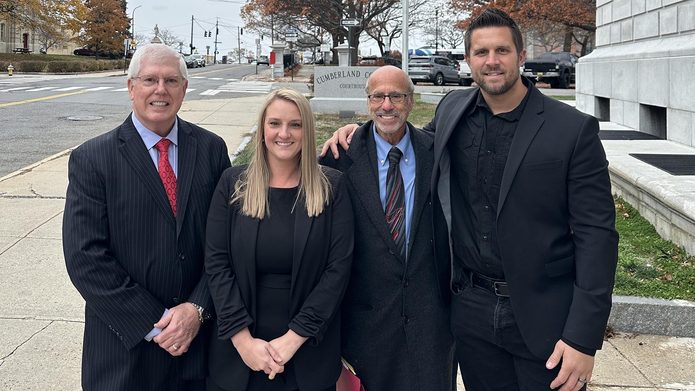
In September, the Maine Supreme Court ruled that Emily Bickford, a single mother, could not take her 13-year-old daughter, Ava, to church and could not expose her to the Bible, despite Ava’s expressed desire to attend church. On Bickford’s behalf, Liberty Counsel has asked the U.S. Supreme Court to review her case.
Under the court custody order, Ava’s father, Matthew Bradeen, who has visitation rights, has sole authority to decide what religious activities his daughter can do. Unlike Bickford, a devout Christian who values Biblical teachings, Bradeen objects to evangelical churches, as well as the church Ava attended and was baptized at—Calvary Chapel Greater Portland.
Per the court order, Bradeen can decide whether his daughter may attend “any services, gatherings, or events associated with Calvary Chapel,” be exposed to any “material, literature, video, or other messaging associated with or created by Calvary Chapel,” or can “associate or communicate with any member” of Calvary Chapel. Bradeen also has the sole right to govern “exposure to the teachings of any religious philosophy or of the Bible in general,” despite Bickford’s status of having primary custody over her daughter. Bickford is also barred from reading the Bible or any religious materials to Ava. Ava is also not permitted to contact her friends who attend Calvary Chapel.
Liberty Counsel is arguing that the Maine Supreme Court disregarded a precedent of its own. In Wisconsin v. Yoder, the court ruled that only through proof of an “immediate and substantial threat” to a child can a parent’s religious practice be restricted. The ban is the first instance in which a state high court has ruled that under the best interest standard, a parent may obtain a total prohibition on a fit parent’s religious upbringing choices.
The petition also argues that U.S. Supreme Court case precedents maintain that before constraining a fit parent’s religious activities with their child, the highest scrutiny must be used, and evidence of substantial harm found. The petition also refers to Massachusetts, Mississippi, Nebraska, Ohio, Utah and Washington rulings.
The petition is asking the court “only to determine the correct constitutional standard” and “grant review to set things right.”
“A parent’s ability to take her child to church during her own parenting time now depends on the State in which she lives,” the petition states. “When a state court strips a fit parent of her right to direct her child’s religious upbringing and vests a co-parent with veto power, it deploys the coercive authority of the State to extinguish a fundamental right.”
The petition also argues that court ruled between parental religious philosophies based on the “court’s subjective assessment of the parent’s faith” rather than remaining neutral and concentrating on evidence of harm.
Mat Staver, Liberty Counsel founder and chairman, said the Supreme Court has “the chance to correct this injustice and determine fit parents retain the fundamental right to share their faith with their child even when the other parent disagrees.”
“The decision abandons the constitutional safeguards that protect parental rights and religious liberty,” Staver said. “If left uncorrected, this ruling threatens far more than a mother and daughter’s rights because it creates a precedent under which courts may suppress religious expression in a parent-child relationship without satisfying the highest scrutiny typically required in such cases.”
The Maine Supreme Court decision favored a December 2024 ruling from the Portland District Court. That court ruled that there was “no showing of harm to [the child] associated with a belief system that is rooted in the Bible,” but the court found issue with Calvary Chapel’s Biblical teachings of eternal salvation, Heaven, hell, angels and demons as well as the church’s “verse by verse, chapter by chapter” teaching style. Bickford and her daughter have requested to attend churches outside of Calvary Chapel together, but Bradeen has rejected every suggestion.
The pushback on Ava’s religious upbringing intensified when she expressed a desire to be baptized. Ava, who had attended the church for three years, had become a Christian in 2021, and Bickford in 2017.