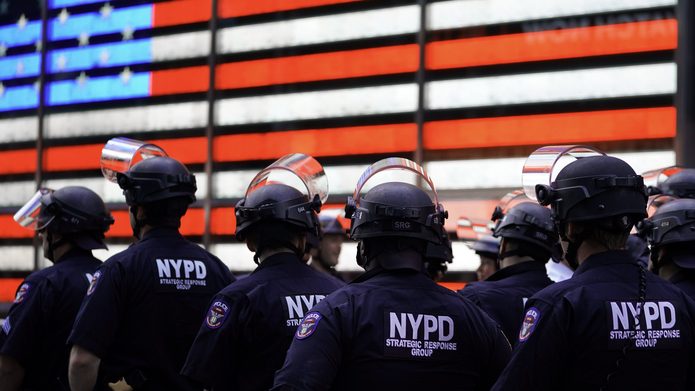
New York City Mayor Zohran Mamdani is dismantling a specialized NYPD unit responsible for responding to violent demonstrations and potential terrorist threats, replacing its protest-management responsibilities with a system that places unarmed civilians at the forefront of crowd control.
The decision marks a major shift in how the nation’s largest police department will handle demonstrations, raising concerns about the city’s ability to respond when protests escalate into riots.
Mamdani announced the changes Monday alongside Democratic City Councilmember Chi Ossé, fulfilling a campaign pledge to eliminate the NYPD’s Strategic Response Group (SRG).
The unit has historically played a prominent role in managing large-scale demonstrations, including the violent Black Lives Matter unrest of 2020 and protests that erupted following Hamas’ October 7, 2023, terrorist attacks against Israel.
During the 2020 unrest, more than 400 NYPD officers were reportedly injured, including approximately 250 who required hospitalization, according to WTMJ. Widespread looting also occurred during demonstrations across the city.
New York experienced another wave of confrontational protests following the October 7 massacre. By November 22, 2023, police had arrested 638 people in connection with demonstrations related to the Israel-Hamas war, according to AMNY.
Despite that history, Mamdani is moving ahead with an overhaul that removes the SRG from the department’s organizational structure.
“During our campaign for mayor, I promised to disband NYPD’s Strategic Response Group, known as the SRG. Today, we are keeping that promise,” the democratic socialist mayor said in a video announcement.
Mamdani argued that counterterrorism operations and protest policing should no longer be handled by the same specialized unit.
“SRG was tasked with both counter-terrorism enforcement and protest response. Those are not the same, and they should be separated,” he said.
Under the new arrangement, responsibilities previously assigned to the SRG will be distributed among other NYPD divisions.
The administration is establishing a Community Dialogue and De-escalation Division that will emphasize communication with demonstrators rather than traditional police crowd-control tactics.
Its civilian First Amendment Support Team will operate without firearms or arrest authority, while the existing NYPD Patrol Support Division will retain the ability to intervene and make arrests when necessary.
City Hall said the police component would carry out arrests during demonstrations only in limited circumstances.
Mamdani also endorsed Ossé’s CURB Act, which seeks to restrict certain crowd-control methods used by police.
“There will be no long guns, tear gas, kettling, or pepper spray used at crowd control tactics during First Amendment activities,” Ossé said.
The announcement drew criticism from commentators who questioned whether unarmed civilian personnel would be equipped to handle demonstrations that turn violent.
Investigative journalist Andy Ngo accused Mamdani of weakening enforcement against rioters who frequently share the mayor’s political ideology.
“The rioters in NYC are leftists—from his political side,” Ngo said, arguing that the move resembled decisions made by Democratic officials during the 2020 unrest.
Although Mamdani has presented the restructuring as a public safety improvement, the changes will test whether his administration can maintain order during potentially violent demonstrations.