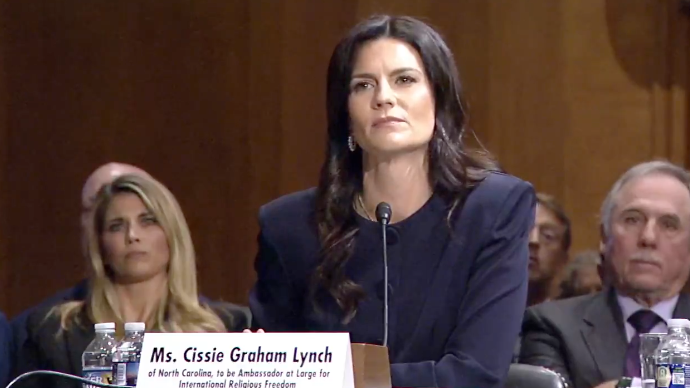
Cissie Graham Lynch, daughter of Franklin Graham and granddaughter of Billy Graham, sat before the U.S. Senate Foreign Relations Committee today as lawmakers considered her nomination to serve as Ambassador at Large for International Religious Freedom.
Introducing Lynch, North Carolina Sen. Ted Budd described her as more than qualified to serve as an “unwavering voice for the voiceless.” He underscored the gravity of the post for which President Donald Trump nominated her, stating, “I am confident [Lynch] is the right person for the job. … If confirmed, I have no doubt that she will serve our country well.”
In her remarks, she told the committee: “It is an honor to appear before you. I am humbled and grateful to President Trump for nominating me, and I want to thank my husband, Corey, our three children, and all who have supported me.”
For the past 16 years, Lynch has worked with two international organizations—Samaritan’s Purse and the Billy Graham Evangelistic Association—operating in more than 120 countries and reaching millions of people across faiths. In the role under consideration, she stressed, her responsibility would center on safeguarding the right to freedom of worship for all.
The lessons that have shaped her most deeply, she said, came from “sitting with mothers who’ve lost sons and daughters to persecution, listening to pastors who’ve rebuilt their congregations after their churches have been burned, and meeting families driven from their homes because of their beliefs.”
Those encounters remain vivid. “I’ve stood in the mass graveyards in northern Iraq,” Lynch said. “I’ve spoken with displaced women in Sudan hiding in the mountains. I’ve met with family members of the 21 Coptic Christians who have been beheaded by ISIS on the shores of Libya. They are not statistics. They have faces, names, and families, and I will carry their stories with me into this role.”
During questioning, Democratic Senators Tim Kaine and Jeanne Shaheen asked Lynch on how she would protect people who believe differently than her.
She responded that she understands her duty, if confirmed, would be to stand for all who are persecuted for their faith, and for many years has worked to help suffering people around the world who do not share her own Christian beliefs. “It has always been my goal to talk about various issues with kindness and respect,” she said.
Lynch emphasized that the ambassadorship is a bipartisan charge—one in which common ground remains possible. While personal convictions may differ, the suffering of people worldwide is a reality that can unite those determined to fight against it.
At least 80% of the world’s population continues to live under high levels of religious restriction. “I know the challenges are immense,” Lynch concluded. “But I have seen the extraordinary courage of those who refuse to surrender their convictions, and it is their stories that remind me why this work matters.”
The United States Commission on International Religious Freedom, an independent federal agency established by Congress in 1998, welcomed news of Lynch’s nomination in a statement in September.
“President Trump’s announcement is a vital step in advancing the human right of freedom of religion or belief (FoRB) abroad,” said USCIRF chair Asif Mahmood. “USCIRF calls for a swift confirmation process for IRF Ambassador-Designate Lynch. Filling these roles demonstrates the ongoing commitment of the United States to international religious freedom as a priority in foreign policy.”