A new award-winning drama is bringing international attention back to the disturbing case, supported by the Christian Legal Centre, of Marius and Ruth Bodnariu, whose five children were removed by Norwegian child welfare authorities following allegations about the Christian couple’s approach to discipline.
Fjord, which has now been released, tells the story of the Bodnariu family and the devastating consequences of the state’s intervention in their family life.
In November 2015, Marius and Ruth faced every parent’s worst nightmare when their five young children were suddenly taken into care and placed in three separate households, up to three hours away from the family home.
The children, Eliana, Naomi, Matei, Ioan and three-month-old Ezekiel, were removed following a complaint by a school headteacher that one of the daughters had said she had been smacked.
Norwegian child welfare services launched an investigation, but Marius and Ruth maintained that the process was prejudiced from the outset by assumptions about their Christian faith and cultural background.
Marius, who has an engineering degree in Applied Informatics and a master’s degree in Computer Networks, and Ruth, a paediatric nurse specialising in child and adolescent psychology, had been living and working in Norway before the intervention turned their family’s life upside down.
Children Subjected To Prolonged Questioning
The children were removed following a short investigation in which the initial questioning focused on the children.
After being taken into care, they were subjected to lengthy questioning without access to legal counsel or independent safeguarding supervision. The family alleges that the questioning was coercive and encouraged the children to provide answers that supported the authorities’ case.
During one interview, Naomi was recorded as saying: “I don’t know what else to make up.”
Despite the seriousness of the allegations, medical and psychological assessments did not substantiate claims that the children had been abused or subjected to violence.
Nevertheless, it took nearly a year for the family to be fully reunited.
During their separation, Marius and Ruth say their children suffered severe emotional and psychological harm. Their baby, Ezekiel, was subjected to multiple X-rays despite the absence of evidence that he had been physically abused.
Marius was also required to sign an agreement preventing him from speaking his native language to his children during supervised contact. Any conversation in that language could be terminated, making it still harder for him to comfort and reassure his traumatised children.
Christian Faith Treated With Suspicion
Documents from the case raised serious concerns that the family’s Christian beliefs had influenced the authorities’ approach.
A confidential note, which was accidentally disclosed to the parents, stated: “The CPS is worried that this is a way of upbringing which is justified by the Bible as the children are talking about forgiveness.”
During proceedings, it was also argued that the alleged conduct should be understood as “Christian upbringing violence,” despite the family’s insistence that the claims had not been substantiated.
The authorities’ suspicion of the family’s faith was further reflected in reports compiled during supervised contact.
In one observation, an official recorded: “After a while he [the father] puts himself on his knees and his body [upper part] over the sofa, he might pray!”
The Bodnarius have said these documents demonstrate how ordinary expressions of Christian faith, including prayer, forgiveness and biblical teaching, were interpreted negatively during the investigation.
Family Forced To Rebuild Its Life
Following their reunification, Marius and Ruth left their home and professional careers in Norway and moved to Romania, where they dedicated themselves to helping their children recover from the trauma of the separation.
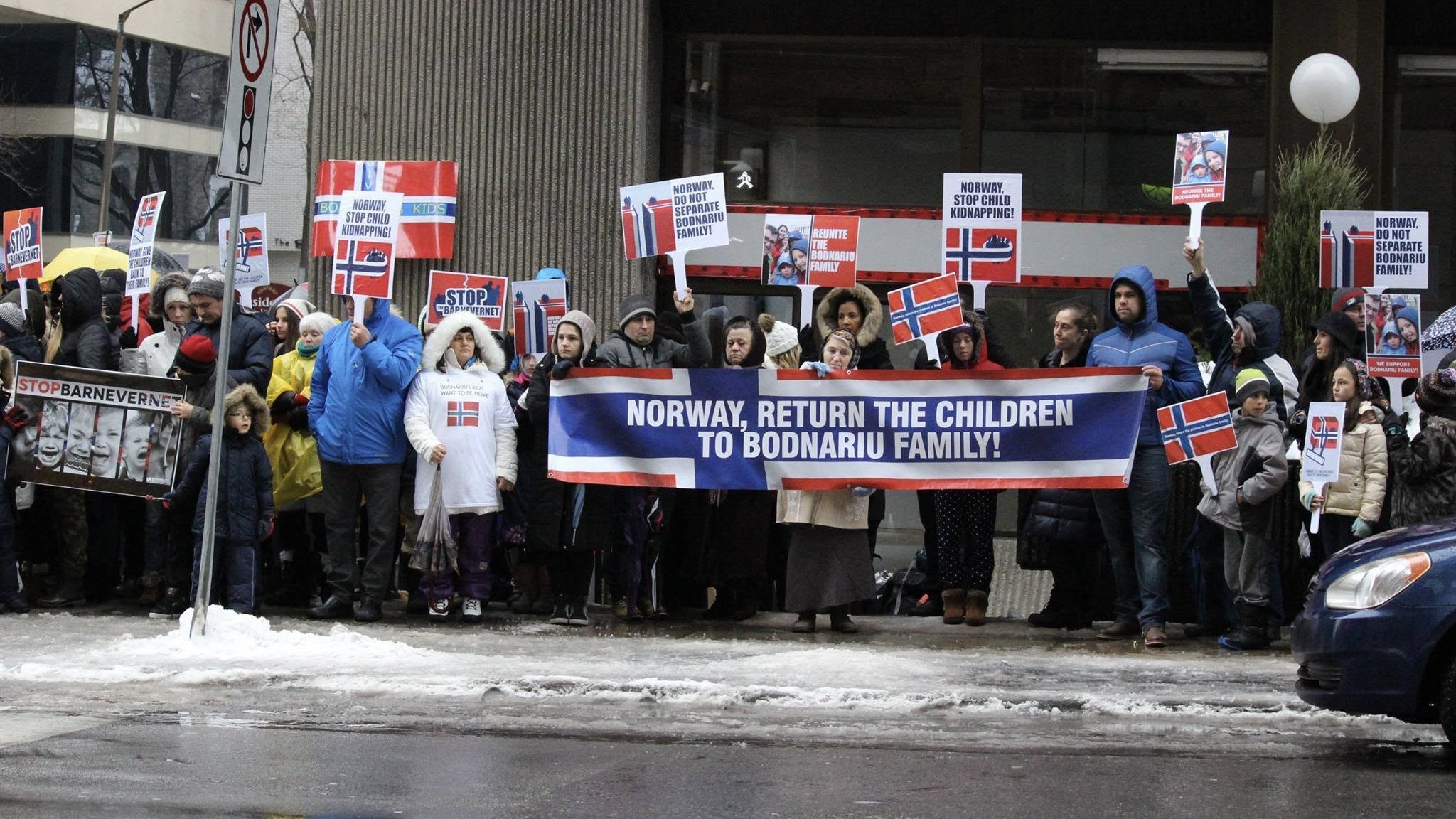
Their case attracted widespread international concern and prompted demonstrations across Europe and the United States.
Politicians and human rights advocates questioned whether the actions of the Norwegian authorities had been proportionate and whether proper respect had been shown for the family’s religious freedom and right to family life.
The controversy also contributed to scrutiny of Norway’s child protection system at the Council of Europe, with parliamentarians from several countries raising concerns about the removal of children from their families.
Strasbourg Challenge
The Christian Legal Centre represented Marius and Ruth Bodnariu in their four-year challenge before the European Court of Human Rights. The family lodged its application on 1 December 2016, after their five children had been returned to them. They pursued the case to seek justice for their family and to help protect other families from similar treatment.
The governments of Slovakia, the Czech Republic and Romania all intervened in support of the family. Roger Kiska, legal counsel for the Christian Legal Centre, received an award from the Slovak Ministry of Justice and the Slovak Association of Family Judges in recognition of his work on the case.
By the time they applied to Strasbourg, the Bodnarius had fled Norway for Romania. After everything they had been through, they were afraid to return and felt profoundly let down by the Norwegian courts, which they believed had failed to protect their family from being separated. In those circumstances, they felt that bringing a fresh legal challenge in Norway was untenable.
On 26 November 2020, the European Court declared the application inadmissible because the family had not exhausted the legal remedies it considered available in Norway. The decision left unanswered whether the removal of the five children had violated the family’s right to respect for family life.
The case had already put Norway’s child welfare system under intense international scrutiny. The separation of the Bodnariu family raised serious questions about the safeguards in place when authorities remove children from their parents and about the role the family’s Christian faith played in the authorities’ decisions. Far from vindicating the Norwegian government, the Strasbourg decision left a dark cloud hanging over Norwegian social services and its treatment of Christian families.
Andrea Williams, chief executive of the Christian Legal Centre, said:
“What happened to the Bodnariu family was a grave injustice and should be a warning to us all. Five children were torn from their loving parents, separated from one another and placed in different homes, in circumstances where their parents’ Christian faith and family values appear to have been viewed through a lens of suspicion and prejudice.
“This case exposed something deeply concerning about the cultural climate in which we live: the growing tendency to regard traditional Christian beliefs, biblical principles and the convictions of Christian parents as somehow suspect, backward or even harmful. When ordinary expressions of Christian faith, such as prayer, forgiveness and biblical teaching, are interpreted as grounds for concern, we must ask whether prejudice against Christianity is influencing decisions that should be based on objective evidence and the welfare of children.
“At the heart of this case is a fundamental question about the relationship between the family and the state. The family is the primary place of love, nurture, responsibility and formation. The state should never impose its own ideological assumptions about how families should live, what parents should believe or how children should be brought up.
“Parental responsibility, Christian freedom and the right to family life are fundamental protections, not privileges granted by the state. When those protections are undermined by cultural prejudice, unsubstantiated allegations or excessive state intervention, the consequences for children and families can be devastating.
“The Christian Legal Centre was honoured to stand alongside Marius and Ruth throughout their ordeal and in taking their case to Strasbourg.
“The release of Fjord gives this family’s story a new audience. We hope it will prompt a much wider debate about the place of Christian faith in modern society, the role and responsibilities of parents, and the dangers of allowing an increasingly intrusive state to displace the family as the primary institution in a child’s life. No family should have to fear that their sincerely held Christian convictions will be used against them.”