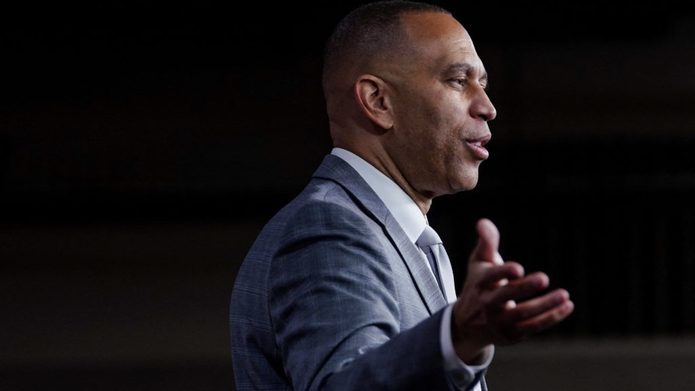
House Democrats have nominated Hakeem Jeffries to become the next Speaker of the House, brushing aside opposition from the party’s far-left flank as Democrats prepare to assume control of Congress following their midterm election victories.
The New York congressman secured the nomination Wednesday despite a campaign by progressive activists who demanded that Democratic lawmakers consider alternative leadership.
After securing the nomination, Jeffries immediately targeted “MAGA extremism.”
Jeffries faced no formal challenger, although the nomination was not unanimous. He received 251 votes, while 11 members opposed him and two did not vote.
The internal opposition comes as the Democratic Party faces growing pressure from its socialist-aligned faction, which has sought greater influence over congressional leadership and the party’s legislative agenda.
A petition demanding that Jeffries be replaced as the party’s choice for Speaker collected more than one million signatures ahead of Wednesday’s vote.
The petition encouraged Democrats to reconsider Jeffries’ leadership by examining his voting history, political positions, campaign contributions and record in Congress. Organizers also called on other Democratic lawmakers to enter the race, but no alternative candidate stepped forward.
Before the leadership election, Jeffries reportedly met privately with incoming Democratic lawmakers who had withheld their support. Several of those members were aligned with the Democratic Socialists of America, reflecting the ideological divisions within the party’s expanding congressional majority.
Wednesday’s election was held by secret ballot, allowing lawmakers to register their opposition without publicly identifying themselves. However, several dissenting Democrats subsequently acknowledged voting against Jeffries.
The leadership fight follows a sweeping midterm election victory that returned control of the House to Democrats.
As of Wednesday morning, the party had captured 257 seats, while Republicans held 171. Seven races remained unresolved.
Jeffries must still win a vote of the full House before formally assuming the speakership. That election is scheduled for January 3, when the 120th Congress convenes.
While Democrats have secured a commanding majority, the resistance to Jeffries highlights the challenges of managing a caucus that includes establishment lawmakers, progressive activists and members aligned with the socialist movement.
The divisions are not limited to the House.
Senate Democratic leader Chuck Schumer is facing his own leadership challenge from Maryland Sen. Chris Van Hollen as Democrats prepare to take control of the upper chamber.
Schumer, another longtime New York Democrat, previously served as Senate majority leader during the Biden administration before Republicans regained control of the chamber.
Van Hollen’s challenge represents another sign of internal disagreement over the direction of Democratic leadership following the election.
For Jeffries, the immediate challenge will be maintaining support from his caucus ahead of January’s Speaker election, when the entire chamber will have an opportunity to vote.