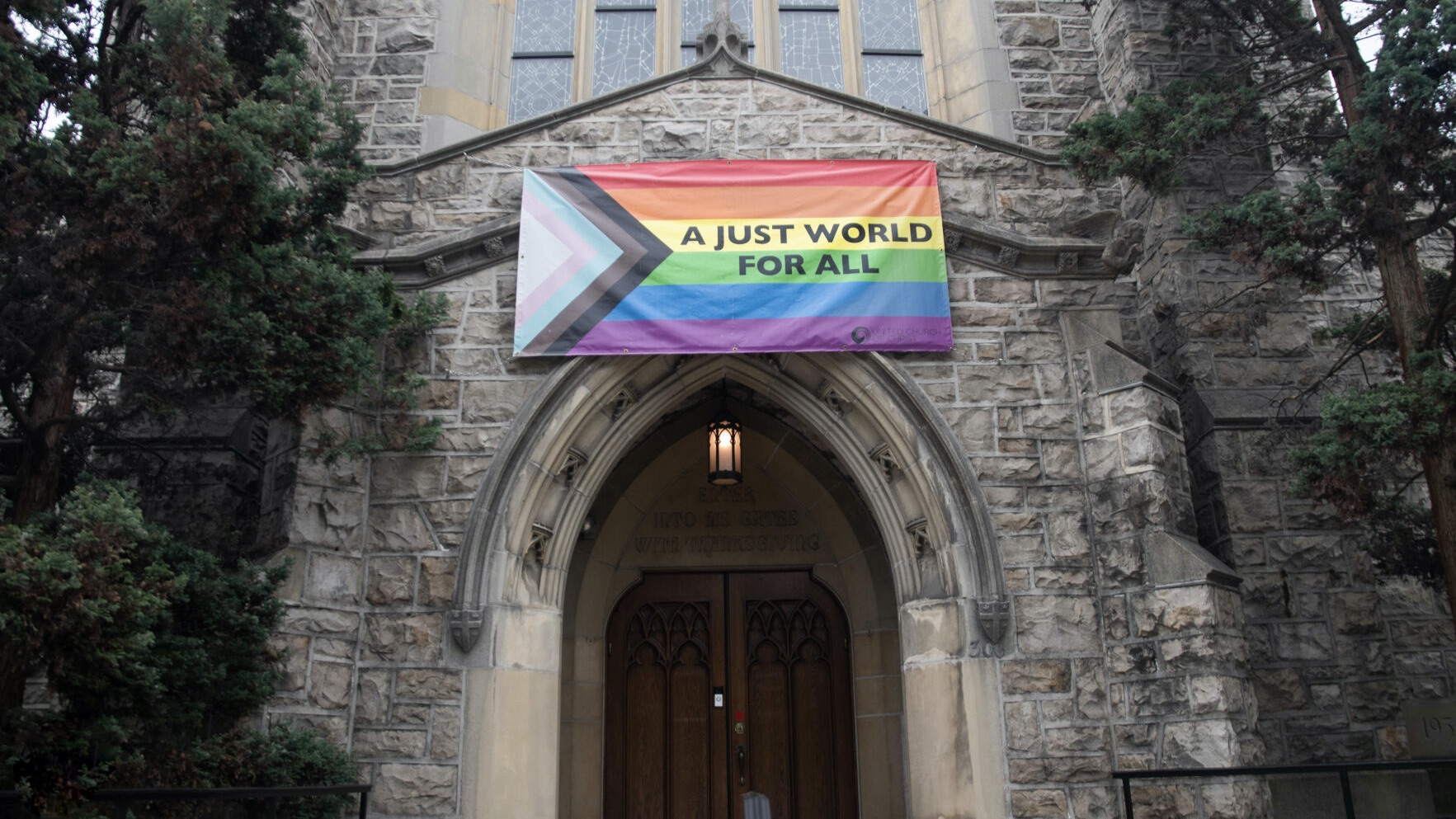

In yet another significant move to the theological left, America’s largest Presbyterian denomination voted decisively to endorse sex-change operations for minors. Critics called the move just the latest evidence the Presbyterian Church (USA) has truly “lost its compass.”
In a 441-30 vote, PCUSA delegates passed GEN-02, also known as “On Access to Healthcare,” during a plenary session of its 227th General Assembly last week.
“Gender-affirming care,” the rationale reads, “is age-appropriate care that is medically necessary and evidence based for the well-being of many transgender, nonbinary, and gender-expansive people who experience symptoms of gender dysphoria or distress that result from having one’s gender identity not match their sex assigned at birth.” It further argues that transgender-related procedures are “critical health services.”
The PCUSA effectively condemned states that have taken action—such as defunding efforts or outright bans—to protect both minors and adults from the harmful, experimental practices.
The rationale concluded: “By preventing doctors from providing this care or threatening to take children away from parents who support their child in their transition, these bills prevent transgender, nonbinary, and gender-expansive youth from accessing medically necessary, safe health care backed by decades of research and supported by every major medical association representing over 1.3 million U.S. doctors.”
One PCUSA member with the Advocacy Committee for LGBTQIA+ Equity told the assembly that “this is a life-and-death matter.” The vote was ultimately summarized in one line, stating that “the PC(USA) supports all individuals”—and initially emphasized the words including minors—“to have access to all medically necessary, evidence-based gender-affirming health care.”
According to PCUSA’s website, membership has been shrinking for years. The most recent numbers from late June show the church has just more than 1 million active members in about 8,300 congregations. Additionally, it is supported by 17,250 ordained ministers and more than 51,000 ruling elders.
In reaction to last week’s vote, many critics across social media platforms have noted that the PCUSA has been “lost” for a “long time.” There was a time when American Presbyterianism operated as one united body. Around the time of the American Civil War, there was a split between the Northern and Southern regions. In 1973, the Presbyterian Church in America (PCA) was formed, followed by the PCUSA in 1983.
Notably, the PCA’s 1970s formation was in reaction to an increasing presence of theological liberalism—a convictional chasm that continues only to widen.
In a comment to Decision, Christian commentator and author Virgil Walker reacted to the PCUSA’s vote. However, rather than focusing on what he—and many—understands to be an unbiblical stance, Walker emphasized the need for all believers to rededicate themselves to standing firm in God’s truth in a world increasingly drifting away from it.
“When a denomination votes to bless what God calls sin, the vote itself is not the real story,” he stated. “The real story is a church that has decided the spirit of the age gets the final word instead of the Word that made the age. That decision was settled long before any ballot was counted.”
As Walker explained, “Scripture does not leave us guessing about who we are. Genesis tells us God made us male and female in His own image, and He called His handiwork very good (Genesis 1:27, 31). A church that can no longer say so has stopped listening to the One it claims to serve and begun echoing the culture it was sent to reach.”
Considering PCUSA’s recent vote explicitly impacts minors, Walker emphasized that children will bear the most severe brunt of this. “Each one is knit together by God in the womb and made to bear His image (Psalm 139:13–14). To tell a confused child that the body God gave is a mistake to be fixed with a scalpel is not compassion. It’s cruelty.”
“The question this puts to the rest of us is not whether the Presbyterian Church (U.S.A.) has drifted,” he added. “It plainly has. The question is whether we will hold the line where God Himself has drawn it. Standing firm will not make us popular, and it will cost us something. Faithfulness always has.”
Walker concluded that this “kind of faithfulness looks ordinary. It is parents teaching their children what God says about their bodies before the world rushes in with its lies. It is families planting themselves in a church that still trembles at His Word and refusing to be moved. The ground beneath them is not shifting, even when everything around it is.”
In 2011, the PCUSA passed a vote to allow LGBT ordination by removing a celibacy requirement from the Presbyterian Book of Order that stated all clergy must “live either in fidelity within the covenant of marriage between a man and a woman, or chastity in singleness.” With the removal of that language, people identifying as gay, lesbian, bisexual and transgender started being ordained that very summer.
At the time, a member of the Korean Presbyterian Church grieved the vote, stating, “I think we should be ashamed of ourselves. This homosexual issue is breaking our church. We need to abide by Scripture.”
In the years since, the PCUSA has only further expanded its so-called “inclusion” policies—even hosting annual events like the “National Queer Presbyterian Gathering.”
In fact, another vote that came from this most recent General Assembly draws from that 2011 shift, requiring all PCUSA congregations to submit a form that indicates “their openness and readiness to call an LGBTQIA+ candidate” for pastoral ministry.
Bible passages to ponder amid spiritual drift: Hebrews 2:1-3, 2 Timothy 4:1-5, James 5:19-20, Galatians 1:6-8