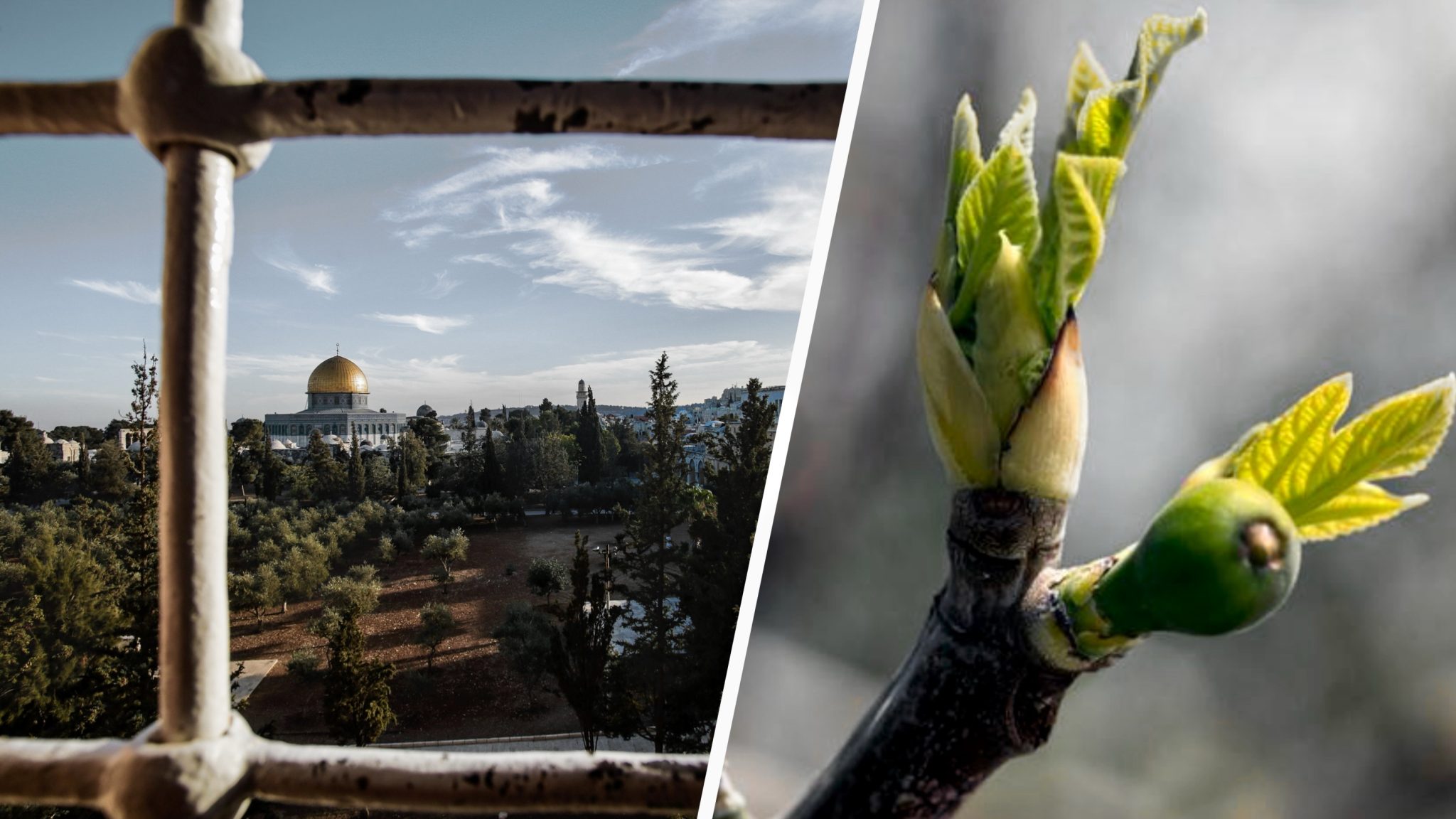

“‘I will plant them in their land, and no longer shall they be pulled up from the land I have given them,’ says the Lord your God.” — Amos 9:15
If we are going to follow a chronological order of events that pertains to the last of the last days, we must begin with the regathering of the Jews into their land and the rebirth of the nation Israel. Jesus said, “Now learn this parable from the fig tree: ‘When its branch has already become tender and puts forth leaves, you know that summer is near. So you also, when you see all these things, know that it is near—at the doors! Assuredly, I say to you, this generation will by no means pass away till all these things take place. Heaven and earth will pass away, but My words will by no means pass away'” (Matthew 24:32-35).
Hosea 9:10 and Joel 1:7 both metaphorically refer to Israel as a “fig tree,” which tells us we are within the boundaries of Scripture to see this as referring to Israel. But there is even more compelling evidence that tells us not only can we see Israel as a fig tree, but we should.
The Olivet Discourse was taught during the Passion Week, the week leading up to Jesus’ crucifixion on Passover. During that week, Jesus made multiple trips into Jerusalem, beginning with the triumphal entry, when He received public worship as Israel’s Messiah for the first time. It was on this day that He cleansed the temple and drove out the money changers and dove sellers.
“Now the next day, when they had come out from Bethany, He was hungry. And seeing from afar a fig tree having leaves, He went to see if perhaps He would find something on it. When He came to it, He found nothing but leaves, for it was not the season for figs. In response Jesus said to it, ‘Let no one eat fruit from you ever again.’ And His disciples heard it… Now in the morning, as they passed by, they saw the fig tree dried up from the roots. And Peter, remembering, said to Him, ‘Rabbi, look! The fig tree which You cursed has withered away'” (Mark 11:12-14, 20-21)
It is almost universally agreed that the fig tree represented fruitless Israel, for at Jesus’ first coming, it was not the season for the people of Israel to recognize their Messiah. That will occur at the second coming. Mark’s Gospel gives us details not provided in Matthew and Luke, and by combining the eyewitness accounts, we can reach this conclusion (remembering that the fig tree represents unbelieving Israel). On Monday of the Passion Week, Jesus curses the fruitless fig tree, and on Tuesday, Jesus and His disciples encounter the same fig tree withered away, which pictures the scattering of the Jews among the nations and the nation ceasing to exist in its homeland. On the next day, Jesus says, “Learn this parable from the fig tree” (Matthew 24:32). He is talking to the same group of men, in the same city, about the same fig tree. Thus, if the fig tree represented unbelieving Israel on Monday and Tuesday, then on Wednesday the fig tree would still represent unbelieving Israel. We know from Ezekiel’s vision in chapter 37 that Israel will be regathered into the land in national unbelief, so the metaphor of the fig tree is consistent in representing unbelieving Israel.
Jesus said, “Learn this parable from the fig tree: When its branch has already become tender and puts forth leaves [which comes before the fig tree bears fruit], you know that summer is near” (Matthew 24:32). He then clarifies the meaning of His words by saying the generation that sees the fig tree become tender and put forth leaves is the generation that will see all the things spoken of in the Olivet Discourse come to pass (verses 33-34).
Within the span of a single generation, Israel will bud in unbelief (become a nation again), and before that generation passes away, the people will look upon the one whom they pierced and mourn as one mourns for an only son (Zechariah 12:10). This is the fruit that will grow after the leaves bud, which will happen at the second coming.