LIVE DEVELOPMENTS — updated Thursday, March 12, 2026
Two Injured In Israel As Hezbollah Launches Its Largest Barrage Since The Start Of The War
WAR IN
ISRAEL
TRUSTED ANALYSIS
LIVE DEVELOPMENTS — updated Thursday, March 12, 2026
Netanyahu Says Michigan Synagogue Attack Shows Antisemitism ‘Knows No Limits’
WAR IN ISRAEL
- Since Oct. 7, over 1,600 Israelis (925 soldiers) have been killed, and 6,420 IDF soldiers wounded since the start of the war.
- On Oct. 7, 2023, one day after the 50th anniversary of the Yom Kippur War, thousands of Hamas gunmen invaded southern Israel, brutally murdering 1,200 Israelis and kidnapping 251 to the Gaza Strip.
- On Oct. 8, 2023, the Israel Security Cabinet voted to officially declare war for the first time since the 1973 Yom Kippur War.
- On Oct. 27, 2023, the IDF began its Ground Operation in Northern Gaza
- Between October 7th, 2023, and March 31, 2024, the IDF made approximately 100,000 phone calls, dropped 9.3 million leaflets, sent 15.5 million text messages, and 17 million voice recordings in efforts to get Gazan civilians out of harm’s way during military operations.
- Between October 7th, 2023, and August 18, 2025, Israel has allowed and facilitated the entry of over 1.9 million tons of aid into Gaza.
- On June 13th, 2025, the 12 Day War began between Israel and the Iranian regime. Israel conducted massive airstrikes targeting Iran’s military infrastructure and leadership, weapons stockpiles, and nuclear scientists—as the regime rained ballistic missiles down, targeting locations of Israel’s largest civilian populations.
- On June 22, 2025, under the orders of President Trump, B2 Bombers dropped bunker-buster bombs on Iran’s nuclear facilities, thwarting the imminent danger of Iran obtaining nuclear weapons.
- On October 10th, 2025, a fragile ceasefire agreement, brokered by the Trump Administration, came into effect between Israel and Hamas.
- On January 27, 2026, after numerous delays, the body of the last remaining Israeli hostage in the Gaza Strip was returned to Israel.
Day 888 — Thursday, March 12

Benjamin Netanyahu responded to the attack at Temple Israel in West Bloomfield, Michigan, saying it reflects the global threat of antisemitism.
“Antisemitism knows no limits or boundaries,” Netanyahu wrote on X. “Israel is attacked because it is the Jewish state. Temple Israel in Detroit was attacked today because it is a Jewish house of worship.”
Netanyahu also praised the synagogue’s security personnel for stopping the attacker.
“I salute the brave security personnel at the synagogue for their swift action. It saved lives,” he said.
The Israeli leader added that he is grateful to President Donald Trump for taking a firm stance against antisemitic attacks in the United States.
The suspect in Thursday’s attack at Temple Israel in West Bloomfield, Michigan, has been preliminarily identified as Ayman Mohamad Ghazali, according to three law enforcement sources who spoke to Fox News.
U.S. Department of Homeland Security (DHS) confirmed the name to Fox News and provided details of his immigration history.
Officials said Ghazali was born in Lebanon in 1985 and entered the United States on May 10, 2011 on an IR1 immigrant visa as the spouse of a U.S. citizen.
According to DHS, Ghazali applied for naturalization on Oct. 20, 2015 and became a U.S. citizen on Feb. 5, 2016. Authorities say Ghazali lived near Dearborn, Michigan.
Law enforcement officials cautioned the identification remains preliminary as investigators continue confirming the suspect’s identity following the attack.
The FBI said it is investigating the attack at Temple Israel in West Bloomfield, Michigan, as a “targeted act of violence against the Jewish community.”
Jennifer Runyan, special agent in charge of the FBI’s Detroit Field Office, said the bureau has taken the lead in the investigation.
“I can confirm that we are leading the investigation right now as a targeted act of violence against the Jewish community,” Runyan said during the Thursday evening press conference.
Authorities said one suspect was involved and is now deceased, and confirmed no congregants or children were killed in the attack.
Oakland County Sheriff Michael Bouchard said the suspect drove a vehicle into the building, where security personnel engaged and stopped the threat.
Officials said a security guard was injured after being struck by the vehicle, and 30 responding officers were treated for smoke inhalation after the vehicle caught fire inside the building.
Runyan said the FBI deployed more than 100 agents and analysts, along with bomb technicians, SWAT teams and evidence response units to process the scene and pursue leads.
“This is an active and ongoing investigation with an active crime scene,” she said. “We ask for patience as we process the evidence and pursue every lead.”
Day 888 — Thursday, March 12

If Lebanon’s government fails to prevent Hezbollah rocket and drone attacks on Israel, Jerusalem will “take control of the territory and do it ourselves,” Israeli Defense Minister Israel Katz threatened on Thursday.
“The prime minister and I have instructed the Israel Defense Forces to prepare to expand its operations in Lebanon and to restore quiet and security to the northern communities,” the defense minister stated.
“We promised quiet and security to the northern communities, and that is exactly what we will do,” Katz added in a Hebrew-language statement.
Hezbollah overnight on Wednesday launched its largest rocket barrage at the Jewish state since the start of the current war, in what the Iranian Islamic Revolutionary Guard Corps said was a combined assault that also included several volleys of ballistic missiles launched by Iran.
According to the Magen David Adom emergency response group, two people sustained light wounds from “flying objects” during the attacks.
The two—a woman with a head injury and a man with a hand wound—were taken to Galilee Medical Center in Nahariya. In addition, several people were treated for injuries sustained while running for shelter.
Speaking during an operational briefing at IDF Northern Command on Monday morning, Katz said that the decision to advance into Lebanon following Hezbollah’s March 2 decision to join the war on Iran’s behalf was “morally and operationally correct, and enables what comes next.”
“It gives confidence to the communities that what happened will not return,” the minister stated, referencing Jerusalem’s past decision to evacuate northern communities for well over a year in response to Hezbollah’s cross-border attacks that started on Oct. 7, 2023, and paused following a U.S.-brokered ceasefire on Nov. 27, 2024.
This time, he vowed, “There will be no evacuation, no abandonment.”
“Everyone remains on their land, in their home, wherever they are. This is the number one mission—to defend the communities and give them security against raids and against anti-tank fire,” continued Katz.
The evacuation of Southern Lebanon and large parts of Beirut will allow the IDF to “thwart threats we have not yet managed to thwart previously, making this region even safer than before ‘Operation Roaring Lion.‘”
Katz added, “We certainly must not only refrain from withdrawing in the face of Hezbollah, but take advantage of the opportunity to strike it.”
Lebanon’s official government has failed to live up to its commitments under the 2024 ceasefire, which forbade the presence of terrorists in the south and tasked the Lebanese Armed Forces with disarming them.
“They allowed Hezbollah to move south,” Katz charged. “The conclusion is always that what we do not do, no one else will do. They are obligated and they must act, and we must ensure that these things happen.”
Lebanese President Joseph Aoun on Monday accused Hezbollah and Iran of working to “collapse” the Lebanese state and expressed his openness to holding “direct negotiations” with Israel, per AFP.
“Whoever launched those missiles wanted to bring about the collapse of the Lebanese state, plunging it into aggression and chaos … all for the sake of the Iranian regime’s calculations,” he told European officials.
Aoun’s proposal reportedly called for “establishing a full truce” with the Jewish state, “logistical support” for the Lebanese Armed Forces to disarm Hezbollah, and direct talks under international auspices.
Israeli Prime Minister Benjamin Netanyahu had warned Beirut over the weekend that if it fails to uphold the ceasefire deal, the Iranian-backed aggression “will bring catastrophic consequences upon Lebanon.”
“It is time for you, too, to take your destiny into your hands,” he told the Lebanese government, declaring that “in any case,” Jerusalem will do “everything necessary to protect our communities and our citizens.”
Day 888 — Thursday, March 12

Prime Minister Benjamin Netanyahu held his first press conference since the start of the war this evening (Thursday) via video conference.
During the press conference, Netanyahu addressed Hezbollah’s attacks on Israel and stated that the Iranian proxy terror group would “pay a very heavy price.”
“This is no longer the same Iran, this is no longer the same Middle East, and this is also not the same Israel. We initiate and attack with force. Trump and I talk almost every day, exchange ideas and advice, and decide together,” Netanyahu said.
“We are crushing Iran and Hezbollah,” Netanyahu declared, adding, “We are becoming a regional power. Our roar is growing louder. We have achieved enormous achievements that are changing the balance of power beyond the Middle East.”
Regarding the campaign in the north, he said, “Hezbollah feels the comfort of our arm and will pay a very heavy price for its aggression.”
In response to a question about the threat from Lebanon and past statements that Hezbollah was defeated in the previous campaign against it, Netanyahu said: “We talked then about 150,000 rockets and missiles, about the destruction of the towers in Tel Aviv, about the eyes of ruins in the rest of the country, and about 15,000 to 20,000 dead. All of this did not materialize because we dealt them a tremendous blow, but that does not mean that they did not have any residual fire left.”
“Threats come and go, but we are strengthening our power compared to what was here,” the prime minister added. “Tomorrow they will be even weaker – both Iran and Hezbollah. We are changing the Middle East. Both against enemies and against friends. Israel is stronger than ever, the whole world understands that.”
He referred to the appointment of Ali Khamenei’s son as Iran’s supreme leader after his father’s assassination. “We have eliminated the old dictator, and the new dictator, the puppet of the Revolutionary Guards, cannot show his face in public. I say to the people of Iran: The moment is approaching when you can embark on the path of freedom. It is in your hands.”
However, he added that he cannot guarantee “that the Iranian regime will collapse, if we join forces, we will repel the enemies time and time again.”
The Prime Minister promised that “many more surprises are expected in the campaign. We have the upper hand, much more than we expected.”
Day 888 — Thursday, March 12

Hezbollah terrorists overnight on Wednesday launched their largest barrage of missiles and drones at Israel since the start of the current war, in what Tehran’s Islamic Revolutionary Guard Corps (IRGC) said was a combined attack from Lebanon and Iran.
Hezbollah fired approximately 200 projectiles at the Jewish state as part of what it dubbed “Operation Al-‘Asf al-Ma‘kul” (“The Eaten Chaff” or “Devoured Straw”), a Quranic reference that refers to the enemy being utterly defeated or destroyed. Around 120 missiles and drones crossed into Israel, Ynet reported.
According to Israel’s Magen David Adom emergency response organization, two people sustained light injuries when they were struck by “flying objects” during an attack on the north.
The casualties—a woman in her 30s with a head injury and a man in his 50s with a hand wound—were evacuated to Galilee Medical Center in Nahariya, MDA said. In addition, several people were treated for minor injuries sustained while running for shelter.
The Hefer Valley Regional Council, which administers a group of communities along Israel’s central coastal plain, said a rocket from Lebanon directly struck the yard of a home in the area, “severely” damaging the house. No injuries were reported.
Air-raid sirens sounded throughout the night in central Israel, warning of ballistic missiles fired by Iran. The IRGC, in a statement carried by Iran’s state-run Tasnim News Agency, confirmed the attacks were a carried out in cooperation with Hezbollah.
Hezbollah began firing rockets and UAVs at Israel on the morning of March 2, in retaliation for Israel’s targeted killing of Iranian Supreme Leader Ali Khamenei. He was killed in the opening shot of “Operation Roaring Lion/Epic Fury” against the regime on Feb. 28.
In response to the terrorist organization’s violation of the U.S.-brokered Nov. 27, 2024, ceasefire deal, Jerusalem launched an aerial campaign against Hezbollah, and ordered IDF troops to advance and take control of additional areas in Lebanon to halt cross-border fire.
IDF Spokesperson Brig. Gen. Effie Defrin told reporters at a briefing on Tuesday evening that the military was seeing attempts by Hezbollah to “increase its rocket fire toward the communities of the north while expanding the range of its attacks” to central Israel and beyond.
“Hezbollah is suffering heavy blows. We are deepening the damage to its capabilities with each passing day and increasing the pressure on it. The fire it is carrying out in order to harm Israeli civilians is a clear response to this,” said Defrin.
Day 888 — Thursday, March 12

Iranian explosive-laden boats appear to have attacked two fuel tankers in Iraqi waters, setting them ablaze and killing one crew member on Wednesday, after projectiles struck three vessels in Gulf waters, said port, maritime security, and risk firms.
The latest attacks mark an escalation in the conflict between Iran and United States-Israeli forces, raising the number of ships struck in the region since fighting began to at least 16.
Shipping in the Gulf and along the narrow Strait of Hormuz, which carries around a fifth of the world’s oil, has come to a near-standstill since the US and Israel began strikes on Iran on February 28, sending global oil prices surging to highs not seen since 2022.
The ships targeted in late-night armed boat attacks in the Gulf near Iraq were the Marshall Islands-flagged Safesea Vishnu and the Zefyros, which had loaded fuel cargoes in Iraq, two Iraqi port officials said.
“We recovered the body of a foreign crew member from the water,” one port security official said, as Iraqi rescue teams continued searching for other missing seafarers. It was not immediately clear which ship the person was linked to.
Day 888 — Thursday, March 12

President Donald Trump said Wednesday that reports of a potential Iranian revenge plot involving drones launched from offshore targeting California are being investigated.
Speaking to reporters in an Air Force One underwing gaggle, Trump was asked by Fox News White House correspondent Peter Doocy about a law-enforcement bulletin warning of a possible Iranian drone attack scenario.
“It’s being investigated,” Trump said. “You have a lot of things happening, and all we can do is take them as they come.”
Trump also said he had been briefed about potential Iranian sleeper cells inside the United States, claiming authorities are monitoring them closely.
“We know where most of them are,” Trump said. “We’ve got our eyes on all of them.”
The president argued some entered the country during the Biden administration’s immigration policies.
Trump also said the U.S. military campaign against Iran is overwhelming Tehran’s forces.
“Iran is being absolutely decimated,” he said.Trump added that Iranian naval and air capabilities have been largely destroyed and said the U.S. is monitoring the Strait of Hormuz as the conflict continues.“
“We’ve knocked out all of their boats,” he said. “I think we’re in very good shape.”
Day 887 — Wednesday, March 11

The United Nations Security Council, which includes the Arab representative Bahrain, voted 13-0 on Wednesday to condemn Iran for its strikes on its Gulf neighbors. The vote, from which Russia and China abstained, was a highly unusual rebuke of the Islamic Republic by Arab states.
Just before the vote, Mike Waltz, the U.S. ambassador to the global body, told reporters that “the atrocities that we’re seeing, the deliberate attacks on civilian infrastructure, on ports, on airports, on energy production facilities, on hotels, on resorts across the Gulf is unacceptable.”
“It’s disgusting, frankly, and I, for one, am proud to see Bahrain lead its neighbors in condemning these actions,” the U.S. envoy said.
The resolution, which the Gulf Cooperation Council drafted, won support from 135 U.N. member states—a record-high, according to Loraine Sievers, co-author of “The Procedure of the UN Security Council” and former chief of the U.N. Security Council secretariat branch.
During the Security Council meeting, Waltz said that he wanted to be “perfectly clear and polite that there has been some misrepresentation here today.”
“The accusation that this resolution put forward by the Kingdom of Bahrain, supported by every member of the GCC, and I see all of them here today, and supported by 135 countries, the most co-sponsors of a U.N. Security Council resolution ever, was somehow manipulated by one or two countries is laughable,” the U.S. envoy said.
“We urge Iran to hear the voice of the council, of this resolution that saw no opposition today and of the entire international community,” Waltz said. “But more importantly, we urge Iran to listen to its own brave people and stop the indiscriminate attacks on civilians across the Middle East.”
Day 887 — Wednesday, March 11

Assassinating Ayatollah Ali Khamenei and nearly all of Iran’s top military and Islamic Revolutionary Guard Corps officers on the first day of the war was an incredible turning point in which all of the IDF’s air and intelligence power combined to change the course of history, an IDF senior officer told The Jerusalem Post on Wednesday.
“Assassinating the supreme leader and all of the top echelon of the Iranian military and the IRGC in around half a minute was made possible by a giant and incredibly coordinated airstrike, which took months of planning,” the senior officer said.
In 40 seconds at around 8:15 a.m. on February 28, Khamenei, IRGC commander Mohammad Pakpour, military commander Abdolrahim Mousavi, defense minister Amir Nasirzadeh, National Defense Council secretary Ali Shamkhani, another top security aide to Khamenei for over a decade, and about 35 other top officials were killed.
Among the Israeli aircraft involved were F-16s, F-35s, and F-15s, although there were many others, including the US military’s involvement.
According to the IDF, the airpower and munitions used during the first day of attacks – both in those assassinations and in wider attacks on Iran’s air defenses and ballistic-missile apparatus – were unprecedented and far beyond any prior similar power used by Israel.
“With around 200 aircraft all carrying precision munitions and all flying 1,000 to 1,500 kilometers to strike hundreds of targets all in a short time period, the effect was to completely throw the Iranians off their game,” the senior officer said. “The total surprise we achieved was extremely deadly and effective.”
When adding in the contribution and profoundly close cooperation with the US military, some in the IDF view the assault and the current war as the most devastating short-term air war in history. The F-16s were flown back and forth to Iran in the early days of the war, essentially nonstop, and took an enormous part in the most critical missions.
By March 5, almost every aircraft had flown nine to 10 sorties back and forth to Iran, with each flight taking five to eight hours round-trip.
While the pace of the F-16s and other aircraft has remained frenetic, one change was that after the first couple of days, the IAF had achieved air supremacy. That allowed stand-in attacks in which Israeli aerial assets could strike from short range, with some even hovering over their targets.
Day 887 — Wednesday, March 11

Spain permanently withdrew its ambassador to Israel on Wednesday as a diplomatic standoff worsened between the two countries over Spain’s opposition to Israeli policies, exacerbated by the US-Israeli strikes on Iran’s regime.
Ambassador Ana Maria Salomon Perez was recalled to Spain last September amid a diplomatic row over Spanish measures banning aircraft and ships carrying weapons to Israel from its ports or airspace due to the war against Hamas in Gaza, a policy Foreign Minister Gideon Sa’ar denounced as antisemitic.
On Tuesday, Spain published an announcement in its official gazette that the ambassador’s position had been terminated. Spain’s Foreign Ministry said its embassy in Tel Aviv will be led by a charge d’affaires for the foreseeable future.
Israel’s embassy in Spain is also run by a charge d’affaires after Israel in May 2024 recalled its ambassador, Rodica Radian-Gordon, in protest of Spain’s decision to recognize a Palestinian state.
“The Foreign Ministry confirms the withdrawal of the ambassador to Tel Aviv, who was called back for consultations ‘indefinitely,’” Spanish Foreign Ministry sources told The Times of Israel, “leaving the Spanish embassy in Tel Aviv under the leadership of a chargé d’affaires, at the same level as the Israeli embassy in Madrid.”
The move marked the latest escalation in a diplomatic spat between the two countries, which have been heavily strained since the start of the Gaza war, which was triggered by the Hamas-led invasion of southern Israel on October 7, 2023.
Ties between Jerusalem and Madrid steadily deteriorated over the following two years as Spain’s government expressed increasing anger and frustration against Israel over the war in Gaza.
Madrid had prohibited sales and purchases of military equipment with Israel from the start of the war; however, last September, Spanish Prime Minister Pedro Sanchez announced measures to enshrine the prohibition in law. Sa’ar criticized Spain as leading “a hostile, anti-Israel line,” after which Madrid also recalled its ambassador.
Day 887 — Wednesday, March 11

Hezbollah and Iran launched a coordinated strike strategy Tuesday, a national security expert claimed, as reports emerged that deadly cluster munitions were hitting Israel in synchronized attacks.
The developments unfolded on day 11 of Operations Epic Fury and Roaring Lion, the joint U.S.-Israeli campaign targeting Iran, marking a potential escalation in the widening regional conflict.
“Hezbollah has fully joined the war, and it looks like they are now very well coordinated with Iran,” Kobi Michael, a senior researcher at the Institute for National Security Studies and the Misgav Institute, told Fox News Digital while speaking from his bomb shelter near Tel Aviv.
“Most of Hezbollah’s rockets and drones are launched simultaneously with the Iranian missiles,” he said.
Israel confirmed Tuesday that Iran had been firing cluster munitions — adding a complicated and deadly challenge to Israel’s stretched air defenses, The Associated Press reported.
The warheads burst open at high altitudes, scattering dozens of smaller bomblets across a wide area. The smaller bombs, which at night can resemble orange fireballs, are difficult to intercept and have proven lethal.
Fox News correspondent Nate Foy also said despite Israel’s strong air defense, half of the missiles are hard to defend against because half of the missiles are cluster munitions.
“The Iranian use of cluster missiles and the idea that they deliberately target civilians and civil facilities must be considered as a use of non-conventional weapons, and the American-Israeli response must be appropriate,” Michael urged.
Banned by more than 120 nations under the 2008 Convention on Cluster Munitions, the weapons are widely condemned for their broad-area, indiscriminate effects that often result in catastrophic civilian harm.
“Israeli citizens have to spend most of the time in the shelter rooms as Hezbollah and Iran deliberately target civilians and civilian facilities,” he said.
As of Tuesday night local time, the IDF said it had launched a wave of airstrikes against Hezbollah infrastructure in Beirut’s southern suburbs.
This came after the military reiterated its warning to evacuate the area, a Hezbollah stronghold known as the Dahiyeh.
Day 887 — Wednesday, March 11

President Donald Trump warned Iran on Tuesday to remove any naval mines from the Strait of Hormuz as U.S. forces struck Iranian mine-laying vessels near the critical waterway, underscoring how control of the narrow passage has become a central flashpoint in the escalating conflict and a major concern for global oil markets.
Trump said U.S. forces had already destroyed Iranian vessels capable of laying mines in the area, part of an effort to keep the shipping lane open.
“I am pleased to report that within the last few hours, we have hit, and completely destroyed, 10 inactive mine-laying boats and/or ships, with more to follow!” Trump wrote Tuesday afternoon on Truth Social.
The U.S. military later said American forces had destroyed a total of 16 Iranian mine-laying vessels operating near the Strait of Hormuz, Reuters reported.
The strikes came as the Trump administration warned Iran that any attempt to block oil shipments through the strategic channel would bring an overwhelming military response.
Day 887 — Wednesday, March 11

Two Jewish men were beaten, and later briefly hospitalized, after they were heard speaking Hebrew in front of a restaurant in San Jose’s Santana Row in California, local media reported on Tuesday.
Footage of the incident, shot by local witnesses, shows the pair of victims attacked by three other individuals outside the Augustine restaurant, NBC Bay Area reported.
“I just turned around, and they literally started punching,” one of the victims, who wished not to be identified, told the outlet. “We got swarmed very badly. I’m in a lot of pain. I still cannot chew. My jaw hurts, my back is hurting.”
According to NBC, the victims said they did not recognize their assailants, and police are investigating the incident as a possible hate crime.
According to ABC7 News, both Jewish men were waiting to be seated at the restaurant when the incident occurred.
“One of the witnesses said that they heard them saying, ‘don’t mess with Iran‘, which we don’t know why,” one of the victims told the outlet. “We don’t have any problem with them. But, I heard at the beginning of the fight, something with, ‘F the Jews’.”
ABC7 added that one of the victims had been knocked out and needed stitches after the assault.
In a statement, the Bay Area Jewish Community Relations Council identified the pair of victims as Israeli Americans.
Day 887 — Wednesday, March 11

Sen. Ted Cruz (R-Texas) sounded the alarm on Tuesday about the rise of antisemitism in the Republican Party and the American right, warning that the tide may be turning against supporters of Jews and Israel.
Speaking to a symposium on Jew-hatred hosted by the Republican Jewish Coalition and National Review, the Texas senator cited the difference in reaction among elected Republicans to former Fox News host and current podcaster Tucker Carlson, who turned sharply against Israel and its supporters in recent years, compared to neo-Nazi influencer Nick Fuentes.
“I believe Tucker Carlson is the single most dangerous demagogue in this country,” Cruz said. “If you look at Republican politicians, Nick Fuentes is easy to denounce, and I actually think it’s a tell among the Republican politicians if they’ll denounce Fuentes but are scared to say Tucker’s name. That tells you a great deal.”
“Virtually every single one of my colleagues in the Senate on the Republican side agrees with me,” Cruz said. “Yet almost none of them will say Tucker’s name.”
Carlson hosted Fuentes on his video podcast for a friendly interview with the Holocaust denier in October.
Speaking to an audience of about 200 RJC and National Review members, administration officials, Hill staffers and Jewish leaders at the Museum of the Bible in Washington, Cruz warned that the anti-Israel and antisemitic politics of figures like Fuentes and Carlson are having a malign influence on young conservatives.
“The Christian church is asleep,” Cruz said. “I have seen more antisemitism in the last 18 months on the right than at any point in my lifetime. A year-and-a-half ago, I could not have imagined we would be here having this conversation.”
“I’m not sure it is accurate as a descriptive matter that we are winning right now,” the senator said, of philosemitic conservatives. “We’re winning with folks in this room with some gray or salt-and-pepper in their hair, but in the college classroom I’m a lot less certain.”
Cruz noted that the model of success for opponents of Israel that has flourished on the Democratic left could be replicated in the Republican Party.
“I don’t want to wake up in five years and find myself in a country where both major political parties are unambiguously anti-Israel and unapologetically antisemitic,” he said.
Cruz’s keynote speech drew the loudest applause among speakers that included fellow Sens. Tom Cotton (R-Ark.) and Jim Banks (R-Ind.) and administration officials, including Leo Terrell, chair of the Department of Justice taskforce to combat antisemitism, and Yehuda Kaploun, a rabbi and U.S. special envoy to monitor and combat antisemitism.
Cotton and Cruz both pushed back against claims from some on the right that U.S. military action against Iran primarily benefits and was at the behest of Israel.
“Before this war started, Iran had thousands and thousands of missiles, and this vast missile arsenal far, far exceeded the combined missile defenses of the United States, Israel and our Arab friends,” Cotton said. “That is an unacceptable threat to the United States.”
“If it’s an unacceptable threat to the United States, it’s an existential threat to Israel,” Cotton added.
“We are not bombing Iran for Israel,” Cruz said. “We are bombing Iran for America.”
Day 886 — Tuesday, March 10

President Donald Trump warned Iran against placing mines in the Strait of Hormuz, saying U.S. forces had destroyed 10 inactive Iranian vessels used to install the explosive devices.
In a post on Truth Social, Trump said Tehran needs to remove any mines in the waterway immediately.
“If for any reason mines were placed, and they are not removed forthwith, the Military consequences to Iran will be at a level never seen before,” he wrote. “If, on the other hand, they remove what may have been placed, it will be a giant step in the right direction!”
Additionally, Trump said U.S. forces were using the technology and missile capabilities deployed against drug traffickers “to permanently eliminate any boat or ship attempting to mine the Hormuz Strait. They will be dealt with quickly and violently. BEWARE!”
In a follow-up post, Trump said U.S. forces had destroyed10 inactive mine laying boats or ships, “with more to follow.”
War Secretary Pete Hegseth said U.S forces have been wiping out the mines with “ruthless precision.”
“We will not allow terrorists to hold the Strait of Hormuz hostage,” he said on X. “To the weakened Iranian regime: you have officially been put on notice!”
Day 886 — Tuesday, March 10

Toronto police have released more information about an early morning shooting at the U.S. Consulate in Toronto that Prime Minister Mark Carney called “a reprehensible act of violence and attempt at intimidation.” They have also put out an image of a suspect vehicle.
Speaking to the media outside the consulate Tuesday morning, RCMP Chief Supt. Chris Leather, who is overseeing the investigation, said he is treating the event as “a national security incident.”
Leather noted that, “for the moment, while the early stages of the investigation are taking place, we have increased security around embassies and consulate buildings here in Toronto and in the Ottawa region.”
He said the U.S. and Israeli consulates topped that list, adding: “I think it’s fairly obvious, based on the incidents that have occurred here in Toronto and elsewhere that these consulates deserve a heightened amount of vigilance and security at this time.”
Leather said, “There will be no tolerance for any form of intimidation, harassment or harmful targeting of any communities or individuals in Canada,” though he added: “There is no indication of an immediate threat to public safety at this time.”
Police responded to a call at 5:29 a.m. Tuesday concerning a firearm being discharged in front of the building on University Avenue at about 4:30 a.m.
They noted that a white Honda CR-V was seen travelling westbound on Dundas Street West before turning southbound onto University Avenue and stopping in front of the Consulate. At that point, they said, two males exited the vehicle and fired multiple rounds at the building.
The suspects then re-entered the vehicle and drove southbound on University. When officers arrived, they found damage to the glass and door of the building, as well as shell casings at the scene. People were inside the building at the time, but no injuries have been reported.
Penny Collenette, a lawyer, adjunct professor at the University of Ottawa and recent Order of Canada recipient, posted news of the consulate attack, adding: “And gunshots fired at two synagogues the night before. Warnings?”
Day 886 — Tuesday, March 10

About half of the roughly 300 ballistic missiles Iran has launched at Israel in the current war carried cluster bomb warheads, according to Israel Defense Forces assessments published Tuesday, a day after the munitions killed two people and seriously wounded another in central Israel.
The data comes as Iran continues to fire missiles at Israel. On Tuesday, most of the missiles were intercepted, but one — carrying a large warhead — exploded in an open area outside Beit Shemesh, near Jerusalem, according to footage and first responders. No injuries were reported.
Cluster bomb warheads indiscriminately spread dozens of submunitions, each with several kilograms of explosives, over a radius of around 10 kilometers (6 miles).
The interception of such missiles has been effective but challenging, military officials said, stressing that Israel’s air defenses are not hermetic.
Use of the munitions is banned under the 2008 Convention on Cluster Munitions, whose over 100 signatories include much of Europe and Africa as well as the UK, Australia and Canada, but not Israel, Iran or the US.
Day 886 — Tuesday, March 10

Iran will face much stronger U.S. military strikes if it closes the Strait of Hormuz to oil tankers, President Donald Trump said Monday.
In a post shared on Truth Social, Trump also said he prayed that it would never happen.
“If Iran does anything that stops the flow of Oil within the Strait of Hormuz, they will be hit by the United States of America TWENTY TIMES HARDER than they have been hit thus far,” Trump said.
“Additionally, we will take out easily destroyable targets that will make it virtually impossible for Iran to ever be built back, as a Nation, again — Death, Fire, and Fury will reign upon them — But I hope, and pray, that it does not happen!” he said.
“This is a gift from the United States of America to China, and all of those Nations that heavily use the Hormuz Strait,” he said before adding that hopefully, it is a “gesture that will be greatly appreciated.”
Day 886 — Tuesday, March 10

U.S. intelligence officials have intercepted encrypted communications believed to have originated in Iran that could serve as an “operational trigger” for sleeper cells operating abroad, according to a federal alert issued to law enforcement agencies.
The alert, reviewed by ABC News, references “preliminary signals analysis” of a transmission described as “likely of Iranian origin” that was sent to multiple countries shortly after the death of Iran’s supreme leader, Ayatollah Ali Khamenei.
Khamenei was killed Feb. 28 during a joint U.S.-Israeli strike.
Officials say the intercepted transmission was encoded and appeared to be intended for “clandestine recipients” who possess the encryption key.
Messages of that type are usually used to pass instructions to “covert operatives or sleeper assets” without relying on the internet or cellular communications.
According to the alert, it is possible the signals could “be intended to activate or provide instructions to prepositioned sleeper assets operating outside the originating country.”
“While the exact contents of these transmissions cannot currently be determined, the sudden appearance of a new station with international rebroadcast characteristics warrants heightened situational awareness,” the alert said.
Authorities emphasized that the alert does not identify a specific threat location. It states there is “no operational threat tied to a specific location,” but urges law enforcement agencies to increase monitoring of suspicious radio-frequency activity.
If confirmed, the communications could reinforce concerns raised by law enforcement officials following the U.S. and Israeli strikes on Iran that sleeper cells positioned throughout Western countries could be used in retaliatory attacks.
Day 886 — Tuesday, March 10
צה”ל תקף מפקדות של ארגון הטרור חיזבאללה במרחב הכפר ממנו בוצעו שיגורים לעבר שטח הארץ
במהלך הלילה, צה”ל תקף במרחב הכפר אנצר שבדרום לבנון מפקדות ותשתיות טרור של ארגון הטרור חיזבאללה, בתגובה לירי הרקטי שביצע אתמול (ב’) ארגון הטרור חיזבאללה לעבר שטח מדינת ישראל ממרחב הכפר.
שעות… pic.twitter.com/arlv4xJEGn
— צבא ההגנה לישראל (@idfonline) March 10, 2026
The IDF says it struck Hezbollah command centers and other infrastructure in the southern Lebanon town of Ansar overnight, from which the terror group launched rockets at Israel.
After the rocket fire last night, and ahead of the strikes, the IDF issued an evacuation warning for residents of the town.
“The Hezbollah terror organization embeds terror infrastructure in civilian areas, thereby endangering the residents of Lebanon. The placement of launchers and firing from civilian areas in Lebanon constitutes a cynical exploitation of Lebanese residents to advance Hezbollah’s terror objectives,” the army says.
Day 885 — Monday, March 9

One Israeli was killed, and almost a dozen were wounded in Iranian ballistic missile attacks across Israel on Monday, according to the Magen David Adom rescue service.
In recent days, Iran has begun using cluster warheads on some of its ballistic missiles. While the cluster munitions do not have the same explosive power as the larger warheads used previously, they scatter damage over a broader area, and can present a greater threat as many of the clusters split before they can be shot down by air defenses.
The cluster munitions hit at least six sites in central Israel, according to reports in Israeli media, including Yehud, Holon, Or Yehuda, and Bat Yam.
In Yehud, a construction worker was killed and another critically wounded by one of the cluster munitions. A third man was injured in the community of Or Yehuda.
Emergency medical services were forced to declare the death of one of the construction workers after resuscitation efforts failed. According to Channel 12 News, the men were part of a Chinese construction crew working in the area.
The death on Monday is the 11th victim of Iranian missile attacks on Israel since the start of the war on Feb. 28.
In recent days, videos on social media showed Israeli overseers demonstrating proper evacuation procedures upon hearing the air raid sirens to groups of Chinese workers. Israeli companies have increasingly hired Chinese or other eastern Asian construction crews following the Oct. 7, 2023, Hamas invasion of Israel.
Previously, many of the companies employed Palestinian workers from the Palestinian territories, however, their entry into Israel has seen stringent new limits since the start of the war.
Magen David Adom paramedic Liz Goral recounted, “Immediately after the sirens, we received reports at MDA about several scenes in central Israel and were dispatched to search them all.”
“One of the scenes in central Israel was at a construction site. It was a difficult scene. The two casualties were lying unconscious and suffering from severe shrapnel injuries to their bodies,” she said. “After performing resuscitation efforts, we had to pronounce the death of a man, approximately 40-years-old, and we evacuated the second casualty in serious condition by Mobile Intensive Care Unit to the hospital.”
Earlier in the day, a woman in Rishon LeZion was wounded by rocks that were thrown into the air after cluster munitions hit outside her home. She was not inside her bomb shelter at the time of the attack.
Home Front Command chief Maj.-Gen. Shai Klapper called on Israelis to obey the warnings and instructions from the military, after it was revealed that all the casualties from the Iranian missile strikes came as the victims were outside of bomb shelters at the time of the strikes.
Speaking outside one of the apartments hit in the cluster munitions attack, Klapper praised the Israeli public for its “steadfastness and resilience,” while urging them to “follow the Home Front Command’s instructions.”
He noted that the family in that particular apartment was safe because they had entered the bomb shelter.
Day 885 — Monday, March 9

U.S. Secretary of State Marco Rubio said on Monday that Iran’s attacks on neighboring countries in the region demonstrate the threat that the Islamic Republic poses to global stability.
Speaking at a flag-raising ceremony for U.S. Hostage and Wrongful Detainee Day, the secretary said that Iran is “trying to hold the world hostage.”
“They are attacking neighboring countries, their energy infrastructure, their civilian population. They’re attacking embassies,” Rubio said. “The objective of this mission is to destroy their ability to continue to do that, and we are well on our way to achieving that objective.”
Iran has launched thousands of missiles and drones at countries around the Middle East since the United States and Israel began combat operations on Feb. 28.
Much of that effort has been directed against the United Arab Emirates and other energy producers around the Persian Gulf as part of an apparent Iranian attempt to spike global oil prices.
The two most commonly used oil commodity benchmarks traded at just under $100 a barrel on Monday, up from around $65 a month ago.
Rubio said that the U.S. military is degrading Iran’s ability to carry out those attacks.
“Every single day, this regime in Iran has less missiles, less launchers, their factories work less, and their navy is being eviscerated,” he said. “The world is going to be a safer and a better place when this mission is accomplished.”
Rubio also highlighted Iran’s history of taking American citizens hostage, going back to the 1979 seizure of the U.S. embassy in Tehran.
“We have to make sure that Americans are no longer viewed as targets of opportunity around the world, and nation-states and terroristic regimes like the one in Iran know that there are consequences for doing that,” the secretary said. “We have to end that cycle.”
Day 885 — Monday, March 9

President Isaac Herzog today (Monday) held a Zoom call with leaders of the Canadian Jewish community after a series of antisemitic shooting attacks on synagogues, Jewish institutions, and businesses in the Greater Toronto Area. President Herzog expressed his shock and dismay at the latest incidents of antisemitism in Canada, following the steep rise in incidents of Jew-hatred in the country since October 7th, 2023.
President Isaac Herzog stated: “I am deeply alarmed by the shocking rise of antisemitism in Canada ever since the October 7th massacre. This most recent series of shooting attacks on synagogues and Jewish communal institutions in the Greater Toronto Area targeted our sisters and brothers in the Jewish Diaspora while Iranian missiles continue to target our people here in Israel. The lessons of previous antisemitic attacks in countries around the world, including the deadly Bondi Beach terror attack in Sydney, must be learned. All eyes are on Canada to halt this unprecedented wave of Jew-hatred.”
“On behalf of the State of Israel, I send a message of resilience, strength, and solidarity to the Jewish community of Toronto. The Jewish people are all one family – in times of joy and in times of difficulty. We in Israel care for every Jew anywhere in the world. We stand together and will prevail over all the forces of evil seeking to harm us,” Herzog said.
Day 885 — Monday, March 9

Mojtaba Khamenei, 56, was named the new “supreme leader” of the Islamic Republic, replacing his father Ali Khamenei, whom the U.S. and Israeli militaries killed, Iranian state television reported on Sunday.
The speaker of the Iranian Parliament stated that the selection of the new leader was “definitive and precise” and that the new leader was a “soothing balm,” according to state media.
The speaker added that the new leader was “faithful, revolutionary, courageous and prudent.”
The U.S. government sanctioned Mojtaba Khamenei in 2019. The U.S. Treasury Department said that the time that “the second son of the supreme leader is designated today for representing the supreme leader in an official capacity despite never being elected or appointed to a government position aside from work in the office of his father.”
“The supreme leader has delegated a part of his leadership responsibilities to Mojtaba Khamenei, who worked closely with the commander of the Islamic Revolutionary Guard Corps-Qods Force and also the Basij Resistance Force to advance his father’s destabilizing regional ambitions and oppressive domestic objectives,” the federal government said.
Trump told Axios last week that “Khamenei’s son is unacceptable to me. We want someone that will bring harmony and peace to Iran.”
“They are wasting their time. Khamenei’s son is a lightweight,” he told the publication. “I have to be involved in the appointment.”
Day 885 — Monday, March 9

Argentina has issued a new arrest warrant for an Iranian official in connection with the 1994 AMIA Jewish community center bombing in Buenos Aires, at the same time that the alleged mastermind was named the new head of Iran’s Islamic Revolutionary Guard Corps.
Ahmad Vahidi was appointed head of the IRGC on Sunday, a day after the unit’s previous leader was killed in the first wave of US-Israeli strikes. Vahidi helmed the IRGC’s Quds Force paramilitary arm responsible for attacks abroad at the time of the AMIA bombing.
Argentinians see poetry in the first strikes, which killed Iran’s supreme leader, Ayatollah Ali Khamenei, and dozens of his deputies as they met in Tehran. The street where they were meeting was named for Louis Pasteur – the same name as the street in Buenos Aires where the AMIA Jewish community organization is located.
Eighty-five people, including children, were killed in the 1994 AMIA bombing. Hezbollah, the Iranian proxy in Lebanon, was quickly identified as having executed the attack, and an arrest warrant for Vahidi was first issued in 2006.
But efforts at accountability faltered for years. A Jewish prosecutor who accused the Argentine president of covering up Iran’s role in exchange for trade benefits, Alberto Nisman, was shot to death in 2015.
Since 2023, when a pro-Israel president was elected, the Argentine government has reinvigorated the investigation and prosecution efforts, as well reopened an inquiry into Nisman’s death, now considered a homicide. A landmark legal ruling in 2024 officially declared that Iran and Hezbollah were responsible for the bombing, setting the state for potential international legal action.
Day 885 — Monday, March 9

The IDF has increased its operations against Hezbollah since the Iranian proxy joined the fighting about a week ago.
Since that time, units from the Northern Command have struck more than 600 targets across Lebanon from the air, sea and land, using more than 820 rounds of munitions, the military said on Sunday.
Additionally, more than 190 terrorists were eliminated in the strikes, including terrorist Abu Hamza Rami, the commander of the Lebanese General Staff, equivalent in rank to a major general, two commanders equivalent in rank to a colonel, and three battalion commanders in the terrorist organization. In addition, 27 waves of strikes have been carried out around Beirut, five of which were in the Dahiyeh district.
The military said that throughout the operations, “The IDF has maintained a commitment to precision and mitigation of civilian harm by issuing evacuation warnings for areas near Hezbollah infrastructure, particularly in Dahiyeh, while employing precise munitions, advanced intelligence and aerial surveillance to focus attacks exclusively on terrorist targets.”
The operation against Hezbollah in southern Lebanon has resulted in the first IDF casualties since the beginning of Operation Roaring Lion.
Day 885 — Monday, March 9

The Iran-backed Houthi terrorist movement has yet to enter the conflict on Iran’s side but in recent days has been ratcheting up its rhetoric in support of Tehran, with its leader, Abdul Malik al-Houthi, declaring that it was prepared to enter the war against the U.S. and Israel if necessary.
“Regarding military escalation and action, our fingers are on the trigger, ready to respond at any moment should developments warrant it,” al-Houthi said on Thursday.
“The reason why the Houthis have not intervened is they are last line of resistance for the axis. Especially after other axis members were degraded,” Nadwa Al-Dawsari, an expert on Yemen and an associate fellow at the Middle East Institute, told Fox News Digital.
The official slogan of the Houthi movement (Ansar Allah) reads, “Allah is Greater. Death to America. Death to Israel. Curse on the Jews. Victory to Islam.”
Day 884 — Sunday, March 8

After reports of an Israeli airstrike in a Beirut hotel killing at least four, the IDF says it carried out a targeted strike on key commanders of Iran’s Revolutionary Guards.
It says the targets were members of the Lebanon Corps of the Quds Force, the IRGC’s extraterritorial arm, who “acted to advance terror plans against the State of Israel and its citizens from Lebanese territory.”
The army adds: “The Iranian terror regime systematically operates among civilian populations in both Iran and Lebanon, cynically exploiting residents and using them as human shields to further terrorist objectives.”
It says it took various steps to minimize the risk to civilians, including the use of precision weaponry and aerial surveillance.
Lebanese officials say the strike killed at least four people. An AFP photographer at the bombed seafront hotel saw shattered windows and heavy damage to one room while security forces sealed off the area.
Ten people were also injured in the attack on Beirut’s Raouche area, the Lebanese health ministry says in a statement.
Day 884 — Sunday, March 8

The USS George H.W. Bush (CVN 77) is expected to deploy to the eastern Mediterranean, Fox News reported on Saturday, joining the USS Abraham Lincoln and USS Gerald R. Ford as the third US Navy aircraft carrier active in the region.
The Bush recently completed the Composite Training Unit Exercise (COMPTUEX), which “brings together all elements of a carrier strike group to operate as a cohesive, multi-domain fighting force,” according to the US Navy.
Like the Lincoln, the Bush is a Nimitz-class supercarrier.
In early February, the Wall Street Journal reported that the Bush could have been deployed to join the Lincoln in the Middle East. However, the Ford was chosen to be sent instead.
On Thursday, the Ford carrier strike group, officially known as Carrier Strike Group 12, crossed the Suez Canal after docking in Haifa and is now positioned in the Red Sea, reportedly prepared to attack or defend should the Houthis attempt to join the ongoing war with Iran.
It entered the Mediterranean after transiting the Strait of Gibraltar, a movement reported by multiple outlets tracking US naval deployments.
General Dan Caine on Wednesday asserted at the Pentagon that the Ford has continued to launch bombers and project combat power in the Gulf, and that the Lincoln Strike Group has pressured Iran from the southeast and attrited the regime’s naval capabilities.
Day 884 — Sunday, March 8
President Donald Trump on Saturday slammed British Prime Minister Keir Starmer, saying he was joining the war in Iran after the U.S. has “already won.”
“The United Kingdom, our once Great Ally, maybe the Greatest of them all, is finally giving serious thought to sending two aircraft carriers to the Middle East,” Trump wrote on Truth Social. “That’s OK, Prime Minister Starmer, we don’t need them any longer — But we will remember. We don’t need people that join Wars after we’ve already won!”
Trump’s statement came after the U.K. Ministry of Defense said that one of the country’s two aircraft carriers had been placed on advanced readiness in Portsmouth, England, for a possible mobilization to the Middle East, according to the BBC.
A British destroyer, HMS Dragon, is also in Portsmouth, waiting to leave for Cyprus after delays.
Starmer said that while the U.K. wasn’t involved in the strikes, it is “operating defensively in the region.”
In an address to the British people Sunday, Starmer condemned “indiscriminate” attacks by Iran after the U.S. strikes, adding, “The only way to stop the threat is to destroy the missiles at source.”
He added that Britain has agreed to the United States’ request to use British bases for that “limited” purpose.
After the strikes, Trump told the Telegraph in the U.K. he was “very disappointed” in Starmer, claiming it “took far too long” for the prime minister to allow the U.S. to use British bases in the region.
British fighter jets are also flying over Jordan, Cyprus and Qatar to strengthen defense in the region, and a Merlin helicopter is on the way for additional airborne surveillance, according to the Ministry of Defense.
“While the region has been plunged into chaos, my focus is providing calm, levelheaded leadership in the national interest,” Starmer said this week. “That means deploying our military and diplomatic strength to protect our people.
“And it means having the strength to stand firm by our values and our principles, no matter the pressure to do otherwise. The longstanding British position is that the best way forward for the regime and world is a negotiated settlement with Iran where they give up their nuclear ambitions.”
He said that’s why he decided the U.K. would not join the initial coordinated strikes launched by the U.S. and Israel Feb. 28.
In Parliament this week, Starmer added, “We all remember the mistakes of Iraq, and we have learned those lessons. Any U.K. actions must always have a lawful basis, and a viable, thought-through plan,” Starmer said. “This government does not believe in regime change from the skies.”
Former British Prime Minister Liz Truss reposted Trump’s Saturday Truth Social comments on X, writing, “Justified and damning.”
Day 883 — Saturday, March 7

Israeli diplomats and officials have often brought poster boards as props to the United Nations, including images of the attacks on Oct. 7 and a bomb illustration to show Iranian enrichment. Danny Danon, the Israeli ambassador to the global body, brought an actual engine and wing from an Iranian Shahed-136 attack drone to a press conference on Thursday.
“Let me make it clear. This is what we are facing,” he said, as he removed a white drape from a mechanical object with wires and a black drape from atop a drone wing.
“This is the engine and the wing of an Iranian Shahed-136 attack drone acquired by the watchdog United Against Nuclear Iran,” he told reporters. “Not a prop. Not a toy. A weapon.”
“Look at the wing,” he added. “Built to travel thousands of miles across borders. It can reach cities in Israel, in Europe and in a few months, even the U.S., carrying more than 100 pounds of explosives. Now imagine it aimed at your house, at your living room, at your child’s bedroom.”
“This is the terror that we are facing,” he said.
Speaking outside the U.N. Security Council chamber, the Israeli envoy added that “Iran has struck more Arab countries than Israel has in its entire existence.”
He named eight countries. “This is a regime going down and trying to set the entire region on fire as it falls,” Danon said.
Touting the successes of the U.S.-Israeli military operation so far, the envoy warned that “this effort is far from over.”
“I think diplomacy will come into action. Not yet,” he said. “We have to dismantle the machine of terror that they built for so many years. It will not last forever. It will not be months. It will be weeks or days, but we need to continue.”
As the Islamic Republic attacks more countries and draws them into the conflict directly or indirectly, Danon denounced his counterpart from Tehran for attempting to convince reporters that the Iranian regime is only targeting military assets.
“That is not just inaccurate. It is a deliberate lie,” he said, noting that Iran has hit airports, hotels and other civilian sites across the region.
“That is indiscriminate aggression,” he said.
Danon praised the Lebanese government for “very strong, bold statements” against the Iran-backed Hezbollah terror group that still controls points of the southern part of the country and which joined its patron earlier this week in the fight against Israel by firing off rockets to the south.
“But they have to take action against Hezbollah,” Danon said of the Lebanese government.
“I think our message is very clear,” he said. “We will find the operatives of Hezbollah and the Iranian regime representatives in Lebanon, and we will eliminate them.”
Day 883 — Saturday, March 7
UN Secretary-General Antonio Guterres on Friday appeared to criticize the Israeli and US strikes on Iran, prompting a response from Israel’s former Ambassador to the UN, Gilad Erdan, who branded the UN chief “irrelevant”.
“All the unlawful attacks in the Middle East and beyond are causing tremendous suffering and harm to civilians throughout the region – and pose a grave a risk to the global economy, particularly to the most vulnerable people,” wrote Guterres in a post on social media, without specifically naming Israel or the US.
He warned, “The situation could spiral beyond anyone’s control. It is time to stop the fighting and get to serious diplomatic negotiations. The stakes could not be higher.”
Erdan wrote in response, “Antonio, you are the most irrelevant person on earth. Go home. You and your corrupt and ineffective organization, the UN, have become a collaborator of dictators and terrorists. Shame on you!”
He added, “We all pray that President Trump and the leaders of the free world would soon defund completely the UN and dismantle it. Then you can go and spend your time with your friends the Ayatollahs.”
Guterres, already known for his anti-Israel bias, has increased his criticism of Israel since the October 7, 2023 massacre carried out by the Hamas terrorist organization in southern Israel.
Several weeks after October 7, the UN Secretary-General said that the attack on Israel “did not happen in a vacuum” and appeared to blame Israel for the attack.
After his remarks were widely condemned, the UN chief claimed his comments were misinterpreted and that he had indeed condemned Hamas.
In October of 2024, then-Foreign Minister Israel Katz – now Defense Minister – announced that Guterres had been barred from entering Israel.
Day 883 — Saturday, March 7

Iran’s president says that a demand by the United States for an unconditional surrender is a “dream that they should to take to their grave.”
President Masoud Pezeshkian makes the statement in a prerecorded address aired by state television.
The comments came as intense Iranian fire targeted the Gulf Arab states as Israel and the United States kept up their airstrikes targeting the Islamic Republic.
There were repeated attacks on Bahrain, Saudi Arabia and the United Arab Emirates.
Day 882 — Friday, March 6

The Israel Defense Forces (IDF) on Friday announced that it had dismantled former Iranian Supreme Leader Ayatollah Ali Khamenei’s underground bunker in Tehran.
“The underground compound was created by the regime as a base for advancing military activities and its extremist ideologies against the State of Israel and the Western world,” the IDF said. “It spanned multiple streets in the heart of Tehran and contained numerous entrances and meeting rooms for senior members of the Iranian terrorist regime.”
Israel later released an illustrated video which showed a number of entry points throughout Tehran with tunnels leading to the underground bunker.
The fortified compound was directly under where Khamenei and other regime leaders were situated on Saturday morning when almost 50 of them were killed in under 50 seconds during the launch of Operation Epic Fury, a senior Israeli official told Fox News.
The official said that Khamenei spent millions of dollars and a number of years building the bunker, which he did not use on the morning of the strike. Sources familiar with the intelligence say that Khamenei believed no one had the guts to strike him.
The senior Israeli official told Fox News that Khamenei’s confidence was partially thanks to an Israeli-American deception plan that included messaging, signals and public statements by President Donald Trump that suggested nothing immediate was coming. Top IDF commanders even went home on Friday night, hours before the strike, in an attempt to deceive Iranian leadership.
Khamenei was killed on the first day of Operation Epic Fury after ruling the Islamic Republic for more than 30 years. During that time, he oversaw harsh internal crackdowns, including the most recent one in January, which targeted Iranian protesters, as well as international confrontations.
Day 882 — Friday, March 6

U.S. President Donald Trump said that Tucker Carlson, the former Fox News host who regularly shares antisemitic conspiracy theories, is “not MAGA,” following Carlson’s sharp criticisms of the administration’s military strikes on Iran.
“Tucker has lost his way,” Trump told chief Washington correspondent Jonathan Karl, of ABC News, in a March 5 interview. “I knew that a long time ago, and he’s not MAGA.”
MAGA refers to the president’s Make America Great Again movement.
“MAGA is saving our country. MAGA is making our country great again. MAGA is America first, and Tucker is none of those things,” Trump said. “Tucker is really not smart enough to understand that.”
Carlson has publicly condemned the joint U.S. and Israeli strikes against Iran as “absolutely disgusting and evil” and warned the conflict could reshape Trump’s political movement.
He has also drawn criticism for unfounded claims linking the Chabad‑Lubavitch movement to the war, which Jewish leaders have rejected as baseless and inflammatory.
Responding to the president’s comments, Carlson told Status that “there are times I get annoyed with Trump, right now definitely included. But I’ll always love him no matter what he says about me.”
Supporters of Trump’s position have applauded the president’s remarks.
The Republican Jewish Coalition praised Trump for distancing himself from Carlson’s rhetoric. Leo Terrell, chair of the U.S. Department of Justice’s task force to fight Jew-hatred, stated that “if you are with Tucker, you are not with President Trump.”
Day 882 — Friday, March 6

Amid the ongoing Israeli and US strikes against the Iranian regime, some officers in the Islamic regime’s armed forces have abandoned their barracks, leaving behind the soldiers under their command to remain on guard duty, a number of conscripts told Iranian opposition outlet Iran International.
The soldiers who spoke with the outlet reported that since the killing of former supreme leader Ayatollah Ali Khamenei on Saturday, confusion has erupted within the Iranian military.
Several soldiers stationed at a military base in Lorestan province told Iran International that they were uncertain about the command structure and were uneasy about the deteriorating security situation.
One soldier told the outlet that many commanders had, fearing strikes, abandoned their posts, leaving conscripted soldiers behind without support.
Some soldiers, also fearing American and Israeli strikes, have been spending nights in open areas outside of the base for fear of being hit in an airstrike, the soldier said, adding that leadership was not paying adequate attention to the needs of the regular troops.
The Iran International report comes as the US and Israel have vowed an escalation in the campaign against Iran’s regime.
On Sunday, Prime Minister Benjamin Netanyahu vowed that Israel would intensify its attacks against Iran in the coming days. On Friday, the Israel Air Force launched its 15th wave of strikes on Iranian targets in Tehran and Isfahan.
During its strikes in the country, the IDF said it had hit over 400 targets, including a “senior Iranian terror regime commander in Tehran.”
US President Donald Trump has also said on Friday that he would only accept unconditional surrender from the Islamic Republic after saying on Thursday that “We want to fight now more than they do.”
Day 882 — Friday, March 6
US-Israel Blitz On Iran Described As One Of The Most Coordinated Allied Operations In Modern Warfare

A massive joint air campaign by the United States and Israel is dismantling Iran’s missile network in what officials and analysts describe as one of the most coordinated allied operations in modern warfare.
Secretary of War Pete Hegseth said the campaign is rapidly establishing dominance over Iranian skies.
“Starting last night and to be completed in a few days … the two most powerful air forces in the world will have complete control of Iranian skies,” Hegseth said Wednesday. “Uncontested airspace.”
“We will fly all day, all night … flying over Tehran, flying over Iran, flying over their capital… Iranian leaders are looking up and seeing only U.S. and Israeli air power every minute of every day until we decide it’s over.”
Israel Defense Forces spokesperson Brig. Gen. Effie Defrin told Fox News Digital in an exclusive interview Tuesday that “the cooperation between us and the American military is amazing. We have mutual planning and mutual executing for the plans in Iran and beyond.”
John Spencer, executive director of the Urban Warfare Institute, told Fox News Digital Israel effectively matched the U.S. military’s opening airpower surge.
“Israel matched the United States in the number of aircraft in the air,” Spencer said. “For Israel, that represents roughly 80% of its air force capability.”
He added that the level of coordination between Washington and Jerusalem represents a new model for allied warfare.
“This isn’t separate work,” Spencer said. “This is combined work. Integrated, synchronized operations combining powers.”
“In the past, we’ve had coalitions of dozens of countries,” Spencer said. “But having a partner that is both willing and capable of bringing immense capabilities like this is very rare.”
The Israeli campaign, known as Operation Roaring Lion, began with roughly 200 fighter jets launching the largest coordinated air operation in the history of the Israeli air force.
Within the first 24 hours of the campaign, Israeli fighter jets had already opened a corridor allowing sustained operations over Tehran, according to the Israeli military.
Israeli aircraft struck missile launch sites and air defense systems across western and central Iran in an opening wave targeting hundreds of sites simultaneously using intelligence gathered by Israel’s Intelligence Directorate and the CIA.
In the joint operation, Israeli aircraft dropped hundreds of munitions on approximately 500 targets, including missile launchers, command centers and air defense batteries.
The opening strike achieved a level of surprise rarely seen in modern warfare, according to Israeli intelligence chief Maj. Gen. Shlomi Binder.
“In 40 seconds, we eliminated more than 40 of the most important people in Iran,” Binder said, referring to senior regime and military officials, including Iran Supreme Leader Ali Khamenei. “We are sending a clear message to our enemies — there is no place where we will not find them.”
Spencer said the strategy behind the opening strike represents a dramatic shift in modern warfare.
“What Israel did in this opening campaign just wasn’t imaginable in the history of war. It never happened,” he said. “To start off by cutting off the brain… usually you target the military first. Here they targeted the political and military leadership and had the ability to wipe them out in a matter of hours.”
Spencer, a veteran of the 2003 Iraq War, said the operation reflects advances in intelligence and strike capabilities.
“I was part of the invasion in 2003,” he said. “Something like this was unthinkable even 20 years ago.”
Day 882 — Friday, March 6

U.S. President Donald Trump on Thursday demanded that Israeli President Isaac Herzog immediately pardon Prime Minister Benjamin Netanyahu, saying the Israeli leader should not be distracted from the war with Iran.
In a phone interview with Channel 12’s Barak Ravid, Trump said Herzog must grant Netanyahu a pardon “today.”
“President Herzog must give Bibi a pardon today,” Trump said, referring to Netanyahu by his nickname. “I don’t want there to be anything troubling Bibi other than the war with Iran. The only pressure on him should be the fighting against Iran.”
Israel and the United States launched a joint preemptive military operation against Iran on Feb. 28.
In the interview, Trump criticized Herzog, calling him “a disgrace” and claiming that the Israeli president “promised me five times that he would give Bibi a pardon.”
He added that Herzog had been holding the issue over Netanyahu “for a year” and urged him to stop using it as leverage. He also said he would refuse to meet the Israeli president until the pardon was granted.
Day 882 — Friday, March 6

Azerbaijan on Thursday warned it could retaliate against Tehran after Iran fired two drones at its northern neighbor, wounding two people.
Azerbaijan summoned the Iranian envoy after the strikes hit an airport and near a school.
Iran has not acknowledged targeting Azerbaijan, but its retaliatory attacks have spread erratically to include regional countries and beyond amid an intense joint US-Israeli air campaign that began over the weekend.
The attacks around midday involved at least two drones that crossed from Iran into Azerbaijan’s exclave of Nakhichevan, which borders Iran and is separated from mainland Azerbaijan by Armenia, said a foreign ministry statement.
“One drone fell on the terminal building of Nakhichevan Airport, while another drone fell near a school building in the village of Shekerabad,” the ministry said, damaging the airport and wounding two civilians.
A source close to the Azerbaijani government told Reuters a fire had started as a result of the incident.
Video footage shared by the source showed black smoke rising near the airport and damage to the skylight inside the terminal building.
The ministry said it had summoned the Iranian envoy in Baku to express “strong protest” over the attack, which “contradicts the norms and principles of international law and contributes to rising tensions in the region.
“Azerbaijan reserves the right to take appropriate retaliatory measures,” it added.
Day 882 — Friday, March 6

British police arrested four people on suspicion of Iran-related spying on Friday, in relation to an investigation into surveillance of locations linked to Jewish communities.
According to the Metropolitan Police, the men, one Iranian and three dual British/Iranian nationals, were arrested last in a pre-planned operation.
“Today’s arrests are part of a long-running investigation and part of our ongoing work to disrupt malign activity where we suspect it,” Commander Helen Flanagan, Head of Counter Terrorism Policing London, said.
“We understand the public may be concerned, in particular the Jewish community, and as always, I would ask them to remain vigilant and if they see or hear anything that concerns them, then to contact us.”
Six other men have been arrested on suspicion of assisting an offender, Police said.
Day 881 — Thursday, March 5

The Israel Defense Forces on Thursday issued an “urgent” warning for some residents of Beirut’s southern suburbs—a stronghold of the Iran-backed Hezbollah terror group—to immediately evacuate their homes.
Col. Avichay Adraee, from the Arab Media Branch in the Israeli military’s Spokesperson’s Unit, ordered residents of Beirut’s Bourj el-Barajneh, Hadath, Haret Hreik and Shiyyah areas to leave and “save your lives.”
The four neighborhoods have a combined total of upward of 75,000 residents, according to official data. However, local reports suggested that as many as 500,000 people could be affected by the evacuation, as the suburbs have large unregistered populations, including refugees.
“We will notify you when it is safe to return to your homes,” tweeted Adraee, noting that they are forbidden from heading south, as “any movement southward may put your lives in danger.”
On Wednesday, the IDF ordered all civilians in Southern Lebanon to move north of the Litani River.
“The activities of the Hezbollah terrorist organization are forcing the Israel Defense Forces to act against it with force. The IDF does not intend to harm you,” wrote Adraee in a notice posted to X.
The spokesperson stressed that any Lebanese civilians “near Hezbollah members, facilities or combat equipment are putting their lives at risk.”
“Any home used by Hezbollah for military purposes may be subject to targeting,” he said. “Any movement southward may endanger your life.”
Hezbollah began firing missiles at northern Israel on Monday morning in retaliation for the targeted elimination in Tehran of Iranian Supreme Leader Ali Khamenei. He was killed by an Israeli strike targeting his Tehran compound in the first moments of “Operation Roaring Lion.”
Hezbollah continued to fire rockets and send explosive drones toward the Jewish state on Thursday, setting off waves of sirens but causing no major casualties as Israeli air defenses and shelters limited the impact.
Under the U.S.-brokered truce between Israel and Lebanon that went into effect on Nov. 27, 2024, Beirut pledged to disarm the Iran-backed terrorist organization that has long controlled the country’s south.
On Thursday, Lebanon’s government announced new steps aimed at curbing the influence of Tehran’s Islamic Revolutionary Guard Corps.
Beirut’s Cabinet ordered that any activity by the IRGC in Lebanon be halted, in addition to fully implementing the previous government decision to disarm Hezbollah, the MTV Lebanon outlet reported.
IRGC operatives will be detained, Reuters cited Lebanese Information Minister Paul Morcos as announcing. In addition, the Saudi-based Al Arabiya network reported that the Cabinet decided that Iranian nationals would no longer be granted visa-free entry to Lebanon.
Day 881 — Thursday, March 5

US President Donald Trump said Thursday that he needs to be “involved” in selecting Iran’s next leader, days after Israeli strikes killed the country’s longtime supreme leader, Ayatollah Ali Khamenei.
The statement was a clear indication that the US intends to have a hand in the shaping of the country’s future leadership, amid shifting signals over whether the US-Israeli campaign is seeking regime change. Trump likened his planned involvement to US influence over Venezuela’s government after Trump ordered the seizure of its president, Nicolas Maduro, earlier this year.
At the same time, Trump brushed off reports in recent days that Mojtaba Khamenei, the late supreme leader’s son, has been tapped as a frontrunner.
“They are wasting their time. Khamenei’s son is a lightweight,” Trump told Axios in a phone interview, adding later, “Khamenei’s son is unacceptable to me. We want someone that will bring harmony and peace to Iran.”
Trump said, “I have to be involved in the appointment, like with Delcy [Rodriguez] in Venezuela,” who is currently leading that country.
In a separate interview with Politico, Trump said of the elder and younger Khamenei: “The reason the father wouldn’t give it to the son is they say he’s incompetent.”
He also told Politico, “I’m going to have a big impact [over Iran’s future leadership], or they’re not going to have any settlement, because we’re not going to have to go do this again.”
“We’ll work with the people and the regime to make sure that somebody gets there that can nicely build Iran but without nuclear weapons,” he told Politico.
Trump had said on Wednesday that Reza Pahlavi, the son of the former shah, who is trying to position himself as a leader should Iran’s Shiite theocracy fall, is not someone that his administration has considered in depth to take over leadership in Iran.
“It would seem to me that somebody from within, maybe, would be more appropriate,” Trump said in comments to the press at the White House, adding that it may make sense for “somebody that’s there, that’s currently popular, if there is such a person” to emerge from the power vacuum.
Day 881 — Thursday, March 5

Iran has attacked 12 countries so far since Operation Epic Fury was unleashed by the U.S. and Israel, CENTCOM Commander Admiral Brad Cooper said in a Pentagon briefing Thursday.
His comments came as the military operation entered its seventh day.
“What I will point out is this is now the 12th country, that Iran has attacked 12 countries,” Cooper told reporters.
“And it goes right back to the secretary’s point. Those 12 countries are none too happy,” he said
“And I look forward to working with all the partners who are willing to join us in this.”
Ahead of Cooper’s comments, Secretary of War Pete Hegseth had described how Iran had been targeting allied countries and “pulling them into the U.S. orbit.”
“What Iran is doing by targeting allied countries that would otherwise want to stay out of this, they’ve actually pulled them into the American orbit,” Hegseth explained.
“So now you’ve got UAE and Qatar and Bahrain and Saudi and Kuwait and others saying, hey, we’re with you. Here’s we’ll shoot with you, we’ll fly with you, we’ll defend with you.”
“It’s actually firming up the unity of the resistance in order to focus exactly where we need to,” he said.
Hegseth’s and Cooper’s remarks followed a meeting with top CENTCOM commanders on Operation Epic Fury.
Day 881 — Thursday, March 5

Iranian state television aired a message Thursday from an ayatollah in Iran calling for the “shedding” of blood from Israelis and US President Donald Trump, as the Islamic Republic continued to threaten revenge and repercussions for the war being waged against it by the US and Israel.
The message from Ayatollah Abdollah Javadi Amoli represented one of the few clerical statements coming from Iran as it faces a combined airstrike campaign from the two countries.
He called for “the shedding of Zionist blood, the shedding of Trump’s blood.”
“The imam of the time says, ‘Fight the oppressive America, his blood is on my shoulders,’” the ayatollah added.
Meanwhile, Iran’s Islamic Revolutionary Guards said on Thursday that they had hit a US tanker in the northern part of the Gulf and the vessel was on fire. There was no confirmation from the US. The Guards said in the statement carried by state media that, in time of war, passage through the Strait of Hormuz will be under the control of the Islamic Republic.
Iran’s Foreign Minister Abbas Araghchi said earlier that Washington “will bitterly regret the precedent it has set” in its torpedo attack on the Iranian frigate Dena in international waters on Wednesday, which sank the ship and apparently led to the deaths of most of the crew.
Araghchi said the strike occurred without warning and called it “an atrocity.”
Day 881 — Thursday, March 5

The pace of Hezbollah rockets and drones being launched on Israel has jumped dramatically since Monday, even as the rate of Iranian ballistic missiles dropped significantly from Saturday-Sunday to the rest of the week, the IDF Home Front Command said on Thursday.
According to the IDF, northern residents spent most of the night in their safe rooms and bomb shelters because of consistent fire.
If on Monday, Hezbollah’s attack on Israel was symbolic, it appears that in response to Jerusalem’s much heavier crackdown on hundreds of attacks on Hezbollah, the terror group has now gone all-in on its attacks against Israel.
IDF sources said that it was even possible that this trend could continue with Iranian ballistic missiles dropping off even further, but the threat from Hezbollah expanding,
The IDF refused to share exact numbers due to the developing security situation.
However, at its height in fall 2024, Hezbollah was launching around 100-250 rockets or drones against Israel per day, and the IDF said that even the spike in threats on Wednesday had not approached those numbers, suggesting aerial threats of more in the dozens per day.
Day 881 — Thursday, March 5

The Israel Defense Forces carried out a large-scale airstrike on an Iranian military compound in eastern Tehran on Wednesday. The compound housed the headquarters of all of the regime’s security organizations, according to the military.
Targeted command centers linked to Iran’s security apparatus included headquarters belonging to the Islamic Revolutionary Guard Corps, the Quds Force, the Basij paramilitary volunteer militia, the Intelligence Directorate, Internal Security forces and the regime’s cyber warfare unit, according to the statement.
According to the IDF, Iranian operatives overseeing operations against Israel and suppressing domestic protests were present at the site. The military said the attack was part of its ongoing effort to “degrade the Iranian terror regime in Tehran.”
Meanwhile, Israeli and U.S. forces continued to jointly attack Iranian targets on Thursday as the IDF announced in the morning that it had begun a “large-scale wave of strikes against infrastructure of the Iranian terror regime across Tehran.”
Day 881 — Thursday, March 5

The US tested a doomsday ballistic missile off the California coast Tuesday night — as war raged in the Middle East.
The Minuteman III ballistic missile — which is capable of carrying nuclear warheads 20 times more powerful than the atomic bomb dropped on Hiroshima — launched from Vandenberg Space Force Base near Santa Barbara at 11 p.m.
The unarmed rocket, known as GT 254, hit its intended target near the Marshall Islands in the west-central Pacific Ocean, according to the US Space Force.
The missile was fired to “verify the effectiveness, readiness and accuracy,” according to the Air Force Global Strike Command.
“[It] allowed us to assess the performance of individual components of the missile system,”Lt. Col. Karrie Wray, commander of the 576th Flight Test Squadron said in a press release.
“By continually assessing varying mission profiles, we are able to enhance the performance of the entire [Intercontinental Ballistic Missile] fleet, ensuring the maximum level of readiness for the land-based leg of the nation’s nuclear triad.”
The test launch comes just days after the US and Israel launched an attack on Iran, killing the nation’s supreme leader, Ayatollah Ali Khamenei, at his compound in Tehran — setting off a war in the region.
President Trump later vowed to step up strikes on Iran, warning, “The big one is coming.”
The Air Force Global Strike Command said Tuesday’s test-launch was routine and scheduled years in advance.
The Minuteman III missile is one part of America’s nuclear triad, which include the ability to launch [nuclear] weapons from the land, sea and air.
The missiles are stored in silos scattered across the American west, ensuring that the US will be able to strike back if it is ever hit with an atomic attack.
A Minuteman III missile was also launched in November after President Trump called for restarting the nuclear weapons tests.
The missile can travel 6,000 miles at speeds of more than 15,000 mph and strike anywhere in the world.
Day 880 — Wednesday, March 4

A U.S. submarine sank a prized Iranian warship by torpedo, the first such sinking of an enemy ship since World War II, Secretary of War Pete Hegseth said Wednesday morning.
Hegseth joined Chairman of the Joint Chiefs of Staff Gen. Dan Caine at the Pentagon to provide an update to reporters on “Operation Epic Fury” in Iran.
“An American submarine sunk an Iranian warship that thought it was safe in international waters,” Hegseth said. “Instead, it was sunk by a torpedo. Quiet death. The first sinking of an enemy ship by a torpedo since World War Two. Like in that war, back when we were still the War Department. We are fighting to win.”
Caine said that an Iranian vessel was “effectively neutralized” in a Navy “fast attack” using a single Mark 48 torpedo. He added that the U.S. Navy achieved “immediate effect, sending the warship to the bottom of the sea.”
The Iranian ship was later identified as the IRIS Dena, a frigate, which was sunk in the Indian Ocean.
In a separate incident, Hegseth said that the U.S. Navy sank another Iranian warship, the Soleimani. The flagship was named for Qasem Soleimani, an Iranian military officer who served in the Islamic Revolutionary Guard Corps who the U.S. killed in a January 2020 drone strike during President Donald Trump’s first term.
“The Iranian Navy rests at the bottom of the Persian Gulf. Combat ineffective, decimated, destroyed, defeated. Pick your adjective,” Hegseth said. “In fact, last night we sunk their prize ship, the Soleimani. Looks like POTUS got him twice. Their navy, not a factor. Pick your adjective. It is no more.”
Officials later said the Soleimani, a corvette class missile ship, was sunk in the Strait of Hormuz near Iranian shores.
Hegseth also told reporters at the briefing that the U.S. and Israel will soon achieve “complete control” over Iranian airspace after Iran’s missile capabilities were drastically diminished in the four days of fighting.
“More bombers and more fighters are arriving just today and now, with complete control of the skies, we will be using 500 pound, one thousand pound and 2,000 pound laser-guided precision gravity bombs, of which we have a nearly unlimited stockpile,” he said.
Day 880 — Wednesday, March 4

In a major victory for the Trump administration, the Senate rejected a War Powers Resolution that sought to curb President Donald Trump’s authority to continue military operations against Iran. This means that Trump retains full operational control over Operation Epic Fury without needing immediate congressional approval.
The measure, led by Senator Tim Kaine (D-Va.), sought to mandate congressional approval for continued military action against Iran. Nonetheless, it fell short in a 48-52 vote.
Although the resolution saw nearly unanimous Democrat support during Wednesday’s vote, Senator John Fetterman (D-Pa.) broke ranks to join Republicans in backing the president’s strikes as “necessary.”
Despite Rand Paul (R-Ky.) crossing the aisle to vote with Democrats, the resolution still failed to clear the 51-vote hurdle in the Republican-led Senate.
Attention now shifts to the House, where a bipartisan companion resolution sponsored by Representatives Ro Khanna (D-Calif.) and Thomas Massie (R-Ky.) is slated for a vote on Thursday.
Despite its bipartisan roots, the measure faces an uphill battle in the Republican-controlled lower chamber, where leadership remains largely in lockstep with the Trump administration’s strategy for Operation Epic Fury.
Day 880 — Wednesday, March 4

NATO Secretary-General Mark Rutte told Newsmax on Wednesday there is “widespread support” among alliance members for President Donald Trump’s campaign targeting Iran’s nuclear and missile capabilities, even as some European leaders have voiced public criticism of the operation.
“NATO is not involved,” Rutte told “The Record With Greta Van Susteren.“ “But obviously allies are basically, on a massive scale, supportive of what the president is doing and are also enabling what the U.S. is doing now in the region, taking out this nuclear capability of Iran and, of course, the missile capability.”
Rutte said European allies have strong security concerns about Tehran, pointing to threats and assassination plots tied to the Iranian regime.
“Here in Europe, we know the impact of Iran and the negative impact they can have,” he said. “Look at the assassination attempts in many NATO countries here in Europe, the Iranian diaspora. My own country [the Netherlands] being under constant threat from the regime in Tehran.”
Despite criticism from some leaders, including French President Emmanuel Macron and Spanish Prime Minister Pedro Sanchez, Rutte said NATO countries are providing “key enabling assistance” to the U.S.-Israeli campaign against Iran.
He also emphasized that NATO forces remain prepared to defend alliance territory as tensions escalate in the region.
“What we are doing at the moment as NATO is making sure that we, in a 360-degree way, defend every inch of NATO territory,” Rutte said.
He pointed to a recent incident involving a missile threat toward Turkey, a NATO member and part of the alliance’s collective defense system.
“You saw that this morning when news came in of a missile which was heading for Turkey and potentially impacting on U.S. interests in Turkey, taken out by NATO anti-missile systems,” he said. “So, this is working. We are vigilant.”
Rutte also addressed questions about NATO’s mutual defense clause, known as Article 5, which states that an attack on one member is considered an attack on all.
“For good reasons, we always will stay very ambiguous about when Article 5 is triggered,” Rutte said. “We keep it very ambiguous because we don’t want to make our enemies, our adversaries, any wiser.”
He added that if Article 5 were invoked, the alliance would make that clear immediately. Until then, he said the ambiguity is intentional, designed to force adversaries to think carefully about the risks of attacking NATO interests.
“Our supreme allied commander, our senior military, but also, of course, all our men and women in uniform, we make sure that we can defend and will defend every inch of territory of NATO,” Rutte said. “And in the meantime, we are very much with our friends and partners in the Middle East because we see these indiscriminate attacks against the UAE, against Bahrain, against Oman, against Saudi Arabia, against Kuwait, against other countries in the region. And we are very much with them.
“I‘m in constant contact with them because we want to make sure that whatever we can do for them to stay safe, we will help them with.”
Day 880 — Wednesday, March 4

Seventy-two retired U.S. generals and admirals signed a Jewish Institute for National Security of America letter supporting the U.S. and Israeli strikes against the Iranian regime over the weekend.
“They wanted to both express what they see as the need for these operations, the need to address the Iranian threat, their confidence in that partnership and communicate that to the American people through this letter,” Blaise Misztal, vice president for policy at JINSA, told JNS.
In the letter, the retired military leaders state that the Iranian regime, whose slogan is “death to America, death to Israel,” has “committed to endangering the lives of U.S. troops, diplomats and civilians across the Middle East and here at home.”
“Hundreds of Americans have lost their lives at the hands of the Islamic Republic and its terrorist proxies,” according to the letter. “Leaders in Tehran openly state their ambitions to spill American blood, evict the United States from the Middle East, eliminate Israel and dominate a region that remains vital to global stability.”
The largest state sponsor of terrorism, Iran has also worked with American enemies, like Russia and China. Despite being offered “every offramp possible,” the Islamic Republic has continued to seek nuclear weapons.
“The regime’s brutal crackdown on protestors showed the entire world just what it is willing to do to keep its people, and the region, under its thumb,” the retired military leaders write.
Misztal told JNS that JINSA, which is celebrating its 50th anniversary, has run an annual program for more than four decades that brings retired U.S. generals and admirals to Israel. JINSA has developed “long-lasting relationships” with participants who are aware of the uniqueness of the U.S.-Israeli alliance, according to Misztal.
Many of those retired officers have served in the Middle East in the past 20 years and seen Iran kill Americans, including 600 U.S. service members in the Iraq War and continuing attacks on U.S. military bases throughout the region, according to Misztal.
The retired military leaders write in the letter that it’s up to the Iranian people to bring the regime down in the end, which, to Misztal, reflects how this conflict differs from the “war on terror” in which the officers fought.
“It’s not a regime-change war, where the United States is the one that was going to topple this regime,” he said. “It’s not a nation-building war, where the United States is going to be committed for decades to keeping troops in Iran and propping up whatever comes next.”
“It’s a recognition that we’re there to eliminate a threat and that we’re hopeful that the Iranian people, who have shown both their bravery in standing up to this regime but also their love of freedom and desire for something better to replace it, will seize the opportunity,” he added. “ Understanding that that’s not necessarily going to be our role to give them that opportunity going forward.”
Day 880 — Wednesday, March 4

The U.S. military killed an Iranian leader who led an attempted assassination plot against President Donald Trump, War Secretary Pete Hegseth revealed on Wednesday.
“We’ve known for a long time that Iran had intentions on trying to kill President Trump and/or other U.S. officials,” Hegseth told reporters in the Pentagon’s briefing room in an update on Operation Epic Fury. “And while that was not the focus of the effort by any stretch of the imagination, in fact, never raised by the president or anybody else, I ensured, and others ensured, that those who were responsible for that were eventually part of the target list.”
While not specifying who the target was, the secretary said that “Iran tried to kill President Trump and President Trump got the last laugh.”
Federal investigators believed that there was an Iranian plot to assassinate Trump during his 2024 presidential campaign, Breitbart News reported.
Trump highlighted the foiled scheme on Sunday when talking about the joint U.S.-Israeli operation that eliminated Supreme Leader Ayatollah Ali Khamenei, telling ABC News, “I got him before he got me.”
Hegseth also reported that the U.S. will soon “have complete control” of Iranian skies, praising the last four days of Operation Epic Fury as “incredible and “historic.”
“I stand before you today with one unmistakable message about Operation Eric Fury — America is winning decisively, devastatingly, and without mercy. They are toast, and they know it,” the secretary announced.
Joint Chiefs of Staff Chairman Dan Caine also spoke at the press conference, announcing that the Pentagon has “hit over 2,000 targets” in Iran to date.
Day 880 — Wednesday, March 4

An Israeli stealth fighter jet has shot down a manned Iranian aircraft in a major show of force as the Islamic Republic continues to be blitzed five days into “Operation Epic Fury.”
The F-35I fighter jet known as “Adir,” which translates to “Mighty One” in Hebrew,” clashed with the Iranian Air Force YAK-130 over Tehran, Israeli military officials confirmed Wednesday.
It marked the first shootdown of a manned F-35I “Aidr” fighter jet in history, according to the Israeli Defense Forces.
The last time an Israeli fighter jet struck down another aircraft in manned air-to-air combat was on Nov. 24, 1985, during the “War of the Camps” in Lebanon, when an IAF F-15 downed two Syrian MiG-23 fighters, the Times of Israel reported.
Israel earlier confirmed that “broad-scale” strikes were underway in Tehran, and other cities are also being bombarded as part of the Israeli and US joint operation.
The Israeli military targeted sites linked to the Basij – an Iranian paramilitary unit – and pummeled command centers by dropping dozens of munitions.
Israeli forces are reportedly prepared for a military campaign that last weeks, but it’s unlikely there will be boots on the ground.
Day 880 — Wednesday, March 4

The IDF targeted a building in which Tehran’s 88-member Assembly of Experts was meeting to choose Iran’s next supreme leader, Israeli sources told The Jerusalem Post on Tuesday.
Iranian news agencies reported that the building was “flattened” during the Israeli strikes.
Earlier on Tuesday, Iran’s ISNA news agency cited a member of the Assembly of Experts as saying that choosing the successor to the previous supreme leader, Ayatollah Ali Khamenei, “won’t take long.”
Khamenei and many top Iranian military and intelligence officials were killed early on Saturday after Israel began Operation Roaring Lion.
As of Monday night, the IDF has dropped over 2,500 bombs on the Islamic Republic and attacked over 600 targets.
The IAF struck a leadership complex in Tehran overnight, with approximately 100 fighter jets dropping over 250 bombs on the complex.
According to the IDF, the complex contained the President’s headquarters, the headquarters of Iran’s Supreme National Security Council, a meeting compound used by the Islamic Republic’s senior forum, and a headquarters for training Iranian military officers.
Day 880 — Wednesday, March 4

The U.S. military has destroyed 17 Iranian ships, including a submarine, and struck nearly 2,000 targets in Iran in the opening phase of President Donald Trump’s campaign against Tehran.
The tally came from U.S. Central Command Cmdr. Brad Cooper, Reuters reported.
Cooper said in a video posted to X that Iranian naval operations have effectively been halted across the region’s most critical waterways.
“Today, there is not a single Iranian ship underway in the Arabian Gulf, Strait of Hormuz, or Gulf of Oman,” Cooper said in the video.
The figures underscore the scale of the U.S. offensive ordered by Trump, which administration officials have framed as a direct effort to dismantle the regime’s ability to threaten Americans, Israel and U.S. partners across the Middle East.
CENTCOM has said publicly that the operation is targeting Iranian command-and-control nodes, air defenses, missile and drone launch infrastructure and other military facilities tied to attacks on U.S. forces and allies.
Stars and Stripes reported that U.S. forces used a wide mix of aircraft, ships, missiles and drones in the opening days of the operation and had already surpassed 1,000 strikes early in the campaign as the target list expanded.
President Trump has argued the pace and breadth of the strikes have crippled Tehran’s ability to fight, saying Iran’s military has effectively been “knocked out” and that key systems including its navy, air force, radar network and air defenses have been neutralized, according to reporting by Time.
Military Times and Axios also reported that Trump said U.S. forces destroyed nine Iranian naval ships and that Iran’s naval headquarters had been “largely destroyed,” as he pointed to the naval campaign as evidence the regime is rapidly losing its ability to project power in the region.
The White House has offered no precise timeline for how long the fighting will continue, and administration officials have generally kept their public guidance broad beyond saying the campaign will continue until threats to the United States and its allies are neutralized.
Day 879 — Tuesday, March 3

The IDF destroyed a secret Iranian nuclear weapons development site on Tuesday, IDF Chief Spokesman Brig.-Gen. Effie Defrin revealed in a press conference. Separately, the IDF stated that, since the start of the war, the air force had destroyed some 300 Iranian missile launchers.
Naming the site as Min Zadai, on the northeast outskirts of Tehran, Defrin said that the site was linked to weapons development. He said that IDF intelligence followed nuclear scientists who tried to travel there clandestinely.
By following these scientists, he said, the IDF was able to learn about the dangerous nature of these activities that could help Tehran resume aspects of weapons development for a nuclear bomb.
Most of the global media attention focuses on uranium enrichment since it is the hardest issue to conquer and can take many years to master.
But without a number of weapons components being developed, enriched uranium cannot be delivered as a weapon.
In June 2025, Israel’s bombing campaign destroyed dozens of sites relating to weapons development, essentially shutting down that side of the nuclear coin.
Defrin’s revelation is the first public statement made by the IDF regarding Iran’s new progress with rehabilitating aspects of its weapons development since the 12 Day War in June 2025.
Day 879 — Tuesday, March 3

U.S. President Donald Trump denied claims on Tuesday that Israel forced him into taking preemptive action against Iran.
Speaking to reporters in the Oval Office alongside German Chancellor Friedrich Merz, Trump said that he believed that Iran was going to launch a first strike during talks between Tehran and Washington.
“We were having negotiations with these lunatics, and it was my opinion that they were going to attack first,” Trump said. “They were going to attack if we didn’t do it. They were going to attack first. I felt strongly about that.”
“If anything, I might have forced Israel’s hand, but Israel was ready, and we were ready,” he added.
Day 879 — Tuesday, March 3

Qatar said its air defenses shot down two Iranian SU-24 fighter jets during an attack on its territory, according to a letter the country sent Tuesday to the United Nations (UN) and shared on X.
The Qatari Ministry of Defense said the Qatar Amiri Air Force intercepted the aircraft, along with seven ballistic missiles and five drones launched toward the country.
Some of the Iranian attacks targeted energy infrastructure, including water tanks at the Mesaieed Power Plant and facilities in the Ras Laffan Industrial City operated by QatarEnergy, the letter said.
Qatar said there were no reported casualties.
The government condemned the strikes as a “flagrant violation” of its sovereignty and warned it reserves the right to respond under Article 51 of the UN Charter, which allows countries to act in self-defense.
Day 879 — Tuesday, March 3

Iranian drones hit the U.S. Embassy in Riyadh, Saudi Arabia, causing a fire and damage to the building on Monday.
“The U.S. Embassy in Riyadh was subjected to an attack by two drones according to initial estimates, resulting in a limited fire and minor material damage to the building,” said the Saudi Ministry of Defense.
In a post on X, the U.S. Embassy in Riyadh said that a “shelter in place” order has been issued for Jeddah, Riyadh, and Dhahran, along with limited “non-essential travel to any military installations in the region.”
“We recommend American citizens in the Kingdom to shelter in place immediately. The U.S. Mission to Saudi Arabia continues to monitor the regional situation,” it continued.
An official later told Fox that no officials were present at the U.S. Embassy in Riyadh around the time of the strike. According to Kellie Meyer of News Nation, President Donald Trump said, “You’ll find soon what the retaliation will be for the attack on the U.S. embassy in Riyadh and for the U.S. service members killed.”
Secretary of State Marco Rubio urged Americans in over a dozen countries in the Middle East to leave as soon as possible due to serious safety concerns amid the escalating conflict in Iran. The order came after Iran escalated missile attacks in the Middle East when the United States and Israel killed Supreme Leader Ayatollah Ali Khamenei in an attack over the weekend.
Day 879 — Tuesday, March 3

The Israel Defense Forces (IDF) entered Lebanese territory on Tuesday, in an operation aimed at seizing high ground that could be used by Hezbollah to fire on Israeli communities.
The new operation followed the entry of Hezbollah into the war on Monday, when it fired rockets and drones at northern Israel as a reaction to the assassination of Iran’s Supreme Leader, Ali Khamenei, who was the group’s biggest backer and spiritual leader.
Defense Minister Israel Katz stated Tuesday morning that he and Prime Minister Benjamin Netanyahu “authorized the IDF to advance and take control of additional strategic high ground in Lebanon in order to prevent fire toward Israeli border communities.”
The Israeli operation follows the dramatic statement by the Lebanese government, which outlawed Hezbollah’s military activities in the country.
Israeli army officials had stated repeatedly in recent days that the decision to evacuate northern Israel after Hezbollah attacked on Oct. 8, 2023, was a mistake that would not be repeated.
The IDF operation is aimed at preventing another situation where terrorists can fire down into Israeli towns from the higher hills on the Lebanese side of the border, as had happened for nearly two years in 2023-24.
“To prevent the possibility of direct-line fire at Israeli communities, the Prime Minister and I have approved the IDF’s advance to seize additional commanding terrain in Lebanon and defend the border communities from there. We promised security for the Galilee communities — and that is what we will deliver,” Katz affirmed.
The IDF said in a statement that “IDF soldiers are operating in southern Lebanon and are positioned at several points near the border area as part of an enhanced forward defense posture.”
Following the ceasefire with Hezbollah at the end of 2024, IDF soldiers continued to hold five strategic points on the Lebanese border. Now, the Israeli military apparently seized additional territory.
On Monday, the IDF had called on residents of some 50 villages, most of them in southern Lebanon, to evacuate.
In January, the Lebanese army had declared southern Lebanon to be empty of any Hezbollah presence, claiming to have established its full control over the area. On Tuesday, troops of the Lebanese Armed Forces vacated dozens of posts across southern Lebanon, according to Lebanese media reports, amid the advance of Israeli troops into the area.
This followed reports that Lebanese President Joseph Aoun ordered the army to avoid clashes with the IDF, noting he didn’t want to endanger the lives of his soldiers over the decision of Hezbollah to drag the country into a war with Israel.
Day 879 — Tuesday, March 3
Hiding Highly Enriched Uranium: US Ambassador To The UN Says Iran Was Weeks Away From Nuclear Weapon

Iran is conducting “indiscriminate” targeting of vessels across the Gulf of Oman and the wider Persian Gulf following the launch of U.S.-Israeli strikes under Operation Epic Fury, according to a maritime intelligence firm.
Windward AI noted the sanctioned Palau-flagged tanker Skylight was hit as the conflict across the Middle East entered its second day, with the tanker also holding Iranian nationals among the crew and ties to the regime.
“Analysis of vessel affiliations, targeting patterns, and cargo data points to a strategy of indiscriminate area denial — not precision targeting — aimed at demonstrating Iran’s capability to disrupt the Strait and deter commercial shipping,” the firm said Monday.
Iran has been retaliating with missiles and drones targeting U.S. and allied positions across the region, including in Qatar, Kuwait and the United Arab Emirates.
Day 878 — Monday, March 2
Hiding Highly Enriched Uranium: US Ambassador To The UN Says Iran Was Weeks Away From Nuclear Weapon

U.S. Ambassador to the United Nations Mike Waltz said Iran was hiding highly enriched uranium and could have converted it into a nuclear weapon within “weeks, a month at the most,” arguing that Iran was dangerously close to weapons capability before U.S. strikes.
Waltz made the remarks during an appearance on “The Ingraham Angle,” where he discussed what he described as the imminent threat posed by Tehran.
“They kept their highly enriched uranium and were hiding it,” Waltz said. “And it is within weeks, a month at the most, that you can take 60% to 90% to have a bomb.”
He added that Iran was also expanding its missile capabilities. “We also know that they are developing a long range ICBM essentially, in addition to quadrupling the amount of missiles shorter range and medium range missiles that they can build per month to overwhelm our air defenses.”
When pressed on whether he believed Iran was weeks away from nuclear weapons capability, Waltz pointed to the administration’s recent military action.
“What I’m saying is Operation Midnight Hammer… obliterated their enrichment capability,” he said. “But we also knew they hid a lot of their highly enriched uranium.”
Day 878 — Monday, March 2

The Israeli Air Force, acting on precise intelligence from the Intelligence Directorate, on Monday evening initiated additional strikes toward targets belonging to the Iranian terrorist regime, said the IDF Spokesperson’s Unit.
Shortly before midnight on Monday evening, the Israeli Air Force struck and dismantled the Iranian terrorist regime’s communications center.
The IDF statement said that the center was also recently used by the Iranian regime’s forces to advance military activities under the guise of civilian activity and assets, in addition to the propaganda activities that emanate from the communications center.
It further pointed out that the activities taking place at the center were carried out and directed by the Iranian Revolutionary Guards Corps.
“Over the years, the Iranian Broadcasting Authority called for the destruction of the State of Israel and for the use of nuclear weapons. In addition, it led directly to the repression of the Iranian population and the spreading of lies to the public,” said the statement.
“The IDF will continue to strike the Iranian regime’s infrastructure across Tehran,” it clarified.
Day 878 — Monday, March 2

The US Central Command (CENTCOM) on Monday announced the death of two additional US servicemembers during the Iran operations, raising the total number of casualties since the beginning of the war to six.
According to their release, the soldiers were killed during the Iranian attack against US bases in the Middle East, with their bodies being retrieved recently.
“As of 4 pm ET, March 2, six U.S. service members have been killed in action. U.S. forces recently recovered the remains of two previously unaccounted-for service members from a facility that was struck during Iran’s initial attacks in the region,” the announcement read.
“Major combat operations continue. The identities of the fallen are being withheld until 24 hours after next of kin notification,” it added.
On Sunday, CENTCOM announced the first US casualties of the war. In total, three US soldiers were killed in action and five others seriously wounded as part of Operation Epic Fury in Yemen.
The announcement confirmed that major combat operations are ongoing as American forces continue strikes against Iran-backed Houthi targets.
Day 878 — Monday, March 2

The US Department of State calls on Americans to immediately depart more than a dozen countries in the Middle East, including Israel, amid the US-Israeli war against Iran.
Americans are urged to depart using commercial means from Bahrain, Egypt, Iran, Iraq, Israel, the West Bank and Gaza, Jordan, Kuwait, Lebanon, Oman, Qatar, Saudi Arabia, Syria, United Arab Emirates and Yemen, according to Mora Namdar, the State Department’s assistant secretary for consular affairs.
The State Department has also activated an inter-agency emergency task force to manage the situation and coordinate the United States’ response to the conflict, a US official says.
The warning comes after the department, in recent days, updated its travel advisories for several countries in the region to recommend against travel.
The US Embassy in Amman, Jordan, announced earlier on Monday that its personnel had departed the site “due to a threat.”
In a post on X, Namdar gives details for those needing assistance.
Day 878 — Monday, March 2

Several US warplanes have crashed in Kuwait but their crews have survived, according to officials.
Video shared on social media on Monday showed one US fighter jet crashing in Kuwait, with the plane on fire and an ejected pilot parachuting to the ground.
The crash happened within 6.2miles of the US Ali Al Salem base in Kuwait, as reports of fire and smoke from inside the US Embassy compound in Kuwait have emerged this morning.
A spokesperson for Kuwait’s defence ministry said: ‘Several US warplanes crashed this morning.’ Confirming that all crew members survived.
‘Authorities immediately initiated search and rescue operations, evacuating the crews and transporting them to a hospital for medical evaluation and treatment. Their condition is stable.’ They added that the cause of the crash was under investigation.
The pilot caught on video successfully ejected and was seen alive and walking on the ground.
The crashes come as Iran presses on with a third day of strikes in the Gulf and US President Donald Trump confirmed that so far three US servicemen have been killed in Kuwait.
Fire and smoke have been seen rising from inside the US Embassy compound in Kuwait after an Iranian attack on the small Middle Eastern nation on Monday.
Reports of smoke inside the building and an alarm going off followed a warning earlier from the United States to American citizens, telling them to take cover and remain indoors.
It said: ‘Do not come to the Embassy’ without elaborating.
The US embassy in Bahrain also issued a chilling warning this morning that ‘terrorist groups’ are planning to attack US citizens in the Gulf state, advising that Americans in Bahrain should avoid hotels as they might be a target.
The conflict in the Middle East continues to disrupt air travel, hit US-friendly Gulf states and stop the safe flow of oil.
Countries looking to evacuate their citizens face major challenges, as thousands of British tourists in Abu Dhabi and Dubai are currently stuck.
Explosions continue to be heard over Dubai, Doha and Cyprus, and so far 100,000 Brits have signed up to be evacuated from the Middle East.
Iran has rejected President Trump’s ultimatum after the US President told Iranian leaders to give up the fight, saying they would never surrender.
Day 878 — Monday, March 2

In a case of revenge best served with patience, the Israel Defense Forces posted on its official X account, “The only thing annihilated was you … ,” responding to a nearly 12-year-old post by the recently departed Supreme Leader Ali Khamenei, in which he forecast Israel’s destruction.
Khamenei, who was eliminated on Saturday during the opening hours of a widespread joint U.S.-Israeli attack on the Islamic Republic, wrote in his 2014 post on X: “Day-by-day, the Israeli regime has moved closer to implosion and annihilation.”
The body of Khamenei, 86, was found in the rubble of his Tehran compound riddled with shrapnel after it was hit during the opening phase of “Operation Roaring Lion” on Feb. 28
U.S. President Donald Trump hailed his elimination.
“This is not only justice for the people of Iran, but for all great Americans, and those people from many countries throughout the world, that have been killed or mutilated by Khamenei and his gang of bloodthirsty THUGS,” he wrote on his Truth Social platform.
Day 878 — Monday, March 2

Iranian Crown Prince Reza Pahlavi said he envisions peace and strategic partnership with Israel in a future Iran, declaring in an interview with CBS News 60 Minutes that “the strategic importance of having a partnership with Israel is critical.”
“Of course,” Pahlavi responded when asked whether he imagines peace with Israel. He added that in modern history, Iran “gave refuge to Jews who were escaping the Nazis during the Second World War, giving them refuge and sanctuary in Iran.”
Speaking from Paris, the 65-year-old son of the late shah described what he believes is the imminent collapse of the Iranian regime following the reported killing of Supreme Leader Ayatollah Ali Khamenei in the opening hours of the war.
“It is definitely a sort of earth-shattering event,” Pahlavi said. “When people identify the entire monstrosity of the regime that is depicted ultimately by the chief monster of these monsters, when he’s gone… It’s like elation. It was like, ‘Oh, my God, it has finally occurred. Maybe this is it. This is our chance now.‘”
He accused Khamenei of presiding over widespread atrocities. “Ever since this regime has taken over, how many Iranians’ lives have been lost?” Pahlavi asked. “I don’t think you can have an example of such a level of atrocity ever in the history of Iran… And this is all because of Ali Khamenei’s insistence and persistence to keep himself and his Mafia regime in power at the expense of the Iranian people.”
Pahlavi said that despite cautioning demonstrators to remain safe for now, many Iranians have continued to protest. “To us, it’s liberation. To us it’s like a humanitarian intervention to protect lives that could otherwise continue to be lost,” he said.
Day 877 — Sunday, March 1

The Strait of Hormuz region became a flashpoint Sunday after U.S.-Israeli strikes on Iran under Operation Epic Fury triggered electronic warfare activity and multiple “attacks” on vessels along one of the world’s most critical energy waterways, according to reports.
The sudden escalation followed a Feb. 28 warning from U.S. maritime authorities urging commercial vessels to avoid strategic waterways if possible, including the Persian Gulf, Gulf of Oman and Arabian Sea, citing heightened security risks.
“It is recommended that vessels keep clear of this area if possible,” the advisory warned.
“The Persian Gulf, Strait of Hormuz and adjacent waters are the most dangerous place right now for commercial shipping,” Jakob P. Larsen, head of maritime security at BIMCO, told Fox News Digital.
“Ships in the Persian Gulf are under threat from Iranian attacks,” Larsen said.
“To protect themselves, most ships stay as far away from Iran as they can,” he added before describing how ships are “trying to depart from the Persian Gulf to get away from the threat.”
The United Kingdom Maritime Trade Operations (UKMTO) and regional authorities reported multiple maritime incidents listed as “attacks” Sunday.
One vessel west of Sharjah, UAE, was rocked by an explosion from an unknown projectile that detonated close alongside, and another tanker north of Muscat, Oman, was struck above the waterline, sparking a fire that was later brought under control, according to data.
A third vessel northwest of Mina Saqr, UAE, was also hit by a projectile that ignited a blaze aboard, the organization reported.
Compounding the physical threats is a surge in electronic warfare with maritime intelligence firm Windward reporting widespread GPS and Automatic Identification System (AIS) interference, impacting 1,000-plus ships.
Windward cited widespread navigation disruption near Iran’s Bandar Abbas port, with ships falsely appearing at airports, a nuclear power plant and inland locations.
Several new AIS jamming clusters were also identified across Emirati, Qatari, Omani and Iranian waters, Windward said.
Major shipping company Maersk announced it would reroute some services away from the region, citing crew and cargo safety.
Roughly 20% of global oil and gas exports pass through the Strait, and traffic has already thinned, with some tankers reversing course or switching off AIS signals.
Industry groups also warned of Houthi retaliation in the Red Sea and Gulf of Aden, while analysts cautioned that Iran could seize vessels tied to U.S. or Israeli interests.
“The Houthis have threatened to resume attacks on ships in the Red Sea, Bab el-Mandeb Strait and Gulf of Aden,” Larsen explained.
Day 877 — Sunday, March 1

The IDF announced that it has begun striking Hezbollah targets in Lebanon in response to the terrorist organization launching projectiles towards Israel in the early morning hours on Monday.
An IDF statement published shortly after Hezbollah attacked read, “Following the sirens that sounded in several areas in northern Israel, a projectile that crossed from Lebanon into Israeli territory was intercepted by the Israeli Air Force, and several projectiles fell in open areas in accordance with standard protocols. No injuries or damages were reported.”
This attack marked Hezbollah’s first action against Israel’s northern regions since 2024, officially joining the conflict alongside Iran.
Day 877 — Sunday, March 1

At least nine people are dead and more than two dozen injured after violent clashes outside the U.S. Consulate in Karachi, Pakistan.
Hundreds of protesters stormed the diplomatic compound in a sharp escalation of anti-American demonstrations.
The unrest followed reports that Iran’s supreme leader, Ayatollah Ali Khamenei, was killed in a joint U.S.-Israeli strike, sparking anger among Shiite Muslims in Pakistan.
Witnesses told The Associated Press that many of the protesters were Shiite Muslims who expressed outrage over Khamenei’s reported death and alleged U.S. involvement. Protesters chanted anti-American and anti-Israel slogans, and attempted to breach the consulate’s perimeter.
Security forces deployed police and paramilitary units as clashes intensified outside the compound.
Between 25 and 30 people were wounded in the clashes, according to local officials.
Pakistani authorities tightened security around the consulate and other U.S. diplomatic missions in Lahore, Islamabad and Peshawar amid fears the unrest could spread. The U.S. Embassy in Pakistan issued a security alert urging American citizens to monitor local news, avoid large crowds and remain vigilant.
“We are monitoring reports of ongoing demonstrations at the U.S. Consulates General in Karachi and Lahore, as well as calls for additional demonstrations at U.S. Embassy Islamabad and Consulate General Peshawar,” the U.S. Embassy in Islamabad said on X. “We advise U.S. citizens in Pakistan to monitor local news and observe good personal security practices, including being aware of your surroundings, avoiding large crowds, and ensuring your STEP registration is up to date.”
The violence comes amid escalating tensions between Iran and the United States over Tehran’s nuclear program, regional influence and support for proxy groups.
Pakistan has seen protests over what demonstrators describe as Western aggression.
The unrest comes as U.S. and Israeli forces continue coordinated strikes targeting Iranian military infrastructure, air defenses and command centers. The Pentagon named the mission Operation Epic Fury, while the Israel Defense Forces called its portion Operation Lion’s Roar. U.S. officials said the strikes aim to degrade Tehran’s military capabilities and neutralize what they describe as imminent threats to the United States and its allies.
Day 877 — Sunday, March 1

Iran names Ayatollah Alireza Arafi to its interim leadership council, which will be at the helm of the country following the killing of supreme leader Ayatollah Ali Khamenei.
“The Expediency Discernment Council has elected Ayatollah Alireza Arafi as a member of the interim leadership council,” says expediency council spokesman Mohsen Dehnavi in a post on X.
The interim council, which will also include the president and the head of the judiciary, will lead the country until the Assembly of Experts “elects a permanent leader as soon as possible.”
Day 877 — Sunday, March 1

Nine people were killed and more than 40 were injured in Beit Shemesh, near Jerusalem, on Sunday afternoon by a direct Iranian ballistic missile impact.
The missile struck a residential area in the city, destroying a synagogue and causing extensive damage to a public bomb shelter beneath it and surrounding homes.
The Magen David Adom ambulance service said it declared the deaths of eight victims at the scene and took 28 others to hospitals, two in serious condition. The death of the ninth victim was declared a short time later.
The military dispatched search and rescue forces and medics to the scene, along with a helicopter to assist with evacuating the injured.
Footage showed the moment of the impact just before 2 p.m., after sirens rang out across much of the country.
Jerusalem District police chief Deputy Commissioner Avshalom Peled said that “as far as I know,” the majority of those killed in the missile impact had been inside the public shelter.
“It was likely a direct impact on the shelter and most, if not all of those killed, were in there,” said Peled.
He noted that while in some circumstances, shelters are unable to withstand the force of a direct ballistic missile impact, they protect those inside in the vast majority of cases.
However later reports suggested that most of those killed had not been inside the shelter.
Shortly before the impact in Beit Shemesh, a range of politicians gathered outside the site in Tel Aviv where a rocket struck Saturday night, killing a home health aide and wounding dozens.
Speaking at the site early Sunday afternoon, President Isaac Herzog thanked US President Donald Trump “for his courage” and Prime Minister Benjamin Netanyahu “for the correct decision” in launching the strikes on Iran.
“We are united at this moment to defeat the enemy and bring about change,” he said.
Israel is at war, the president stressed, “and in war, you must first take care of the home front and protect it, and second, attack and act with full force to defeat the enemy.”
Day 877 — Sunday, March 1

Three U.S. servicemembers have been killed in action and five others have been “seriously’ wounded amid the joint U.S.-Israel operation against Iran, U.S. Central Command announced Sunday.
CENTCOM says several other servicemembers sustained shrapnel injuries and concussions, but they are in the process of being returned to active duty.
“Major combat operations continue and our response effort is ongoing,” CENTCOM wrote in a statement on X.
“The situation is fluid, so out of respect for the families, we will withhold additional information, including the identities of our fallen warriors, until 24 hours after next of kin have been notified,” it added.
President Donald Trump said that U.S. forces “expect” to take some casualties amid the joint U.S.-Israeli assault on Iran on Sunday.
Trump made the statement during an interview with NBC News, addressing the three U.S. servicemembers who were confirmed to be killed in action amid Operation Epic Fury.
“We expect casualties with something like this. We have three, but we expect casualties — but in the end it’s going to be a great deal for the world,” Trump said.
U.S. Central Command says five more servicemembers were “seriously injured” amid Iranian retaliation.
“There are many outcomes that are good,” Trump added on the operation so far. “Number one is decapitating them, getting rid of their whole group of killers and thugs. And there are many, many outcomes. We could do the short version or the longer version.”
Day 877 — Sunday, March 1

The gunman who killed two people at a bar in Texas early Sunday in a mass shooting that left 14 others wounded was wearing a sweatshirt that said “Property of Allah,” and another shirt with an Iranian flag design, a law enforcement official told The Associated Press.
The shooter has been identified as 53-year-old Ndiaga Diagne, the law enforcement official and another person familiar with the matter said. The sources spoke on the condition of anonymity because they were not authorized to publicly discuss the investigation.
Diagne is originally from Senegal, according to multiple people briefed on the investigation. One of the people told the AP that Diagne came to the U.S. in 2006 and was a naturalized U.S. citizen.
Officers in Austin shot and killed the gunman, who used both a pistol and a rifle to carry out the attack, police said. The FBI said the shooting was being investigated as a potential act of terrorism.
The suspect drove past the bar several times before stopping and shooting a pistol out the window of his SUV at people on a patio and in front of the bar, said Austin Police Chief Lisa Davis.
The gunman then parked the vehicle, got out with a rifle, and began shooting at people walking in the area before officers who rushed to the intersection shot him, Davis said.
The FBI is investigating whether the shooting early Sunday was act of terrorism because of “indicators” found on the gunman and in his vehicle, said Alex Doran, the acting agent in charge of the FBI’s San Antonio office.
The shooting happened outside Buford’s Backyard Beer Garden just before 2 a.m. along Sixth Street, a nightlife destination filled with bars and music clubs and only a few miles from the University of Texas.
The school’s president said on social media that some of those impacted included “members of our Longhorn family.”
“Our prayers are with the victims and all those impacted,” said university President Jim Davis.
The entertainment district has a heavy police presence on weekends, and officers were able to confront the gunman within a minute of the first call for help, Davis said.
Austin Mayor Kirk Watson praised the fast response by police and rescuers.
“They definitely saved lives,” he said.
Day 877 — Sunday, March 1

Iran’s Islamic Revolutionary Guard Corps vows to punish the “murderers” of Supreme Leader Ali Khamenei, after his death is confirmed by state television, promising what it says will be the “most ferocious offensive operation in history” against US bases and Israel.
“The hand of revenge of the Iranian nation for a severe, decisive and regrettable punishment for the murderers of the Imam of the Ummah will not let go of them,” the IRGC says in a statement.
“The Islamic Revolutionary Guard Corps, the Armed Forces of the Islamic Republic of Iran, and what it called the vast popular Basij forces will powerfully continue the path of their leader in defending his legacy, standing firm against internal and external plots and delivering what it described as a lesson-giving punishment to aggressors against the Islamic homeland,” it says.
Iran’s cabinet meanwhile warns that this “great crime will never go unanswered.”
Day 877 — Sunday, March 1

US President Donald Trump launched Saturday’s attack on Iran after a weeks-long lobbying effort by the leaders of Israel and Saudi Arabia, The Washington Post reported, citing four people familiar with the matter.
According to the sources, Saudi Crown Prince Mohammed bin Salman made multiple private phone calls to Trump over the past month advocating a US attack, in contrast to his public calls for a diplomatic solution.
Prime Minister Benjamin Netanyahu, meanwhile, continued his public campaign for US strikes against Iran, as an existential enemy of Israel, the Post said.
Day 876 — Saturday, February 28

The Iranian diaspora around the world has begun to celebrate the death of Iranian Supreme Leader Ayatollah Ali Khamenei after the United States and Israel carried out strikes on Tehran.
Several videos came out online on Saturday of Iranians cheering and dancing after missiles descended on Iran’s capital city. Celebrations ramped up as President Donald Trump and Israeli officials confirmed the religious leader was killed at age 86 after 35 years of leadership.
Citizens in Tehran whistled and cheered from their balconies and through their windows in video footage posted to X after 11 p.m., local time.
Sana Ebrahimi, an Iranian-born Fox News contributor, announced the news to her hundreds of thousands of followers on Saturday afternoon.
“I am an Iranian and this is the best day of my life,” she said. “The dictator, the killer, Ali Khamenei is dead.”
Independent journalist Raheem J. Kassam posted his experience at the White House to X, attaching a video of a large crowd waving American and Persian flags.
“Wow, it’s crazy in downtown D.C. right now as hundreds of Persians descend on the White House to celebrate the ouster of the Iranian Islamic regime,” he wrote.
Before Khamenei’s death was confirmed, Iranians gathered in the streets in Australia, the United Kingdom, Norway, Spain and Germany, waving the historical Persian flag from before the Islamic Revolution of the late 1970s, which features a lion and sun symbol.
Prior to the Islamic revolution, Iran was a monarchy under the Pahlavi dynasty, which ruled since 1925. From the 1950s to the 1970s, the Shah pursued many modernization efforts, building roads, railways and factories and expanding universities and hospitals. Iran became a leading economy in the region during the 1960s and 70s.
Day 876 — Saturday, February 28

(President Donald Trump) — Khamenei, one of the most evil people in History, is dead. This is not only Justice for the people of Iran, but for all Great Americans, and those people from many Countries throughout the World, that have been killed or mutilated by Khamenei and his gang of bloodthirsty THUGS.
He was unable to avoid our Intelligence and Highly Sophisticated Tracking Systems and, working closely with Israel, there was not a thing he, or the other leaders that have been killed along with him, could do.
This is the single greatest chance for the Iranian people to take back their Country. We are hearing that many of their IRGC, Military, and other Security and Police Forces, no longer want to fight, and are looking for Immunity from us. As I said last night, “Now they can have Immunity, later they only get Death!”
Hopefully, the IRGC and Police will peacefully merge with the Iranian Patriots, and work together as a unit to bring back the Country to the Greatness it deserves. That process should soon be starting in that, not only the death of Khamenei but the Country has been, in only one day, very much destroyed and, even, obliterated.
The heavy and pinpoint bombing, however, will continue, uninterrupted throughout the week or, as long as necessary to achieve our objective of PEACE THROUGHOUT THE MIDDLE EAST AND, INDEED, THE WORLD!
Thank you for your attention to this matter.
Day 876 — Saturday, February 28

An Iranian missile barrage on central Israel left 21 injured on Saturday night, including one person who was critically injured, and another who was severely injured.
Three other people were moderately injured, and 16 were lightly injured.
Emergency responders arrived at two locations in the Tel Aviv area where missiles had fallen. Magen David Adom (MDA) teams evacuated to the hospital a seriously wounded man and an additional victim who was moderately injured, along with nine others whose injuries were light.
The woman who suffered critical injuries was declared dead shortly thereafter.
Significant damage was caused to the scenes of the strikes, and there are concerns that people may be trapped. Emergency teams are continuing to search the area.
The Tel Aviv District commander told the media that there was a direct hit to two homes in Tel Aviv, explaining, “This is a serious scene and we are conducting searches. We evacuated five people from one of the homes, but the work is ongoing.”
MDA EMT Ori Garbi reported from the scene: “From the very first moment, it was clear to us that this was a serious scene. We saw thick black smoke rising from a residential building with extensive and significant destruction, cars going up in flames, and great commotion. We quickly established a casualty treatment point near the scene, where we provided medical care to several injured people, some of whom have already been evacuated to the hospital. Among the first casualties who reached us were a man in his 40s who was seriously injured and a man in his 30s in moderate condition. At the same time, together with Home Front Command, fire and police forces, we are conducting additional searches for casualties and actively treating more injured individuals at the scene.”
The barrage activated sirens in central Israel, northern Israel, Judea and Samaria, and Jerusalem. It is believed that 16 missiles were launched, eight of them towards Israel, two towards the United Arab Emirates, two towards Qatar, and two towards Jordan.
Following the launches, the IRGC declared that it had “launched the third and fourth waves against military and security targets belonging to the US and Israel.”
Day 876 — Saturday, February 28

Iranian Supreme Leader Ayatollah Ali Khamenei was assassinated in an Israeli strike on Tehran, with his body found under the rubble caused by an Israeli airstrike, senior Israeli officials were informed on Saturday evening.
Documentation of Khamenei’s body was reportedly shown to Prime Minister Benjamin Netanyahu.
In a televised address on Saturday evening, Netanyahu said there were “growing indications” that Khamenei was killed, but did not provide additional details.
Khamenei has ruled the Islamic Republic of Iran since 1989, previously serving as president under Ruhollah Khomeini’s regime from 1981 until his ascension to supreme leader.
He was 86 years old.
Day 876 — Saturday, February 28

Iran attacked Saudi Arabia, the United Arab Emirates, Bahrain, Qatar and Kuwait on Saturday, targeting American military targets in response to the joint U.S.-Israel military operation against the Iranian regime, the Associated Press and Gulf news outlets reported.
Jordan was also hit, according to a statement by the Saudi Foreign Ministry, as reported by AFP. The attacks in the Gulf followed dozens of Iranian missiles fired at Israel.
Saudi Arabia’s foreign ministry condemned what it called the “blatant and cowardly Iranian attacks that targeted the Riyadh Region and the Eastern Province, which were successfully intercepted.”
The strikes “came despite the Iranian authorities’ knowledge that the Kingdom had affirmed it would not allow its airspace or territory to be used to target Iran,” the Saudi ministry added.
Qatar also condemned the Iranian strikes and suggested it may retaliate. Doha “reserves its full right to respond to this attack in accordance with the provisions of international law and in a manner proportionate to the nature of the aggression,” Qatar’s foreign ministry said.
The Emirates News Agency (WAM) reported that at least one person was killed in Abu Dhabi from debris from an Iranian projectile.
Saudi Arabia also condemned Iranian attacks targeting its neighbors, in a statement by the kingdom’s official press agency.
“The kingdom strongly condemns and denounces in the strongest terms the brutal Iranian aggression and the blatant violation of the sovereignty of the United Arab Emirates, the Kingdom of Bahrain, the State of Qatar, the State of Kuwait, and the Hashemite Kingdom of Jordan,” said the statement.
The attacks on Gulf states took place hours after Israel and the U.S. launched what Prime Minister Benjamin Netanyahu has labeled “Operation Roaring Lion” and the U.S. Defense Department calls “Operation Epic Fury,” a joint military campaign against the Islamist regime in Iran.
The Emirati Ministry of Defense announced that the UAE today was subjected to “a blatant attack involving Iranian ballistic missiles,” and that interceptors “successfully intercepted a number of missiles,” WAM reported.
The fallen debris “resulted in one civilian death of an Asian nationality. The authorities confirmed that the security situation in the UAE remains stable and that all concerned entities are monitoring developments around the clock,” the statement said.
Day 876 — Saturday, February 28

The IDF announced on Saturday evening that the Israel Air Force carried out the largest aerial operation in its history, striking over 500 targets in Iran in the first hours of Operation Roaring Lion.
“Since the morning, about 200 fighter jets under the guidance of the Military Intelligence and the Air Force have completed a large-scale blow against the Iranian terror regime’s missile system and defense systems in western and central Iran,” the military said in a statement.
“This is the largest strike mission in the history of the Israeli Air Force, carried out after close planning with high-quality intelligence, while synchronizing hundreds of aircraft simultaneously,” the IDF continued.
Day 876 — Saturday, February 28

The IDF confirms killing several members of Iran’s security leadership, including top defense official Ali Shamkhani and the commander of the Islamic Revolutionary Guard Corps.
Israel’s opening strikes in Iran this morning began with a “surprise attack after the Military Intelligence Directorate identified two locations in Tehran where senior figures of the Iranian security leadership had convened,” the military says.
The IDF says it can confirm the deaths of the following officials in the strikes:
Ali Shamkhani, a former IRGC Navy chief and Iranian army chief, and a top adviser to Iran’s Supreme Leader Ayatollah Ali Khamenei. Israel targeted him in last June’s war, and initially believed it had killed him.
Mohammad Pakpour, the commander of the IRGC. The IDF says Pakpour led Iran’s “plan to destroy Israel,” and he was responsible for missile and drone attacks on Israel, supporting Iran’s proxy groups, and ” effectively commanded the violent suppression of Iranian protesters during the internal protests last month.”
Salah Asadi, the chief of intelligence in Iran’s military emergency headquarters, and the senior intelligence officer of Iran’s armed forces’ general staff. The IDF says he was also involved in Iran’s “plan to destroy Israel.”
Mohammad Shirazi, the chief of Khamenei’s military bureau since 1989. The IDF says he was responsible for “the liaison between the senior commanders of the armed forces and the leader, and was a central figure in the top ranks of the Iranian terror regime.”
Aziz Nasirzadeh, Iran’s minister of defense, and a former chief of the Iranian air force and deputy chief of staff. The IDF says he was responsible for “industries producing long-range missiles and weapons transferred to regime proxies, as well as for the SPND organization, which advanced projects in the fields of nuclear, biological, and chemical weapons.”
Hossein Jabal-Amelian, chairman of SPND. The IDF says he was responsible for “developing advanced technologies and weapons for the regime” and advanced “projects for years in the fields of nuclear, biological, and chemical weapons.”
Reza Mozafari-Nia, a former chairman of SPND. The IDF says he “advanced efforts to develop nuclear weapons.”
Day 876 — Saturday, February 28
(Franklin Graham) – Thank you, President Donald J. Trump, for giving the Iranian people a chance to be free. Pray for him and for all those in our military who are risking their lives to protect America and bring freedom to the Iranian people.
This regime has been killing Americans for years, and we haven’t had a president who had the guts to take them on. Thank you, Mr. President, for standing up to bring this evil empire to an end.
Day 876 — Saturday, February 28

Israeli Prime Minister Benjamin Netanyahu’s photo of him speaking with President Donald Trump during the strikes on Iran had a subtle message. In front of the prime minister is a map and sitting on top of the map is a book entitled “Allies at War: The Politics of Defeating Hitler.”
The book, which has the U.K. version of the title, according to X, is gives the history of World War II alliances based on more than 100 archives, including tensions among the the Allied Powers. The use of the book in the photo could be seen as a nod to cooperation between the U.S. and Israel, both of which carried out attacks against Iran on Saturday.
Day 876 — Saturday, February 28

Iranian Foreign Minister Abbas Araqchi said Iran’s response to the joint U.S.-Israel attack on the country would be to target “all” U.S. military bases in the region.
U.S. military infrastructure within Iran’s missile range include: Al Udeid Air Base in Qatar, forward headquarters for U.S. Central Command; Naval Support Activity Bahrain, home to the U.S. 5th Fleet; Camp Arifjan in Kuwait, a major Army logistics and command hub; Ali Al Salem Air Base in Kuwait, used by U.S. Air Force units; Prince Sultan Air Base in Saudi Arabia; Al Dhafra Air Base in the United Arab Emirates; and Muwaffaq Salti Air Base in Jordan, which hosts U.S. aircraft.
The foreign minister’s threats came as the Israel Defense Forces (IDF) issued an urgent warning to all people staying inside or near military industrial factories and military infrastructure across Iran.
“You are in proximity to weapons and facilities that are dangerous,” the IDF wrote in a statement.
“For the sake of your safety and health, we kindly request that you immediately evacuate these areas and remain outside them until a new announcement is issued,” they continued. “Your presence in these locations puts your life at risk.”
Day 876 — Saturday, February 28

Israel’s Sheba Medical Center says it is moving patients and services underground into protected areas as Israel and the United States launched strikes on Iran.
“As of this morning, Sheba Medical Center has switched to advanced preparedness mode in preparation for the strike in Iran,” says Prof.Itai Pessach, Deputy Director General, Sheba Medical Center. “We are in the process of moving all our Department of Services into protected areas.”
“However, all the medical services continue as usual, and we provide the care needed for citizens and people here in Israel,” says Pessach.
Day 876 — Saturday, February 28

Reza Pahlavi, a leader of the Iranian opposition in exile, on Saturday called the joint Israeli-U.S. military strikes in Iran a “humanitarian intervention” that offered Iranians a chance to “reclaim” their country.
“The aid that the President of the United States promised to the brave people of Iran has now arrived,” Pahlavi said in a video message he posted on X shortly after the launch of “Operation Lion’s Roar,” the name Israeli Prime Minister Benjamin Netanyahu used on Sunday to refer to his country’s actions in Iran. Pahlavi did not mention Israel in his speech.
The joint operation is a “humanitarian intervention; and its target is the Islamic Republic, its repressive apparatus, and its machinery of slaughter—not the country and great nation of Iran,” said Pahlavi, who lives in the United States and whose father, Mohammad Reza Pahlavi, was the shah of Iran before he was deposed in the 1979 Islamic Revolution that brought the ayatollah regime to power.
Reza Pahlavi asked U.S. President Donald Trump to “exercise the utmost caution to preserve the lives of civilians and my compatriots” and asked officials in Iran to turn against the regime because “Your duty is to defend the people, not a regime that has taken our homeland hostage through repression and crime.”
Pahlavi told his fellow countrymen: “We must stay focused on our ultimate goal: reclaiming Iran.” He asked Iranian to stay in their homes but be “ready so that, at the appropriate time—which I will announce to you precisely—you can return to the streets for the final action.
“We are very close to final victory,” he added.
Day 876 — Saturday, February 28

Smoke was seen billowing above Bahrain’s Juffair area, housing a US Navy base, witnesses told Reuters on Saturday morning.
The US Embassy in Bahrain urged citizens to shelter in place while citing media reports of threats of missiles and drones over Bahraini airspace.
The Bahraini Interior Ministry later confirmed that a warning alarm siren had been activated, with citizens and residents requested to head to the nearest safe place.
A source living in Manama, Bahrain, confirmed to The Jerusalem Post that blasts were heard in the area.
Bahrain hosts the US Central Command’s 5th Fleet.
Additionally, the US Embassy in Qatar implemented shelter-in-place for all personnel, recommending that all of its citizens do the same until further notice.
Later on Saturday, loud blasts were also heard in Abu Dhabi, in the United Arab Emirates, witnesses said.
Day 876 — Saturday, February 28
American embassies in Qatar, Manama, Jordan and Abu Dhabi, along with the U.S. Consulate in Dubai, have issued shelter-in-place orders for all personnel following the U.S.-Israel joint attack on Iran Saturday morning.
Officials recommended all Americans also shelter-in-place “until further notice.”
Qatar, which has previously been attacked by Iran, is home to Al Udeid Air Base, forward headquarters for U.S. Central Command.
Thousands of American service members are stationed at the base.
Day 876 — Saturday, February 28

The IDF says its strikes with the United States on Iran included attacks on “dozens of military targets, and were carried out as part of a wide, coordinated, and joint offensive against the regime.”
In a statement, the military says the “joint, broad, and powerful operation” with the US is “aimed at a thorough strike against the Iranian terror regime and at eliminating existential threats to the State of Israel over time.”
“The Iranian regime has not abandoned its plan to destroy Israel,” the military says, adding that in recent months, “despite the severe blow” Iran sustained during June 2025’s war, “the IDF identified that the regime continued its attempts to fortify, shield, and conceal its nuclear programs, alongside the rehabilitation of its missile production process.”
According to the IDF, Iran had accelerated its production of ballistic missiles to dozens a month.
“In addition, the regime continued financing, training, and arming its operatives positioned along Israel’s borders. These are actions constituting an existential threat to the State of Israel and pose a threat to the Middle East and the world at large,” the military says.
The IDF says that in the months preceding the operation, “close and joint planning was conducted” between the IDF and the American military, “which enabled the execution of the broad strike with maximum synchronization and coordination between the armies.”
“The IDF, across all its branches, undertook a meticulous and long-term preparation process for the operation, both in defensive arrays and in various attack plans,” the military says.
IDF Chief of Staff Lt. Gen. Eyal Zamir is currently holding an assessment with top commanders, and troops are on high alert for “for attacks across all fronts and against any adversary,” the army says.
The IDF says that the operation “will continue as long as necessary.”
Day 876 — Saturday, February 28

Iranian citizens have shared footage of the locations of US and Israeli strikes on Saturday morning, despite the regime urging civilians not to publish such information publicly during the 12 Day War in June.
Footage shared by a citizen and republished by Iran International revealed footage of government and IRGC official buildings being targeted in the strikes.
One clip alleged Tehran’s Intelligence Ministry was targeted, while others claimed that the Office of the Supreme Leader was hit. Ayatollah Ali Khamenei is not in Tehran and was transferred to a secure location, an Iranian official told Reuters, matching earlier reports prior to the strikes.
Thousands of members of the Islamic Revolutionary Guard Corps have been killed or wounded following attacks on several military centers and positions, the semi-official Iranian Student News Agency reported.
Netblocks, a global internet watchdog, confirmed that a near-total internet blackout is being enacted in Iran, similar to those seen when protests erupted last month. The regime shut down internet access to disrupt the organization of protests.
The national connectivity level across the country is said to stand at only 4%.
Exiled Iranian prince Reza Pahlavi also urged on Saturday morning that citizens to ready themselves to return to the streets in protest against the regime.
Prior to the outage, there were a number of cyberattacks reported to have hit state media sites and websites affiliated with the regime. IRNA, ISNA, Tabnak, and Asr-e Iran were reportedly among those impacted.
Mossad launched a Farsi-language Telegram channel for Iranians to follow news updates on Saturday morning, following the IDF’s surprise attacks on Iran as part of the joint US-Israeli operation.
Day 876 — Saturday, February 28

Sirens sound in Jerusalem and the surrounding area, as well as across northern and southern Israel, following the launch of ballistic missiles from Iran.
The IDF says air defense systems are working to intercept the missiles.
Prime Minister Benjamin Netanyahu issues a video message in Hebrew after Israel and the US launched a wave of strikes against Iran, saying the operation was launched “to remove the existential threat” posed by the Islamic Republic, and “create the conditions” for Iranians to change their destiny.
“My brothers and sisters, citizens of Israel, a short while ago Israel and the United States launched an operation to remove the existential threat posed by the terror regime in Iran,” he says.
“I thank our great friend, President Donald Trump, for his historic leadership,” he adds.
“For 47 years, the Ayatollah regime has called out ‘Death to Israel’ and ‘Death to America.’ It has shed our blood, murdered many Americans, and massacred its own people,” Netanyahu continues.
“This murderous terror regime must not be allowed to arm itself with nuclear weapons that would enable it to threaten all of humanity,” he says, adding: “Our joint action will create the conditions for the brave Iranian people to take their destiny into their own hands.”
“The time has come for all parts of the Iranian people — the Persians, the Kurds, the Azeris, the Baloch, and the Ahwazi — to cast off the yoke of tyranny and bring about a free and peace-seeking Iran.”
“I call upon you, citizens of Israel, to follow the instructions of the Home Front Command. In the coming days, during Operation ‘Roar of the Lion,’ we will all be required to show patience and inner strength,” he says.
“Together we will stand, together we will fight, and together we will ensure the future of Israel,” he adds.
Day 876 — Saturday, February 28

President Donald Trump and the Israeli Defense Minister have confirmed the launch of a “massive and ongoing operation” against Iran, with Israel declaring an “immediate state of emergency throughout the entire country” in preparation for Iranian retaliation.
“A short time ago, the United States military began major combat operations in Iran,” President Trump said in a video statement. “Our objective is to defend the American people by eliminating imminent threats from the Iranian regime, a vicious group of very hard, terrible people. Its menacing activities directly endanger the United States, our troops, our bases overseas, and our allies throughout the world.”
“The United States military is undertaking a massive and ongoing operation to prevent this very wicked, radical dictatorship from threatening America and our core national security interests,” he warned. “We are going to destroy their missiles and raise their missile industry to the ground. It will be totally again obliterated. We are going to annihilate their navy. We are going to ensure that the region’s terrorist proxies can no longer destabilize the region or the world and attack our forces, and no longer use their IEDs or roadside bombs, as they are sometimes called, to so gravely wound and kill thousands and thousands of people, including many Americans.”
“It’s been mass terror, and we’re not going to put up with it any longer,” Trump stressed.
“They will never have a nuclear weapon,” the President underscored. “This regime will soon learn that no one should challenge the strength and might of the United States Armed Forces. I built and rebuilt our military in my first administration, and there is no military on earth even close to its power, strength, or sophistication. My administration has taken every possible step to minimize the risk to US personnel in the region. Even so—and I do not make this statement lightly—the Iranian regime seeks to kill, the lives of courageous American heroes may be lost, and we may have casualties. That often happens in war, but we’re doing this, not for now, we’re doing this for the future. It is a noble mission. We pray for every service member as they selflessly risk their lives to ensure that Americans and our children will never be threatened by a nuclear-armed Iran.”
“We ask God to protect all of our heroes in harm’s way, and we trust that with His help, the men and women of the armed forces will prevail,” he stated.
“To the members of the Islamic Revolutionary Guard, the armed forces, and all of the police, I say tonight that you must lay down your weapons and have complete immunity, or in the alternative, face certain death,” Trump announced.
“Finally, to the great, proud people of Iran, I say tonight that the hour of your freedom is at hand,” the President emphasized. “Stay sheltered. Don’t leave your home. It’s very dangerous outside. Bombs will be dropping everywhere. When we are finished, take over your government. It will be yours to take. This will be probably your only chance for generations.”
Footage emerging from Iran shows smoke and explosions in the country’s capital, with the Daily Mail reporting that the initial ‘Blitz’ on Tehran took place “near the offices of Supreme Leader Ayatollah Ali Khamenei.”
“It is not immediately clear whether Khamenei, 86, had been in his offices at the time,” they clarified.
The IDF has issued a proactive directive, calling Israelis to remain in close proximity to bomb shelters, as the nation braces for Iranian retaliation.
“In the last few minutes, sirens have sounded across the country, and a preliminary directive from the Home Front Command was distributed directly to mobile phones, instructing to remain in proximity to a protected space,” the IDF wrote on its Hebrew X account. “This is an initiated alert whose purpose is to drill the public for the possibility of missile fire into our territory. The IDF emphasizes that, as of now, there is no need to stay inside protected spaces.”
Immediately following the strikes, Israel’s Transportation Ministry announced the closure of its airspace “until further notice.”
US Ambassador to Israel Mike Huckabee on Friday advised non-essential personnel and the family members of diplomats wanting to leave the country to do so “sooner rather than later.”
“Focus on getting a seat to anyplace from which you can then continue travel to DC,” Huckabee stated, “but the first priority will be getting expeditiously out of the country. There is no need to panic, but for those desiring to leave, it’s important to make plans to depart sooner rather than later.”
The development follows an increasing American military presence in the Middle East. On Friday, the USS Gerald R. Ford, the world’s largest aircraft carrier, arrived in Haifa, Israel. Additionally, according to the Times of Israel, “American F-22 stealth fighter jets were deployed at an Israeli Air Force base in southern Israel on Tuesday, as part of the United States’s massive buildup of military forces in the Middle East. Their arrival in Israel is another step in the amassing of American aircraft in the region as tensions between Iran and the US threaten to erupt into war.”
Day 875 — Friday, February 27

United States Central Command (CENTCOM) chief Admiral Brad Cooper briefed US President Donald Trump on potential military options in Iran, ABC News cited a person close to the president as saying on Thursday night.
Chairman of the Joint Chiefs of Staff Gen. Dan Caine was also present, according to a second person familiar with the discussions, ABC reported.
Meanwhile, US Vice President JD Vance stated that there is “no chance” that US strikes on Iran would result in Washington being drawn into a drawn-out war in the Middle East during a Thursday interview with The Washington Post.
Speaking aboard Air Force Two, Vance told the outlet that he does not know what Trump will decide, noting that possibilities include military strikes “to ensure Iran isn’t going to get a nuclear weapon,” or to solve “the problem diplomatically.”
“The idea that we’re going to be in a Middle Eastern war for years with no end in sight – there is no chance that will happen,” he told the outlet.
Additionally, Oman’s Foreign Minister Badr bin Hamad al-Busaidi is due to meet with Vance and other US officials in Washington on Friday for talks “in an effort to stave off war with Iran,” MS NOW reported on Thursday night.
Cooper’s briefing came while the Trump administration’s special envoy Steve Witkoff and Trump’s son-in-law Jared Kushner were in Geneva holding nuclear talks with Iran.
Busaidi described the talks as having made “significant progress” and announced that more discussions will take place next week in Vienna.
A source familiar with the details told The Jerusalem Post that several issues were clarified during the second round of talks, which he described as positive, and work is continuing toward formulating an agreement.
Trump has amassed the largest buildup of American forces in the Middle East since 2003 to increase pressure on the Islamic Republic to reach a deal, with the open question being whether the two sides’ redlines can overlap just enough to avoid a broader war.
On Wednesday, the Post asked four major AI platforms when the US is likely to strike Iran.
Senior advisors to the Trump administration would prefer if Israel struck Iran first, as such a move would provide better optics and help muster voter support for a US strike, Politico reported on Wednesday, citing two people familiar with the discussions.
“There’s thinking in and around the administration that the politics are a lot better if the Israelis go first and alone and the Iranians retaliate against us, and give us more reason to take action,” the sources told Politico.
The motivation behind the idea centers on Iran’s retaliation, the sources claimed, as “more Americans would stomach a war with Iran if the United States or an ally were attacked first.”
Meanwhile, 12 American F-22 Raptor fighter jets landed at an Israel Air Force base on Tuesday evening. Photographs of the jets were later published by the Chinese intelligence agency MizarVision on Thursday.
Day 875 — Friday, February 27

U.S. Secretary of State Marco Rubio called Iran’s refusal to discuss its ballistic missile program a “big problem” and an “unsustainable threat” to the American home front ahead of Thursday’s indirect nuclear talks in Geneva, the third round this month between Washington and Tehran.
“Iran possesses a very large number of ballistic missiles, particularly short-range ballistic missiles that threaten the United States and our bases in the region and our partners in the region, and all of our bases—in the UAE, in Qatar, in Bahrain, and they also possess naval assets that threaten shipping and try to threaten the U.S. Navy,” the top American diplomat said on Wednesday.
“So I want everybody to understand that beyond just a nuclear program, they possess these conventional weapons that are solely designed to attack America and attack Americans, if they choose to do so,” Rubio continued.
Rubio delivered his warning about Iran’s missile ambitions while speaking to reporters in a departure lounge at Robert L. Bradshaw International Airport in Basseterre, Saint Kitts and Nevis following meetings with Caribbean Community (CARICOM) leaders.
The United States currently maintains around 30,000–40,000 troops in the Middle East region, The New York Times reported, including at bases operating near Iran.
Rubio has told lawmakers in recent weeks that Iranian missiles can reach about nine bases where U.S. forces are stationed. “They are all within range of a system comprising thousands of Iranian drones and short-range ballistic missiles threatening our force presence,” Rubio told lawmakers, according to The Wall Street Journal.
“These things have to be addressed. The negotiations tomorrow and the talks tomorrow will be largely focused on the nuclear program, and we hope progress can be made because that’s the president’s preference, to make progress on the diplomatic front,” he asserted on Wednesday. “But it’s also important to remember that Iran refuses to talk about the ballistic missiles to us or to anyone, and that’s a big problem.”
Day 874 — Thursday, February 26

To some ears, Indian Prime Minister Narendra Modi ending his landmark speech to the Knesset on Wednesday with the words “Am Yisrael Chai” (the people of Israel live) might have sounded unspectacular.
A foreign leader seeking to win the good graces of his hosts by repeating, in their native tongue, a phrase laden with meaning for the locals. But those ears would have missed the larger historical resonance.
India’s founding father, Mahatma Gandhi – who leaned firmly against Zionism – would likely have squirmed; his successor, Jawaharlal Nehru, whose government kept Israel at arm’s length for decades, might well have winced.
Yet there stood the leader of the world’s most populous country, breaking with the instincts of his nation’s founders and declaring that the people of Israel live.
To understand the magnitude of Modi’s words, it is necessary to briefly revisit where India once stood.
In the early decades of the 20th century, the Indian National Congress’s position on Israel was largely shaped by domestic politics.
Gandhi’s opposition to Zionism and sympathy for the Arab cause were largely influenced by his desire to maintain unity with India’s Muslim leaders in the struggle against British rule. Nehru carried that legacy into India’s early foreign policy, opposing the 1947 UN partition plan and keeping Israel diplomatically distant to avoid alienating Arab states and to remain sensitive to Muslim sentiment at home.
That posture defined India’s approach for decades. India recognized Israel in 1950 – Modi told the Knesset this happened on the day he was born – but full diplomatic ties were deferred until 1992. Sympathy for the Palestinian cause became a central tenet of Indian foreign policy.
What unfolded in the Knesset on Wednesday marked something altogether different.
Modi invoked the Indus Valley and the Jordan Valley. He spoke of tikkun olam, the Hebrew term for repairing the world, and Vasudhaiva Kutumbakam, an ancient Sanskrit phrase meaning, “The World is One Family.”
This was not about commerce and cooperation alone; it was the alignment of two ancient civilizations. But the most consequential part of his address came not in the civilizational references, but in the moral clarity.
“I carry with me the deepest condolences of the people of India,” he said, “for every life lost, and for every family whose world was shattered in the barbaric terrorist attack by Hamas on October 7.”
“With a heavy heart, we share your grief.”
“India stands with Israel – firmly, with full conviction – in this moment and beyond.”
And then came the line that distinguished his speech from the post-October 7 massacre refrain – voiced in some European capitals and stated explicitly by UN Secretary-General António Guterres – that the attacks “did not happen in a vacuum.” He said: “No cause can justify the murder of civilians. Nothing can justify terrorism.”
No equivocation. No contextualization. No “on the one hand.” No reference to “root causes.” No “balancing” intended to dilute the condemnation.
India’s policy of zero tolerance for terrorism is “with no double standards,” he said, emphasizing the point further. He was perfectly clear: Murder of civilians is unjustifiable – period.
This has been Modi’s – and India’s – position since the very beginning, and it did not go unnoticed in Jerusalem.
Prime Minister Benjamin Netanyahu, in his welcoming remarks, made this position the centerpiece of his own speech.
“Immediately after the terrible massacre of October 7 – immediately after that murderous attack – you stood clearly, morally, firmly with Israel,” he said. “You did not flinch. You did not waver. You did not give excuses. You stood next to Israel. You stood by Israel. You stood for Israel. You stood for the truth.”
Many governments offered sympathy immediately after the attack. Some recalibrated within weeks. Others grew more critical as the war unfolded. Modi, Netanyahu made clear, remained steady.
And that steadiness reflects where the relationship between the two countries now stands.
Day 874 — Thursday, February 26

Following diplomatic activity by several countries at the UN, the Palestinian Authority’s (PA) UN representative, Riyad Mansour, who submitted his candidacy for the position of President of the General Assembly this month, withdrew his candidacy on Wednesday.
Israel’s Ambassador to the UN, Danny Danon, welcomed the development, saying, “From the outset, the very submission of the candidacy was yet another attempt to turn the UN General Assembly into a political circus against Israel and to bolster the status of the Palestinian delegation through the back door.”
He added, “Instead, the Palestinian delegation should start focusing on stopping incitement of terrorism and on actually reforming the Palestinian Authority.”
In November of 2012, the United Nations passed a resolution recognizing “Palestine” as a non-member observer state.
The US in 2022 urged the PA not to pursue a vote at the UN Security Council on gaining full UN membership, stressing it will likely veto any such move.
The US followed through on that in April of 2024, vetoing a UN Security Council resolution that would have accepted the PA as a full member state.
A month later, the United Nations General Assembly voted in favor of a resolution granting the PA the powers and rights of a UN member state.
Day 873 — Wednesday, February 25

U.S. President Donald Trump said at the State of the Union on Tuesday that Iran has not yet given up on its pursuit of nuclear weapons.
The president told the assembled members of Congress, Supreme Court, the U.S. military and his administration that the United States warned Iran not to attempt to rebuild its weapons programs after Operation Midnight Hammer in June.
“We wiped it out, and they want to start all over again, and are at this moment again, pursuing their sinister ambitions,” Trump said.
“We are in negotiations with them,” he said. “They want to make a deal, but we haven’t heard those secret words, ‘We will never have a nuclear weapon.’”
Iran’s Foreign Minister Abbas Araghchi said earlier on Tuesday that talks with the United States would resume shortly and that “Iran will under no circumstances ever develop a nuclear weapon” but refused to forgo what he claimed was “peaceful nuclear technology” in the Islamic Republic.
Trump also accused Iran of killing “at least” 32,000 people during its crackdown on domestic protests in the past few months.
“We stopped them from hanging a lot of them with the threat of serious violence,” Trump said. “But this is—some terrible people.”
Trump said his “preference” was to resolve issues with Iran through diplomacy but that he will “never allow the world’s number one sponsor of terror, which they are by far, to have a nuclear weapon.”
Day 873 — Wednesday, February 25

As part of a broad deployment by the United States military in the Middle East, advanced fighter jets have been stationed in Israel.
According to the information provided, the US has deployed a squadron of approximately 12 F-22 Raptor aircraft to Israel as part of preparations for a potential strike on Iran.
The F-22 is considered one of the most advanced air-superiority fighter jets in the world. The US Air Force views it as a central component of the US’s deterrence capability.
At the same time, the aircraft carrier USS Gerald R. Ford passed Crete and is moving toward the eastern Mediterranean, where it is expected to join the aircraft carrier USS Abraham Lincoln.
Amid mounting military pressure, Iranian Foreign Minister Abbas Araghchi published a series of posts emphasizing Iran’s willingness to return to the negotiating table in Geneva.
Araghchi claimed that Iran is determined to reach a “fair and just” agreement in a short time. “Our principled positions are clear: Iran will under no circumstances initiate the development of nuclear weapons; and we, the Iranian people, will never relinquish our right to benefit from nuclear technology for peaceful purposes for our nation.”
He added that “a historic opportunity stands before us to reach an unprecedented agreement that addresses mutual concerns and achieves shared interests. An agreement is within reach – but only if diplomacy is prioritized. We have proven that we will stop at nothing to courageously defend our sovereignty. We bring that same courage to the negotiating table, where we will work to achieve a peaceful solution.”
Meanwhile, Iranian President Masoud Pezeshkian reinforced the moderate line, stating that his country’s approach is based on supporting stability and that “tension in the region will harm all countries.”
Day 872 — Tuesday, February 24

Israeli Prime Minister Benjamin Netanyahu said on Monday that Israel has never been stronger, the bond between Washington and Jerusalem has never been tighter, and Iran would be making the worst mistake in its history were it to attack Israel.
He declared this during an address to the Knesset plenum on Feb. 23.
“I recently returned from my seventh meeting with the president of the United States since he was elected,” he said, describing the relationship between U.S. President Donald Trump and himself as unprecedented.
That relationship extends to the Israel Defense Forces and the U.S. military, according to Netanyahu, who emphasized: “Our security agencies and their security services—there has never been anything like this.”
Together, the United States and Israel have eliminated threats facing every Israeli citizen. “Israel has never been stronger,” he said.
“No one knows what the day will bring,” stated the prime minister. “We are prepared for any scenario.”
He said he relayed the message to Iran that it would make “perhaps the worst mistake in its history,” if it attacked the State of Israel. “We will respond with a force that they cannot even imagine,” he added.
“This is not the time for argument. In these days, on the eve of Purim, in those days as in this time, we need to close the ranks of the people, stand shoulder to shoulder,” he said.
“I trust in our strength. I trust our commanders. I trust our fighters. I trust our people. I trust you, the citizens of Israel. We have already proven that when we stand together, we achieve great achievements,” said Netanyahu. “On the eve of Purim, we will stand together, and with God’s help, we will ensure the eternity of Israel.”
Day 872 — Tuesday, February 24

One of Australia’s largest Islamic schools is being investigated after its director, Faraz Nomani, posted a video of armed Hamas terrorists overlaid with an Arabic prayer for victory.
On Monday, Sky News reported that Nomani, a prominent pro-Palestine activist with links to the Islamist fundamentalist organization Hizb ut-Tahrir, had resigned from the board of Sydney’s Malek Fahd Islamic School after the outlet uncovered the disturbing video.
The New South Wales (NSW) Education Standards Authority initiated an investigation, and there have been calls for Federal Minister for Education Jason Clare to step in, given that the school is predominantly funded by the federal government.
The prayer in the video asks Allah to give victory to the fighters, “make them catch the neck of their enemies… make their shots hit the targets…” and considers those who died as “martyrs.”
Nomani shared the video of Hamas on his public Instagram account on February 15, with the caption “Ameen. Ameen. Ameen.”
Sky News also raised the fact that Nomani has previously been linked with Islamist group Hizb ut-Tahrir, having spoken at the group’s events a decade ago.
After Sky News sent questions to the school about the Hamas video and Nomani’s past associations with Hizb ut-Tahrir, crisis communications specialist Peter Wilkinson said: “The director has resigned.”
A spokesperson for the NSW Education Standards Authority (NESA) told Sky News that it will assess the information provided and “pursue all available lines of inquiry.”
“NESA takes such reported misconduct very seriously and will investigate these matters thoroughly to ensure students and other staff are not at risk,” the spokesperson stated.
A lawyer for Nomani, Omar Satar, told Sky News that the social media post “was not intended to glorify, endorse, or support Hamas or any other prohibited organisation in any way” and that Nomani “ceased any involvement with Hizb ut-Tahrir nine years ago and has had no association with the organisation since”.
Malek Fahd Islamic School is a registered charity that receives 60 percent of its funding from the federal government and 18 percent from the state government.
On Sunday, Australia’s Home Affairs Minister Tony Burke revealed that he has started the process of listing Hizb ut-Tahrir as a terror organization under the country’s new hate laws.
The Australian Security Intelligence Organisation (ASIO) has now advised that it meets the threshold for a ban.
Day 871 — Monday, February 23

Tucker Carlson on Sunday found himself scrambling to apologize to Israeli President Isaac Herzog, hoping to head off a possible major lawsuit over libel and defamation of character.
Tucker also said he edited those allegations out of his podcast posted on YouTube. But will this be enough? The Israeli president’s office is actively considering suing Tucker and directly warned the right-wing podcaster of this in writing.
What exactly did Tucker say in his podcast before it was edited?
“The current Israeli president – the current president, whom I know that you know, President Herzog – apparently was at ‘Pedo Island,’” Tucker stated in the interview, seen by millions before it was edited, referring to the late Jeffrey Epstein’s notorious island of sexual debauchery in the Caribbean.
“That’s what it says in the disclosures,” Tucker said, referring to Epstein files that have been released by the U.S. Justice Department.
“In the Epstein files,” Tucker said again a few moments later, “he (Herzog) is listed as a visitor to Pedo Island, so that’s kind of a big deal.”
Tucker used his interview with U.S. Ambassador to Israel Mike Huckabee to link President Herzog to Epstein and an island that reportedly involved sick and sordid cases of child sex crimes, thus earning it the nickname among some as “Pedophilia Island” or “Pedo Island.”
“So, still-living, high-level Israeli officials are directly implicated in Epstein’s life, if not his crimes,” Tucker said on camera.
“So, I would think that you would be following this,” Tucker told Huckabee, part of his repeated allegations throughout the 2-hour-plus podcast that Huckabee is not doing a good job as an American ambassador and cares more about defending Israelis involved in depravity than faithfully serving the American people and the American government.
Huckabee said he had never heard of such allegations but would inquire of the Israeli president.
He also said that he would be surprised if that were the case.
Huckabee did acknowledge that he was aware of public reporting that former Israeli Prime Minister Ehud Barak had many dealings with Epstein, but did not imagine that Herzog had any.
Epstein pled guilty to sex crimes in Florida state court in 2008 and was sentenced to 18 months in prison.
In 2019, Epstein was charged with federal sex trafficking crimes by the U.S. Justice Department.
He purportedly committed suicide in prison in 2019.
What exactly did President Herzog’s Office say?
To his credit, Huckabee kept his word and made inquiries.
Tucker’s vicious and incendiary allegations prompted a quick and very strong response – and threat – from President Herzog’s office.
“The allegations are entirely unfounded and are unequivocally denied,” the statement on Saturday began. “There has never been any contact or connection, directly or indirectly, between Isaac Herzog and Jeffrey Epstein.”
“There was never any acquaintance or personal relationship of any kind between them. The President was never invited to, never visited, and was never present at the location in question. Any claim suggesting otherwise is false and may constitute libel and defamation.”
Later, President Herzog’s spokesman told reporters this: “We sent a letter to Tucker Carlson detailing the President’s response to the claims Tucker made in the interview with Huckabee.”
“Included in the response was that any statement suggesting a connection between the president and Jeffrey Epstein and his crimes is defamatory and libelous,” the spokesman added.
How exactly did Tucker apologize?
After Herzog’s team issued such a strong and sweeping denial, Tucker appeared to be rattled.
“We are taking it seriously,” he said in a video released on 𝕏. “There is nothing worse than impugning the reputation of an innocent man.”
“So, I just want to say clearly I’m sorry to imply that I knew something I didn’t know – of course, I didn’t know that Isaac Herzog was on that island. I was referring to an email and the protest against him. But I don’t know that, and I didn’t mean to suggest that I do know that.”
What exactly was the fake photo?
As ALL ISRAEL NEWS reported yesterday, one of the sickest and most sinister moments in the interview was when Tucker accused Herzog – one of the most humble, upright, and honorable leaders in modern Israeli history – of being a friend of Jeffrey Epstein and a visitor to Epstein’s “sex island.”
When Huckabee said he had never heard of such allegations in the American, Israeli, or foreign media, Tucker seemed outraged and demanded that Huckabee confront Herzog and get immediate answers.
“Tucker challenged me to ask Israeli Pres @Isaac_Herzog re: allegation he was at Epstein island,” Huckabee wrote on 𝕏 on Saturday morning.
“I did ask,” Huckabee continued. “As expected, it was a lie. The reporter who spread it admits it was fake. Tucker may need to talk to his lawyers. Libel & defamation of a good & honorable man is reckless.”
Tucker’s allegations appear to stem in part, at least, from reporting and social media posts by Gabrielle Silvia Weiniger, a reporter for The Times of London.
Yet weeks ago, Weiniger admitted that a photo she posted on 𝕏 of Herzog with Epstein on the island was completely fake.
“I mistakenly posted a photo of President Herzog, without checking the source, and I am sorry for that,” she admitted on 𝕏 on Feb. 9.
The next day, she went further.
“Just to clarify: the photograph was an AI fake,” she wrote on 𝕏 on Feb.10. “I can only apologise for the grave error in judgment for reposting the photo, and to the president for any harm this has caused.”
What Weiniger did was not professional journalism. Rather, it was a malicious attack designed to smear the honorable reputation of the President of Israel and make it seem like Israel is complicit in Epstein’s disgusting and wicked crimes, including against underage girls.
The photo was a patently obvious artificial intelligence fake image. Weiniger now admits she never checked the facts. She now admits she didn’t check the source. And all that is bad enough. But what Tucker did is worse.
Tucker is making the same sleazy and sinister allegations to his 17 million 𝕏 followers against Herzog – and doing so more than two weeks after this reporter admitted the photo is fake and the allegations are untrue.
All Israel News
Day 871 — Monday, February 23

For the first time, the Israeli flag was raised today (Monday) on the summit of Mount Sartaba, a historic site in the Jordan Valley. The initiative, led by the Ministry of Heritage, is part of a broader series of symbolic actions at historic sites across Judea and Samaria, aimed at strengthening the connection to Jewish heritage.
Rising approximately 650 meters above sea level, Mount Sartaba is closely associated with the Second Temple period. The flag, now visible from afar, marks Israel’s presence in this strategically significant area.
Day 871 — Monday, February 23

Senior British police relied on false, AI-generated information to justify banning Israeli soccer fans in Birmingham last year, ignoring contradictory facts and failing to consult local Jews, a British parliamentary committee said on Sunday.
These findings were part of a Home Affairs Committee report on the decision of the West Midlands Police to ban Maccabi Tel Aviv fans from the Europa League fixture against Aston Villa team in Birmingham in November.
The report confirmed many allegations by critics in the media and beyond. The exclusion of Israelis in Birmingham became an international scandal that underlined authorities’ failures in confronting anti-Israel vitriol, including when it targeted local Jews.
West Midlands Police’s former chief constable, Craig Guildford, retired early last month because of the affair.
“The evidence used to assess the threat level posed by Maccabi fans was partly based on false information generated by AI that gave a misleading picture of the violence around their fixture with Ajax in Amsterdam,” the Home Affairs Committee said.
“The report finds that West Midlands Police were overly reliant on inaccurate and unverified information for decision-making that proved wholly inadequate to stand up to subsequent scrutiny. Evidence that supported pre-held narratives was readily accepted, while contradictory evidence from authoritative sources was seemingly ignored,” the Committee added.
The Board of Deputies of British Jews, in a statement on Sunday, welcomed the report.
“We call on the police and ministers to consider the committee’s recommendations carefully to ensure lessons are learned,” it said.
The gathering of evidence by West Midlands Police is subject to a separate and ongoing investigation by the Independent Office for Police Conduct, the Committee noted.
Guildford and Assistant Chief Constable Mike O’Hara had both testified before the Committee that their inquiry into Maccabi did not rely on AI. But the Committee wrote that its members had found that AI was used, via the Microsoft Copilot platform, resulting in so-called hallucinations about violence that erupted in Amsterdam in 2024.
In November 2024, hundreds of Muslims and Arabs in the Netherlands coordinated an attack on Israeli Maccabi fans who were in Amsterdam for a match. West Midlands Police cited this as the grounds for the ban, claiming that Dutch police told them that Israeli fans instigated violence. Dutch police later denied having said this.
The AI hallucinations included claims that 2,000 Dutch police had been deployed in November 2024, that “people were thrown into the river” and that the disorder was “well organized and targeted towards Muslim communities.”
The only people found in a canal in Amsterdam on Nov. 7-9 were Israelis. Police had a thin deployment of a few dozen officers in Amsterdam’s center when the violence broke out. Muslims had not been targeted, but those who targeted Jews were Muslim or of Muslim descent.
Assuming Guildford was misinformed when he denied the use of AI, he had demonstrated a “remarkable lack of professional curiosity […] not to interrogate the evidential basis to furnish himself with accurate information ahead of our session on 6 January,” the report said.
Day 870 — Sunday, February 22

Hamas appears to be turning its back on the US-brokered peace plan for Gaza, saying it will only accept an international force in the Strip as long as it doesn’t interfere with the terror group’s “internal affairs.”
“Our position on international forces is clear: we want peacekeeping forces that monitor the ceasefire, ensure its implementation, and act as a buffer between the occupation army and our people in the Gaza Strip, without interfering in Gaza’s internal affairs,” Hamas spokesman Hazem Qassem told AFP.
An International Stabilization Force is one of the key features of President Trump’s 20-point plan for the reconstruction of war-torn Gaza — geared toward removing Hamas from the governance of the region.
Both Israel and Hamas signed off on the cease-fire agreement, effectively ending the war in Gaza, in October 2025.
That plan called for the immediate release of all Israeli hostages and the gradual withdrawal of Israel Defense Forces from areas it had seized inside Gaza.
The remains of the final captive, Sgt. Ran Gvili, were turned over to Israeli authorities in late January.
The deal also calls for Hamas to disarm, Gaza to be completely demilitarized, and the Strip ruled by a technocratic committee that ultimately reports to the Board of Peace, an international group chaired by President Trump.
Hamas and Israel have continued to trade attacks along the Strip despite the tenuous cease-fire, with the terror group committing daily violations of the truce…
“We see them test our troops. We see them carrying out attacks every week … [Hamas] injured and killed soldiers since the ceasefire began,” IDF Lt. Col. Nadav Shoshani told The Post.
Day 869 — Saturday, February 21

President Trump said in June he would decide “within the next two weeks” whether to strike Iran. He made the decision two days later.
On Thursday, he gave Tehran another deadline, saying the Islamic Republic has 10 to 15 days to come to the negotiating table or face consequences.
The compressed timeline now sits at the center of a new round of high-stakes nuclear diplomacy. But with Trump, deadlines can serve as both a warning and a weapon.
Jason Brodsky, policy director at United Against Nuclear Iran, told Fox News Digital, “The Iranian regime has been operating under a grand delusion that they can turn President Trump into President Obama, and President Trump has made it clear that that’s not happening.”
Brodsky said there is little expectation inside the administration that diplomacy will produce a breakthrough.
“I think there’s deep skepticism in the Trump administration that this negotiation is going to produce any acceptable outcome,” he said.
Instead, he said, the talks may be serving a dual purpose.
“They’re using the diplomatic process to sharpen the choices of the Iranian leadership and to buy time to make sure that we have the appropriate military assets in the region,” Brodsky said.
A Middle Eastern source with knowledge of the negotiations told Fox News Digital Tehran understands how close the risk of war feels and is unlikely to deliberately provoke Trump at this stage.
However, the source said Iran cannot accept limitations on its short-range missile program, describing the issue as a firm red line set by Supreme Leader Ali Khamenei. Iranian negotiators are not authorized to cross that boundary, and conceding on missiles would be viewed internally as equivalent to losing a war.
The source indicated there may be more flexibility about uranium enrichment parameters if sanctions relief is part of the equation.
According to Brodsky, Iran’s core positions remain unchanged.
“They’re trying to engage in a lot of distraction — shiny objects — to distract from the fact that they’re not prepared to make the concessions that President Trump is requiring of them,” he said.
“The Iranian positions do not change and have not changed fundamentally. They refuse to accept President Trump’s position on zero enrichment. They refuse to dismantle their nuclear infrastructure. They refuse limitations on Iran’s missile program, and they refuse to end support for terror groups.”
Day 869 — Saturday, February 21

Israel was ranked the most targeted nation for cyberattacks throughout 2025 in Radware’s 2026 Global Threat Analysis Report, released on Thursday.
The Jewish state registered the highest volume of claimed attacks at 12.2%, followed by the United States (9.4%) and Ukraine (8.9%), according to the report.
Government services were the primary target at 38.8% of all claimed attacks, which indicates that the hackers sought to disrupt state functions and undermine public confidence, the report states.
The next most targeted sectors were manufacturing and hospitality at eight and six percent respectively, indicating a strategic effort to inflict both political and economic damage, according to Radware.
The report further states that the pro-Russian group “NoName057(16)” was responsible for 4,692 attack claims, “making it the most prolific hacktivist actor not only in 2025, but in the history of hacktivism.”
The report’s broader remarks point to a clear surge in cyberattack activity in light of the emergence of AI technology. Radware recorded a 168% year over year increase in network-layer attacks in 2025.
In the second half of 2025, the average Radware customer experienced more than 25,351 cyberattacks, an average of 139 per day.
“The democratization of cyber offense is no longer a theoretical concern; it is our current reality,” the report warns. “The convergence of generative AI-based attack frameworks… has effectively lowered the barrier to entry, allowing even novice hackers to wield the power once reserved for nation-states.”
It moreover describes the present situation as “a digital Garden of Eden for threat actors.”
Radware is a leading global provider of cybersecurity and application delivery solutions for physical, cloud and software-defined data centers based in Tel Aviv. The 2026 report is grounded on comprehensive analysis of data from Radware’s cloud and managed security services and threat intelligence research teams.
Day 868 — Friday, February 20

Media coverage and demonstrations related to the IDF’s entry into Rafah received approximately 100 times more attention than those addressing the Iranian protests, a Jewish People Policy Institute (JPPI) study released Thursday revealed.
The study examined the disparity between the global response to the scale of violence during the protests in Iran and the response to the Israel-Hamas war, particularly the IDF’s entry into Rafah, and was conducted by the Glazer Information Center at JPPI, with Shlomi Berznick, Eli Kanai, and Yaakov Katz serving as the responsible researchers.
JPPI President Prof. Yedidia Stern said the research aimed primarily to demonstrate that when Israel conducts a “defensive war against armed terrorist organizations that attacked it, it is judged harshly.”
By contrast, Stern noted that when the Islamic regime “massacred its own citizens, who are defenseless,” the response from the international community was relatively modest.
Among its findings, the JPPI study highlighted significant gaps in both the volume of international media coverage and the number of protests held in the United States surrounding each issue.
As part of the analysis, the number of protests in the United States related to Israel’s entry into Rafah was compared with protests addressing the suppression of demonstrations in Tehran. These figures were then cross-referenced with the volume of international media coverage in leading outlets focused on both events.
To ensure comparability, the researchers used two identical 22-day time windows. The analysis revealed substantially greater traction surrounding the Rafah case, a trend linked in part to the social media campaign “All Eyes on Rafah.” This period also coincided with a wave of protests on US college campuses.
To analyze protest activity, the study relied on the Crowd Counting Consortium, the largest database documenting protests in the United States, including their locations, organizers, and central messages.
The findings showed that only 25 protests were held in the United States during the period of the Iranian protest crackdown. In addition, not all of these demonstrations expressed solidarity with the Iranian protesters, with some instead calling for avoiding American involvement in the unfolding violence.
In contrast, during the Israel-Hamas war, 476 protests against Israel were held, along with 2,120 protests in the United States during the 22-day period examined around the IDF’s entry into Rafah.
The JPPI study also examined the involvement of human rights organizations and women’s groups in both contexts. The data showed that during the Iranian demonstrations, organizations that led protests against Israel were absent from expressions of solidarity with the Iranian protesters.
Among the organizations examined were Codepink, Kalamazoo Nonviolent Opponents of War, and Geneva Women’s Assembly.
To assess media coverage, JPPI used the Lexis-Nexis database to review reporting in major international outlets, including Al Jazeera (English), CNN, CBC, NPR, Sky News, the Los Angeles Times, the Washington Post, the Chicago Tribune, Axios, Politico, the Times of India, the Irish Times, Time, and the Daily Telegraph.
The resulting data showed that, during the period of the IDF’s entry into Rafah, the coverage of the Palestinian issue was nearly twice as extensive as coverage of the Iranian protests during their violent suppression.
According to the authors of the JPPI study, conflicts involving Israel receive a particularly high level of attention, which may at times be disproportionate when compared with more severe events elsewhere. The researchers concluded that these findings point to a clear bias in the international discourse surrounding Israel.
Day 868 — Friday, February 20

An annual festival in Andorra drew condemnation from the country’s small Jewish community after an effigy bearing the Israeli flag was staged in a mock trial and then hung and shot.
The incident was part of the traditional Catalan festival Carnestoltes, which occurs yearly before Lent, the 40-day period that precedes Easter. At Monday’s festival in Andorra, where a mock king is typically tried and burned, organizers instead used an effigy wearing blue with the Israeli flag painted on its face.
During the festivities, the Israeli effigy was symbolically tried, hung, shot and burned, according to social media posts and a Ynet report.
The incident drew outcry from the microstate’s tiny Jewish community, which only just got its first full-time rabbi, a Chabad-Lubavitch emissary, in the last two years.
“This is a ritual they perform every year as part of carnival, where they mock many things,” Jewish Andorra resident Esther Pujol told Ynet. “This time they dressed the effigy in the colors of the Israeli flag, with a Star of David on its face. They put it on trial, sentenced it to death and carried out the sentence by shooting and burning it. It is completely unacceptable.”
Pujol told the outlet that it was the first time she had seen the festival include anti-Israel or antisemitic elements, and that she had contacted Andorran lawmakers to express her outrage. The mayor of Encamp, the city where the incident took place, and local politicians took part in the ceremony, according to Ynet.
The European Jewish Congress also decried the display in a post on X, writing that the mock-execution was a “deeply disturbing act that risks normalizing antisemitism and incitement.”
“This incident requires unequivocal condemnation, full clarification of responsibilities and concrete measures to ensure that antisemitism is never tolerated in public celebrations or institutions in Andorra or anywhere in Europe,” the post continued.
Other Lent festivities have also been the site of antisemitism in recent years, with Belgian celebrations in 2019 featuring antisemitic caricatures and a Spanish parade in 2020 featuring a Holocaust-themed display.
The incident marks a rare instance of open turmoil for Jews in Andorra, which is nestled between France and Spain in the Pyrenees mountains. While France and Spain have seen widespread pro-Palestinian protests and antisemitic incidents in recent years, Andorra has largely avoided similar tensions.
In September, Andorra formally announced its recognition of Palestinian statehood alongside a host of other European nations during the United Nations General Assembly in New York City.
But local Jews have also sought to remain under the radar, considering that Andorra officially prohibits non-Catholic houses of worship. The Jewish community calls their gathering place a community center rather than a synagogue. In 2023, Andorra’s parliament elected a Jewish lawmaker for the first time.
Day 867 — Thursday, February 19

Tucker Carlson, the former Fox News anchor who has drawn flak for his ferocious anti-Israel activism in recent months, added more controversy on Wednesday by claiming Israeli officials detained him before his departure, which the Airport Authority and the U.S. embassy denied.
Carlson spent only several hours on Israeli soil to interview U.S. Ambassador Mike Huckabee, whom he has often singled out for criticism. Media outlets reported that the conversation, which hasn’t been released yet, focused on Carlson’s false claims regarding the treatment of Christians in Israel, according to the Jerusalem Post.
The visit followed a public exchange of blows between Carlson and Huckabee, after Carlson published an interview with Arab Christians titled “Christian Persecution,” which was filmed in Jordan, and harshly criticized its alleged maltreatment of Christians, as well as its ostensible defenders, like Huckabee.
Carlson refused to leave Ben Gurion Airport, conducting the interview on airport grounds before claiming he was detained and questioned ahead of his departure.
Carlson told the Daily Mail that his passport was confiscated by Israeli officials following the sit-down with Huckabee. “Men who identified themselves as airport security took our passports, hauled our executive producer into a side room and then demanded to know what we spoke to Ambassador Huckabee about,” Carlson told the British newspaper.
“It was bizarre. We’re now out of the country,” he added. After landing, Carlson had published a picture of himself and his business partner, Neil Patel, in front of Israeli flags with the caption: “Greetings from Israel.”
Several people on 𝕏 pointed out that the picture was taken in the airport’s area for private jets. “Tucker flew private into the VIP terminal where, yes, they take your passport and do all of the passport control stuff for you and you can go get a drink at the bar. I know this not bc I have ever flown private, but because I have interviewed foreign dignitaries there,” commented Lahav Harkov, Senior Political Correspondent at the Jewish Insider.
The Airport Authority and the U.S. Embassy strongly denied Carlson’s claims of mistreatment, noting that this was standard procedure.
“Tucker Carlson and his entourage were not detained, delayed, or interrogated,” the Israel Airport Authority said in a statement.
“Mr. Carlson and his party were politely asked a few routine questions, in accordance with standard procedures applied to many travelers. The conversation took place in a separate room within the VIP lounge solely to protect their privacy and to avoid conducting such a discussion in public. No unusual incident occurred, and the Israel Airports Authority firmly rejects any other claims.”
A spokesman for the U.S. embassy in Israel affirmed that Carlson “received the same passport control questions that countless visitors to Israel, including Ambassador Huckabee and other diplomats, receive as part of normal entrance and exit from Israel.”
“It is not accurate that Israel was only going to let Tucker into the country for the interview,” he added.
“The only engagement the Embassy had with Israel about his visit was to coordinate his private plane landing as part of facilitating a seamless visit. It was Tucker who chose to only come into the country for a few hours and depart. And Tucker received the same positive treatment of any visitors to Israel.”
“EVERYONE who comes in/out of Israel (every country for that matter) has passports checked & routinely asked security questions. Even ME going in/out with Diplomatic Passport & Diplomatic Visa,” Huckabee later noted on 𝕏.
Former U.S. Ambassador David Friedman commented, “Too bad Tucker stayed in the airport in the face of so many invitations to see so many wonderful places. A huge and obviously intentional missed opportunity.”
Day 867 — Thursday, February 19

A debate sparked between Foreign Minister Gideon Sa’ar and British Foreign Secretary Yvette Cooper during a UN Security Council session on the Middle East on Wednesday night.
The confrontation began when Cooper criticized the Jewish people’s right to their land and questioned the decisions made by Israel’s cabinet in her open remarks.
The UN session, called by the UK as part of its presidency of the Security Council, saw escalating tensions as Cooper attacked Israeli policies in [Judea and Samariah].
Sa’ar responded to Cooper’s claims by paying honour to Britain’s long-standing support for the State of Israel, referencing pivotal moments such as the Balfour Declaration, Winston Churchill’s visit, and the Commonwealth’s role in supporting the establishment of a Jewish state.
He addressed Cooper directly, saying, “In 1917, the British government published the historic Balfour Declaration to establish a national home for the Jewish people in our land.”
Sa’ar continued by citing Winston Churchill’s 1921 visit to Israel, reinforcing the claim that Jews deserve a national home.
“Where else could it be but this land, with which for over 3,000 years they have been intimately and profoundly associated?” he echoed Churchill’s question.
He posed another pointed question to the British representative: “In 1922, the predecessor of the UN, the Commonwealth Council, tasked Britain with re-establishing a Jewish national home. Madam President, what have you left of the lofty and historical tradition of Balfour and Churchill?”
Following the debate, Sa’ar condemned Cooper’s arguments, labeling them part of a “hypocritical obsession against Jewish presence in the heart of our tiny land.”
He contended, “The claim that Israelis cannot live in Judea and Samaria (The West Bank) isn’t just inconsistent with international law and Britain’s own Balfour Declaration, but it is also morally distorted. How can Jews live in London, Paris, or New York, but not in the cradle of our civilization?”
The tensions in the room escalated further when Sa’ar addressed the Russian ambassador to the UN, saying, “It was amusing to hear the representative of the Russian Federation talk about law, international law, occupation, land expansion, and peaceful resolutions.
“I must admit, I had to restrain myself from laughing out loud,” he said.
Day 866 — Wednesday, February 18

A Hamas-linked organization, Euro-Med Human Rights Monitor, is training Gazans to edit Wikipedia pages about the Israel-Hamas war as part of its “WikiRights” program.
Euro-Med Human Rights Monitor announced last week the launch of the third edition of the WikiRights project in the Gaza Strip, which targets 12 young Palestinian men and women and provides them with “in-depth training in human rights research and documentation, as well as professional editing on Wikipedia.”
Euro-Med Human Rights Monitor launched the WikiRights project in 2015 to “record victims’ stories alongside official narratives.”
The training covers creating, developing, and updating content, and involves using editing and contribution tools in both Arabic and English.
Euro-Med claims to want to help participants to produce reliable content and address knowledge gaps concerning human rights violations in Palestine, “at a time when online platforms often disseminate false information about victims of armed conflicts.”
Euro-Med, however, has ties to Hamas. Its current and former Board Chairs (Mazen Kahel and Ramy Abdu) appear on a 2013 list, published by Israel, of Hamas’ “main operatives and institutions” in Europe.
Abdu, the founder of Euro-Med, has also been involved with organizations like the European Campaign to End the Siege on Gaza (ECESG) and the Council for European Palestinian Relations (CEPR), which too have been linked to Hamas.
The Israeli government imposed sanctions on him under its anti-terrorism law in 2020.
According to NGO Monitor, Euro-Med has been active in disseminating blood libels and conspiracy theories about Israel, and accuses Israel of “apartheid,” genocide,” “ethnic cleansing,” “collective punishment,” and “war crimes.”
Its staff has expressed support for Hamas or Hamas figures.
Day 865 — Tuesday, February 17
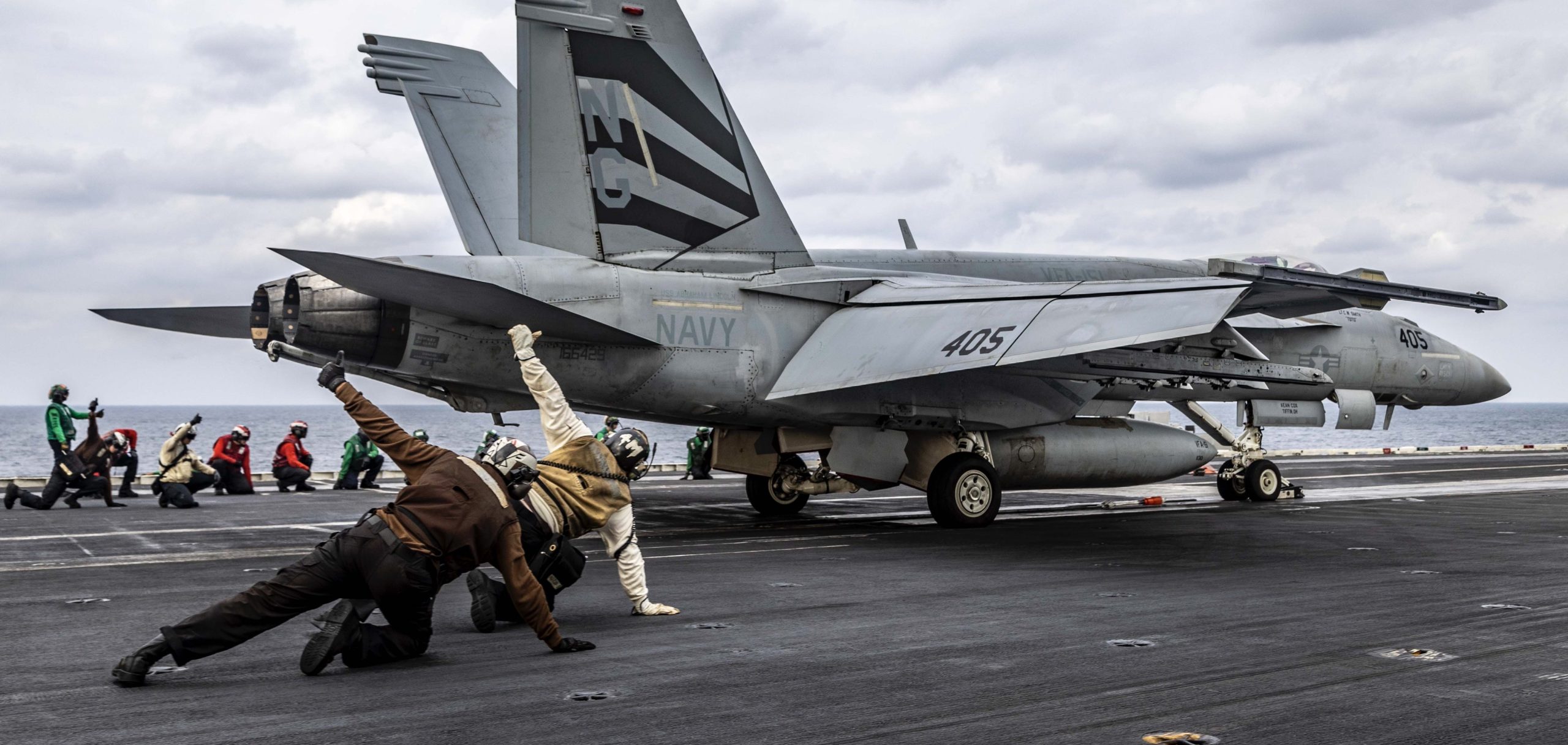
Iran launched live-fire naval exercises in the Strait of Hormuz on Monday in preparation for potential security and military threats in the strategic waterway, according to the country’s state-run IRNA news agency.
The drill, called “Smart Control of the Strait of Hormuz,” was led by the naval forces of the Islamic Revolutionary Guard Corps (IRGC) under the supervision of IRGC Commander in Chief Maj. Gen. Mohammad Pakpour, according to Iran International.
State media said the exercise was organized to assess the readiness of operational units, review security plans and rehearse scenarios for responding to any security and military threats in the area.
The exercises came within hours of renewed diplomatic efforts starting in Geneva between the U.S. and Iran that are aimed at reviving negotiations over Iran’s nuclear program.
“I am in Geneva with real ideas to achieve a fair and equitable deal,” Iranian Foreign Minister Abbas Araghchi wrote on X on Monday “What is not on the table: submission before threats,” he said.
President Donald Trump has ordered a buildup of U.S. military forces in the Middle East and has threatened to strike Iran if its leadership does not agree to a deal on its nuclear program.
On Friday, Trump also offered an endorsement of regime change in Tehran and said it would be the “best thing that could happen” for Iran.
U.S. Central Command, or CENTCOM, went on to show U.S. military presence in the region Monday.
In a post on X, it shared images of EA-18G Growlers from Electronic Attack Squadron 133 and F-35C Lightning IIs from Marine Fighter Attack Squadron 314 preparing for launch from the flight deck of the USS Abraham Lincoln.
“Operating in international waters in the Middle East, the aircraft carrier conducts around-the-clock flight operations in support of regional security,” the post said.
The Pentagon has been building up what Trump has described as an “armada” in the region.
The USS Abraham Lincoln is present flanked by three warships equipped with Tomahawk missiles and is at the center of a broader U.S. naval buildup in the region.
Meanwhile, Tehran said the second round of talks would be held on Tuesday “with the mediation and good offices of Oman.”
Negotiations restarted in Muscat on Feb. 6, after previous talks collapsed when Israel launched an unprecedented bombing campaign against Iran in June that sparked a 12-day war and escalated tensions across the region.
On Monday, U.S. Ambassador to Israel Mike Huckabee said there was “significant and legitimate doubt that the Iranians will ever agree to something that would cause them to lay down any ambitions of nuclear weaponry.”
Trump also told reporters Monday, “I’ll be involved in those talks indirectly, and they’ll be very important, and we’ll see what can happen.”
He added, “I would say they’re bad negotiators because we could have had a deal instead of sending the B2’s to knock out their nuclear potential. I hope they’re going to be more reasonable. They want to make a deal.”
Day 865 — Tuesday, February 17
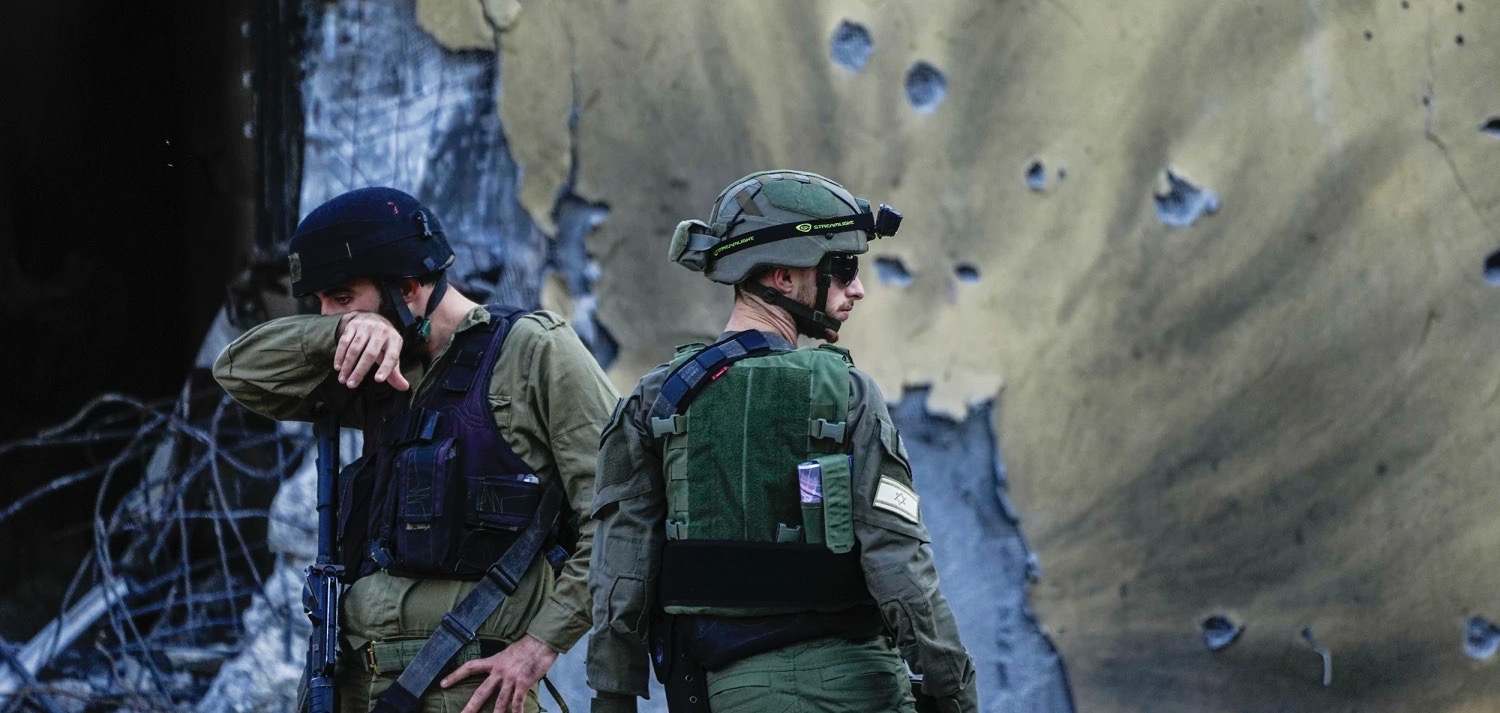
The Hamas terrorist organization used a sequence of emojis as a code name for launching the Oct. 7, 2023, cross-border massacre, the Israel Defense Forces’ Military Censor allowed for publication on Monday.
According to Israel’s Channel 12 broadcaster, the emoticons were found on phones belonging to operatives of Hamas’s elite Nukhba Force that spearheaded the deadliest single-day slaughter of Jews since the Holocaust.
The IDF concluded that the same sequence of emojis had been used ahead of two failed large-scale attacks by the Islamist terrorist group in September 2022 and April 2023, Channel 12 reported.
The emojis signaled to the Nukhba terrorists to switch to Israeli SIM cards ahead of the invasion, according to the Ynet site.
At 2:45 a.m. on Oct. 7, Israeli intelligence noticed that dozens of Israeli SIM cards were activated in Gaza, but the activity was disregarded by the Israel Security Agency (Shin Bet), local media reported last year.
It was not the first such activation. One took place the previous night, on Friday evening at around 9 o’clock. (By Wednesday, Oct. 5, some 45 communication devices of Gaza terrorists had also been activated.)
An intelligence summary by the Shin Bet southern region sent to a group of intelligence and political officials dismissed the activity.
“Today and yesterday, there were SIMs in certain areas of Gaza. This is not unusual, since similar tests were carried out by Hamas last year as well,” the summary reportedly stated.
“According to the division and the command [leadership], Hamas has not changed its routine. The information is preliminary and there are routine activities in Hamas. A discussion on the matter will be held by the [IDF] Southern Command Intelligence Officer at 08:30 and by the Southern Command heads at 10:00,” the Shin Bet added.
The anomaly was detected some three hours and 45 minutes before thousands of Gazan terrorists stormed the security fence and murdered around 1,200 people, wounded thousands of others and took 251 hostages.
Day 864 — Monday, February 16
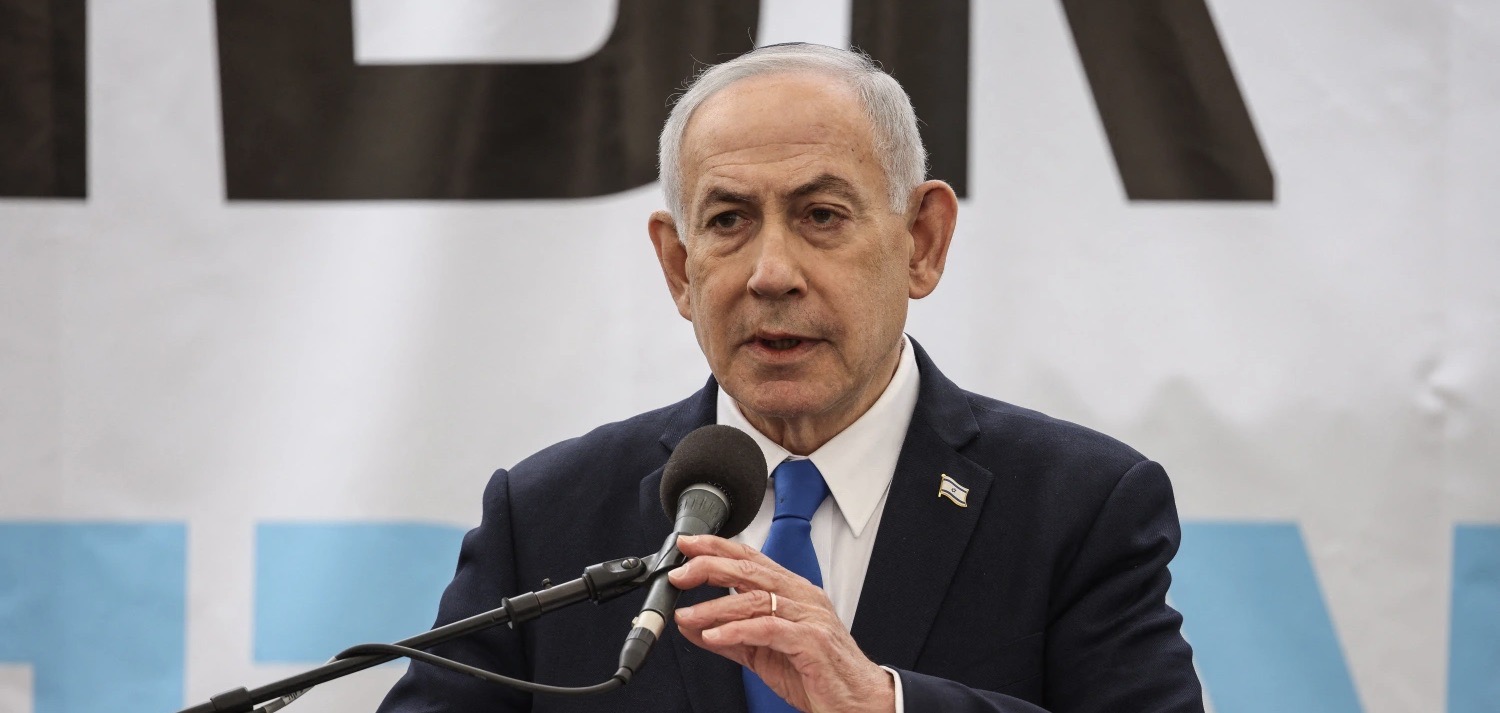
Israeli Prime Minister Benjamin Netanyahu on Sunday reiterated his doubts regarding the possibility of any deal with Iran, which he said must include the dismantling of Iran’s nuclear infrastructure, and not just stopping uranium enrichment.
His comments came ahead of a second round of U.S.-Iranian talks in Geneva, Switzerland, on Tuesday, and amid a major American military buildup in the region which is still underway.
“I will not hide from you that I express my skepticism of any deal with Iran, because, frankly, Iran is reliable on one thing: they lie, and they cheat,” Netanyahu said in a keynote speech to the annual gathering of the Conference of Presidents of Major American Jewish Organizations in Jerusalem.
In his first public address after meeting with U.S. President Donald Trump in Washington last week, the Israeli leader said that any agreement must remove all enriched nuclear material from Iran, dismantle its enrichment infrastructure, curb its ballistic missile program and dismantle the axis of terror that Tehran has built across the region.
“There shall be no enrichment capability—not stopping the enrichment process, but dismantling the equipment and the infrastructure that allows you to enrich in the first place,” he said.
Paraphrasing Ronald Reagan’s “trust but verify” dictum regarding the Soviet Union, he advised Trump: “Distrust. Distrust, and always verify.”
Day 864 — Monday, February 16
Britain’s High Court has used the ECHR to rule against the government’s declaration of a left-wing direct action group that targets defence firms selling equipment to Israel as a terrorist organisation, forcing police to suspend arrests of supporters.
Palestine Action, a group connected to factory-smashing raids and other acts of vandalism has committed acts of terrorism and its methods are “inconsistent with the hallmarks of civil disobedience”, but it hasn’t committed enough acts of terrorism or been terroristic persistently enough to make its designation as a terrorist group a proportionate response, Britain’s High Court ruled on Friday.
Despite the ruling, supporting Palestine Action remains illegal for now as the court said it was suspending changes pending the appeals process, the government having already confirmed it intended to challenge the decision. Nevertheless the police said they had immediately ended arrests of people professing support for Palestine Action. Instead, officers will “gather evidence” until the appeals process is over and a final decision is taken on whether the group was right to be banned or not.
In reaching the verdict, the bench of three senior judges found that “Palestine Action has undertaken activities amounting to terrorism”, but only a “very small number” of their actions qualified, and for those cases it would be more proportionate for the government to prosecute using criminal law. Citing the European Convention on Human Rights (ECHR), the court said the ban breached rights to freedom of speech and freedom of assembly for protesters who passively supported Palestine Action, even if its most dedicated members did engage in terrorism.
The court rejected other grounds, however, and found the original decision to ban Palestine Action by the government wasn’t motivated by racial or national discrimination, as the claimant had asserted.
The British Board of Deputies, which represents British Jews, replied with alarm to the ruling, asserting that Palestine Action had been hostile towards Jewish sites before the ban took force last year. They said in a statement: “We are deeply concerned by today’s High Court decision to find against the Government’s proscription of Palestine Action… Palestine Action has repeatedly targeted buildings hosting Jewish communal institutions, Jewish-owned businesses, or sites associated with Israel, in ways that cause fear and disruption far beyond the immediate protest sites… We will seek urgent clarity from the Government, police forces and the CPS regarding the implications Of this ruling and the steps they intend to take to ensure that communities are protected from intimidation and criminality.”
Brexit pioneer and Reform UK leader Nigel Farage linked the ruling to Britain’s problem with two-tier justice, which according to critics sees separate legal standards applied to groups depending on their racial or political characteristics. He said: “Yet another example of how, in Britain today, if you’re a left-wing group that hates our country, attacks our police officers, and damages our armed forces, you can break the law and get away with it.”
Day 863 — Sunday, February 15

In December, when two gunmen opened fire at a Hanukkah celebration on Sydney’s Bondi Beach, killing 15 people and wounding dozens more, Israel’s message to the global Jewish community was clear.
“Today, Jews are being hunted across the world,” Israel’s Foreign Minister Gideon Sa’ar said in the aftermath of the massacre, calling on Jews in Australia, Britain, France, Canada, and Belgium to “come home” to Israel.
Prime Minister Benjamin Netanyahu echoed the sentiment, urging Western governments to do more to protect Jewish citizens, while framing Israel as the only place where Jews could truly be safe.
Now the government appears to be backing up the words with action.
According to the Hebrew newspaper Makor Rishon, officials have begun advancing an emergency immigration plan called Aliyat HaTekuma, designed to fast-track the immigration process for those coming from countries experiencing a surge in antisemitism.
With a target of absorbing 30,000 new immigrants in 2026, the proposal promises shorter waiting times, financial support, employment placement, and housing assistance in designated cities.
Day 862 — Saturday, February 14

US President Donald Trump was asked on Friday about a potential regime change in Iran and said, “Seems like that could be the best thing that could happen.”
Speaking to reporters upon returning from Fort Bragg, Trump was asked what the people of Iran could do to avoid a US attack and replied, “They give us the deal that they should have given us the first time. If they give us the right deal, we won’t do that. But, you know, historically, they haven’t done that. I will say they want to talk, but so far they do a lot of talking and no action.”
A reporter then asked the President if he would like to see a regime change in Iran and he responded, “Well, it seems like that would be the best thing that could happen. For 47 years, they’ve been talking and talking and talking. In the meantime, we’ve lost a lot of lives while they talk, legs blown off, arms blown off, faces blown off…tt’s been going on for a long time, so let’s see what happens. In the meantime, tremendous power has arrived, and additional power, as you know, and other carriers going out shortly. If we could get it settled for once and for all, that would be good.”
Earlier in the day, Trump was asked by reporters about his decision to deploy the USS Gerald R. Ford aircraft carrier to the Middle East, in addition to the USS Abraham Lincoln which is already in the region.
The aircraft carrier was sent “in case we don’t make a deal, we’ll need it. If we don’t have a deal, we’ll need it. We have one out there that just arrived. If we need it, we have it ready. A big, a very big force,” said Trump.
Asked how confident he is that the negotiations with Iran will be successful, the President replied, “I think they’ll be successful, and if they’re not, it’s going to be a bad day for Iran, very bad.”
Day 861 — Friday, February 13

Palestinian Authority President Mahmoud Abbas ordered the publication of the draft constitution for a Palestinian state earlier this week, the PA’s official news agency WAFA announced.
The full draft of the constitution, read by The Jerusalem Post, omitted Jewish ties to Jerusalem in Article III, claiming it as the “capital of the State of Palestine, and its political, spiritual, cultural, and educational center, as well as its national symbol,” and committed to “preserving its religious character and protecting its Islamic and Christian sanctuaries.”
The same article called on the state to commit to protecting Jerusalem’s “legal, political, and historical status,” and affirmed that “any measures to change its character or historical identity are considered null and void according to international law.”
Additionally, Article IV designated the official religion of a Palestinian state as Islam, with Islamic Sharia principles to be the “primary source for legislation,” while also protecting Christianity as having a special status, with designated rights.
The president must also “swear by God Almighty” when entering office, per Article LXXVI, and Article CXXXII called for Sharia disputes to be handled by Sharia and religious courts.
While Article XXVII called for equality without discrimination based on personal aspects, including religion, and Article XXXVII affirmed “freedom of belief and to practice religious rites, establishing places of worship for followers of monotheistic religions,” there is no mention of Judaism or Jewish people in any article of the constitution.
Further, Article I affirmed Palestine as “part of the Arab homeland,” and notes that the “Palestinian people are part of the Arab nation.”
Meanwhile, Article XI reaffirmed the Palestine Liberation Organization as the “sole legitimate representative of the Palestinian people” – a status it has claimed since its founding by Yasser Arafat.
Article XXIV described how the state would “work to provide protection and care for the families of martyrs, wounded, and prisoners, and those released from the occupation prisons and the victims of genocide.”
This article is drafted into the constitution, appearing to formalize the continuation of the PA’s controversial “pay-for-slay” policy, which provides financial stipends to families of convicted terrorists and terror suspects.
The article also calls to “pursue the perpetrators of these crimes before the judiciary.”
Article XLIV furthered this by calling for the “provision of comprehensive care for the families of the martyrs, wounded, and prisoners, and those released [from prison], in preservation of their national dignity and their humanitarian and living needs.”
Day 861 — Friday, February 13

Colleges and universities in the United States have received over $1.1 billion in funding from Qatar and more than $285 million from Saudi Arabia, according to data for 2025 released by the U.S. Department of Education.
In total, U.S. colleges and universities received $5.2 billion in foreign gifts and contracts in 2025, the Department of Education revealed on Wednesday citing data its new online portal, which went live in early 2025 and was designed to increase transparency regarding foreign funding of U.S. higher education.
The Department of Education documented over 8,300 transactions on the portal, with Qatar topping the list of foreign funding by countries in 2025, with over $1.1 billion, followed by the United Kingdom at $633 million, and China at $528 million. Switzerland ($451 million) and Japan ($374 million) were the next largest donors.
China and Qatar have in recent years drawn scrutiny over claims that they use funding and donations to higher education institutions to influence public perceptions of their countries. Overall, about $67.6 billion in foreign funding to U.S. colleges and universities has been reported since disclosure became legally required in 1986, though much of that funding has been disclosed only since 2019.
When examining the data, Qatar leads the list of nation, having donated $7.7 billion, followed by China with $6.4 billion, Germany with $4.7 billion, England with $4.3 billion, and Saudi Arabia with $4.2 billion.
Linda McMahon, the U.S. secretary of education, said the new portal offers “unprecedented visibility into the foreign dollars flowing into our colleges and universities.”
“Thanks to the Trump administration’s new accountability portal, the American people have unprecedented visibility into the foreign dollars flowing into our colleges and universities – including funding from countries and entities that are involved in activities that threaten America’s national security,” McMahon said in a statement.
“This marks a new era of transparency for the American people and streamlined compliance for colleges and universities, making it easier than ever for institutions to meet their legal obligations.”
McMahon said the new portal is important for both academic integrity and national security.
“This transparency is essential not only to preserving the integrity of academic research but also to ensure the security and resilience of our nation,” she stated.
Cornell University, which saw several anti-Israel protests during the two-year Gaza war, received the largest amount of Qatari funding overall ($2.3 billion), followed by Carnegie Mellon University with $2 billion.
The large amount of funding by Qatar has raised concern among Israel’s supporters, as many of the schools that received the funding also hosted anti-Israel demonstrations over the past two years. The Trump administration even initiated lawsuits against several of the schools, or canceled federal funding.
The Trump administration also initiated lawsuits against several schools and moved to cancel federal funding
In a press statement, the Department of Education said Harvard University has received more funding from entities in “countries of concern” since 1986 than any other institution. Both Harvard University and the University of California, Berkeley are the subject of ongoing federal probes launched after President Trump began his second term, over alleged failures to disclose foreign donations.
Section 117 of the Higher Education Act, which was added in 1986, requires universities that receive federal funding to disclose any funding by a foreign entity, whether gifts or contracts, totaling more than $250,000 per year. The government has previously alleged that universities have not disclosed the full extent of their foreign funding, which is supported by research showing that over the past decade, about100 U.S. colleges and universities failed to disclose approximately $13 billion in undocumented contributions from foreign governments.
Quick Facts
- Since Oct. 7, over 1,600 Israelis (925 soldiers) have been killed, and 6,420 IDF soldiers wounded since the start of the war.
- On Oct. 7, 2023, one day after the 50th anniversary of the Yom Kippur War, thousands of Hamas gunmen invaded southern Israel, brutally murdering 1,200 Israelis and kidnapping 251 to the Gaza Strip.
- On Oct. 8, 2023, the Israel Security Cabinet voted to officially declare war for the first time since the 1973 Yom Kippur War.
- On Oct. 27, 2023, the IDF began its Ground Operation in Northern Gaza
- Between October 7th, 2023, and March 31, 2024, the IDF made approximately 100,000 phone calls, dropped 9.3 million leaflets, sent 15.5 million text messages, and 17 million voice recordings in efforts to get Gazan civilians out of harm’s way during military operations.
- Between October 7th, 2023, and August 18, 2025, Israel has allowed and facilitated the entry of over 1.9 million tons of aid into Gaza.
- On June 13th, 2025, the 12 Day War began between Israel and the Iranian regime. Israel conducted massive airstrikes targeting Iran’s military infrastructure and leadership, weapons stockpiles, and nuclear scientists— the regime rained ballistic missiles down, targeting locations of Israel’s largest civilian populations.
- On June 22, 2025, under the orders of President Trump, B2 Bombers dropped bunker-buster bombs on Iran’s nuclear facilities, thwarting the imminent danger of Iran obtaining nuclear weapons.
- On October 10th, 2025, a fragile ceasefire agreement, brokered by the Trump Administration, came into effect between Israel and Hamas.
- On January 27, 2026, after numerous delays, the body of the last remaining Israeli hostage in the Gaza Strip was returned to Israel.

![]()
YOU CARE ABOUT BIBLICAL TRUTH. SO DO WE.
Together, We Can Deliver A Biblical Understanding Of News Events Around The World.
![]()
YOU CARE ABOUT BIBLICAL TRUTH. SO DO WE.
Together, We Can Deliver A Biblical Understanding Of News Events Around The World.
Day 888 — Thursday, March 12

Benjamin Netanyahu responded to the attack at Temple Israel in West Bloomfield, Michigan, saying it reflects the global threat of antisemitism.
“Antisemitism knows no limits or boundaries,” Netanyahu wrote on X. “Israel is attacked because it is the Jewish state. Temple Israel in Detroit was attacked today because it is a Jewish house of worship.”
Netanyahu also praised the synagogue’s security personnel for stopping the attacker.
“I salute the brave security personnel at the synagogue for their swift action. It saved lives,” he said.
The Israeli leader added that he is grateful to President Donald Trump for taking a firm stance against antisemitic attacks in the United States.
The suspect in Thursday’s attack at Temple Israel in West Bloomfield, Michigan, has been preliminarily identified as Ayman Mohamad Ghazali, according to three law enforcement sources who spoke to Fox News.
U.S. Department of Homeland Security (DHS) confirmed the name to Fox News and provided details of his immigration history.
Officials said Ghazali was born in Lebanon in 1985 and entered the United States on May 10, 2011 on an IR1 immigrant visa as the spouse of a U.S. citizen.
According to DHS, Ghazali applied for naturalization on Oct. 20, 2015 and became a U.S. citizen on Feb. 5, 2016. Authorities say Ghazali lived near Dearborn, Michigan.
Law enforcement officials cautioned the identification remains preliminary as investigators continue confirming the suspect’s identity following the attack.
The FBI said it is investigating the attack at Temple Israel in West Bloomfield, Michigan, as a “targeted act of violence against the Jewish community.”
Jennifer Runyan, special agent in charge of the FBI’s Detroit Field Office, said the bureau has taken the lead in the investigation.
“I can confirm that we are leading the investigation right now as a targeted act of violence against the Jewish community,” Runyan said during the Thursday evening press conference.
Authorities said one suspect was involved and is now deceased, and confirmed no congregants or children were killed in the attack.
Oakland County Sheriff Michael Bouchard said the suspect drove a vehicle into the building, where security personnel engaged and stopped the threat.
Officials said a security guard was injured after being struck by the vehicle, and 30 responding officers were treated for smoke inhalation after the vehicle caught fire inside the building.
Runyan said the FBI deployed more than 100 agents and analysts, along with bomb technicians, SWAT teams and evidence response units to process the scene and pursue leads.
“This is an active and ongoing investigation with an active crime scene,” she said. “We ask for patience as we process the evidence and pursue every lead.”
Day 888 — Thursday, March 12

If Lebanon’s government fails to prevent Hezbollah rocket and drone attacks on Israel, Jerusalem will “take control of the territory and do it ourselves,” Israeli Defense Minister Israel Katz threatened on Thursday.
“The prime minister and I have instructed the Israel Defense Forces to prepare to expand its operations in Lebanon and to restore quiet and security to the northern communities,” the defense minister stated.
“We promised quiet and security to the northern communities, and that is exactly what we will do,” Katz added in a Hebrew-language statement.
Hezbollah overnight on Wednesday launched its largest rocket barrage at the Jewish state since the start of the current war, in what the Iranian Islamic Revolutionary Guard Corps said was a combined assault that also included several volleys of ballistic missiles launched by Iran.
According to the Magen David Adom emergency response group, two people sustained light wounds from “flying objects” during the attacks.
The two—a woman with a head injury and a man with a hand wound—were taken to Galilee Medical Center in Nahariya. In addition, several people were treated for injuries sustained while running for shelter.
Speaking during an operational briefing at IDF Northern Command on Monday morning, Katz said that the decision to advance into Lebanon following Hezbollah’s March 2 decision to join the war on Iran’s behalf was “morally and operationally correct, and enables what comes next.”
“It gives confidence to the communities that what happened will not return,” the minister stated, referencing Jerusalem’s past decision to evacuate northern communities for well over a year in response to Hezbollah’s cross-border attacks that started on Oct. 7, 2023, and paused following a U.S.-brokered ceasefire on Nov. 27, 2024.
This time, he vowed, “There will be no evacuation, no abandonment.”
“Everyone remains on their land, in their home, wherever they are. This is the number one mission—to defend the communities and give them security against raids and against anti-tank fire,” continued Katz.
The evacuation of Southern Lebanon and large parts of Beirut will allow the IDF to “thwart threats we have not yet managed to thwart previously, making this region even safer than before ‘Operation Roaring Lion.‘”
Katz added, “We certainly must not only refrain from withdrawing in the face of Hezbollah, but take advantage of the opportunity to strike it.”
Lebanon’s official government has failed to live up to its commitments under the 2024 ceasefire, which forbade the presence of terrorists in the south and tasked the Lebanese Armed Forces with disarming them.
“They allowed Hezbollah to move south,” Katz charged. “The conclusion is always that what we do not do, no one else will do. They are obligated and they must act, and we must ensure that these things happen.”
Lebanese President Joseph Aoun on Monday accused Hezbollah and Iran of working to “collapse” the Lebanese state and expressed his openness to holding “direct negotiations” with Israel, per AFP.
“Whoever launched those missiles wanted to bring about the collapse of the Lebanese state, plunging it into aggression and chaos … all for the sake of the Iranian regime’s calculations,” he told European officials.
Aoun’s proposal reportedly called for “establishing a full truce” with the Jewish state, “logistical support” for the Lebanese Armed Forces to disarm Hezbollah, and direct talks under international auspices.
Israeli Prime Minister Benjamin Netanyahu had warned Beirut over the weekend that if it fails to uphold the ceasefire deal, the Iranian-backed aggression “will bring catastrophic consequences upon Lebanon.”
“It is time for you, too, to take your destiny into your hands,” he told the Lebanese government, declaring that “in any case,” Jerusalem will do “everything necessary to protect our communities and our citizens.”
Day 888 — Thursday, March 12

Prime Minister Benjamin Netanyahu held his first press conference since the start of the war this evening (Thursday) via video conference.
During the press conference, Netanyahu addressed Hezbollah’s attacks on Israel and stated that the Iranian proxy terror group would “pay a very heavy price.”
“This is no longer the same Iran, this is no longer the same Middle East, and this is also not the same Israel. We initiate and attack with force. Trump and I talk almost every day, exchange ideas and advice, and decide together,” Netanyahu said.
“We are crushing Iran and Hezbollah,” Netanyahu declared, adding, “We are becoming a regional power. Our roar is growing louder. We have achieved enormous achievements that are changing the balance of power beyond the Middle East.”
Regarding the campaign in the north, he said, “Hezbollah feels the comfort of our arm and will pay a very heavy price for its aggression.”
In response to a question about the threat from Lebanon and past statements that Hezbollah was defeated in the previous campaign against it, Netanyahu said: “We talked then about 150,000 rockets and missiles, about the destruction of the towers in Tel Aviv, about the eyes of ruins in the rest of the country, and about 15,000 to 20,000 dead. All of this did not materialize because we dealt them a tremendous blow, but that does not mean that they did not have any residual fire left.”
“Threats come and go, but we are strengthening our power compared to what was here,” the prime minister added. “Tomorrow they will be even weaker – both Iran and Hezbollah. We are changing the Middle East. Both against enemies and against friends. Israel is stronger than ever, the whole world understands that.”
He referred to the appointment of Ali Khamenei’s son as Iran’s supreme leader after his father’s assassination. “We have eliminated the old dictator, and the new dictator, the puppet of the Revolutionary Guards, cannot show his face in public. I say to the people of Iran: The moment is approaching when you can embark on the path of freedom. It is in your hands.”
However, he added that he cannot guarantee “that the Iranian regime will collapse, if we join forces, we will repel the enemies time and time again.”
The Prime Minister promised that “many more surprises are expected in the campaign. We have the upper hand, much more than we expected.”
Day 888 — Thursday, March 12

Hezbollah terrorists overnight on Wednesday launched their largest barrage of missiles and drones at Israel since the start of the current war, in what Tehran’s Islamic Revolutionary Guard Corps (IRGC) said was a combined attack from Lebanon and Iran.
Hezbollah fired approximately 200 projectiles at the Jewish state as part of what it dubbed “Operation Al-‘Asf al-Ma‘kul” (“The Eaten Chaff” or “Devoured Straw”), a Quranic reference that refers to the enemy being utterly defeated or destroyed. Around 120 missiles and drones crossed into Israel, Ynet reported.
According to Israel’s Magen David Adom emergency response organization, two people sustained light injuries when they were struck by “flying objects” during an attack on the north.
The casualties—a woman in her 30s with a head injury and a man in his 50s with a hand wound—were evacuated to Galilee Medical Center in Nahariya, MDA said. In addition, several people were treated for minor injuries sustained while running for shelter.
The Hefer Valley Regional Council, which administers a group of communities along Israel’s central coastal plain, said a rocket from Lebanon directly struck the yard of a home in the area, “severely” damaging the house. No injuries were reported.
Air-raid sirens sounded throughout the night in central Israel, warning of ballistic missiles fired by Iran. The IRGC, in a statement carried by Iran’s state-run Tasnim News Agency, confirmed the attacks were a carried out in cooperation with Hezbollah.
Hezbollah began firing rockets and UAVs at Israel on the morning of March 2, in retaliation for Israel’s targeted killing of Iranian Supreme Leader Ali Khamenei. He was killed in the opening shot of “Operation Roaring Lion/Epic Fury” against the regime on Feb. 28.
In response to the terrorist organization’s violation of the U.S.-brokered Nov. 27, 2024, ceasefire deal, Jerusalem launched an aerial campaign against Hezbollah, and ordered IDF troops to advance and take control of additional areas in Lebanon to halt cross-border fire.
IDF Spokesperson Brig. Gen. Effie Defrin told reporters at a briefing on Tuesday evening that the military was seeing attempts by Hezbollah to “increase its rocket fire toward the communities of the north while expanding the range of its attacks” to central Israel and beyond.
“Hezbollah is suffering heavy blows. We are deepening the damage to its capabilities with each passing day and increasing the pressure on it. The fire it is carrying out in order to harm Israeli civilians is a clear response to this,” said Defrin.
Day 888 — Thursday, March 12

Iranian explosive-laden boats appear to have attacked two fuel tankers in Iraqi waters, setting them ablaze and killing one crew member on Wednesday, after projectiles struck three vessels in Gulf waters, said port, maritime security, and risk firms.
The latest attacks mark an escalation in the conflict between Iran and United States-Israeli forces, raising the number of ships struck in the region since fighting began to at least 16.
Shipping in the Gulf and along the narrow Strait of Hormuz, which carries around a fifth of the world’s oil, has come to a near-standstill since the US and Israel began strikes on Iran on February 28, sending global oil prices surging to highs not seen since 2022.
The ships targeted in late-night armed boat attacks in the Gulf near Iraq were the Marshall Islands-flagged Safesea Vishnu and the Zefyros, which had loaded fuel cargoes in Iraq, two Iraqi port officials said.
“We recovered the body of a foreign crew member from the water,” one port security official said, as Iraqi rescue teams continued searching for other missing seafarers. It was not immediately clear which ship the person was linked to.
Day 888 — Thursday, March 12

President Donald Trump said Wednesday that reports of a potential Iranian revenge plot involving drones launched from offshore targeting California are being investigated.
Speaking to reporters in an Air Force One underwing gaggle, Trump was asked by Fox News White House correspondent Peter Doocy about a law-enforcement bulletin warning of a possible Iranian drone attack scenario.
“It’s being investigated,” Trump said. “You have a lot of things happening, and all we can do is take them as they come.”
Trump also said he had been briefed about potential Iranian sleeper cells inside the United States, claiming authorities are monitoring them closely.
“We know where most of them are,” Trump said. “We’ve got our eyes on all of them.”
The president argued some entered the country during the Biden administration’s immigration policies.
Trump also said the U.S. military campaign against Iran is overwhelming Tehran’s forces.
“Iran is being absolutely decimated,” he said.Trump added that Iranian naval and air capabilities have been largely destroyed and said the U.S. is monitoring the Strait of Hormuz as the conflict continues.“
“We’ve knocked out all of their boats,” he said. “I think we’re in very good shape.”
Day 887 — Wednesday, March 11

The United Nations Security Council, which includes the Arab representative Bahrain, voted 13-0 on Wednesday to condemn Iran for its strikes on its Gulf neighbors. The vote, from which Russia and China abstained, was a highly unusual rebuke of the Islamic Republic by Arab states.
Just before the vote, Mike Waltz, the U.S. ambassador to the global body, told reporters that “the atrocities that we’re seeing, the deliberate attacks on civilian infrastructure, on ports, on airports, on energy production facilities, on hotels, on resorts across the Gulf is unacceptable.”
“It’s disgusting, frankly, and I, for one, am proud to see Bahrain lead its neighbors in condemning these actions,” the U.S. envoy said.
The resolution, which the Gulf Cooperation Council drafted, won support from 135 U.N. member states—a record-high, according to Loraine Sievers, co-author of “The Procedure of the UN Security Council” and former chief of the U.N. Security Council secretariat branch.
During the Security Council meeting, Waltz said that he wanted to be “perfectly clear and polite that there has been some misrepresentation here today.”
“The accusation that this resolution put forward by the Kingdom of Bahrain, supported by every member of the GCC, and I see all of them here today, and supported by 135 countries, the most co-sponsors of a U.N. Security Council resolution ever, was somehow manipulated by one or two countries is laughable,” the U.S. envoy said.
“We urge Iran to hear the voice of the council, of this resolution that saw no opposition today and of the entire international community,” Waltz said. “But more importantly, we urge Iran to listen to its own brave people and stop the indiscriminate attacks on civilians across the Middle East.”
Day 887 — Wednesday, March 11

Assassinating Ayatollah Ali Khamenei and nearly all of Iran’s top military and Islamic Revolutionary Guard Corps officers on the first day of the war was an incredible turning point in which all of the IDF’s air and intelligence power combined to change the course of history, an IDF senior officer told The Jerusalem Post on Wednesday.
“Assassinating the supreme leader and all of the top echelon of the Iranian military and the IRGC in around half a minute was made possible by a giant and incredibly coordinated airstrike, which took months of planning,” the senior officer said.
In 40 seconds at around 8:15 a.m. on February 28, Khamenei, IRGC commander Mohammad Pakpour, military commander Abdolrahim Mousavi, defense minister Amir Nasirzadeh, National Defense Council secretary Ali Shamkhani, another top security aide to Khamenei for over a decade, and about 35 other top officials were killed.
Among the Israeli aircraft involved were F-16s, F-35s, and F-15s, although there were many others, including the US military’s involvement.
According to the IDF, the airpower and munitions used during the first day of attacks – both in those assassinations and in wider attacks on Iran’s air defenses and ballistic-missile apparatus – were unprecedented and far beyond any prior similar power used by Israel.
“With around 200 aircraft all carrying precision munitions and all flying 1,000 to 1,500 kilometers to strike hundreds of targets all in a short time period, the effect was to completely throw the Iranians off their game,” the senior officer said. “The total surprise we achieved was extremely deadly and effective.”
When adding in the contribution and profoundly close cooperation with the US military, some in the IDF view the assault and the current war as the most devastating short-term air war in history. The F-16s were flown back and forth to Iran in the early days of the war, essentially nonstop, and took an enormous part in the most critical missions.
By March 5, almost every aircraft had flown nine to 10 sorties back and forth to Iran, with each flight taking five to eight hours round-trip.
While the pace of the F-16s and other aircraft has remained frenetic, one change was that after the first couple of days, the IAF had achieved air supremacy. That allowed stand-in attacks in which Israeli aerial assets could strike from short range, with some even hovering over their targets.
Day 887 — Wednesday, March 11

Spain permanently withdrew its ambassador to Israel on Wednesday as a diplomatic standoff worsened between the two countries over Spain’s opposition to Israeli policies, exacerbated by the US-Israeli strikes on Iran’s regime.
Ambassador Ana Maria Salomon Perez was recalled to Spain last September amid a diplomatic row over Spanish measures banning aircraft and ships carrying weapons to Israel from its ports or airspace due to the war against Hamas in Gaza, a policy Foreign Minister Gideon Sa’ar denounced as antisemitic.
On Tuesday, Spain published an announcement in its official gazette that the ambassador’s position had been terminated. Spain’s Foreign Ministry said its embassy in Tel Aviv will be led by a charge d’affaires for the foreseeable future.
Israel’s embassy in Spain is also run by a charge d’affaires after Israel in May 2024 recalled its ambassador, Rodica Radian-Gordon, in protest of Spain’s decision to recognize a Palestinian state.
“The Foreign Ministry confirms the withdrawal of the ambassador to Tel Aviv, who was called back for consultations ‘indefinitely,’” Spanish Foreign Ministry sources told The Times of Israel, “leaving the Spanish embassy in Tel Aviv under the leadership of a chargé d’affaires, at the same level as the Israeli embassy in Madrid.”
The move marked the latest escalation in a diplomatic spat between the two countries, which have been heavily strained since the start of the Gaza war, which was triggered by the Hamas-led invasion of southern Israel on October 7, 2023.
Ties between Jerusalem and Madrid steadily deteriorated over the following two years as Spain’s government expressed increasing anger and frustration against Israel over the war in Gaza.
Madrid had prohibited sales and purchases of military equipment with Israel from the start of the war; however, last September, Spanish Prime Minister Pedro Sanchez announced measures to enshrine the prohibition in law. Sa’ar criticized Spain as leading “a hostile, anti-Israel line,” after which Madrid also recalled its ambassador.
Day 887 — Wednesday, March 11

Hezbollah and Iran launched a coordinated strike strategy Tuesday, a national security expert claimed, as reports emerged that deadly cluster munitions were hitting Israel in synchronized attacks.
The developments unfolded on day 11 of Operations Epic Fury and Roaring Lion, the joint U.S.-Israeli campaign targeting Iran, marking a potential escalation in the widening regional conflict.
“Hezbollah has fully joined the war, and it looks like they are now very well coordinated with Iran,” Kobi Michael, a senior researcher at the Institute for National Security Studies and the Misgav Institute, told Fox News Digital while speaking from his bomb shelter near Tel Aviv.
“Most of Hezbollah’s rockets and drones are launched simultaneously with the Iranian missiles,” he said.
Israel confirmed Tuesday that Iran had been firing cluster munitions — adding a complicated and deadly challenge to Israel’s stretched air defenses, The Associated Press reported.
The warheads burst open at high altitudes, scattering dozens of smaller bomblets across a wide area. The smaller bombs, which at night can resemble orange fireballs, are difficult to intercept and have proven lethal.
Fox News correspondent Nate Foy also said despite Israel’s strong air defense, half of the missiles are hard to defend against because half of the missiles are cluster munitions.
“The Iranian use of cluster missiles and the idea that they deliberately target civilians and civil facilities must be considered as a use of non-conventional weapons, and the American-Israeli response must be appropriate,” Michael urged.
Banned by more than 120 nations under the 2008 Convention on Cluster Munitions, the weapons are widely condemned for their broad-area, indiscriminate effects that often result in catastrophic civilian harm.
“Israeli citizens have to spend most of the time in the shelter rooms as Hezbollah and Iran deliberately target civilians and civilian facilities,” he said.
As of Tuesday night local time, the IDF said it had launched a wave of airstrikes against Hezbollah infrastructure in Beirut’s southern suburbs.
This came after the military reiterated its warning to evacuate the area, a Hezbollah stronghold known as the Dahiyeh.
Day 887 — Wednesday, March 11

President Donald Trump warned Iran on Tuesday to remove any naval mines from the Strait of Hormuz as U.S. forces struck Iranian mine-laying vessels near the critical waterway, underscoring how control of the narrow passage has become a central flashpoint in the escalating conflict and a major concern for global oil markets.
Trump said U.S. forces had already destroyed Iranian vessels capable of laying mines in the area, part of an effort to keep the shipping lane open.
“I am pleased to report that within the last few hours, we have hit, and completely destroyed, 10 inactive mine-laying boats and/or ships, with more to follow!” Trump wrote Tuesday afternoon on Truth Social.
The U.S. military later said American forces had destroyed a total of 16 Iranian mine-laying vessels operating near the Strait of Hormuz, Reuters reported.
The strikes came as the Trump administration warned Iran that any attempt to block oil shipments through the strategic channel would bring an overwhelming military response.
Day 887 — Wednesday, March 11

Two Jewish men were beaten, and later briefly hospitalized, after they were heard speaking Hebrew in front of a restaurant in San Jose’s Santana Row in California, local media reported on Tuesday.
Footage of the incident, shot by local witnesses, shows the pair of victims attacked by three other individuals outside the Augustine restaurant, NBC Bay Area reported.
“I just turned around, and they literally started punching,” one of the victims, who wished not to be identified, told the outlet. “We got swarmed very badly. I’m in a lot of pain. I still cannot chew. My jaw hurts, my back is hurting.”
According to NBC, the victims said they did not recognize their assailants, and police are investigating the incident as a possible hate crime.
According to ABC7 News, both Jewish men were waiting to be seated at the restaurant when the incident occurred.
“One of the witnesses said that they heard them saying, ‘don’t mess with Iran‘, which we don’t know why,” one of the victims told the outlet. “We don’t have any problem with them. But, I heard at the beginning of the fight, something with, ‘F the Jews’.”
ABC7 added that one of the victims had been knocked out and needed stitches after the assault.
In a statement, the Bay Area Jewish Community Relations Council identified the pair of victims as Israeli Americans.
Day 887 — Wednesday, March 11

Sen. Ted Cruz (R-Texas) sounded the alarm on Tuesday about the rise of antisemitism in the Republican Party and the American right, warning that the tide may be turning against supporters of Jews and Israel.
Speaking to a symposium on Jew-hatred hosted by the Republican Jewish Coalition and National Review, the Texas senator cited the difference in reaction among elected Republicans to former Fox News host and current podcaster Tucker Carlson, who turned sharply against Israel and its supporters in recent years, compared to neo-Nazi influencer Nick Fuentes.
“I believe Tucker Carlson is the single most dangerous demagogue in this country,” Cruz said. “If you look at Republican politicians, Nick Fuentes is easy to denounce, and I actually think it’s a tell among the Republican politicians if they’ll denounce Fuentes but are scared to say Tucker’s name. That tells you a great deal.”
“Virtually every single one of my colleagues in the Senate on the Republican side agrees with me,” Cruz said. “Yet almost none of them will say Tucker’s name.”
Carlson hosted Fuentes on his video podcast for a friendly interview with the Holocaust denier in October.
Speaking to an audience of about 200 RJC and National Review members, administration officials, Hill staffers and Jewish leaders at the Museum of the Bible in Washington, Cruz warned that the anti-Israel and antisemitic politics of figures like Fuentes and Carlson are having a malign influence on young conservatives.
“The Christian church is asleep,” Cruz said. “I have seen more antisemitism in the last 18 months on the right than at any point in my lifetime. A year-and-a-half ago, I could not have imagined we would be here having this conversation.”
“I’m not sure it is accurate as a descriptive matter that we are winning right now,” the senator said, of philosemitic conservatives. “We’re winning with folks in this room with some gray or salt-and-pepper in their hair, but in the college classroom I’m a lot less certain.”
Cruz noted that the model of success for opponents of Israel that has flourished on the Democratic left could be replicated in the Republican Party.
“I don’t want to wake up in five years and find myself in a country where both major political parties are unambiguously anti-Israel and unapologetically antisemitic,” he said.
Cruz’s keynote speech drew the loudest applause among speakers that included fellow Sens. Tom Cotton (R-Ark.) and Jim Banks (R-Ind.) and administration officials, including Leo Terrell, chair of the Department of Justice taskforce to combat antisemitism, and Yehuda Kaploun, a rabbi and U.S. special envoy to monitor and combat antisemitism.
Cotton and Cruz both pushed back against claims from some on the right that U.S. military action against Iran primarily benefits and was at the behest of Israel.
“Before this war started, Iran had thousands and thousands of missiles, and this vast missile arsenal far, far exceeded the combined missile defenses of the United States, Israel and our Arab friends,” Cotton said. “That is an unacceptable threat to the United States.”
“If it’s an unacceptable threat to the United States, it’s an existential threat to Israel,” Cotton added.
“We are not bombing Iran for Israel,” Cruz said. “We are bombing Iran for America.”
Day 886 — Tuesday, March 10

President Donald Trump warned Iran against placing mines in the Strait of Hormuz, saying U.S. forces had destroyed 10 inactive Iranian vessels used to install the explosive devices.
In a post on Truth Social, Trump said Tehran needs to remove any mines in the waterway immediately.
“If for any reason mines were placed, and they are not removed forthwith, the Military consequences to Iran will be at a level never seen before,” he wrote. “If, on the other hand, they remove what may have been placed, it will be a giant step in the right direction!”
Additionally, Trump said U.S. forces were using the technology and missile capabilities deployed against drug traffickers “to permanently eliminate any boat or ship attempting to mine the Hormuz Strait. They will be dealt with quickly and violently. BEWARE!”
In a follow-up post, Trump said U.S. forces had destroyed10 inactive mine laying boats or ships, “with more to follow.”
War Secretary Pete Hegseth said U.S forces have been wiping out the mines with “ruthless precision.”
“We will not allow terrorists to hold the Strait of Hormuz hostage,” he said on X. “To the weakened Iranian regime: you have officially been put on notice!”
Day 886 — Tuesday, March 10

Toronto police have released more information about an early morning shooting at the U.S. Consulate in Toronto that Prime Minister Mark Carney called “a reprehensible act of violence and attempt at intimidation.” They have also put out an image of a suspect vehicle.
Speaking to the media outside the consulate Tuesday morning, RCMP Chief Supt. Chris Leather, who is overseeing the investigation, said he is treating the event as “a national security incident.”
Leather noted that, “for the moment, while the early stages of the investigation are taking place, we have increased security around embassies and consulate buildings here in Toronto and in the Ottawa region.”
He said the U.S. and Israeli consulates topped that list, adding: “I think it’s fairly obvious, based on the incidents that have occurred here in Toronto and elsewhere that these consulates deserve a heightened amount of vigilance and security at this time.”
Leather said, “There will be no tolerance for any form of intimidation, harassment or harmful targeting of any communities or individuals in Canada,” though he added: “There is no indication of an immediate threat to public safety at this time.”
Police responded to a call at 5:29 a.m. Tuesday concerning a firearm being discharged in front of the building on University Avenue at about 4:30 a.m.
They noted that a white Honda CR-V was seen travelling westbound on Dundas Street West before turning southbound onto University Avenue and stopping in front of the Consulate. At that point, they said, two males exited the vehicle and fired multiple rounds at the building.
The suspects then re-entered the vehicle and drove southbound on University. When officers arrived, they found damage to the glass and door of the building, as well as shell casings at the scene. People were inside the building at the time, but no injuries have been reported.
Penny Collenette, a lawyer, adjunct professor at the University of Ottawa and recent Order of Canada recipient, posted news of the consulate attack, adding: “And gunshots fired at two synagogues the night before. Warnings?”
Day 886 — Tuesday, March 10

About half of the roughly 300 ballistic missiles Iran has launched at Israel in the current war carried cluster bomb warheads, according to Israel Defense Forces assessments published Tuesday, a day after the munitions killed two people and seriously wounded another in central Israel.
The data comes as Iran continues to fire missiles at Israel. On Tuesday, most of the missiles were intercepted, but one — carrying a large warhead — exploded in an open area outside Beit Shemesh, near Jerusalem, according to footage and first responders. No injuries were reported.
Cluster bomb warheads indiscriminately spread dozens of submunitions, each with several kilograms of explosives, over a radius of around 10 kilometers (6 miles).
The interception of such missiles has been effective but challenging, military officials said, stressing that Israel’s air defenses are not hermetic.
Use of the munitions is banned under the 2008 Convention on Cluster Munitions, whose over 100 signatories include much of Europe and Africa as well as the UK, Australia and Canada, but not Israel, Iran or the US.
Day 886 — Tuesday, March 10

Iran will face much stronger U.S. military strikes if it closes the Strait of Hormuz to oil tankers, President Donald Trump said Monday.
In a post shared on Truth Social, Trump also said he prayed that it would never happen.
“If Iran does anything that stops the flow of Oil within the Strait of Hormuz, they will be hit by the United States of America TWENTY TIMES HARDER than they have been hit thus far,” Trump said.
“Additionally, we will take out easily destroyable targets that will make it virtually impossible for Iran to ever be built back, as a Nation, again — Death, Fire, and Fury will reign upon them — But I hope, and pray, that it does not happen!” he said.
“This is a gift from the United States of America to China, and all of those Nations that heavily use the Hormuz Strait,” he said before adding that hopefully, it is a “gesture that will be greatly appreciated.”
Day 886 — Tuesday, March 10

U.S. intelligence officials have intercepted encrypted communications believed to have originated in Iran that could serve as an “operational trigger” for sleeper cells operating abroad, according to a federal alert issued to law enforcement agencies.
The alert, reviewed by ABC News, references “preliminary signals analysis” of a transmission described as “likely of Iranian origin” that was sent to multiple countries shortly after the death of Iran’s supreme leader, Ayatollah Ali Khamenei.
Khamenei was killed Feb. 28 during a joint U.S.-Israeli strike.
Officials say the intercepted transmission was encoded and appeared to be intended for “clandestine recipients” who possess the encryption key.
Messages of that type are usually used to pass instructions to “covert operatives or sleeper assets” without relying on the internet or cellular communications.
According to the alert, it is possible the signals could “be intended to activate or provide instructions to prepositioned sleeper assets operating outside the originating country.”
“While the exact contents of these transmissions cannot currently be determined, the sudden appearance of a new station with international rebroadcast characteristics warrants heightened situational awareness,” the alert said.
Authorities emphasized that the alert does not identify a specific threat location. It states there is “no operational threat tied to a specific location,” but urges law enforcement agencies to increase monitoring of suspicious radio-frequency activity.
If confirmed, the communications could reinforce concerns raised by law enforcement officials following the U.S. and Israeli strikes on Iran that sleeper cells positioned throughout Western countries could be used in retaliatory attacks.
Day 886 — Tuesday, March 10
צה”ל תקף מפקדות של ארגון הטרור חיזבאללה במרחב הכפר ממנו בוצעו שיגורים לעבר שטח הארץ
במהלך הלילה, צה”ל תקף במרחב הכפר אנצר שבדרום לבנון מפקדות ותשתיות טרור של ארגון הטרור חיזבאללה, בתגובה לירי הרקטי שביצע אתמול (ב’) ארגון הטרור חיזבאללה לעבר שטח מדינת ישראל ממרחב הכפר.
שעות… pic.twitter.com/arlv4xJEGn
— צבא ההגנה לישראל (@idfonline) March 10, 2026
The IDF says it struck Hezbollah command centers and other infrastructure in the southern Lebanon town of Ansar overnight, from which the terror group launched rockets at Israel.
After the rocket fire last night, and ahead of the strikes, the IDF issued an evacuation warning for residents of the town.
“The Hezbollah terror organization embeds terror infrastructure in civilian areas, thereby endangering the residents of Lebanon. The placement of launchers and firing from civilian areas in Lebanon constitutes a cynical exploitation of Lebanese residents to advance Hezbollah’s terror objectives,” the army says.
Day 885 — Monday, March 9

One Israeli was killed, and almost a dozen were wounded in Iranian ballistic missile attacks across Israel on Monday, according to the Magen David Adom rescue service.
In recent days, Iran has begun using cluster warheads on some of its ballistic missiles. While the cluster munitions do not have the same explosive power as the larger warheads used previously, they scatter damage over a broader area, and can present a greater threat as many of the clusters split before they can be shot down by air defenses.
The cluster munitions hit at least six sites in central Israel, according to reports in Israeli media, including Yehud, Holon, Or Yehuda, and Bat Yam.
In Yehud, a construction worker was killed and another critically wounded by one of the cluster munitions. A third man was injured in the community of Or Yehuda.
Emergency medical services were forced to declare the death of one of the construction workers after resuscitation efforts failed. According to Channel 12 News, the men were part of a Chinese construction crew working in the area.
The death on Monday is the 11th victim of Iranian missile attacks on Israel since the start of the war on Feb. 28.
In recent days, videos on social media showed Israeli overseers demonstrating proper evacuation procedures upon hearing the air raid sirens to groups of Chinese workers. Israeli companies have increasingly hired Chinese or other eastern Asian construction crews following the Oct. 7, 2023, Hamas invasion of Israel.
Previously, many of the companies employed Palestinian workers from the Palestinian territories, however, their entry into Israel has seen stringent new limits since the start of the war.
Magen David Adom paramedic Liz Goral recounted, “Immediately after the sirens, we received reports at MDA about several scenes in central Israel and were dispatched to search them all.”
“One of the scenes in central Israel was at a construction site. It was a difficult scene. The two casualties were lying unconscious and suffering from severe shrapnel injuries to their bodies,” she said. “After performing resuscitation efforts, we had to pronounce the death of a man, approximately 40-years-old, and we evacuated the second casualty in serious condition by Mobile Intensive Care Unit to the hospital.”
Earlier in the day, a woman in Rishon LeZion was wounded by rocks that were thrown into the air after cluster munitions hit outside her home. She was not inside her bomb shelter at the time of the attack.
Home Front Command chief Maj.-Gen. Shai Klapper called on Israelis to obey the warnings and instructions from the military, after it was revealed that all the casualties from the Iranian missile strikes came as the victims were outside of bomb shelters at the time of the strikes.
Speaking outside one of the apartments hit in the cluster munitions attack, Klapper praised the Israeli public for its “steadfastness and resilience,” while urging them to “follow the Home Front Command’s instructions.”
He noted that the family in that particular apartment was safe because they had entered the bomb shelter.
Day 885 — Monday, March 9

U.S. Secretary of State Marco Rubio said on Monday that Iran’s attacks on neighboring countries in the region demonstrate the threat that the Islamic Republic poses to global stability.
Speaking at a flag-raising ceremony for U.S. Hostage and Wrongful Detainee Day, the secretary said that Iran is “trying to hold the world hostage.”
“They are attacking neighboring countries, their energy infrastructure, their civilian population. They’re attacking embassies,” Rubio said. “The objective of this mission is to destroy their ability to continue to do that, and we are well on our way to achieving that objective.”
Iran has launched thousands of missiles and drones at countries around the Middle East since the United States and Israel began combat operations on Feb. 28.
Much of that effort has been directed against the United Arab Emirates and other energy producers around the Persian Gulf as part of an apparent Iranian attempt to spike global oil prices.
The two most commonly used oil commodity benchmarks traded at just under $100 a barrel on Monday, up from around $65 a month ago.
Rubio said that the U.S. military is degrading Iran’s ability to carry out those attacks.
“Every single day, this regime in Iran has less missiles, less launchers, their factories work less, and their navy is being eviscerated,” he said. “The world is going to be a safer and a better place when this mission is accomplished.”
Rubio also highlighted Iran’s history of taking American citizens hostage, going back to the 1979 seizure of the U.S. embassy in Tehran.
“We have to make sure that Americans are no longer viewed as targets of opportunity around the world, and nation-states and terroristic regimes like the one in Iran know that there are consequences for doing that,” the secretary said. “We have to end that cycle.”
Day 885 — Monday, March 9

President Isaac Herzog today (Monday) held a Zoom call with leaders of the Canadian Jewish community after a series of antisemitic shooting attacks on synagogues, Jewish institutions, and businesses in the Greater Toronto Area. President Herzog expressed his shock and dismay at the latest incidents of antisemitism in Canada, following the steep rise in incidents of Jew-hatred in the country since October 7th, 2023.
President Isaac Herzog stated: “I am deeply alarmed by the shocking rise of antisemitism in Canada ever since the October 7th massacre. This most recent series of shooting attacks on synagogues and Jewish communal institutions in the Greater Toronto Area targeted our sisters and brothers in the Jewish Diaspora while Iranian missiles continue to target our people here in Israel. The lessons of previous antisemitic attacks in countries around the world, including the deadly Bondi Beach terror attack in Sydney, must be learned. All eyes are on Canada to halt this unprecedented wave of Jew-hatred.”
“On behalf of the State of Israel, I send a message of resilience, strength, and solidarity to the Jewish community of Toronto. The Jewish people are all one family – in times of joy and in times of difficulty. We in Israel care for every Jew anywhere in the world. We stand together and will prevail over all the forces of evil seeking to harm us,” Herzog said.
Day 885 — Monday, March 9

Mojtaba Khamenei, 56, was named the new “supreme leader” of the Islamic Republic, replacing his father Ali Khamenei, whom the U.S. and Israeli militaries killed, Iranian state television reported on Sunday.
The speaker of the Iranian Parliament stated that the selection of the new leader was “definitive and precise” and that the new leader was a “soothing balm,” according to state media.
The speaker added that the new leader was “faithful, revolutionary, courageous and prudent.”
The U.S. government sanctioned Mojtaba Khamenei in 2019. The U.S. Treasury Department said that the time that “the second son of the supreme leader is designated today for representing the supreme leader in an official capacity despite never being elected or appointed to a government position aside from work in the office of his father.”
“The supreme leader has delegated a part of his leadership responsibilities to Mojtaba Khamenei, who worked closely with the commander of the Islamic Revolutionary Guard Corps-Qods Force and also the Basij Resistance Force to advance his father’s destabilizing regional ambitions and oppressive domestic objectives,” the federal government said.
Trump told Axios last week that “Khamenei’s son is unacceptable to me. We want someone that will bring harmony and peace to Iran.”
“They are wasting their time. Khamenei’s son is a lightweight,” he told the publication. “I have to be involved in the appointment.”
Day 885 — Monday, March 9

Argentina has issued a new arrest warrant for an Iranian official in connection with the 1994 AMIA Jewish community center bombing in Buenos Aires, at the same time that the alleged mastermind was named the new head of Iran’s Islamic Revolutionary Guard Corps.
Ahmad Vahidi was appointed head of the IRGC on Sunday, a day after the unit’s previous leader was killed in the first wave of US-Israeli strikes. Vahidi helmed the IRGC’s Quds Force paramilitary arm responsible for attacks abroad at the time of the AMIA bombing.
Argentinians see poetry in the first strikes, which killed Iran’s supreme leader, Ayatollah Ali Khamenei, and dozens of his deputies as they met in Tehran. The street where they were meeting was named for Louis Pasteur – the same name as the street in Buenos Aires where the AMIA Jewish community organization is located.
Eighty-five people, including children, were killed in the 1994 AMIA bombing. Hezbollah, the Iranian proxy in Lebanon, was quickly identified as having executed the attack, and an arrest warrant for Vahidi was first issued in 2006.
But efforts at accountability faltered for years. A Jewish prosecutor who accused the Argentine president of covering up Iran’s role in exchange for trade benefits, Alberto Nisman, was shot to death in 2015.
Since 2023, when a pro-Israel president was elected, the Argentine government has reinvigorated the investigation and prosecution efforts, as well reopened an inquiry into Nisman’s death, now considered a homicide. A landmark legal ruling in 2024 officially declared that Iran and Hezbollah were responsible for the bombing, setting the state for potential international legal action.
Day 885 — Monday, March 9

The IDF has increased its operations against Hezbollah since the Iranian proxy joined the fighting about a week ago.
Since that time, units from the Northern Command have struck more than 600 targets across Lebanon from the air, sea and land, using more than 820 rounds of munitions, the military said on Sunday.
Additionally, more than 190 terrorists were eliminated in the strikes, including terrorist Abu Hamza Rami, the commander of the Lebanese General Staff, equivalent in rank to a major general, two commanders equivalent in rank to a colonel, and three battalion commanders in the terrorist organization. In addition, 27 waves of strikes have been carried out around Beirut, five of which were in the Dahiyeh district.
The military said that throughout the operations, “The IDF has maintained a commitment to precision and mitigation of civilian harm by issuing evacuation warnings for areas near Hezbollah infrastructure, particularly in Dahiyeh, while employing precise munitions, advanced intelligence and aerial surveillance to focus attacks exclusively on terrorist targets.”
The operation against Hezbollah in southern Lebanon has resulted in the first IDF casualties since the beginning of Operation Roaring Lion.
Day 885 — Monday, March 9

The Iran-backed Houthi terrorist movement has yet to enter the conflict on Iran’s side but in recent days has been ratcheting up its rhetoric in support of Tehran, with its leader, Abdul Malik al-Houthi, declaring that it was prepared to enter the war against the U.S. and Israel if necessary.
“Regarding military escalation and action, our fingers are on the trigger, ready to respond at any moment should developments warrant it,” al-Houthi said on Thursday.
“The reason why the Houthis have not intervened is they are last line of resistance for the axis. Especially after other axis members were degraded,” Nadwa Al-Dawsari, an expert on Yemen and an associate fellow at the Middle East Institute, told Fox News Digital.
The official slogan of the Houthi movement (Ansar Allah) reads, “Allah is Greater. Death to America. Death to Israel. Curse on the Jews. Victory to Islam.”
Day 884 — Sunday, March 8

After reports of an Israeli airstrike in a Beirut hotel killing at least four, the IDF says it carried out a targeted strike on key commanders of Iran’s Revolutionary Guards.
It says the targets were members of the Lebanon Corps of the Quds Force, the IRGC’s extraterritorial arm, who “acted to advance terror plans against the State of Israel and its citizens from Lebanese territory.”
The army adds: “The Iranian terror regime systematically operates among civilian populations in both Iran and Lebanon, cynically exploiting residents and using them as human shields to further terrorist objectives.”
It says it took various steps to minimize the risk to civilians, including the use of precision weaponry and aerial surveillance.
Lebanese officials say the strike killed at least four people. An AFP photographer at the bombed seafront hotel saw shattered windows and heavy damage to one room while security forces sealed off the area.
Ten people were also injured in the attack on Beirut’s Raouche area, the Lebanese health ministry says in a statement.
Day 884 — Sunday, March 8

The USS George H.W. Bush (CVN 77) is expected to deploy to the eastern Mediterranean, Fox News reported on Saturday, joining the USS Abraham Lincoln and USS Gerald R. Ford as the third US Navy aircraft carrier active in the region.
The Bush recently completed the Composite Training Unit Exercise (COMPTUEX), which “brings together all elements of a carrier strike group to operate as a cohesive, multi-domain fighting force,” according to the US Navy.
Like the Lincoln, the Bush is a Nimitz-class supercarrier.
In early February, the Wall Street Journal reported that the Bush could have been deployed to join the Lincoln in the Middle East. However, the Ford was chosen to be sent instead.
On Thursday, the Ford carrier strike group, officially known as Carrier Strike Group 12, crossed the Suez Canal after docking in Haifa and is now positioned in the Red Sea, reportedly prepared to attack or defend should the Houthis attempt to join the ongoing war with Iran.
It entered the Mediterranean after transiting the Strait of Gibraltar, a movement reported by multiple outlets tracking US naval deployments.
General Dan Caine on Wednesday asserted at the Pentagon that the Ford has continued to launch bombers and project combat power in the Gulf, and that the Lincoln Strike Group has pressured Iran from the southeast and attrited the regime’s naval capabilities.
Day 884 — Sunday, March 8
President Donald Trump on Saturday slammed British Prime Minister Keir Starmer, saying he was joining the war in Iran after the U.S. has “already won.”
“The United Kingdom, our once Great Ally, maybe the Greatest of them all, is finally giving serious thought to sending two aircraft carriers to the Middle East,” Trump wrote on Truth Social. “That’s OK, Prime Minister Starmer, we don’t need them any longer — But we will remember. We don’t need people that join Wars after we’ve already won!”
Trump’s statement came after the U.K. Ministry of Defense said that one of the country’s two aircraft carriers had been placed on advanced readiness in Portsmouth, England, for a possible mobilization to the Middle East, according to the BBC.
A British destroyer, HMS Dragon, is also in Portsmouth, waiting to leave for Cyprus after delays.
Starmer said that while the U.K. wasn’t involved in the strikes, it is “operating defensively in the region.”
In an address to the British people Sunday, Starmer condemned “indiscriminate” attacks by Iran after the U.S. strikes, adding, “The only way to stop the threat is to destroy the missiles at source.”
He added that Britain has agreed to the United States’ request to use British bases for that “limited” purpose.
After the strikes, Trump told the Telegraph in the U.K. he was “very disappointed” in Starmer, claiming it “took far too long” for the prime minister to allow the U.S. to use British bases in the region.
British fighter jets are also flying over Jordan, Cyprus and Qatar to strengthen defense in the region, and a Merlin helicopter is on the way for additional airborne surveillance, according to the Ministry of Defense.
“While the region has been plunged into chaos, my focus is providing calm, levelheaded leadership in the national interest,” Starmer said this week. “That means deploying our military and diplomatic strength to protect our people.
“And it means having the strength to stand firm by our values and our principles, no matter the pressure to do otherwise. The longstanding British position is that the best way forward for the regime and world is a negotiated settlement with Iran where they give up their nuclear ambitions.”
He said that’s why he decided the U.K. would not join the initial coordinated strikes launched by the U.S. and Israel Feb. 28.
In Parliament this week, Starmer added, “We all remember the mistakes of Iraq, and we have learned those lessons. Any U.K. actions must always have a lawful basis, and a viable, thought-through plan,” Starmer said. “This government does not believe in regime change from the skies.”
Former British Prime Minister Liz Truss reposted Trump’s Saturday Truth Social comments on X, writing, “Justified and damning.”
Day 883 — Saturday, March 7

Israeli diplomats and officials have often brought poster boards as props to the United Nations, including images of the attacks on Oct. 7 and a bomb illustration to show Iranian enrichment. Danny Danon, the Israeli ambassador to the global body, brought an actual engine and wing from an Iranian Shahed-136 attack drone to a press conference on Thursday.
“Let me make it clear. This is what we are facing,” he said, as he removed a white drape from a mechanical object with wires and a black drape from atop a drone wing.
“This is the engine and the wing of an Iranian Shahed-136 attack drone acquired by the watchdog United Against Nuclear Iran,” he told reporters. “Not a prop. Not a toy. A weapon.”
“Look at the wing,” he added. “Built to travel thousands of miles across borders. It can reach cities in Israel, in Europe and in a few months, even the U.S., carrying more than 100 pounds of explosives. Now imagine it aimed at your house, at your living room, at your child’s bedroom.”
“This is the terror that we are facing,” he said.
Speaking outside the U.N. Security Council chamber, the Israeli envoy added that “Iran has struck more Arab countries than Israel has in its entire existence.”
He named eight countries. “This is a regime going down and trying to set the entire region on fire as it falls,” Danon said.
Touting the successes of the U.S.-Israeli military operation so far, the envoy warned that “this effort is far from over.”
“I think diplomacy will come into action. Not yet,” he said. “We have to dismantle the machine of terror that they built for so many years. It will not last forever. It will not be months. It will be weeks or days, but we need to continue.”
As the Islamic Republic attacks more countries and draws them into the conflict directly or indirectly, Danon denounced his counterpart from Tehran for attempting to convince reporters that the Iranian regime is only targeting military assets.
“That is not just inaccurate. It is a deliberate lie,” he said, noting that Iran has hit airports, hotels and other civilian sites across the region.
“That is indiscriminate aggression,” he said.
Danon praised the Lebanese government for “very strong, bold statements” against the Iran-backed Hezbollah terror group that still controls points of the southern part of the country and which joined its patron earlier this week in the fight against Israel by firing off rockets to the south.
“But they have to take action against Hezbollah,” Danon said of the Lebanese government.
“I think our message is very clear,” he said. “We will find the operatives of Hezbollah and the Iranian regime representatives in Lebanon, and we will eliminate them.”
Day 883 — Saturday, March 7

UN Secretary-General Antonio Guterres on Friday appeared to criticize the Israeli and US strikes on Iran, prompting a response from Israel’s former Ambassador to the UN, Gilad Erdan, who branded the UN chief “irrelevant”.
“All the unlawful attacks in the Middle East and beyond are causing tremendous suffering and harm to civilians throughout the region – and pose a grave a risk to the global economy, particularly to the most vulnerable people,” wrote Guterres in a post on social media, without specifically naming Israel or the US.
He warned, “The situation could spiral beyond anyone’s control. It is time to stop the fighting and get to serious diplomatic negotiations. The stakes could not be higher.”
Erdan wrote in response, “Antonio, you are the most irrelevant person on earth. Go home. You and your corrupt and ineffective organization, the UN, have become a collaborator of dictators and terrorists. Shame on you!”
He added, “We all pray that President Trump and the leaders of the free world would soon defund completely the UN and dismantle it. Then you can go and spend your time with your friends the Ayatollahs.”
Guterres, already known for his anti-Israel bias, has increased his criticism of Israel since the October 7, 2023 massacre carried out by the Hamas terrorist organization in southern Israel.
Several weeks after October 7, the UN Secretary-General said that the attack on Israel “did not happen in a vacuum” and appeared to blame Israel for the attack.
After his remarks were widely condemned, the UN chief claimed his comments were misinterpreted and that he had indeed condemned Hamas.
In October of 2024, then-Foreign Minister Israel Katz – now Defense Minister – announced that Guterres had been barred from entering Israel.
Day 883 — Saturday, March 7

Iran’s president says that a demand by the United States for an unconditional surrender is a “dream that they should to take to their grave.”
President Masoud Pezeshkian makes the statement in a prerecorded address aired by state television.
The comments came as intense Iranian fire targeted the Gulf Arab states as Israel and the United States kept up their airstrikes targeting the Islamic Republic.
There were repeated attacks on Bahrain, Saudi Arabia and the United Arab Emirates.
Day 882 — Friday, March 6

The Israel Defense Forces (IDF) on Friday announced that it had dismantled former Iranian Supreme Leader Ayatollah Ali Khamenei’s underground bunker in Tehran.
“The underground compound was created by the regime as a base for advancing military activities and its extremist ideologies against the State of Israel and the Western world,” the IDF said. “It spanned multiple streets in the heart of Tehran and contained numerous entrances and meeting rooms for senior members of the Iranian terrorist regime.”
Israel later released an illustrated video which showed a number of entry points throughout Tehran with tunnels leading to the underground bunker.
The fortified compound was directly under where Khamenei and other regime leaders were situated on Saturday morning when almost 50 of them were killed in under 50 seconds during the launch of Operation Epic Fury, a senior Israeli official told Fox News.
The official said that Khamenei spent millions of dollars and a number of years building the bunker, which he did not use on the morning of the strike. Sources familiar with the intelligence say that Khamenei believed no one had the guts to strike him.
The senior Israeli official told Fox News that Khamenei’s confidence was partially thanks to an Israeli-American deception plan that included messaging, signals and public statements by President Donald Trump that suggested nothing immediate was coming. Top IDF commanders even went home on Friday night, hours before the strike, in an attempt to deceive Iranian leadership.
Khamenei was killed on the first day of Operation Epic Fury after ruling the Islamic Republic for more than 30 years. During that time, he oversaw harsh internal crackdowns, including the most recent one in January, which targeted Iranian protesters, as well as international confrontations.
Day 882 — Friday, March 6

U.S. President Donald Trump said that Tucker Carlson, the former Fox News host who regularly shares antisemitic conspiracy theories, is “not MAGA,” following Carlson’s sharp criticisms of the administration’s military strikes on Iran.
“Tucker has lost his way,” Trump told chief Washington correspondent Jonathan Karl, of ABC News, in a March 5 interview. “I knew that a long time ago, and he’s not MAGA.”
MAGA refers to the president’s Make America Great Again movement.
“MAGA is saving our country. MAGA is making our country great again. MAGA is America first, and Tucker is none of those things,” Trump said. “Tucker is really not smart enough to understand that.”
Carlson has publicly condemned the joint U.S. and Israeli strikes against Iran as “absolutely disgusting and evil” and warned the conflict could reshape Trump’s political movement.
He has also drawn criticism for unfounded claims linking the Chabad‑Lubavitch movement to the war, which Jewish leaders have rejected as baseless and inflammatory.
Responding to the president’s comments, Carlson told Status that “there are times I get annoyed with Trump, right now definitely included. But I’ll always love him no matter what he says about me.”
Supporters of Trump’s position have applauded the president’s remarks.
The Republican Jewish Coalition praised Trump for distancing himself from Carlson’s rhetoric. Leo Terrell, chair of the U.S. Department of Justice’s task force to fight Jew-hatred, stated that “if you are with Tucker, you are not with President Trump.”
Day 882 — Friday, March 6

Amid the ongoing Israeli and US strikes against the Iranian regime, some officers in the Islamic regime’s armed forces have abandoned their barracks, leaving behind the soldiers under their command to remain on guard duty, a number of conscripts told Iranian opposition outlet Iran International.
The soldiers who spoke with the outlet reported that since the killing of former supreme leader Ayatollah Ali Khamenei on Saturday, confusion has erupted within the Iranian military.
Several soldiers stationed at a military base in Lorestan province told Iran International that they were uncertain about the command structure and were uneasy about the deteriorating security situation.
One soldier told the outlet that many commanders had, fearing strikes, abandoned their posts, leaving conscripted soldiers behind without support.
Some soldiers, also fearing American and Israeli strikes, have been spending nights in open areas outside of the base for fear of being hit in an airstrike, the soldier said, adding that leadership was not paying adequate attention to the needs of the regular troops.
The Iran International report comes as the US and Israel have vowed an escalation in the campaign against Iran’s regime.
On Sunday, Prime Minister Benjamin Netanyahu vowed that Israel would intensify its attacks against Iran in the coming days. On Friday, the Israel Air Force launched its 15th wave of strikes on Iranian targets in Tehran and Isfahan.
During its strikes in the country, the IDF said it had hit over 400 targets, including a “senior Iranian terror regime commander in Tehran.”
US President Donald Trump has also said on Friday that he would only accept unconditional surrender from the Islamic Republic after saying on Thursday that “We want to fight now more than they do.”
Day 882 — Friday, March 6
US-Israel Blitz On Iran Described As One Of The Most Coordinated Allied Operations In Modern Warfare

A massive joint air campaign by the United States and Israel is dismantling Iran’s missile network in what officials and analysts describe as one of the most coordinated allied operations in modern warfare.
Secretary of War Pete Hegseth said the campaign is rapidly establishing dominance over Iranian skies.
“Starting last night and to be completed in a few days … the two most powerful air forces in the world will have complete control of Iranian skies,” Hegseth said Wednesday. “Uncontested airspace.”
“We will fly all day, all night … flying over Tehran, flying over Iran, flying over their capital… Iranian leaders are looking up and seeing only U.S. and Israeli air power every minute of every day until we decide it’s over.”
Israel Defense Forces spokesperson Brig. Gen. Effie Defrin told Fox News Digital in an exclusive interview Tuesday that “the cooperation between us and the American military is amazing. We have mutual planning and mutual executing for the plans in Iran and beyond.”
John Spencer, executive director of the Urban Warfare Institute, told Fox News Digital Israel effectively matched the U.S. military’s opening airpower surge.
“Israel matched the United States in the number of aircraft in the air,” Spencer said. “For Israel, that represents roughly 80% of its air force capability.”
He added that the level of coordination between Washington and Jerusalem represents a new model for allied warfare.
“This isn’t separate work,” Spencer said. “This is combined work. Integrated, synchronized operations combining powers.”
“In the past, we’ve had coalitions of dozens of countries,” Spencer said. “But having a partner that is both willing and capable of bringing immense capabilities like this is very rare.”
The Israeli campaign, known as Operation Roaring Lion, began with roughly 200 fighter jets launching the largest coordinated air operation in the history of the Israeli air force.
Within the first 24 hours of the campaign, Israeli fighter jets had already opened a corridor allowing sustained operations over Tehran, according to the Israeli military.
Israeli aircraft struck missile launch sites and air defense systems across western and central Iran in an opening wave targeting hundreds of sites simultaneously using intelligence gathered by Israel’s Intelligence Directorate and the CIA.
In the joint operation, Israeli aircraft dropped hundreds of munitions on approximately 500 targets, including missile launchers, command centers and air defense batteries.
The opening strike achieved a level of surprise rarely seen in modern warfare, according to Israeli intelligence chief Maj. Gen. Shlomi Binder.
“In 40 seconds, we eliminated more than 40 of the most important people in Iran,” Binder said, referring to senior regime and military officials, including Iran Supreme Leader Ali Khamenei. “We are sending a clear message to our enemies — there is no place where we will not find them.”
Spencer said the strategy behind the opening strike represents a dramatic shift in modern warfare.
“What Israel did in this opening campaign just wasn’t imaginable in the history of war. It never happened,” he said. “To start off by cutting off the brain… usually you target the military first. Here they targeted the political and military leadership and had the ability to wipe them out in a matter of hours.”
Spencer, a veteran of the 2003 Iraq War, said the operation reflects advances in intelligence and strike capabilities.
“I was part of the invasion in 2003,” he said. “Something like this was unthinkable even 20 years ago.”
Day 882 — Friday, March 6

Azerbaijan on Thursday warned it could retaliate against Tehran after Iran fired two drones at its northern neighbor, wounding two people.
Azerbaijan summoned the Iranian envoy after the strikes hit an airport and near a school.
Iran has not acknowledged targeting Azerbaijan, but its retaliatory attacks have spread erratically to include regional countries and beyond amid an intense joint US-Israeli air campaign that began over the weekend.
The attacks around midday involved at least two drones that crossed from Iran into Azerbaijan’s exclave of Nakhichevan, which borders Iran and is separated from mainland Azerbaijan by Armenia, said a foreign ministry statement.
“One drone fell on the terminal building of Nakhichevan Airport, while another drone fell near a school building in the village of Shekerabad,” the ministry said, damaging the airport and wounding two civilians.
A source close to the Azerbaijani government told Reuters a fire had started as a result of the incident.
Video footage shared by the source showed black smoke rising near the airport and damage to the skylight inside the terminal building.
The ministry said it had summoned the Iranian envoy in Baku to express “strong protest” over the attack, which “contradicts the norms and principles of international law and contributes to rising tensions in the region.
“Azerbaijan reserves the right to take appropriate retaliatory measures,” it added.
Day 882 — Friday, March 6

British police arrested four people on suspicion of Iran-related spying on Friday, in relation to an investigation into surveillance of locations linked to Jewish communities.
According to the Metropolitan Police, the men, one Iranian and three dual British/Iranian nationals, were arrested last in a pre-planned operation.
“Today’s arrests are part of a long-running investigation and part of our ongoing work to disrupt malign activity where we suspect it,” Commander Helen Flanagan, Head of Counter Terrorism Policing London, said.
“We understand the public may be concerned, in particular the Jewish community, and as always, I would ask them to remain vigilant and if they see or hear anything that concerns them, then to contact us.”
Six other men have been arrested on suspicion of assisting an offender, Police said.
Day 881 — Thursday, March 5

The Israel Defense Forces on Thursday issued an “urgent” warning for some residents of Beirut’s southern suburbs—a stronghold of the Iran-backed Hezbollah terror group—to immediately evacuate their homes.
Col. Avichay Adraee, from the Arab Media Branch in the Israeli military’s Spokesperson’s Unit, ordered residents of Beirut’s Bourj el-Barajneh, Hadath, Haret Hreik and Shiyyah areas to leave and “save your lives.”
The four neighborhoods have a combined total of upward of 75,000 residents, according to official data. However, local reports suggested that as many as 500,000 people could be affected by the evacuation, as the suburbs have large unregistered populations, including refugees.
“We will notify you when it is safe to return to your homes,” tweeted Adraee, noting that they are forbidden from heading south, as “any movement southward may put your lives in danger.”
On Wednesday, the IDF ordered all civilians in Southern Lebanon to move north of the Litani River.
“The activities of the Hezbollah terrorist organization are forcing the Israel Defense Forces to act against it with force. The IDF does not intend to harm you,” wrote Adraee in a notice posted to X.
The spokesperson stressed that any Lebanese civilians “near Hezbollah members, facilities or combat equipment are putting their lives at risk.”
“Any home used by Hezbollah for military purposes may be subject to targeting,” he said. “Any movement southward may endanger your life.”
Hezbollah began firing missiles at northern Israel on Monday morning in retaliation for the targeted elimination in Tehran of Iranian Supreme Leader Ali Khamenei. He was killed by an Israeli strike targeting his Tehran compound in the first moments of “Operation Roaring Lion.”
Hezbollah continued to fire rockets and send explosive drones toward the Jewish state on Thursday, setting off waves of sirens but causing no major casualties as Israeli air defenses and shelters limited the impact.
Under the U.S.-brokered truce between Israel and Lebanon that went into effect on Nov. 27, 2024, Beirut pledged to disarm the Iran-backed terrorist organization that has long controlled the country’s south.
On Thursday, Lebanon’s government announced new steps aimed at curbing the influence of Tehran’s Islamic Revolutionary Guard Corps.
Beirut’s Cabinet ordered that any activity by the IRGC in Lebanon be halted, in addition to fully implementing the previous government decision to disarm Hezbollah, the MTV Lebanon outlet reported.
IRGC operatives will be detained, Reuters cited Lebanese Information Minister Paul Morcos as announcing. In addition, the Saudi-based Al Arabiya network reported that the Cabinet decided that Iranian nationals would no longer be granted visa-free entry to Lebanon.
Day 881 — Thursday, March 5

US President Donald Trump said Thursday that he needs to be “involved” in selecting Iran’s next leader, days after Israeli strikes killed the country’s longtime supreme leader, Ayatollah Ali Khamenei.
The statement was a clear indication that the US intends to have a hand in the shaping of the country’s future leadership, amid shifting signals over whether the US-Israeli campaign is seeking regime change. Trump likened his planned involvement to US influence over Venezuela’s government after Trump ordered the seizure of its president, Nicolas Maduro, earlier this year.
At the same time, Trump brushed off reports in recent days that Mojtaba Khamenei, the late supreme leader’s son, has been tapped as a frontrunner.
“They are wasting their time. Khamenei’s son is a lightweight,” Trump told Axios in a phone interview, adding later, “Khamenei’s son is unacceptable to me. We want someone that will bring harmony and peace to Iran.”
Trump said, “I have to be involved in the appointment, like with Delcy [Rodriguez] in Venezuela,” who is currently leading that country.
In a separate interview with Politico, Trump said of the elder and younger Khamenei: “The reason the father wouldn’t give it to the son is they say he’s incompetent.”
He also told Politico, “I’m going to have a big impact [over Iran’s future leadership], or they’re not going to have any settlement, because we’re not going to have to go do this again.”
“We’ll work with the people and the regime to make sure that somebody gets there that can nicely build Iran but without nuclear weapons,” he told Politico.
Trump had said on Wednesday that Reza Pahlavi, the son of the former shah, who is trying to position himself as a leader should Iran’s Shiite theocracy fall, is not someone that his administration has considered in depth to take over leadership in Iran.
“It would seem to me that somebody from within, maybe, would be more appropriate,” Trump said in comments to the press at the White House, adding that it may make sense for “somebody that’s there, that’s currently popular, if there is such a person” to emerge from the power vacuum.
Day 881 — Thursday, March 5

Iran has attacked 12 countries so far since Operation Epic Fury was unleashed by the U.S. and Israel, CENTCOM Commander Admiral Brad Cooper said in a Pentagon briefing Thursday.
His comments came as the military operation entered its seventh day.
“What I will point out is this is now the 12th country, that Iran has attacked 12 countries,” Cooper told reporters.
“And it goes right back to the secretary’s point. Those 12 countries are none too happy,” he said
“And I look forward to working with all the partners who are willing to join us in this.”
Ahead of Cooper’s comments, Secretary of War Pete Hegseth had described how Iran had been targeting allied countries and “pulling them into the U.S. orbit.”
“What Iran is doing by targeting allied countries that would otherwise want to stay out of this, they’ve actually pulled them into the American orbit,” Hegseth explained.
“So now you’ve got UAE and Qatar and Bahrain and Saudi and Kuwait and others saying, hey, we’re with you. Here’s we’ll shoot with you, we’ll fly with you, we’ll defend with you.”
“It’s actually firming up the unity of the resistance in order to focus exactly where we need to,” he said.
Hegseth’s and Cooper’s remarks followed a meeting with top CENTCOM commanders on Operation Epic Fury.
Day 881 — Thursday, March 5

Iranian state television aired a message Thursday from an ayatollah in Iran calling for the “shedding” of blood from Israelis and US President Donald Trump, as the Islamic Republic continued to threaten revenge and repercussions for the war being waged against it by the US and Israel.
The message from Ayatollah Abdollah Javadi Amoli represented one of the few clerical statements coming from Iran as it faces a combined airstrike campaign from the two countries.
He called for “the shedding of Zionist blood, the shedding of Trump’s blood.”
“The imam of the time says, ‘Fight the oppressive America, his blood is on my shoulders,’” the ayatollah added.
Meanwhile, Iran’s Islamic Revolutionary Guards said on Thursday that they had hit a US tanker in the northern part of the Gulf and the vessel was on fire. There was no confirmation from the US. The Guards said in the statement carried by state media that, in time of war, passage through the Strait of Hormuz will be under the control of the Islamic Republic.
Iran’s Foreign Minister Abbas Araghchi said earlier that Washington “will bitterly regret the precedent it has set” in its torpedo attack on the Iranian frigate Dena in international waters on Wednesday, which sank the ship and apparently led to the deaths of most of the crew.
Araghchi said the strike occurred without warning and called it “an atrocity.”
Day 881 — Thursday, March 5

The pace of Hezbollah rockets and drones being launched on Israel has jumped dramatically since Monday, even as the rate of Iranian ballistic missiles dropped significantly from Saturday-Sunday to the rest of the week, the IDF Home Front Command said on Thursday.
According to the IDF, northern residents spent most of the night in their safe rooms and bomb shelters because of consistent fire.
If on Monday, Hezbollah’s attack on Israel was symbolic, it appears that in response to Jerusalem’s much heavier crackdown on hundreds of attacks on Hezbollah, the terror group has now gone all-in on its attacks against Israel.
IDF sources said that it was even possible that this trend could continue with Iranian ballistic missiles dropping off even further, but the threat from Hezbollah expanding,
The IDF refused to share exact numbers due to the developing security situation.
However, at its height in fall 2024, Hezbollah was launching around 100-250 rockets or drones against Israel per day, and the IDF said that even the spike in threats on Wednesday had not approached those numbers, suggesting aerial threats of more in the dozens per day.
Day 881 — Thursday, March 5

The Israel Defense Forces carried out a large-scale airstrike on an Iranian military compound in eastern Tehran on Wednesday. The compound housed the headquarters of all of the regime’s security organizations, according to the military.
Targeted command centers linked to Iran’s security apparatus included headquarters belonging to the Islamic Revolutionary Guard Corps, the Quds Force, the Basij paramilitary volunteer militia, the Intelligence Directorate, Internal Security forces and the regime’s cyber warfare unit, according to the statement.
According to the IDF, Iranian operatives overseeing operations against Israel and suppressing domestic protests were present at the site. The military said the attack was part of its ongoing effort to “degrade the Iranian terror regime in Tehran.”
Meanwhile, Israeli and U.S. forces continued to jointly attack Iranian targets on Thursday as the IDF announced in the morning that it had begun a “large-scale wave of strikes against infrastructure of the Iranian terror regime across Tehran.”
Day 881 — Thursday, March 5

The US tested a doomsday ballistic missile off the California coast Tuesday night — as war raged in the Middle East.
The Minuteman III ballistic missile — which is capable of carrying nuclear warheads 20 times more powerful than the atomic bomb dropped on Hiroshima — launched from Vandenberg Space Force Base near Santa Barbara at 11 p.m.
The unarmed rocket, known as GT 254, hit its intended target near the Marshall Islands in the west-central Pacific Ocean, according to the US Space Force.
The missile was fired to “verify the effectiveness, readiness and accuracy,” according to the Air Force Global Strike Command.
“[It] allowed us to assess the performance of individual components of the missile system,”Lt. Col. Karrie Wray, commander of the 576th Flight Test Squadron said in a press release.
“By continually assessing varying mission profiles, we are able to enhance the performance of the entire [Intercontinental Ballistic Missile] fleet, ensuring the maximum level of readiness for the land-based leg of the nation’s nuclear triad.”
The test launch comes just days after the US and Israel launched an attack on Iran, killing the nation’s supreme leader, Ayatollah Ali Khamenei, at his compound in Tehran — setting off a war in the region.
President Trump later vowed to step up strikes on Iran, warning, “The big one is coming.”
The Air Force Global Strike Command said Tuesday’s test-launch was routine and scheduled years in advance.
The Minuteman III missile is one part of America’s nuclear triad, which include the ability to launch [nuclear] weapons from the land, sea and air.
The missiles are stored in silos scattered across the American west, ensuring that the US will be able to strike back if it is ever hit with an atomic attack.
A Minuteman III missile was also launched in November after President Trump called for restarting the nuclear weapons tests.
The missile can travel 6,000 miles at speeds of more than 15,000 mph and strike anywhere in the world.
Day 880 — Wednesday, March 4

A U.S. submarine sank a prized Iranian warship by torpedo, the first such sinking of an enemy ship since World War II, Secretary of War Pete Hegseth said Wednesday morning.
Hegseth joined Chairman of the Joint Chiefs of Staff Gen. Dan Caine at the Pentagon to provide an update to reporters on “Operation Epic Fury” in Iran.
“An American submarine sunk an Iranian warship that thought it was safe in international waters,” Hegseth said. “Instead, it was sunk by a torpedo. Quiet death. The first sinking of an enemy ship by a torpedo since World War Two. Like in that war, back when we were still the War Department. We are fighting to win.”
Caine said that an Iranian vessel was “effectively neutralized” in a Navy “fast attack” using a single Mark 48 torpedo. He added that the U.S. Navy achieved “immediate effect, sending the warship to the bottom of the sea.”
The Iranian ship was later identified as the IRIS Dena, a frigate, which was sunk in the Indian Ocean.
In a separate incident, Hegseth said that the U.S. Navy sank another Iranian warship, the Soleimani. The flagship was named for Qasem Soleimani, an Iranian military officer who served in the Islamic Revolutionary Guard Corps who the U.S. killed in a January 2020 drone strike during President Donald Trump’s first term.
“The Iranian Navy rests at the bottom of the Persian Gulf. Combat ineffective, decimated, destroyed, defeated. Pick your adjective,” Hegseth said. “In fact, last night we sunk their prize ship, the Soleimani. Looks like POTUS got him twice. Their navy, not a factor. Pick your adjective. It is no more.”
Officials later said the Soleimani, a corvette class missile ship, was sunk in the Strait of Hormuz near Iranian shores.
Hegseth also told reporters at the briefing that the U.S. and Israel will soon achieve “complete control” over Iranian airspace after Iran’s missile capabilities were drastically diminished in the four days of fighting.
“More bombers and more fighters are arriving just today and now, with complete control of the skies, we will be using 500 pound, one thousand pound and 2,000 pound laser-guided precision gravity bombs, of which we have a nearly unlimited stockpile,” he said.
Day 880 — Wednesday, March 4

In a major victory for the Trump administration, the Senate rejected a War Powers Resolution that sought to curb President Donald Trump’s authority to continue military operations against Iran. This means that Trump retains full operational control over Operation Epic Fury without needing immediate congressional approval.
The measure, led by Senator Tim Kaine (D-Va.), sought to mandate congressional approval for continued military action against Iran. Nonetheless, it fell short in a 48-52 vote.
Although the resolution saw nearly unanimous Democrat support during Wednesday’s vote, Senator John Fetterman (D-Pa.) broke ranks to join Republicans in backing the president’s strikes as “necessary.”
Despite Rand Paul (R-Ky.) crossing the aisle to vote with Democrats, the resolution still failed to clear the 51-vote hurdle in the Republican-led Senate.
Attention now shifts to the House, where a bipartisan companion resolution sponsored by Representatives Ro Khanna (D-Calif.) and Thomas Massie (R-Ky.) is slated for a vote on Thursday.
Despite its bipartisan roots, the measure faces an uphill battle in the Republican-controlled lower chamber, where leadership remains largely in lockstep with the Trump administration’s strategy for Operation Epic Fury.
Day 880 — Wednesday, March 4

NATO Secretary-General Mark Rutte told Newsmax on Wednesday there is “widespread support” among alliance members for President Donald Trump’s campaign targeting Iran’s nuclear and missile capabilities, even as some European leaders have voiced public criticism of the operation.
“NATO is not involved,” Rutte told “The Record With Greta Van Susteren.“ “But obviously allies are basically, on a massive scale, supportive of what the president is doing and are also enabling what the U.S. is doing now in the region, taking out this nuclear capability of Iran and, of course, the missile capability.”
Rutte said European allies have strong security concerns about Tehran, pointing to threats and assassination plots tied to the Iranian regime.
“Here in Europe, we know the impact of Iran and the negative impact they can have,” he said. “Look at the assassination attempts in many NATO countries here in Europe, the Iranian diaspora. My own country [the Netherlands] being under constant threat from the regime in Tehran.”
Despite criticism from some leaders, including French President Emmanuel Macron and Spanish Prime Minister Pedro Sanchez, Rutte said NATO countries are providing “key enabling assistance” to the U.S.-Israeli campaign against Iran.
He also emphasized that NATO forces remain prepared to defend alliance territory as tensions escalate in the region.
“What we are doing at the moment as NATO is making sure that we, in a 360-degree way, defend every inch of NATO territory,” Rutte said.
He pointed to a recent incident involving a missile threat toward Turkey, a NATO member and part of the alliance’s collective defense system.
“You saw that this morning when news came in of a missile which was heading for Turkey and potentially impacting on U.S. interests in Turkey, taken out by NATO anti-missile systems,” he said. “So, this is working. We are vigilant.”
Rutte also addressed questions about NATO’s mutual defense clause, known as Article 5, which states that an attack on one member is considered an attack on all.
“For good reasons, we always will stay very ambiguous about when Article 5 is triggered,” Rutte said. “We keep it very ambiguous because we don’t want to make our enemies, our adversaries, any wiser.”
He added that if Article 5 were invoked, the alliance would make that clear immediately. Until then, he said the ambiguity is intentional, designed to force adversaries to think carefully about the risks of attacking NATO interests.
“Our supreme allied commander, our senior military, but also, of course, all our men and women in uniform, we make sure that we can defend and will defend every inch of territory of NATO,” Rutte said. “And in the meantime, we are very much with our friends and partners in the Middle East because we see these indiscriminate attacks against the UAE, against Bahrain, against Oman, against Saudi Arabia, against Kuwait, against other countries in the region. And we are very much with them.
“I‘m in constant contact with them because we want to make sure that whatever we can do for them to stay safe, we will help them with.”
Day 880 — Wednesday, March 4

Seventy-two retired U.S. generals and admirals signed a Jewish Institute for National Security of America letter supporting the U.S. and Israeli strikes against the Iranian regime over the weekend.
“They wanted to both express what they see as the need for these operations, the need to address the Iranian threat, their confidence in that partnership and communicate that to the American people through this letter,” Blaise Misztal, vice president for policy at JINSA, told JNS.
In the letter, the retired military leaders state that the Iranian regime, whose slogan is “death to America, death to Israel,” has “committed to endangering the lives of U.S. troops, diplomats and civilians across the Middle East and here at home.”
“Hundreds of Americans have lost their lives at the hands of the Islamic Republic and its terrorist proxies,” according to the letter. “Leaders in Tehran openly state their ambitions to spill American blood, evict the United States from the Middle East, eliminate Israel and dominate a region that remains vital to global stability.”
The largest state sponsor of terrorism, Iran has also worked with American enemies, like Russia and China. Despite being offered “every offramp possible,” the Islamic Republic has continued to seek nuclear weapons.
“The regime’s brutal crackdown on protestors showed the entire world just what it is willing to do to keep its people, and the region, under its thumb,” the retired military leaders write.
Misztal told JNS that JINSA, which is celebrating its 50th anniversary, has run an annual program for more than four decades that brings retired U.S. generals and admirals to Israel. JINSA has developed “long-lasting relationships” with participants who are aware of the uniqueness of the U.S.-Israeli alliance, according to Misztal.
Many of those retired officers have served in the Middle East in the past 20 years and seen Iran kill Americans, including 600 U.S. service members in the Iraq War and continuing attacks on U.S. military bases throughout the region, according to Misztal.
The retired military leaders write in the letter that it’s up to the Iranian people to bring the regime down in the end, which, to Misztal, reflects how this conflict differs from the “war on terror” in which the officers fought.
“It’s not a regime-change war, where the United States is the one that was going to topple this regime,” he said. “It’s not a nation-building war, where the United States is going to be committed for decades to keeping troops in Iran and propping up whatever comes next.”
“It’s a recognition that we’re there to eliminate a threat and that we’re hopeful that the Iranian people, who have shown both their bravery in standing up to this regime but also their love of freedom and desire for something better to replace it, will seize the opportunity,” he added. “ Understanding that that’s not necessarily going to be our role to give them that opportunity going forward.”
Day 880 — Wednesday, March 4

The U.S. military killed an Iranian leader who led an attempted assassination plot against President Donald Trump, War Secretary Pete Hegseth revealed on Wednesday.
“We’ve known for a long time that Iran had intentions on trying to kill President Trump and/or other U.S. officials,” Hegseth told reporters in the Pentagon’s briefing room in an update on Operation Epic Fury. “And while that was not the focus of the effort by any stretch of the imagination, in fact, never raised by the president or anybody else, I ensured, and others ensured, that those who were responsible for that were eventually part of the target list.”
While not specifying who the target was, the secretary said that “Iran tried to kill President Trump and President Trump got the last laugh.”
Federal investigators believed that there was an Iranian plot to assassinate Trump during his 2024 presidential campaign, Breitbart News reported.
Trump highlighted the foiled scheme on Sunday when talking about the joint U.S.-Israeli operation that eliminated Supreme Leader Ayatollah Ali Khamenei, telling ABC News, “I got him before he got me.”
Hegseth also reported that the U.S. will soon “have complete control” of Iranian skies, praising the last four days of Operation Epic Fury as “incredible and “historic.”
“I stand before you today with one unmistakable message about Operation Eric Fury — America is winning decisively, devastatingly, and without mercy. They are toast, and they know it,” the secretary announced.
Joint Chiefs of Staff Chairman Dan Caine also spoke at the press conference, announcing that the Pentagon has “hit over 2,000 targets” in Iran to date.
Day 880 — Wednesday, March 4

An Israeli stealth fighter jet has shot down a manned Iranian aircraft in a major show of force as the Islamic Republic continues to be blitzed five days into “Operation Epic Fury.”
The F-35I fighter jet known as “Adir,” which translates to “Mighty One” in Hebrew,” clashed with the Iranian Air Force YAK-130 over Tehran, Israeli military officials confirmed Wednesday.
It marked the first shootdown of a manned F-35I “Aidr” fighter jet in history, according to the Israeli Defense Forces.
The last time an Israeli fighter jet struck down another aircraft in manned air-to-air combat was on Nov. 24, 1985, during the “War of the Camps” in Lebanon, when an IAF F-15 downed two Syrian MiG-23 fighters, the Times of Israel reported.
Israel earlier confirmed that “broad-scale” strikes were underway in Tehran, and other cities are also being bombarded as part of the Israeli and US joint operation.
The Israeli military targeted sites linked to the Basij – an Iranian paramilitary unit – and pummeled command centers by dropping dozens of munitions.
Israeli forces are reportedly prepared for a military campaign that last weeks, but it’s unlikely there will be boots on the ground.
Day 880 — Wednesday, March 4

The IDF targeted a building in which Tehran’s 88-member Assembly of Experts was meeting to choose Iran’s next supreme leader, Israeli sources told The Jerusalem Post on Tuesday.
Iranian news agencies reported that the building was “flattened” during the Israeli strikes.
Earlier on Tuesday, Iran’s ISNA news agency cited a member of the Assembly of Experts as saying that choosing the successor to the previous supreme leader, Ayatollah Ali Khamenei, “won’t take long.”
Khamenei and many top Iranian military and intelligence officials were killed early on Saturday after Israel began Operation Roaring Lion.
As of Monday night, the IDF has dropped over 2,500 bombs on the Islamic Republic and attacked over 600 targets.
The IAF struck a leadership complex in Tehran overnight, with approximately 100 fighter jets dropping over 250 bombs on the complex.
According to the IDF, the complex contained the President’s headquarters, the headquarters of Iran’s Supreme National Security Council, a meeting compound used by the Islamic Republic’s senior forum, and a headquarters for training Iranian military officers.
Day 880 — Wednesday, March 4

The U.S. military has destroyed 17 Iranian ships, including a submarine, and struck nearly 2,000 targets in Iran in the opening phase of President Donald Trump’s campaign against Tehran.
The tally came from U.S. Central Command Cmdr. Brad Cooper, Reuters reported.
Cooper said in a video posted to X that Iranian naval operations have effectively been halted across the region’s most critical waterways.
“Today, there is not a single Iranian ship underway in the Arabian Gulf, Strait of Hormuz, or Gulf of Oman,” Cooper said in the video.
The figures underscore the scale of the U.S. offensive ordered by Trump, which administration officials have framed as a direct effort to dismantle the regime’s ability to threaten Americans, Israel and U.S. partners across the Middle East.
CENTCOM has said publicly that the operation is targeting Iranian command-and-control nodes, air defenses, missile and drone launch infrastructure and other military facilities tied to attacks on U.S. forces and allies.
Stars and Stripes reported that U.S. forces used a wide mix of aircraft, ships, missiles and drones in the opening days of the operation and had already surpassed 1,000 strikes early in the campaign as the target list expanded.
President Trump has argued the pace and breadth of the strikes have crippled Tehran’s ability to fight, saying Iran’s military has effectively been “knocked out” and that key systems including its navy, air force, radar network and air defenses have been neutralized, according to reporting by Time.
Military Times and Axios also reported that Trump said U.S. forces destroyed nine Iranian naval ships and that Iran’s naval headquarters had been “largely destroyed,” as he pointed to the naval campaign as evidence the regime is rapidly losing its ability to project power in the region.
The White House has offered no precise timeline for how long the fighting will continue, and administration officials have generally kept their public guidance broad beyond saying the campaign will continue until threats to the United States and its allies are neutralized.
Day 879 — Tuesday, March 3

The IDF destroyed a secret Iranian nuclear weapons development site on Tuesday, IDF Chief Spokesman Brig.-Gen. Effie Defrin revealed in a press conference. Separately, the IDF stated that, since the start of the war, the air force had destroyed some 300 Iranian missile launchers.
Naming the site as Min Zadai, on the northeast outskirts of Tehran, Defrin said that the site was linked to weapons development. He said that IDF intelligence followed nuclear scientists who tried to travel there clandestinely.
By following these scientists, he said, the IDF was able to learn about the dangerous nature of these activities that could help Tehran resume aspects of weapons development for a nuclear bomb.
Most of the global media attention focuses on uranium enrichment since it is the hardest issue to conquer and can take many years to master.
But without a number of weapons components being developed, enriched uranium cannot be delivered as a weapon.
In June 2025, Israel’s bombing campaign destroyed dozens of sites relating to weapons development, essentially shutting down that side of the nuclear coin.
Defrin’s revelation is the first public statement made by the IDF regarding Iran’s new progress with rehabilitating aspects of its weapons development since the 12 Day War in June 2025.
Day 879 — Tuesday, March 3

U.S. President Donald Trump denied claims on Tuesday that Israel forced him into taking preemptive action against Iran.
Speaking to reporters in the Oval Office alongside German Chancellor Friedrich Merz, Trump said that he believed that Iran was going to launch a first strike during talks between Tehran and Washington.
“We were having negotiations with these lunatics, and it was my opinion that they were going to attack first,” Trump said. “They were going to attack if we didn’t do it. They were going to attack first. I felt strongly about that.”
“If anything, I might have forced Israel’s hand, but Israel was ready, and we were ready,” he added.
Day 879 — Tuesday, March 3

Qatar said its air defenses shot down two Iranian SU-24 fighter jets during an attack on its territory, according to a letter the country sent Tuesday to the United Nations (UN) and shared on X.
The Qatari Ministry of Defense said the Qatar Amiri Air Force intercepted the aircraft, along with seven ballistic missiles and five drones launched toward the country.
Some of the Iranian attacks targeted energy infrastructure, including water tanks at the Mesaieed Power Plant and facilities in the Ras Laffan Industrial City operated by QatarEnergy, the letter said.
Qatar said there were no reported casualties.
The government condemned the strikes as a “flagrant violation” of its sovereignty and warned it reserves the right to respond under Article 51 of the UN Charter, which allows countries to act in self-defense.
Day 879 — Tuesday, March 3

Iranian drones hit the U.S. Embassy in Riyadh, Saudi Arabia, causing a fire and damage to the building on Monday.
“The U.S. Embassy in Riyadh was subjected to an attack by two drones according to initial estimates, resulting in a limited fire and minor material damage to the building,” said the Saudi Ministry of Defense.
In a post on X, the U.S. Embassy in Riyadh said that a “shelter in place” order has been issued for Jeddah, Riyadh, and Dhahran, along with limited “non-essential travel to any military installations in the region.”
“We recommend American citizens in the Kingdom to shelter in place immediately. The U.S. Mission to Saudi Arabia continues to monitor the regional situation,” it continued.
An official later told Fox that no officials were present at the U.S. Embassy in Riyadh around the time of the strike. According to Kellie Meyer of News Nation, President Donald Trump said, “You’ll find soon what the retaliation will be for the attack on the U.S. embassy in Riyadh and for the U.S. service members killed.”
Secretary of State Marco Rubio urged Americans in over a dozen countries in the Middle East to leave as soon as possible due to serious safety concerns amid the escalating conflict in Iran. The order came after Iran escalated missile attacks in the Middle East when the United States and Israel killed Supreme Leader Ayatollah Ali Khamenei in an attack over the weekend.
Day 879 — Tuesday, March 3

The Israel Defense Forces (IDF) entered Lebanese territory on Tuesday, in an operation aimed at seizing high ground that could be used by Hezbollah to fire on Israeli communities.
The new operation followed the entry of Hezbollah into the war on Monday, when it fired rockets and drones at northern Israel as a reaction to the assassination of Iran’s Supreme Leader, Ali Khamenei, who was the group’s biggest backer and spiritual leader.
Defense Minister Israel Katz stated Tuesday morning that he and Prime Minister Benjamin Netanyahu “authorized the IDF to advance and take control of additional strategic high ground in Lebanon in order to prevent fire toward Israeli border communities.”
The Israeli operation follows the dramatic statement by the Lebanese government, which outlawed Hezbollah’s military activities in the country.
Israeli army officials had stated repeatedly in recent days that the decision to evacuate northern Israel after Hezbollah attacked on Oct. 8, 2023, was a mistake that would not be repeated.
The IDF operation is aimed at preventing another situation where terrorists can fire down into Israeli towns from the higher hills on the Lebanese side of the border, as had happened for nearly two years in 2023-24.
“To prevent the possibility of direct-line fire at Israeli communities, the Prime Minister and I have approved the IDF’s advance to seize additional commanding terrain in Lebanon and defend the border communities from there. We promised security for the Galilee communities — and that is what we will deliver,” Katz affirmed.
The IDF said in a statement that “IDF soldiers are operating in southern Lebanon and are positioned at several points near the border area as part of an enhanced forward defense posture.”
Following the ceasefire with Hezbollah at the end of 2024, IDF soldiers continued to hold five strategic points on the Lebanese border. Now, the Israeli military apparently seized additional territory.
On Monday, the IDF had called on residents of some 50 villages, most of them in southern Lebanon, to evacuate.
In January, the Lebanese army had declared southern Lebanon to be empty of any Hezbollah presence, claiming to have established its full control over the area. On Tuesday, troops of the Lebanese Armed Forces vacated dozens of posts across southern Lebanon, according to Lebanese media reports, amid the advance of Israeli troops into the area.
This followed reports that Lebanese President Joseph Aoun ordered the army to avoid clashes with the IDF, noting he didn’t want to endanger the lives of his soldiers over the decision of Hezbollah to drag the country into a war with Israel.
Day 879 — Tuesday, March 3
Hiding Highly Enriched Uranium: US Ambassador To The UN Says Iran Was Weeks Away From Nuclear Weapon

Iran is conducting “indiscriminate” targeting of vessels across the Gulf of Oman and the wider Persian Gulf following the launch of U.S.-Israeli strikes under Operation Epic Fury, according to a maritime intelligence firm.
Windward AI noted the sanctioned Palau-flagged tanker Skylight was hit as the conflict across the Middle East entered its second day, with the tanker also holding Iranian nationals among the crew and ties to the regime.
“Analysis of vessel affiliations, targeting patterns, and cargo data points to a strategy of indiscriminate area denial — not precision targeting — aimed at demonstrating Iran’s capability to disrupt the Strait and deter commercial shipping,” the firm said Monday.
Iran has been retaliating with missiles and drones targeting U.S. and allied positions across the region, including in Qatar, Kuwait and the United Arab Emirates.
Day 878 — Monday, March 2
Hiding Highly Enriched Uranium: US Ambassador To The UN Says Iran Was Weeks Away From Nuclear Weapon

U.S. Ambassador to the United Nations Mike Waltz said Iran was hiding highly enriched uranium and could have converted it into a nuclear weapon within “weeks, a month at the most,” arguing that Iran was dangerously close to weapons capability before U.S. strikes.
Waltz made the remarks during an appearance on “The Ingraham Angle,” where he discussed what he described as the imminent threat posed by Tehran.
“They kept their highly enriched uranium and were hiding it,” Waltz said. “And it is within weeks, a month at the most, that you can take 60% to 90% to have a bomb.”
He added that Iran was also expanding its missile capabilities. “We also know that they are developing a long range ICBM essentially, in addition to quadrupling the amount of missiles shorter range and medium range missiles that they can build per month to overwhelm our air defenses.”
When pressed on whether he believed Iran was weeks away from nuclear weapons capability, Waltz pointed to the administration’s recent military action.
“What I’m saying is Operation Midnight Hammer… obliterated their enrichment capability,” he said. “But we also knew they hid a lot of their highly enriched uranium.”
Day 878 — Monday, March 2

The Israeli Air Force, acting on precise intelligence from the Intelligence Directorate, on Monday evening initiated additional strikes toward targets belonging to the Iranian terrorist regime, said the IDF Spokesperson’s Unit.
Shortly before midnight on Monday evening, the Israeli Air Force struck and dismantled the Iranian terrorist regime’s communications center.
The IDF statement said that the center was also recently used by the Iranian regime’s forces to advance military activities under the guise of civilian activity and assets, in addition to the propaganda activities that emanate from the communications center.
It further pointed out that the activities taking place at the center were carried out and directed by the Iranian Revolutionary Guards Corps.
“Over the years, the Iranian Broadcasting Authority called for the destruction of the State of Israel and for the use of nuclear weapons. In addition, it led directly to the repression of the Iranian population and the spreading of lies to the public,” said the statement.
“The IDF will continue to strike the Iranian regime’s infrastructure across Tehran,” it clarified.
Day 878 — Monday, March 2

The US Central Command (CENTCOM) on Monday announced the death of two additional US servicemembers during the Iran operations, raising the total number of casualties since the beginning of the war to six.
According to their release, the soldiers were killed during the Iranian attack against US bases in the Middle East, with their bodies being retrieved recently.
“As of 4 pm ET, March 2, six U.S. service members have been killed in action. U.S. forces recently recovered the remains of two previously unaccounted-for service members from a facility that was struck during Iran’s initial attacks in the region,” the announcement read.
“Major combat operations continue. The identities of the fallen are being withheld until 24 hours after next of kin notification,” it added.
On Sunday, CENTCOM announced the first US casualties of the war. In total, three US soldiers were killed in action and five others seriously wounded as part of Operation Epic Fury in Yemen.
The announcement confirmed that major combat operations are ongoing as American forces continue strikes against Iran-backed Houthi targets.
Day 878 — Monday, March 2

The US Department of State calls on Americans to immediately depart more than a dozen countries in the Middle East, including Israel, amid the US-Israeli war against Iran.
Americans are urged to depart using commercial means from Bahrain, Egypt, Iran, Iraq, Israel, the West Bank and Gaza, Jordan, Kuwait, Lebanon, Oman, Qatar, Saudi Arabia, Syria, United Arab Emirates and Yemen, according to Mora Namdar, the State Department’s assistant secretary for consular affairs.
The State Department has also activated an inter-agency emergency task force to manage the situation and coordinate the United States’ response to the conflict, a US official says.
The warning comes after the department, in recent days, updated its travel advisories for several countries in the region to recommend against travel.
The US Embassy in Amman, Jordan, announced earlier on Monday that its personnel had departed the site “due to a threat.”
In a post on X, Namdar gives details for those needing assistance.
Day 878 — Monday, March 2

Several US warplanes have crashed in Kuwait but their crews have survived, according to officials.
Video shared on social media on Monday showed one US fighter jet crashing in Kuwait, with the plane on fire and an ejected pilot parachuting to the ground.
The crash happened within 6.2miles of the US Ali Al Salem base in Kuwait, as reports of fire and smoke from inside the US Embassy compound in Kuwait have emerged this morning.
A spokesperson for Kuwait’s defence ministry said: ‘Several US warplanes crashed this morning.’ Confirming that all crew members survived.
‘Authorities immediately initiated search and rescue operations, evacuating the crews and transporting them to a hospital for medical evaluation and treatment. Their condition is stable.’ They added that the cause of the crash was under investigation.
The pilot caught on video successfully ejected and was seen alive and walking on the ground.
The crashes come as Iran presses on with a third day of strikes in the Gulf and US President Donald Trump confirmed that so far three US servicemen have been killed in Kuwait.
Fire and smoke have been seen rising from inside the US Embassy compound in Kuwait after an Iranian attack on the small Middle Eastern nation on Monday.
Reports of smoke inside the building and an alarm going off followed a warning earlier from the United States to American citizens, telling them to take cover and remain indoors.
It said: ‘Do not come to the Embassy’ without elaborating.
The US embassy in Bahrain also issued a chilling warning this morning that ‘terrorist groups’ are planning to attack US citizens in the Gulf state, advising that Americans in Bahrain should avoid hotels as they might be a target.
The conflict in the Middle East continues to disrupt air travel, hit US-friendly Gulf states and stop the safe flow of oil.
Countries looking to evacuate their citizens face major challenges, as thousands of British tourists in Abu Dhabi and Dubai are currently stuck.
Explosions continue to be heard over Dubai, Doha and Cyprus, and so far 100,000 Brits have signed up to be evacuated from the Middle East.
Iran has rejected President Trump’s ultimatum after the US President told Iranian leaders to give up the fight, saying they would never surrender.
Day 878 — Monday, March 2

In a case of revenge best served with patience, the Israel Defense Forces posted on its official X account, “The only thing annihilated was you … ,” responding to a nearly 12-year-old post by the recently departed Supreme Leader Ali Khamenei, in which he forecast Israel’s destruction.
Khamenei, who was eliminated on Saturday during the opening hours of a widespread joint U.S.-Israeli attack on the Islamic Republic, wrote in his 2014 post on X: “Day-by-day, the Israeli regime has moved closer to implosion and annihilation.”
The body of Khamenei, 86, was found in the rubble of his Tehran compound riddled with shrapnel after it was hit during the opening phase of “Operation Roaring Lion” on Feb. 28
U.S. President Donald Trump hailed his elimination.
“This is not only justice for the people of Iran, but for all great Americans, and those people from many countries throughout the world, that have been killed or mutilated by Khamenei and his gang of bloodthirsty THUGS,” he wrote on his Truth Social platform.
Day 878 — Monday, March 2

Iranian Crown Prince Reza Pahlavi said he envisions peace and strategic partnership with Israel in a future Iran, declaring in an interview with CBS News 60 Minutes that “the strategic importance of having a partnership with Israel is critical.”
“Of course,” Pahlavi responded when asked whether he imagines peace with Israel. He added that in modern history, Iran “gave refuge to Jews who were escaping the Nazis during the Second World War, giving them refuge and sanctuary in Iran.”
Speaking from Paris, the 65-year-old son of the late shah described what he believes is the imminent collapse of the Iranian regime following the reported killing of Supreme Leader Ayatollah Ali Khamenei in the opening hours of the war.
“It is definitely a sort of earth-shattering event,” Pahlavi said. “When people identify the entire monstrosity of the regime that is depicted ultimately by the chief monster of these monsters, when he’s gone… It’s like elation. It was like, ‘Oh, my God, it has finally occurred. Maybe this is it. This is our chance now.‘”
He accused Khamenei of presiding over widespread atrocities. “Ever since this regime has taken over, how many Iranians’ lives have been lost?” Pahlavi asked. “I don’t think you can have an example of such a level of atrocity ever in the history of Iran… And this is all because of Ali Khamenei’s insistence and persistence to keep himself and his Mafia regime in power at the expense of the Iranian people.”
Pahlavi said that despite cautioning demonstrators to remain safe for now, many Iranians have continued to protest. “To us, it’s liberation. To us it’s like a humanitarian intervention to protect lives that could otherwise continue to be lost,” he said.
Day 877 — Sunday, March 1

The Strait of Hormuz region became a flashpoint Sunday after U.S.-Israeli strikes on Iran under Operation Epic Fury triggered electronic warfare activity and multiple “attacks” on vessels along one of the world’s most critical energy waterways, according to reports.
The sudden escalation followed a Feb. 28 warning from U.S. maritime authorities urging commercial vessels to avoid strategic waterways if possible, including the Persian Gulf, Gulf of Oman and Arabian Sea, citing heightened security risks.
“It is recommended that vessels keep clear of this area if possible,” the advisory warned.
“The Persian Gulf, Strait of Hormuz and adjacent waters are the most dangerous place right now for commercial shipping,” Jakob P. Larsen, head of maritime security at BIMCO, told Fox News Digital.
“Ships in the Persian Gulf are under threat from Iranian attacks,” Larsen said.
“To protect themselves, most ships stay as far away from Iran as they can,” he added before describing how ships are “trying to depart from the Persian Gulf to get away from the threat.”
The United Kingdom Maritime Trade Operations (UKMTO) and regional authorities reported multiple maritime incidents listed as “attacks” Sunday.
One vessel west of Sharjah, UAE, was rocked by an explosion from an unknown projectile that detonated close alongside, and another tanker north of Muscat, Oman, was struck above the waterline, sparking a fire that was later brought under control, according to data.
A third vessel northwest of Mina Saqr, UAE, was also hit by a projectile that ignited a blaze aboard, the organization reported.
Compounding the physical threats is a surge in electronic warfare with maritime intelligence firm Windward reporting widespread GPS and Automatic Identification System (AIS) interference, impacting 1,000-plus ships.
Windward cited widespread navigation disruption near Iran’s Bandar Abbas port, with ships falsely appearing at airports, a nuclear power plant and inland locations.
Several new AIS jamming clusters were also identified across Emirati, Qatari, Omani and Iranian waters, Windward said.
Major shipping company Maersk announced it would reroute some services away from the region, citing crew and cargo safety.
Roughly 20% of global oil and gas exports pass through the Strait, and traffic has already thinned, with some tankers reversing course or switching off AIS signals.
Industry groups also warned of Houthi retaliation in the Red Sea and Gulf of Aden, while analysts cautioned that Iran could seize vessels tied to U.S. or Israeli interests.
“The Houthis have threatened to resume attacks on ships in the Red Sea, Bab el-Mandeb Strait and Gulf of Aden,” Larsen explained.
Day 877 — Sunday, March 1

The IDF announced that it has begun striking Hezbollah targets in Lebanon in response to the terrorist organization launching projectiles towards Israel in the early morning hours on Monday.
An IDF statement published shortly after Hezbollah attacked read, “Following the sirens that sounded in several areas in northern Israel, a projectile that crossed from Lebanon into Israeli territory was intercepted by the Israeli Air Force, and several projectiles fell in open areas in accordance with standard protocols. No injuries or damages were reported.”
This attack marked Hezbollah’s first action against Israel’s northern regions since 2024, officially joining the conflict alongside Iran.
Day 877 — Sunday, March 1

At least nine people are dead and more than two dozen injured after violent clashes outside the U.S. Consulate in Karachi, Pakistan.
Hundreds of protesters stormed the diplomatic compound in a sharp escalation of anti-American demonstrations.
The unrest followed reports that Iran’s supreme leader, Ayatollah Ali Khamenei, was killed in a joint U.S.-Israeli strike, sparking anger among Shiite Muslims in Pakistan.
Witnesses told The Associated Press that many of the protesters were Shiite Muslims who expressed outrage over Khamenei’s reported death and alleged U.S. involvement. Protesters chanted anti-American and anti-Israel slogans, and attempted to breach the consulate’s perimeter.
Security forces deployed police and paramilitary units as clashes intensified outside the compound.
Between 25 and 30 people were wounded in the clashes, according to local officials.
Pakistani authorities tightened security around the consulate and other U.S. diplomatic missions in Lahore, Islamabad and Peshawar amid fears the unrest could spread. The U.S. Embassy in Pakistan issued a security alert urging American citizens to monitor local news, avoid large crowds and remain vigilant.
“We are monitoring reports of ongoing demonstrations at the U.S. Consulates General in Karachi and Lahore, as well as calls for additional demonstrations at U.S. Embassy Islamabad and Consulate General Peshawar,” the U.S. Embassy in Islamabad said on X. “We advise U.S. citizens in Pakistan to monitor local news and observe good personal security practices, including being aware of your surroundings, avoiding large crowds, and ensuring your STEP registration is up to date.”
The violence comes amid escalating tensions between Iran and the United States over Tehran’s nuclear program, regional influence and support for proxy groups.
Pakistan has seen protests over what demonstrators describe as Western aggression.
The unrest comes as U.S. and Israeli forces continue coordinated strikes targeting Iranian military infrastructure, air defenses and command centers. The Pentagon named the mission Operation Epic Fury, while the Israel Defense Forces called its portion Operation Lion’s Roar. U.S. officials said the strikes aim to degrade Tehran’s military capabilities and neutralize what they describe as imminent threats to the United States and its allies.
Day 877 — Sunday, March 1

Iran names Ayatollah Alireza Arafi to its interim leadership council, which will be at the helm of the country following the killing of supreme leader Ayatollah Ali Khamenei.
“The Expediency Discernment Council has elected Ayatollah Alireza Arafi as a member of the interim leadership council,” says expediency council spokesman Mohsen Dehnavi in a post on X.
The interim council, which will also include the president and the head of the judiciary, will lead the country until the Assembly of Experts “elects a permanent leader as soon as possible.”
Day 877 — Sunday, March 1

Nine people were killed and more than 40 were injured in Beit Shemesh, near Jerusalem, on Sunday afternoon by a direct Iranian ballistic missile impact.
The missile struck a residential area in the city, destroying a synagogue and causing extensive damage to a public bomb shelter beneath it and surrounding homes.
The Magen David Adom ambulance service said it declared the deaths of eight victims at the scene and took 28 others to hospitals, two in serious condition. The death of the ninth victim was declared a short time later.
The military dispatched search and rescue forces and medics to the scene, along with a helicopter to assist with evacuating the injured.
Footage showed the moment of the impact just before 2 p.m., after sirens rang out across much of the country.
Jerusalem District police chief Deputy Commissioner Avshalom Peled said that “as far as I know,” the majority of those killed in the missile impact had been inside the public shelter.
“It was likely a direct impact on the shelter and most, if not all of those killed, were in there,” said Peled.
He noted that while in some circumstances, shelters are unable to withstand the force of a direct ballistic missile impact, they protect those inside in the vast majority of cases.
However later reports suggested that most of those killed had not been inside the shelter.
Shortly before the impact in Beit Shemesh, a range of politicians gathered outside the site in Tel Aviv where a rocket struck Saturday night, killing a home health aide and wounding dozens.
Speaking at the site early Sunday afternoon, President Isaac Herzog thanked US President Donald Trump “for his courage” and Prime Minister Benjamin Netanyahu “for the correct decision” in launching the strikes on Iran.
“We are united at this moment to defeat the enemy and bring about change,” he said.
Israel is at war, the president stressed, “and in war, you must first take care of the home front and protect it, and second, attack and act with full force to defeat the enemy.”
Day 877 — Sunday, March 1

Three U.S. servicemembers have been killed in action and five others have been “seriously’ wounded amid the joint U.S.-Israel operation against Iran, U.S. Central Command announced Sunday.
CENTCOM says several other servicemembers sustained shrapnel injuries and concussions, but they are in the process of being returned to active duty.
“Major combat operations continue and our response effort is ongoing,” CENTCOM wrote in a statement on X.
“The situation is fluid, so out of respect for the families, we will withhold additional information, including the identities of our fallen warriors, until 24 hours after next of kin have been notified,” it added.
President Donald Trump said that U.S. forces “expect” to take some casualties amid the joint U.S.-Israeli assault on Iran on Sunday.
Trump made the statement during an interview with NBC News, addressing the three U.S. servicemembers who were confirmed to be killed in action amid Operation Epic Fury.
“We expect casualties with something like this. We have three, but we expect casualties — but in the end it’s going to be a great deal for the world,” Trump said.
U.S. Central Command says five more servicemembers were “seriously injured” amid Iranian retaliation.
“There are many outcomes that are good,” Trump added on the operation so far. “Number one is decapitating them, getting rid of their whole group of killers and thugs. And there are many, many outcomes. We could do the short version or the longer version.”
Day 877 — Sunday, March 1

The gunman who killed two people at a bar in Texas early Sunday in a mass shooting that left 14 others wounded was wearing a sweatshirt that said “Property of Allah,” and another shirt with an Iranian flag design, a law enforcement official told The Associated Press.
The shooter has been identified as 53-year-old Ndiaga Diagne, the law enforcement official and another person familiar with the matter said. The sources spoke on the condition of anonymity because they were not authorized to publicly discuss the investigation.
Diagne is originally from Senegal, according to multiple people briefed on the investigation. One of the people told the AP that Diagne came to the U.S. in 2006 and was a naturalized U.S. citizen.
Officers in Austin shot and killed the gunman, who used both a pistol and a rifle to carry out the attack, police said. The FBI said the shooting was being investigated as a potential act of terrorism.
The suspect drove past the bar several times before stopping and shooting a pistol out the window of his SUV at people on a patio and in front of the bar, said Austin Police Chief Lisa Davis.
The gunman then parked the vehicle, got out with a rifle, and began shooting at people walking in the area before officers who rushed to the intersection shot him, Davis said.
The FBI is investigating whether the shooting early Sunday was act of terrorism because of “indicators” found on the gunman and in his vehicle, said Alex Doran, the acting agent in charge of the FBI’s San Antonio office.
The shooting happened outside Buford’s Backyard Beer Garden just before 2 a.m. along Sixth Street, a nightlife destination filled with bars and music clubs and only a few miles from the University of Texas.
The school’s president said on social media that some of those impacted included “members of our Longhorn family.”
“Our prayers are with the victims and all those impacted,” said university President Jim Davis.
The entertainment district has a heavy police presence on weekends, and officers were able to confront the gunman within a minute of the first call for help, Davis said.
Austin Mayor Kirk Watson praised the fast response by police and rescuers.
“They definitely saved lives,” he said.
Day 877 — Sunday, March 1

Iran’s Islamic Revolutionary Guard Corps vows to punish the “murderers” of Supreme Leader Ali Khamenei, after his death is confirmed by state television, promising what it says will be the “most ferocious offensive operation in history” against US bases and Israel.
“The hand of revenge of the Iranian nation for a severe, decisive and regrettable punishment for the murderers of the Imam of the Ummah will not let go of them,” the IRGC says in a statement.
“The Islamic Revolutionary Guard Corps, the Armed Forces of the Islamic Republic of Iran, and what it called the vast popular Basij forces will powerfully continue the path of their leader in defending his legacy, standing firm against internal and external plots and delivering what it described as a lesson-giving punishment to aggressors against the Islamic homeland,” it says.
Iran’s cabinet meanwhile warns that this “great crime will never go unanswered.”
Day 877 — Sunday, March 1

US President Donald Trump launched Saturday’s attack on Iran after a weeks-long lobbying effort by the leaders of Israel and Saudi Arabia, The Washington Post reported, citing four people familiar with the matter.
According to the sources, Saudi Crown Prince Mohammed bin Salman made multiple private phone calls to Trump over the past month advocating a US attack, in contrast to his public calls for a diplomatic solution.
Prime Minister Benjamin Netanyahu, meanwhile, continued his public campaign for US strikes against Iran, as an existential enemy of Israel, the Post said.
Day 876 — Saturday, February 28

The Iranian diaspora around the world has begun to celebrate the death of Iranian Supreme Leader Ayatollah Ali Khamenei after the United States and Israel carried out strikes on Tehran.
Several videos came out online on Saturday of Iranians cheering and dancing after missiles descended on Iran’s capital city. Celebrations ramped up as President Donald Trump and Israeli officials confirmed the religious leader was killed at age 86 after 35 years of leadership.
Citizens in Tehran whistled and cheered from their balconies and through their windows in video footage posted to X after 11 p.m., local time.
Sana Ebrahimi, an Iranian-born Fox News contributor, announced the news to her hundreds of thousands of followers on Saturday afternoon.
“I am an Iranian and this is the best day of my life,” she said. “The dictator, the killer, Ali Khamenei is dead.”
Independent journalist Raheem J. Kassam posted his experience at the White House to X, attaching a video of a large crowd waving American and Persian flags.
“Wow, it’s crazy in downtown D.C. right now as hundreds of Persians descend on the White House to celebrate the ouster of the Iranian Islamic regime,” he wrote.
Before Khamenei’s death was confirmed, Iranians gathered in the streets in Australia, the United Kingdom, Norway, Spain and Germany, waving the historical Persian flag from before the Islamic Revolution of the late 1970s, which features a lion and sun symbol.
Prior to the Islamic revolution, Iran was a monarchy under the Pahlavi dynasty, which ruled since 1925. From the 1950s to the 1970s, the Shah pursued many modernization efforts, building roads, railways and factories and expanding universities and hospitals. Iran became a leading economy in the region during the 1960s and 70s.
Day 876 — Saturday, February 28

(President Donald Trump) — Khamenei, one of the most evil people in History, is dead. This is not only Justice for the people of Iran, but for all Great Americans, and those people from many Countries throughout the World, that have been killed or mutilated by Khamenei and his gang of bloodthirsty THUGS.
He was unable to avoid our Intelligence and Highly Sophisticated Tracking Systems and, working closely with Israel, there was not a thing he, or the other leaders that have been killed along with him, could do.
This is the single greatest chance for the Iranian people to take back their Country. We are hearing that many of their IRGC, Military, and other Security and Police Forces, no longer want to fight, and are looking for Immunity from us. As I said last night, “Now they can have Immunity, later they only get Death!”
Hopefully, the IRGC and Police will peacefully merge with the Iranian Patriots, and work together as a unit to bring back the Country to the Greatness it deserves. That process should soon be starting in that, not only the death of Khamenei but the Country has been, in only one day, very much destroyed and, even, obliterated.
The heavy and pinpoint bombing, however, will continue, uninterrupted throughout the week or, as long as necessary to achieve our objective of PEACE THROUGHOUT THE MIDDLE EAST AND, INDEED, THE WORLD!
Thank you for your attention to this matter.
Day 876 — Saturday, February 28

An Iranian missile barrage on central Israel left 21 injured on Saturday night, including one person who was critically injured, and another who was severely injured.
Three other people were moderately injured, and 16 were lightly injured.
Emergency responders arrived at two locations in the Tel Aviv area where missiles had fallen. Magen David Adom (MDA) teams evacuated to the hospital a seriously wounded man and an additional victim who was moderately injured, along with nine others whose injuries were light.
The woman who suffered critical injuries was declared dead shortly thereafter.
Significant damage was caused to the scenes of the strikes, and there are concerns that people may be trapped. Emergency teams are continuing to search the area.
The Tel Aviv District commander told the media that there was a direct hit to two homes in Tel Aviv, explaining, “This is a serious scene and we are conducting searches. We evacuated five people from one of the homes, but the work is ongoing.”
MDA EMT Ori Garbi reported from the scene: “From the very first moment, it was clear to us that this was a serious scene. We saw thick black smoke rising from a residential building with extensive and significant destruction, cars going up in flames, and great commotion. We quickly established a casualty treatment point near the scene, where we provided medical care to several injured people, some of whom have already been evacuated to the hospital. Among the first casualties who reached us were a man in his 40s who was seriously injured and a man in his 30s in moderate condition. At the same time, together with Home Front Command, fire and police forces, we are conducting additional searches for casualties and actively treating more injured individuals at the scene.”
The barrage activated sirens in central Israel, northern Israel, Judea and Samaria, and Jerusalem. It is believed that 16 missiles were launched, eight of them towards Israel, two towards the United Arab Emirates, two towards Qatar, and two towards Jordan.
Following the launches, the IRGC declared that it had “launched the third and fourth waves against military and security targets belonging to the US and Israel.”
Day 876 — Saturday, February 28

Iranian Supreme Leader Ayatollah Ali Khamenei was assassinated in an Israeli strike on Tehran, with his body found under the rubble caused by an Israeli airstrike, senior Israeli officials were informed on Saturday evening.
Documentation of Khamenei’s body was reportedly shown to Prime Minister Benjamin Netanyahu.
In a televised address on Saturday evening, Netanyahu said there were “growing indications” that Khamenei was killed, but did not provide additional details.
Khamenei has ruled the Islamic Republic of Iran since 1989, previously serving as president under Ruhollah Khomeini’s regime from 1981 until his ascension to supreme leader.
He was 86 years old.
Day 876 — Saturday, February 28

Iran attacked Saudi Arabia, the United Arab Emirates, Bahrain, Qatar and Kuwait on Saturday, targeting American military targets in response to the joint U.S.-Israel military operation against the Iranian regime, the Associated Press and Gulf news outlets reported.
Jordan was also hit, according to a statement by the Saudi Foreign Ministry, as reported by AFP. The attacks in the Gulf followed dozens of Iranian missiles fired at Israel.
Saudi Arabia’s foreign ministry condemned what it called the “blatant and cowardly Iranian attacks that targeted the Riyadh Region and the Eastern Province, which were successfully intercepted.”
The strikes “came despite the Iranian authorities’ knowledge that the Kingdom had affirmed it would not allow its airspace or territory to be used to target Iran,” the Saudi ministry added.
Qatar also condemned the Iranian strikes and suggested it may retaliate. Doha “reserves its full right to respond to this attack in accordance with the provisions of international law and in a manner proportionate to the nature of the aggression,” Qatar’s foreign ministry said.
The Emirates News Agency (WAM) reported that at least one person was killed in Abu Dhabi from debris from an Iranian projectile.
Saudi Arabia also condemned Iranian attacks targeting its neighbors, in a statement by the kingdom’s official press agency.
“The kingdom strongly condemns and denounces in the strongest terms the brutal Iranian aggression and the blatant violation of the sovereignty of the United Arab Emirates, the Kingdom of Bahrain, the State of Qatar, the State of Kuwait, and the Hashemite Kingdom of Jordan,” said the statement.
The attacks on Gulf states took place hours after Israel and the U.S. launched what Prime Minister Benjamin Netanyahu has labeled “Operation Roaring Lion” and the U.S. Defense Department calls “Operation Epic Fury,” a joint military campaign against the Islamist regime in Iran.
The Emirati Ministry of Defense announced that the UAE today was subjected to “a blatant attack involving Iranian ballistic missiles,” and that interceptors “successfully intercepted a number of missiles,” WAM reported.
The fallen debris “resulted in one civilian death of an Asian nationality. The authorities confirmed that the security situation in the UAE remains stable and that all concerned entities are monitoring developments around the clock,” the statement said.
Day 876 — Saturday, February 28

The IDF announced on Saturday evening that the Israel Air Force carried out the largest aerial operation in its history, striking over 500 targets in Iran in the first hours of Operation Roaring Lion.
“Since the morning, about 200 fighter jets under the guidance of the Military Intelligence and the Air Force have completed a large-scale blow against the Iranian terror regime’s missile system and defense systems in western and central Iran,” the military said in a statement.
“This is the largest strike mission in the history of the Israeli Air Force, carried out after close planning with high-quality intelligence, while synchronizing hundreds of aircraft simultaneously,” the IDF continued.
Day 876 — Saturday, February 28

The IDF confirms killing several members of Iran’s security leadership, including top defense official Ali Shamkhani and the commander of the Islamic Revolutionary Guard Corps.
Israel’s opening strikes in Iran this morning began with a “surprise attack after the Military Intelligence Directorate identified two locations in Tehran where senior figures of the Iranian security leadership had convened,” the military says.
The IDF says it can confirm the deaths of the following officials in the strikes:
Ali Shamkhani, a former IRGC Navy chief and Iranian army chief, and a top adviser to Iran’s Supreme Leader Ayatollah Ali Khamenei. Israel targeted him in last June’s war, and initially believed it had killed him.
Mohammad Pakpour, the commander of the IRGC. The IDF says Pakpour led Iran’s “plan to destroy Israel,” and he was responsible for missile and drone attacks on Israel, supporting Iran’s proxy groups, and ” effectively commanded the violent suppression of Iranian protesters during the internal protests last month.”
Salah Asadi, the chief of intelligence in Iran’s military emergency headquarters, and the senior intelligence officer of Iran’s armed forces’ general staff. The IDF says he was also involved in Iran’s “plan to destroy Israel.”
Mohammad Shirazi, the chief of Khamenei’s military bureau since 1989. The IDF says he was responsible for “the liaison between the senior commanders of the armed forces and the leader, and was a central figure in the top ranks of the Iranian terror regime.”
Aziz Nasirzadeh, Iran’s minister of defense, and a former chief of the Iranian air force and deputy chief of staff. The IDF says he was responsible for “industries producing long-range missiles and weapons transferred to regime proxies, as well as for the SPND organization, which advanced projects in the fields of nuclear, biological, and chemical weapons.”
Hossein Jabal-Amelian, chairman of SPND. The IDF says he was responsible for “developing advanced technologies and weapons for the regime” and advanced “projects for years in the fields of nuclear, biological, and chemical weapons.”
Reza Mozafari-Nia, a former chairman of SPND. The IDF says he “advanced efforts to develop nuclear weapons.”
Day 876 — Saturday, February 28
(Franklin Graham) – Thank you, President Donald J. Trump, for giving the Iranian people a chance to be free. Pray for him and for all those in our military who are risking their lives to protect America and bring freedom to the Iranian people.
This regime has been killing Americans for years, and we haven’t had a president who had the guts to take them on. Thank you, Mr. President, for standing up to bring this evil empire to an end.
Day 876 — Saturday, February 28

Israeli Prime Minister Benjamin Netanyahu’s photo of him speaking with President Donald Trump during the strikes on Iran had a subtle message. In front of the prime minister is a map and sitting on top of the map is a book entitled “Allies at War: The Politics of Defeating Hitler.”
The book, which has the U.K. version of the title, according to X, is gives the history of World War II alliances based on more than 100 archives, including tensions among the the Allied Powers. The use of the book in the photo could be seen as a nod to cooperation between the U.S. and Israel, both of which carried out attacks against Iran on Saturday.
Day 876 — Saturday, February 28

Iranian Foreign Minister Abbas Araqchi said Iran’s response to the joint U.S.-Israel attack on the country would be to target “all” U.S. military bases in the region.
U.S. military infrastructure within Iran’s missile range include: Al Udeid Air Base in Qatar, forward headquarters for U.S. Central Command; Naval Support Activity Bahrain, home to the U.S. 5th Fleet; Camp Arifjan in Kuwait, a major Army logistics and command hub; Ali Al Salem Air Base in Kuwait, used by U.S. Air Force units; Prince Sultan Air Base in Saudi Arabia; Al Dhafra Air Base in the United Arab Emirates; and Muwaffaq Salti Air Base in Jordan, which hosts U.S. aircraft.
The foreign minister’s threats came as the Israel Defense Forces (IDF) issued an urgent warning to all people staying inside or near military industrial factories and military infrastructure across Iran.
“You are in proximity to weapons and facilities that are dangerous,” the IDF wrote in a statement.
“For the sake of your safety and health, we kindly request that you immediately evacuate these areas and remain outside them until a new announcement is issued,” they continued. “Your presence in these locations puts your life at risk.”
Day 876 — Saturday, February 28

Israel’s Sheba Medical Center says it is moving patients and services underground into protected areas as Israel and the United States launched strikes on Iran.
“As of this morning, Sheba Medical Center has switched to advanced preparedness mode in preparation for the strike in Iran,” says Prof.Itai Pessach, Deputy Director General, Sheba Medical Center. “We are in the process of moving all our Department of Services into protected areas.”
“However, all the medical services continue as usual, and we provide the care needed for citizens and people here in Israel,” says Pessach.
Day 876 — Saturday, February 28

Reza Pahlavi, a leader of the Iranian opposition in exile, on Saturday called the joint Israeli-U.S. military strikes in Iran a “humanitarian intervention” that offered Iranians a chance to “reclaim” their country.
“The aid that the President of the United States promised to the brave people of Iran has now arrived,” Pahlavi said in a video message he posted on X shortly after the launch of “Operation Lion’s Roar,” the name Israeli Prime Minister Benjamin Netanyahu used on Sunday to refer to his country’s actions in Iran. Pahlavi did not mention Israel in his speech.
The joint operation is a “humanitarian intervention; and its target is the Islamic Republic, its repressive apparatus, and its machinery of slaughter—not the country and great nation of Iran,” said Pahlavi, who lives in the United States and whose father, Mohammad Reza Pahlavi, was the shah of Iran before he was deposed in the 1979 Islamic Revolution that brought the ayatollah regime to power.
Reza Pahlavi asked U.S. President Donald Trump to “exercise the utmost caution to preserve the lives of civilians and my compatriots” and asked officials in Iran to turn against the regime because “Your duty is to defend the people, not a regime that has taken our homeland hostage through repression and crime.”
Pahlavi told his fellow countrymen: “We must stay focused on our ultimate goal: reclaiming Iran.” He asked Iranian to stay in their homes but be “ready so that, at the appropriate time—which I will announce to you precisely—you can return to the streets for the final action.
“We are very close to final victory,” he added.
Day 876 — Saturday, February 28

Smoke was seen billowing above Bahrain’s Juffair area, housing a US Navy base, witnesses told Reuters on Saturday morning.
The US Embassy in Bahrain urged citizens to shelter in place while citing media reports of threats of missiles and drones over Bahraini airspace.
The Bahraini Interior Ministry later confirmed that a warning alarm siren had been activated, with citizens and residents requested to head to the nearest safe place.
A source living in Manama, Bahrain, confirmed to The Jerusalem Post that blasts were heard in the area.
Bahrain hosts the US Central Command’s 5th Fleet.
Additionally, the US Embassy in Qatar implemented shelter-in-place for all personnel, recommending that all of its citizens do the same until further notice.
Later on Saturday, loud blasts were also heard in Abu Dhabi, in the United Arab Emirates, witnesses said.
Day 876 — Saturday, February 28
American embassies in Qatar, Manama, Jordan and Abu Dhabi, along with the U.S. Consulate in Dubai, have issued shelter-in-place orders for all personnel following the U.S.-Israel joint attack on Iran Saturday morning.
Officials recommended all Americans also shelter-in-place “until further notice.”
Qatar, which has previously been attacked by Iran, is home to Al Udeid Air Base, forward headquarters for U.S. Central Command.
Thousands of American service members are stationed at the base.
Day 876 — Saturday, February 28

The IDF says its strikes with the United States on Iran included attacks on “dozens of military targets, and were carried out as part of a wide, coordinated, and joint offensive against the regime.”
In a statement, the military says the “joint, broad, and powerful operation” with the US is “aimed at a thorough strike against the Iranian terror regime and at eliminating existential threats to the State of Israel over time.”
“The Iranian regime has not abandoned its plan to destroy Israel,” the military says, adding that in recent months, “despite the severe blow” Iran sustained during June 2025’s war, “the IDF identified that the regime continued its attempts to fortify, shield, and conceal its nuclear programs, alongside the rehabilitation of its missile production process.”
According to the IDF, Iran had accelerated its production of ballistic missiles to dozens a month.
“In addition, the regime continued financing, training, and arming its operatives positioned along Israel’s borders. These are actions constituting an existential threat to the State of Israel and pose a threat to the Middle East and the world at large,” the military says.
The IDF says that in the months preceding the operation, “close and joint planning was conducted” between the IDF and the American military, “which enabled the execution of the broad strike with maximum synchronization and coordination between the armies.”
“The IDF, across all its branches, undertook a meticulous and long-term preparation process for the operation, both in defensive arrays and in various attack plans,” the military says.
IDF Chief of Staff Lt. Gen. Eyal Zamir is currently holding an assessment with top commanders, and troops are on high alert for “for attacks across all fronts and against any adversary,” the army says.
The IDF says that the operation “will continue as long as necessary.”
Day 876 — Saturday, February 28

Iranian citizens have shared footage of the locations of US and Israeli strikes on Saturday morning, despite the regime urging civilians not to publish such information publicly during the 12 Day War in June.
Footage shared by a citizen and republished by Iran International revealed footage of government and IRGC official buildings being targeted in the strikes.
One clip alleged Tehran’s Intelligence Ministry was targeted, while others claimed that the Office of the Supreme Leader was hit. Ayatollah Ali Khamenei is not in Tehran and was transferred to a secure location, an Iranian official told Reuters, matching earlier reports prior to the strikes.
Thousands of members of the Islamic Revolutionary Guard Corps have been killed or wounded following attacks on several military centers and positions, the semi-official Iranian Student News Agency reported.
Netblocks, a global internet watchdog, confirmed that a near-total internet blackout is being enacted in Iran, similar to those seen when protests erupted last month. The regime shut down internet access to disrupt the organization of protests.
The national connectivity level across the country is said to stand at only 4%.
Exiled Iranian prince Reza Pahlavi also urged on Saturday morning that citizens to ready themselves to return to the streets in protest against the regime.
Prior to the outage, there were a number of cyberattacks reported to have hit state media sites and websites affiliated with the regime. IRNA, ISNA, Tabnak, and Asr-e Iran were reportedly among those impacted.
Mossad launched a Farsi-language Telegram channel for Iranians to follow news updates on Saturday morning, following the IDF’s surprise attacks on Iran as part of the joint US-Israeli operation.
Day 876 — Saturday, February 28

Sirens sound in Jerusalem and the surrounding area, as well as across northern and southern Israel, following the launch of ballistic missiles from Iran.
The IDF says air defense systems are working to intercept the missiles.
Prime Minister Benjamin Netanyahu issues a video message in Hebrew after Israel and the US launched a wave of strikes against Iran, saying the operation was launched “to remove the existential threat” posed by the Islamic Republic, and “create the conditions” for Iranians to change their destiny.
“My brothers and sisters, citizens of Israel, a short while ago Israel and the United States launched an operation to remove the existential threat posed by the terror regime in Iran,” he says.
“I thank our great friend, President Donald Trump, for his historic leadership,” he adds.
“For 47 years, the Ayatollah regime has called out ‘Death to Israel’ and ‘Death to America.’ It has shed our blood, murdered many Americans, and massacred its own people,” Netanyahu continues.
“This murderous terror regime must not be allowed to arm itself with nuclear weapons that would enable it to threaten all of humanity,” he says, adding: “Our joint action will create the conditions for the brave Iranian people to take their destiny into their own hands.”
“The time has come for all parts of the Iranian people — the Persians, the Kurds, the Azeris, the Baloch, and the Ahwazi — to cast off the yoke of tyranny and bring about a free and peace-seeking Iran.”
“I call upon you, citizens of Israel, to follow the instructions of the Home Front Command. In the coming days, during Operation ‘Roar of the Lion,’ we will all be required to show patience and inner strength,” he says.
“Together we will stand, together we will fight, and together we will ensure the future of Israel,” he adds.
Day 876 — Saturday, February 28

President Donald Trump and the Israeli Defense Minister have confirmed the launch of a “massive and ongoing operation” against Iran, with Israel declaring an “immediate state of emergency throughout the entire country” in preparation for Iranian retaliation.
“A short time ago, the United States military began major combat operations in Iran,” President Trump said in a video statement. “Our objective is to defend the American people by eliminating imminent threats from the Iranian regime, a vicious group of very hard, terrible people. Its menacing activities directly endanger the United States, our troops, our bases overseas, and our allies throughout the world.”
“The United States military is undertaking a massive and ongoing operation to prevent this very wicked, radical dictatorship from threatening America and our core national security interests,” he warned. “We are going to destroy their missiles and raise their missile industry to the ground. It will be totally again obliterated. We are going to annihilate their navy. We are going to ensure that the region’s terrorist proxies can no longer destabilize the region or the world and attack our forces, and no longer use their IEDs or roadside bombs, as they are sometimes called, to so gravely wound and kill thousands and thousands of people, including many Americans.”
“It’s been mass terror, and we’re not going to put up with it any longer,” Trump stressed.
“They will never have a nuclear weapon,” the President underscored. “This regime will soon learn that no one should challenge the strength and might of the United States Armed Forces. I built and rebuilt our military in my first administration, and there is no military on earth even close to its power, strength, or sophistication. My administration has taken every possible step to minimize the risk to US personnel in the region. Even so—and I do not make this statement lightly—the Iranian regime seeks to kill, the lives of courageous American heroes may be lost, and we may have casualties. That often happens in war, but we’re doing this, not for now, we’re doing this for the future. It is a noble mission. We pray for every service member as they selflessly risk their lives to ensure that Americans and our children will never be threatened by a nuclear-armed Iran.”
“We ask God to protect all of our heroes in harm’s way, and we trust that with His help, the men and women of the armed forces will prevail,” he stated.
“To the members of the Islamic Revolutionary Guard, the armed forces, and all of the police, I say tonight that you must lay down your weapons and have complete immunity, or in the alternative, face certain death,” Trump announced.
“Finally, to the great, proud people of Iran, I say tonight that the hour of your freedom is at hand,” the President emphasized. “Stay sheltered. Don’t leave your home. It’s very dangerous outside. Bombs will be dropping everywhere. When we are finished, take over your government. It will be yours to take. This will be probably your only chance for generations.”
Footage emerging from Iran shows smoke and explosions in the country’s capital, with the Daily Mail reporting that the initial ‘Blitz’ on Tehran took place “near the offices of Supreme Leader Ayatollah Ali Khamenei.”
“It is not immediately clear whether Khamenei, 86, had been in his offices at the time,” they clarified.
The IDF has issued a proactive directive, calling Israelis to remain in close proximity to bomb shelters, as the nation braces for Iranian retaliation.
“In the last few minutes, sirens have sounded across the country, and a preliminary directive from the Home Front Command was distributed directly to mobile phones, instructing to remain in proximity to a protected space,” the IDF wrote on its Hebrew X account. “This is an initiated alert whose purpose is to drill the public for the possibility of missile fire into our territory. The IDF emphasizes that, as of now, there is no need to stay inside protected spaces.”
Immediately following the strikes, Israel’s Transportation Ministry announced the closure of its airspace “until further notice.”
US Ambassador to Israel Mike Huckabee on Friday advised non-essential personnel and the family members of diplomats wanting to leave the country to do so “sooner rather than later.”
“Focus on getting a seat to anyplace from which you can then continue travel to DC,” Huckabee stated, “but the first priority will be getting expeditiously out of the country. There is no need to panic, but for those desiring to leave, it’s important to make plans to depart sooner rather than later.”
The development follows an increasing American military presence in the Middle East. On Friday, the USS Gerald R. Ford, the world’s largest aircraft carrier, arrived in Haifa, Israel. Additionally, according to the Times of Israel, “American F-22 stealth fighter jets were deployed at an Israeli Air Force base in southern Israel on Tuesday, as part of the United States’s massive buildup of military forces in the Middle East. Their arrival in Israel is another step in the amassing of American aircraft in the region as tensions between Iran and the US threaten to erupt into war.”
Day 875 — Friday, February 27

United States Central Command (CENTCOM) chief Admiral Brad Cooper briefed US President Donald Trump on potential military options in Iran, ABC News cited a person close to the president as saying on Thursday night.
Chairman of the Joint Chiefs of Staff Gen. Dan Caine was also present, according to a second person familiar with the discussions, ABC reported.
Meanwhile, US Vice President JD Vance stated that there is “no chance” that US strikes on Iran would result in Washington being drawn into a drawn-out war in the Middle East during a Thursday interview with The Washington Post.
Speaking aboard Air Force Two, Vance told the outlet that he does not know what Trump will decide, noting that possibilities include military strikes “to ensure Iran isn’t going to get a nuclear weapon,” or to solve “the problem diplomatically.”
“The idea that we’re going to be in a Middle Eastern war for years with no end in sight – there is no chance that will happen,” he told the outlet.
Additionally, Oman’s Foreign Minister Badr bin Hamad al-Busaidi is due to meet with Vance and other US officials in Washington on Friday for talks “in an effort to stave off war with Iran,” MS NOW reported on Thursday night.
Cooper’s briefing came while the Trump administration’s special envoy Steve Witkoff and Trump’s son-in-law Jared Kushner were in Geneva holding nuclear talks with Iran.
Busaidi described the talks as having made “significant progress” and announced that more discussions will take place next week in Vienna.
A source familiar with the details told The Jerusalem Post that several issues were clarified during the second round of talks, which he described as positive, and work is continuing toward formulating an agreement.
Trump has amassed the largest buildup of American forces in the Middle East since 2003 to increase pressure on the Islamic Republic to reach a deal, with the open question being whether the two sides’ redlines can overlap just enough to avoid a broader war.
On Wednesday, the Post asked four major AI platforms when the US is likely to strike Iran.
Senior advisors to the Trump administration would prefer if Israel struck Iran first, as such a move would provide better optics and help muster voter support for a US strike, Politico reported on Wednesday, citing two people familiar with the discussions.
“There’s thinking in and around the administration that the politics are a lot better if the Israelis go first and alone and the Iranians retaliate against us, and give us more reason to take action,” the sources told Politico.
The motivation behind the idea centers on Iran’s retaliation, the sources claimed, as “more Americans would stomach a war with Iran if the United States or an ally were attacked first.”
Meanwhile, 12 American F-22 Raptor fighter jets landed at an Israel Air Force base on Tuesday evening. Photographs of the jets were later published by the Chinese intelligence agency MizarVision on Thursday.
Day 875 — Friday, February 27

U.S. Secretary of State Marco Rubio called Iran’s refusal to discuss its ballistic missile program a “big problem” and an “unsustainable threat” to the American home front ahead of Thursday’s indirect nuclear talks in Geneva, the third round this month between Washington and Tehran.
“Iran possesses a very large number of ballistic missiles, particularly short-range ballistic missiles that threaten the United States and our bases in the region and our partners in the region, and all of our bases—in the UAE, in Qatar, in Bahrain, and they also possess naval assets that threaten shipping and try to threaten the U.S. Navy,” the top American diplomat said on Wednesday.
“So I want everybody to understand that beyond just a nuclear program, they possess these conventional weapons that are solely designed to attack America and attack Americans, if they choose to do so,” Rubio continued.
Rubio delivered his warning about Iran’s missile ambitions while speaking to reporters in a departure lounge at Robert L. Bradshaw International Airport in Basseterre, Saint Kitts and Nevis following meetings with Caribbean Community (CARICOM) leaders.
The United States currently maintains around 30,000–40,000 troops in the Middle East region, The New York Times reported, including at bases operating near Iran.
Rubio has told lawmakers in recent weeks that Iranian missiles can reach about nine bases where U.S. forces are stationed. “They are all within range of a system comprising thousands of Iranian drones and short-range ballistic missiles threatening our force presence,” Rubio told lawmakers, according to The Wall Street Journal.
“These things have to be addressed. The negotiations tomorrow and the talks tomorrow will be largely focused on the nuclear program, and we hope progress can be made because that’s the president’s preference, to make progress on the diplomatic front,” he asserted on Wednesday. “But it’s also important to remember that Iran refuses to talk about the ballistic missiles to us or to anyone, and that’s a big problem.”
Day 874 — Thursday, February 26

To some ears, Indian Prime Minister Narendra Modi ending his landmark speech to the Knesset on Wednesday with the words “Am Yisrael Chai” (the people of Israel live) might have sounded unspectacular.
A foreign leader seeking to win the good graces of his hosts by repeating, in their native tongue, a phrase laden with meaning for the locals. But those ears would have missed the larger historical resonance.
India’s founding father, Mahatma Gandhi – who leaned firmly against Zionism – would likely have squirmed; his successor, Jawaharlal Nehru, whose government kept Israel at arm’s length for decades, might well have winced.
Yet there stood the leader of the world’s most populous country, breaking with the instincts of his nation’s founders and declaring that the people of Israel live.
To understand the magnitude of Modi’s words, it is necessary to briefly revisit where India once stood.
In the early decades of the 20th century, the Indian National Congress’s position on Israel was largely shaped by domestic politics.
Gandhi’s opposition to Zionism and sympathy for the Arab cause were largely influenced by his desire to maintain unity with India’s Muslim leaders in the struggle against British rule. Nehru carried that legacy into India’s early foreign policy, opposing the 1947 UN partition plan and keeping Israel diplomatically distant to avoid alienating Arab states and to remain sensitive to Muslim sentiment at home.
That posture defined India’s approach for decades. India recognized Israel in 1950 – Modi told the Knesset this happened on the day he was born – but full diplomatic ties were deferred until 1992. Sympathy for the Palestinian cause became a central tenet of Indian foreign policy.
What unfolded in the Knesset on Wednesday marked something altogether different.
Modi invoked the Indus Valley and the Jordan Valley. He spoke of tikkun olam, the Hebrew term for repairing the world, and Vasudhaiva Kutumbakam, an ancient Sanskrit phrase meaning, “The World is One Family.”
This was not about commerce and cooperation alone; it was the alignment of two ancient civilizations. But the most consequential part of his address came not in the civilizational references, but in the moral clarity.
“I carry with me the deepest condolences of the people of India,” he said, “for every life lost, and for every family whose world was shattered in the barbaric terrorist attack by Hamas on October 7.”
“With a heavy heart, we share your grief.”
“India stands with Israel – firmly, with full conviction – in this moment and beyond.”
And then came the line that distinguished his speech from the post-October 7 massacre refrain – voiced in some European capitals and stated explicitly by UN Secretary-General António Guterres – that the attacks “did not happen in a vacuum.” He said: “No cause can justify the murder of civilians. Nothing can justify terrorism.”
No equivocation. No contextualization. No “on the one hand.” No reference to “root causes.” No “balancing” intended to dilute the condemnation.
India’s policy of zero tolerance for terrorism is “with no double standards,” he said, emphasizing the point further. He was perfectly clear: Murder of civilians is unjustifiable – period.
This has been Modi’s – and India’s – position since the very beginning, and it did not go unnoticed in Jerusalem.
Prime Minister Benjamin Netanyahu, in his welcoming remarks, made this position the centerpiece of his own speech.
“Immediately after the terrible massacre of October 7 – immediately after that murderous attack – you stood clearly, morally, firmly with Israel,” he said. “You did not flinch. You did not waver. You did not give excuses. You stood next to Israel. You stood by Israel. You stood for Israel. You stood for the truth.”
Many governments offered sympathy immediately after the attack. Some recalibrated within weeks. Others grew more critical as the war unfolded. Modi, Netanyahu made clear, remained steady.
And that steadiness reflects where the relationship between the two countries now stands.
Day 874 — Thursday, February 26

Following diplomatic activity by several countries at the UN, the Palestinian Authority’s (PA) UN representative, Riyad Mansour, who submitted his candidacy for the position of President of the General Assembly this month, withdrew his candidacy on Wednesday.
Israel’s Ambassador to the UN, Danny Danon, welcomed the development, saying, “From the outset, the very submission of the candidacy was yet another attempt to turn the UN General Assembly into a political circus against Israel and to bolster the status of the Palestinian delegation through the back door.”
He added, “Instead, the Palestinian delegation should start focusing on stopping incitement of terrorism and on actually reforming the Palestinian Authority.”
In November of 2012, the United Nations passed a resolution recognizing “Palestine” as a non-member observer state.
The US in 2022 urged the PA not to pursue a vote at the UN Security Council on gaining full UN membership, stressing it will likely veto any such move.
The US followed through on that in April of 2024, vetoing a UN Security Council resolution that would have accepted the PA as a full member state.
A month later, the United Nations General Assembly voted in favor of a resolution granting the PA the powers and rights of a UN member state.
Day 873 — Wednesday, February 25

U.S. President Donald Trump said at the State of the Union on Tuesday that Iran has not yet given up on its pursuit of nuclear weapons.
The president told the assembled members of Congress, Supreme Court, the U.S. military and his administration that the United States warned Iran not to attempt to rebuild its weapons programs after Operation Midnight Hammer in June.
“We wiped it out, and they want to start all over again, and are at this moment again, pursuing their sinister ambitions,” Trump said.
“We are in negotiations with them,” he said. “They want to make a deal, but we haven’t heard those secret words, ‘We will never have a nuclear weapon.’”
Iran’s Foreign Minister Abbas Araghchi said earlier on Tuesday that talks with the United States would resume shortly and that “Iran will under no circumstances ever develop a nuclear weapon” but refused to forgo what he claimed was “peaceful nuclear technology” in the Islamic Republic.
Trump also accused Iran of killing “at least” 32,000 people during its crackdown on domestic protests in the past few months.
“We stopped them from hanging a lot of them with the threat of serious violence,” Trump said. “But this is—some terrible people.”
Trump said his “preference” was to resolve issues with Iran through diplomacy but that he will “never allow the world’s number one sponsor of terror, which they are by far, to have a nuclear weapon.”
Day 873 — Wednesday, February 25

As part of a broad deployment by the United States military in the Middle East, advanced fighter jets have been stationed in Israel.
According to the information provided, the US has deployed a squadron of approximately 12 F-22 Raptor aircraft to Israel as part of preparations for a potential strike on Iran.
The F-22 is considered one of the most advanced air-superiority fighter jets in the world. The US Air Force views it as a central component of the US’s deterrence capability.
At the same time, the aircraft carrier USS Gerald R. Ford passed Crete and is moving toward the eastern Mediterranean, where it is expected to join the aircraft carrier USS Abraham Lincoln.
Amid mounting military pressure, Iranian Foreign Minister Abbas Araghchi published a series of posts emphasizing Iran’s willingness to return to the negotiating table in Geneva.
Araghchi claimed that Iran is determined to reach a “fair and just” agreement in a short time. “Our principled positions are clear: Iran will under no circumstances initiate the development of nuclear weapons; and we, the Iranian people, will never relinquish our right to benefit from nuclear technology for peaceful purposes for our nation.”
He added that “a historic opportunity stands before us to reach an unprecedented agreement that addresses mutual concerns and achieves shared interests. An agreement is within reach – but only if diplomacy is prioritized. We have proven that we will stop at nothing to courageously defend our sovereignty. We bring that same courage to the negotiating table, where we will work to achieve a peaceful solution.”
Meanwhile, Iranian President Masoud Pezeshkian reinforced the moderate line, stating that his country’s approach is based on supporting stability and that “tension in the region will harm all countries.”
Day 872 — Tuesday, February 24

Israeli Prime Minister Benjamin Netanyahu said on Monday that Israel has never been stronger, the bond between Washington and Jerusalem has never been tighter, and Iran would be making the worst mistake in its history were it to attack Israel.
He declared this during an address to the Knesset plenum on Feb. 23.
“I recently returned from my seventh meeting with the president of the United States since he was elected,” he said, describing the relationship between U.S. President Donald Trump and himself as unprecedented.
That relationship extends to the Israel Defense Forces and the U.S. military, according to Netanyahu, who emphasized: “Our security agencies and their security services—there has never been anything like this.”
Together, the United States and Israel have eliminated threats facing every Israeli citizen. “Israel has never been stronger,” he said.
“No one knows what the day will bring,” stated the prime minister. “We are prepared for any scenario.”
He said he relayed the message to Iran that it would make “perhaps the worst mistake in its history,” if it attacked the State of Israel. “We will respond with a force that they cannot even imagine,” he added.
“This is not the time for argument. In these days, on the eve of Purim, in those days as in this time, we need to close the ranks of the people, stand shoulder to shoulder,” he said.
“I trust in our strength. I trust our commanders. I trust our fighters. I trust our people. I trust you, the citizens of Israel. We have already proven that when we stand together, we achieve great achievements,” said Netanyahu. “On the eve of Purim, we will stand together, and with God’s help, we will ensure the eternity of Israel.”
Day 872 — Tuesday, February 24

One of Australia’s largest Islamic schools is being investigated after its director, Faraz Nomani, posted a video of armed Hamas terrorists overlaid with an Arabic prayer for victory.
On Monday, Sky News reported that Nomani, a prominent pro-Palestine activist with links to the Islamist fundamentalist organization Hizb ut-Tahrir, had resigned from the board of Sydney’s Malek Fahd Islamic School after the outlet uncovered the disturbing video.
The New South Wales (NSW) Education Standards Authority initiated an investigation, and there have been calls for Federal Minister for Education Jason Clare to step in, given that the school is predominantly funded by the federal government.
The prayer in the video asks Allah to give victory to the fighters, “make them catch the neck of their enemies… make their shots hit the targets…” and considers those who died as “martyrs.”
Nomani shared the video of Hamas on his public Instagram account on February 15, with the caption “Ameen. Ameen. Ameen.”
Sky News also raised the fact that Nomani has previously been linked with Islamist group Hizb ut-Tahrir, having spoken at the group’s events a decade ago.
After Sky News sent questions to the school about the Hamas video and Nomani’s past associations with Hizb ut-Tahrir, crisis communications specialist Peter Wilkinson said: “The director has resigned.”
A spokesperson for the NSW Education Standards Authority (NESA) told Sky News that it will assess the information provided and “pursue all available lines of inquiry.”
“NESA takes such reported misconduct very seriously and will investigate these matters thoroughly to ensure students and other staff are not at risk,” the spokesperson stated.
A lawyer for Nomani, Omar Satar, told Sky News that the social media post “was not intended to glorify, endorse, or support Hamas or any other prohibited organisation in any way” and that Nomani “ceased any involvement with Hizb ut-Tahrir nine years ago and has had no association with the organisation since”.
Malek Fahd Islamic School is a registered charity that receives 60 percent of its funding from the federal government and 18 percent from the state government.
On Sunday, Australia’s Home Affairs Minister Tony Burke revealed that he has started the process of listing Hizb ut-Tahrir as a terror organization under the country’s new hate laws.
The Australian Security Intelligence Organisation (ASIO) has now advised that it meets the threshold for a ban.
Day 871 — Monday, February 23

Tucker Carlson on Sunday found himself scrambling to apologize to Israeli President Isaac Herzog, hoping to head off a possible major lawsuit over libel and defamation of character.
Tucker also said he edited those allegations out of his podcast posted on YouTube. But will this be enough? The Israeli president’s office is actively considering suing Tucker and directly warned the right-wing podcaster of this in writing.
What exactly did Tucker say in his podcast before it was edited?
“The current Israeli president – the current president, whom I know that you know, President Herzog – apparently was at ‘Pedo Island,’” Tucker stated in the interview, seen by millions before it was edited, referring to the late Jeffrey Epstein’s notorious island of sexual debauchery in the Caribbean.
“That’s what it says in the disclosures,” Tucker said, referring to Epstein files that have been released by the U.S. Justice Department.
“In the Epstein files,” Tucker said again a few moments later, “he (Herzog) is listed as a visitor to Pedo Island, so that’s kind of a big deal.”
Tucker used his interview with U.S. Ambassador to Israel Mike Huckabee to link President Herzog to Epstein and an island that reportedly involved sick and sordid cases of child sex crimes, thus earning it the nickname among some as “Pedophilia Island” or “Pedo Island.”
“So, still-living, high-level Israeli officials are directly implicated in Epstein’s life, if not his crimes,” Tucker said on camera.
“So, I would think that you would be following this,” Tucker told Huckabee, part of his repeated allegations throughout the 2-hour-plus podcast that Huckabee is not doing a good job as an American ambassador and cares more about defending Israelis involved in depravity than faithfully serving the American people and the American government.
Huckabee said he had never heard of such allegations but would inquire of the Israeli president.
He also said that he would be surprised if that were the case.
Huckabee did acknowledge that he was aware of public reporting that former Israeli Prime Minister Ehud Barak had many dealings with Epstein, but did not imagine that Herzog had any.
Epstein pled guilty to sex crimes in Florida state court in 2008 and was sentenced to 18 months in prison.
In 2019, Epstein was charged with federal sex trafficking crimes by the U.S. Justice Department.
He purportedly committed suicide in prison in 2019.
What exactly did President Herzog’s Office say?
To his credit, Huckabee kept his word and made inquiries.
Tucker’s vicious and incendiary allegations prompted a quick and very strong response – and threat – from President Herzog’s office.
“The allegations are entirely unfounded and are unequivocally denied,” the statement on Saturday began. “There has never been any contact or connection, directly or indirectly, between Isaac Herzog and Jeffrey Epstein.”
“There was never any acquaintance or personal relationship of any kind between them. The President was never invited to, never visited, and was never present at the location in question. Any claim suggesting otherwise is false and may constitute libel and defamation.”
Later, President Herzog’s spokesman told reporters this: “We sent a letter to Tucker Carlson detailing the President’s response to the claims Tucker made in the interview with Huckabee.”
“Included in the response was that any statement suggesting a connection between the president and Jeffrey Epstein and his crimes is defamatory and libelous,” the spokesman added.
How exactly did Tucker apologize?
After Herzog’s team issued such a strong and sweeping denial, Tucker appeared to be rattled.
“We are taking it seriously,” he said in a video released on 𝕏. “There is nothing worse than impugning the reputation of an innocent man.”
“So, I just want to say clearly I’m sorry to imply that I knew something I didn’t know – of course, I didn’t know that Isaac Herzog was on that island. I was referring to an email and the protest against him. But I don’t know that, and I didn’t mean to suggest that I do know that.”
What exactly was the fake photo?
As ALL ISRAEL NEWS reported yesterday, one of the sickest and most sinister moments in the interview was when Tucker accused Herzog – one of the most humble, upright, and honorable leaders in modern Israeli history – of being a friend of Jeffrey Epstein and a visitor to Epstein’s “sex island.”
When Huckabee said he had never heard of such allegations in the American, Israeli, or foreign media, Tucker seemed outraged and demanded that Huckabee confront Herzog and get immediate answers.
“Tucker challenged me to ask Israeli Pres @Isaac_Herzog re: allegation he was at Epstein island,” Huckabee wrote on 𝕏 on Saturday morning.
“I did ask,” Huckabee continued. “As expected, it was a lie. The reporter who spread it admits it was fake. Tucker may need to talk to his lawyers. Libel & defamation of a good & honorable man is reckless.”
Tucker’s allegations appear to stem in part, at least, from reporting and social media posts by Gabrielle Silvia Weiniger, a reporter for The Times of London.
Yet weeks ago, Weiniger admitted that a photo she posted on 𝕏 of Herzog with Epstein on the island was completely fake.
“I mistakenly posted a photo of President Herzog, without checking the source, and I am sorry for that,” she admitted on 𝕏 on Feb. 9.
The next day, she went further.
“Just to clarify: the photograph was an AI fake,” she wrote on 𝕏 on Feb.10. “I can only apologise for the grave error in judgment for reposting the photo, and to the president for any harm this has caused.”
What Weiniger did was not professional journalism. Rather, it was a malicious attack designed to smear the honorable reputation of the President of Israel and make it seem like Israel is complicit in Epstein’s disgusting and wicked crimes, including against underage girls.
The photo was a patently obvious artificial intelligence fake image. Weiniger now admits she never checked the facts. She now admits she didn’t check the source. And all that is bad enough. But what Tucker did is worse.
Tucker is making the same sleazy and sinister allegations to his 17 million 𝕏 followers against Herzog – and doing so more than two weeks after this reporter admitted the photo is fake and the allegations are untrue.
All Israel News
Day 871 — Monday, February 23

For the first time, the Israeli flag was raised today (Monday) on the summit of Mount Sartaba, a historic site in the Jordan Valley. The initiative, led by the Ministry of Heritage, is part of a broader series of symbolic actions at historic sites across Judea and Samaria, aimed at strengthening the connection to Jewish heritage.
Rising approximately 650 meters above sea level, Mount Sartaba is closely associated with the Second Temple period. The flag, now visible from afar, marks Israel’s presence in this strategically significant area.
Day 871 — Monday, February 23

Senior British police relied on false, AI-generated information to justify banning Israeli soccer fans in Birmingham last year, ignoring contradictory facts and failing to consult local Jews, a British parliamentary committee said on Sunday.
These findings were part of a Home Affairs Committee report on the decision of the West Midlands Police to ban Maccabi Tel Aviv fans from the Europa League fixture against Aston Villa team in Birmingham in November.
The report confirmed many allegations by critics in the media and beyond. The exclusion of Israelis in Birmingham became an international scandal that underlined authorities’ failures in confronting anti-Israel vitriol, including when it targeted local Jews.
West Midlands Police’s former chief constable, Craig Guildford, retired early last month because of the affair.
“The evidence used to assess the threat level posed by Maccabi fans was partly based on false information generated by AI that gave a misleading picture of the violence around their fixture with Ajax in Amsterdam,” the Home Affairs Committee said.
“The report finds that West Midlands Police were overly reliant on inaccurate and unverified information for decision-making that proved wholly inadequate to stand up to subsequent scrutiny. Evidence that supported pre-held narratives was readily accepted, while contradictory evidence from authoritative sources was seemingly ignored,” the Committee added.
The Board of Deputies of British Jews, in a statement on Sunday, welcomed the report.
“We call on the police and ministers to consider the committee’s recommendations carefully to ensure lessons are learned,” it said.
The gathering of evidence by West Midlands Police is subject to a separate and ongoing investigation by the Independent Office for Police Conduct, the Committee noted.
Guildford and Assistant Chief Constable Mike O’Hara had both testified before the Committee that their inquiry into Maccabi did not rely on AI. But the Committee wrote that its members had found that AI was used, via the Microsoft Copilot platform, resulting in so-called hallucinations about violence that erupted in Amsterdam in 2024.
In November 2024, hundreds of Muslims and Arabs in the Netherlands coordinated an attack on Israeli Maccabi fans who were in Amsterdam for a match. West Midlands Police cited this as the grounds for the ban, claiming that Dutch police told them that Israeli fans instigated violence. Dutch police later denied having said this.
The AI hallucinations included claims that 2,000 Dutch police had been deployed in November 2024, that “people were thrown into the river” and that the disorder was “well organized and targeted towards Muslim communities.”
The only people found in a canal in Amsterdam on Nov. 7-9 were Israelis. Police had a thin deployment of a few dozen officers in Amsterdam’s center when the violence broke out. Muslims had not been targeted, but those who targeted Jews were Muslim or of Muslim descent.
Assuming Guildford was misinformed when he denied the use of AI, he had demonstrated a “remarkable lack of professional curiosity […] not to interrogate the evidential basis to furnish himself with accurate information ahead of our session on 6 January,” the report said.
Day 870 — Sunday, February 22

Hamas appears to be turning its back on the US-brokered peace plan for Gaza, saying it will only accept an international force in the Strip as long as it doesn’t interfere with the terror group’s “internal affairs.”
“Our position on international forces is clear: we want peacekeeping forces that monitor the ceasefire, ensure its implementation, and act as a buffer between the occupation army and our people in the Gaza Strip, without interfering in Gaza’s internal affairs,” Hamas spokesman Hazem Qassem told AFP.
An International Stabilization Force is one of the key features of President Trump’s 20-point plan for the reconstruction of war-torn Gaza — geared toward removing Hamas from the governance of the region.
Both Israel and Hamas signed off on the cease-fire agreement, effectively ending the war in Gaza, in October 2025.
That plan called for the immediate release of all Israeli hostages and the gradual withdrawal of Israel Defense Forces from areas it had seized inside Gaza.
The remains of the final captive, Sgt. Ran Gvili, were turned over to Israeli authorities in late January.
The deal also calls for Hamas to disarm, Gaza to be completely demilitarized, and the Strip ruled by a technocratic committee that ultimately reports to the Board of Peace, an international group chaired by President Trump.
Hamas and Israel have continued to trade attacks along the Strip despite the tenuous cease-fire, with the terror group committing daily violations of the truce…
“We see them test our troops. We see them carrying out attacks every week … [Hamas] injured and killed soldiers since the ceasefire began,” IDF Lt. Col. Nadav Shoshani told The Post.
Day 869 — Saturday, February 21

President Trump said in June he would decide “within the next two weeks” whether to strike Iran. He made the decision two days later.
On Thursday, he gave Tehran another deadline, saying the Islamic Republic has 10 to 15 days to come to the negotiating table or face consequences.
The compressed timeline now sits at the center of a new round of high-stakes nuclear diplomacy. But with Trump, deadlines can serve as both a warning and a weapon.
Jason Brodsky, policy director at United Against Nuclear Iran, told Fox News Digital, “The Iranian regime has been operating under a grand delusion that they can turn President Trump into President Obama, and President Trump has made it clear that that’s not happening.”
Brodsky said there is little expectation inside the administration that diplomacy will produce a breakthrough.
“I think there’s deep skepticism in the Trump administration that this negotiation is going to produce any acceptable outcome,” he said.
Instead, he said, the talks may be serving a dual purpose.
“They’re using the diplomatic process to sharpen the choices of the Iranian leadership and to buy time to make sure that we have the appropriate military assets in the region,” Brodsky said.
A Middle Eastern source with knowledge of the negotiations told Fox News Digital Tehran understands how close the risk of war feels and is unlikely to deliberately provoke Trump at this stage.
However, the source said Iran cannot accept limitations on its short-range missile program, describing the issue as a firm red line set by Supreme Leader Ali Khamenei. Iranian negotiators are not authorized to cross that boundary, and conceding on missiles would be viewed internally as equivalent to losing a war.
The source indicated there may be more flexibility about uranium enrichment parameters if sanctions relief is part of the equation.
According to Brodsky, Iran’s core positions remain unchanged.
“They’re trying to engage in a lot of distraction — shiny objects — to distract from the fact that they’re not prepared to make the concessions that President Trump is requiring of them,” he said.
“The Iranian positions do not change and have not changed fundamentally. They refuse to accept President Trump’s position on zero enrichment. They refuse to dismantle their nuclear infrastructure. They refuse limitations on Iran’s missile program, and they refuse to end support for terror groups.”
Day 869 — Saturday, February 21

Israel was ranked the most targeted nation for cyberattacks throughout 2025 in Radware’s 2026 Global Threat Analysis Report, released on Thursday.
The Jewish state registered the highest volume of claimed attacks at 12.2%, followed by the United States (9.4%) and Ukraine (8.9%), according to the report.
Government services were the primary target at 38.8% of all claimed attacks, which indicates that the hackers sought to disrupt state functions and undermine public confidence, the report states.
The next most targeted sectors were manufacturing and hospitality at eight and six percent respectively, indicating a strategic effort to inflict both political and economic damage, according to Radware.
The report further states that the pro-Russian group “NoName057(16)” was responsible for 4,692 attack claims, “making it the most prolific hacktivist actor not only in 2025, but in the history of hacktivism.”
The report’s broader remarks point to a clear surge in cyberattack activity in light of the emergence of AI technology. Radware recorded a 168% year over year increase in network-layer attacks in 2025.
In the second half of 2025, the average Radware customer experienced more than 25,351 cyberattacks, an average of 139 per day.
“The democratization of cyber offense is no longer a theoretical concern; it is our current reality,” the report warns. “The convergence of generative AI-based attack frameworks… has effectively lowered the barrier to entry, allowing even novice hackers to wield the power once reserved for nation-states.”
It moreover describes the present situation as “a digital Garden of Eden for threat actors.”
Radware is a leading global provider of cybersecurity and application delivery solutions for physical, cloud and software-defined data centers based in Tel Aviv. The 2026 report is grounded on comprehensive analysis of data from Radware’s cloud and managed security services and threat intelligence research teams.
Day 868 — Friday, February 20

Media coverage and demonstrations related to the IDF’s entry into Rafah received approximately 100 times more attention than those addressing the Iranian protests, a Jewish People Policy Institute (JPPI) study released Thursday revealed.
The study examined the disparity between the global response to the scale of violence during the protests in Iran and the response to the Israel-Hamas war, particularly the IDF’s entry into Rafah, and was conducted by the Glazer Information Center at JPPI, with Shlomi Berznick, Eli Kanai, and Yaakov Katz serving as the responsible researchers.
JPPI President Prof. Yedidia Stern said the research aimed primarily to demonstrate that when Israel conducts a “defensive war against armed terrorist organizations that attacked it, it is judged harshly.”
By contrast, Stern noted that when the Islamic regime “massacred its own citizens, who are defenseless,” the response from the international community was relatively modest.
Among its findings, the JPPI study highlighted significant gaps in both the volume of international media coverage and the number of protests held in the United States surrounding each issue.
As part of the analysis, the number of protests in the United States related to Israel’s entry into Rafah was compared with protests addressing the suppression of demonstrations in Tehran. These figures were then cross-referenced with the volume of international media coverage in leading outlets focused on both events.
To ensure comparability, the researchers used two identical 22-day time windows. The analysis revealed substantially greater traction surrounding the Rafah case, a trend linked in part to the social media campaign “All Eyes on Rafah.” This period also coincided with a wave of protests on US college campuses.
To analyze protest activity, the study relied on the Crowd Counting Consortium, the largest database documenting protests in the United States, including their locations, organizers, and central messages.
The findings showed that only 25 protests were held in the United States during the period of the Iranian protest crackdown. In addition, not all of these demonstrations expressed solidarity with the Iranian protesters, with some instead calling for avoiding American involvement in the unfolding violence.
In contrast, during the Israel-Hamas war, 476 protests against Israel were held, along with 2,120 protests in the United States during the 22-day period examined around the IDF’s entry into Rafah.
The JPPI study also examined the involvement of human rights organizations and women’s groups in both contexts. The data showed that during the Iranian demonstrations, organizations that led protests against Israel were absent from expressions of solidarity with the Iranian protesters.
Among the organizations examined were Codepink, Kalamazoo Nonviolent Opponents of War, and Geneva Women’s Assembly.
To assess media coverage, JPPI used the Lexis-Nexis database to review reporting in major international outlets, including Al Jazeera (English), CNN, CBC, NPR, Sky News, the Los Angeles Times, the Washington Post, the Chicago Tribune, Axios, Politico, the Times of India, the Irish Times, Time, and the Daily Telegraph.
The resulting data showed that, during the period of the IDF’s entry into Rafah, the coverage of the Palestinian issue was nearly twice as extensive as coverage of the Iranian protests during their violent suppression.
According to the authors of the JPPI study, conflicts involving Israel receive a particularly high level of attention, which may at times be disproportionate when compared with more severe events elsewhere. The researchers concluded that these findings point to a clear bias in the international discourse surrounding Israel.
Day 868 — Friday, February 20

An annual festival in Andorra drew condemnation from the country’s small Jewish community after an effigy bearing the Israeli flag was staged in a mock trial and then hung and shot.
The incident was part of the traditional Catalan festival Carnestoltes, which occurs yearly before Lent, the 40-day period that precedes Easter. At Monday’s festival in Andorra, where a mock king is typically tried and burned, organizers instead used an effigy wearing blue with the Israeli flag painted on its face.
During the festivities, the Israeli effigy was symbolically tried, hung, shot and burned, according to social media posts and a Ynet report.
The incident drew outcry from the microstate’s tiny Jewish community, which only just got its first full-time rabbi, a Chabad-Lubavitch emissary, in the last two years.
“This is a ritual they perform every year as part of carnival, where they mock many things,” Jewish Andorra resident Esther Pujol told Ynet. “This time they dressed the effigy in the colors of the Israeli flag, with a Star of David on its face. They put it on trial, sentenced it to death and carried out the sentence by shooting and burning it. It is completely unacceptable.”
Pujol told the outlet that it was the first time she had seen the festival include anti-Israel or antisemitic elements, and that she had contacted Andorran lawmakers to express her outrage. The mayor of Encamp, the city where the incident took place, and local politicians took part in the ceremony, according to Ynet.
The European Jewish Congress also decried the display in a post on X, writing that the mock-execution was a “deeply disturbing act that risks normalizing antisemitism and incitement.”
“This incident requires unequivocal condemnation, full clarification of responsibilities and concrete measures to ensure that antisemitism is never tolerated in public celebrations or institutions in Andorra or anywhere in Europe,” the post continued.
Other Lent festivities have also been the site of antisemitism in recent years, with Belgian celebrations in 2019 featuring antisemitic caricatures and a Spanish parade in 2020 featuring a Holocaust-themed display.
The incident marks a rare instance of open turmoil for Jews in Andorra, which is nestled between France and Spain in the Pyrenees mountains. While France and Spain have seen widespread pro-Palestinian protests and antisemitic incidents in recent years, Andorra has largely avoided similar tensions.
In September, Andorra formally announced its recognition of Palestinian statehood alongside a host of other European nations during the United Nations General Assembly in New York City.
But local Jews have also sought to remain under the radar, considering that Andorra officially prohibits non-Catholic houses of worship. The Jewish community calls their gathering place a community center rather than a synagogue. In 2023, Andorra’s parliament elected a Jewish lawmaker for the first time.
Day 867 — Thursday, February 19

Tucker Carlson, the former Fox News anchor who has drawn flak for his ferocious anti-Israel activism in recent months, added more controversy on Wednesday by claiming Israeli officials detained him before his departure, which the Airport Authority and the U.S. embassy denied.
Carlson spent only several hours on Israeli soil to interview U.S. Ambassador Mike Huckabee, whom he has often singled out for criticism. Media outlets reported that the conversation, which hasn’t been released yet, focused on Carlson’s false claims regarding the treatment of Christians in Israel, according to the Jerusalem Post.
The visit followed a public exchange of blows between Carlson and Huckabee, after Carlson published an interview with Arab Christians titled “Christian Persecution,” which was filmed in Jordan, and harshly criticized its alleged maltreatment of Christians, as well as its ostensible defenders, like Huckabee.
Carlson refused to leave Ben Gurion Airport, conducting the interview on airport grounds before claiming he was detained and questioned ahead of his departure.
Carlson told the Daily Mail that his passport was confiscated by Israeli officials following the sit-down with Huckabee. “Men who identified themselves as airport security took our passports, hauled our executive producer into a side room and then demanded to know what we spoke to Ambassador Huckabee about,” Carlson told the British newspaper.
“It was bizarre. We’re now out of the country,” he added. After landing, Carlson had published a picture of himself and his business partner, Neil Patel, in front of Israeli flags with the caption: “Greetings from Israel.”
Several people on 𝕏 pointed out that the picture was taken in the airport’s area for private jets. “Tucker flew private into the VIP terminal where, yes, they take your passport and do all of the passport control stuff for you and you can go get a drink at the bar. I know this not bc I have ever flown private, but because I have interviewed foreign dignitaries there,” commented Lahav Harkov, Senior Political Correspondent at the Jewish Insider.
The Airport Authority and the U.S. Embassy strongly denied Carlson’s claims of mistreatment, noting that this was standard procedure.
“Tucker Carlson and his entourage were not detained, delayed, or interrogated,” the Israel Airport Authority said in a statement.
“Mr. Carlson and his party were politely asked a few routine questions, in accordance with standard procedures applied to many travelers. The conversation took place in a separate room within the VIP lounge solely to protect their privacy and to avoid conducting such a discussion in public. No unusual incident occurred, and the Israel Airports Authority firmly rejects any other claims.”
A spokesman for the U.S. embassy in Israel affirmed that Carlson “received the same passport control questions that countless visitors to Israel, including Ambassador Huckabee and other diplomats, receive as part of normal entrance and exit from Israel.”
“It is not accurate that Israel was only going to let Tucker into the country for the interview,” he added.
“The only engagement the Embassy had with Israel about his visit was to coordinate his private plane landing as part of facilitating a seamless visit. It was Tucker who chose to only come into the country for a few hours and depart. And Tucker received the same positive treatment of any visitors to Israel.”
“EVERYONE who comes in/out of Israel (every country for that matter) has passports checked & routinely asked security questions. Even ME going in/out with Diplomatic Passport & Diplomatic Visa,” Huckabee later noted on 𝕏.
Former U.S. Ambassador David Friedman commented, “Too bad Tucker stayed in the airport in the face of so many invitations to see so many wonderful places. A huge and obviously intentional missed opportunity.”
Day 867 — Thursday, February 19

A debate sparked between Foreign Minister Gideon Sa’ar and British Foreign Secretary Yvette Cooper during a UN Security Council session on the Middle East on Wednesday night.
The confrontation began when Cooper criticized the Jewish people’s right to their land and questioned the decisions made by Israel’s cabinet in her open remarks.
The UN session, called by the UK as part of its presidency of the Security Council, saw escalating tensions as Cooper attacked Israeli policies in [Judea and Samariah].
Sa’ar responded to Cooper’s claims by paying honour to Britain’s long-standing support for the State of Israel, referencing pivotal moments such as the Balfour Declaration, Winston Churchill’s visit, and the Commonwealth’s role in supporting the establishment of a Jewish state.
He addressed Cooper directly, saying, “In 1917, the British government published the historic Balfour Declaration to establish a national home for the Jewish people in our land.”
Sa’ar continued by citing Winston Churchill’s 1921 visit to Israel, reinforcing the claim that Jews deserve a national home.
“Where else could it be but this land, with which for over 3,000 years they have been intimately and profoundly associated?” he echoed Churchill’s question.
He posed another pointed question to the British representative: “In 1922, the predecessor of the UN, the Commonwealth Council, tasked Britain with re-establishing a Jewish national home. Madam President, what have you left of the lofty and historical tradition of Balfour and Churchill?”
Following the debate, Sa’ar condemned Cooper’s arguments, labeling them part of a “hypocritical obsession against Jewish presence in the heart of our tiny land.”
He contended, “The claim that Israelis cannot live in Judea and Samaria (The West Bank) isn’t just inconsistent with international law and Britain’s own Balfour Declaration, but it is also morally distorted. How can Jews live in London, Paris, or New York, but not in the cradle of our civilization?”
The tensions in the room escalated further when Sa’ar addressed the Russian ambassador to the UN, saying, “It was amusing to hear the representative of the Russian Federation talk about law, international law, occupation, land expansion, and peaceful resolutions.
“I must admit, I had to restrain myself from laughing out loud,” he said.
Day 866 — Wednesday, February 18

A Hamas-linked organization, Euro-Med Human Rights Monitor, is training Gazans to edit Wikipedia pages about the Israel-Hamas war as part of its “WikiRights” program.
Euro-Med Human Rights Monitor announced last week the launch of the third edition of the WikiRights project in the Gaza Strip, which targets 12 young Palestinian men and women and provides them with “in-depth training in human rights research and documentation, as well as professional editing on Wikipedia.”
Euro-Med Human Rights Monitor launched the WikiRights project in 2015 to “record victims’ stories alongside official narratives.”
The training covers creating, developing, and updating content, and involves using editing and contribution tools in both Arabic and English.
Euro-Med claims to want to help participants to produce reliable content and address knowledge gaps concerning human rights violations in Palestine, “at a time when online platforms often disseminate false information about victims of armed conflicts.”
Euro-Med, however, has ties to Hamas. Its current and former Board Chairs (Mazen Kahel and Ramy Abdu) appear on a 2013 list, published by Israel, of Hamas’ “main operatives and institutions” in Europe.
Abdu, the founder of Euro-Med, has also been involved with organizations like the European Campaign to End the Siege on Gaza (ECESG) and the Council for European Palestinian Relations (CEPR), which too have been linked to Hamas.
The Israeli government imposed sanctions on him under its anti-terrorism law in 2020.
According to NGO Monitor, Euro-Med has been active in disseminating blood libels and conspiracy theories about Israel, and accuses Israel of “apartheid,” genocide,” “ethnic cleansing,” “collective punishment,” and “war crimes.”
Its staff has expressed support for Hamas or Hamas figures.
Day 865 — Tuesday, February 17

Iran launched live-fire naval exercises in the Strait of Hormuz on Monday in preparation for potential security and military threats in the strategic waterway, according to the country’s state-run IRNA news agency.
The drill, called “Smart Control of the Strait of Hormuz,” was led by the naval forces of the Islamic Revolutionary Guard Corps (IRGC) under the supervision of IRGC Commander in Chief Maj. Gen. Mohammad Pakpour, according to Iran International.
State media said the exercise was organized to assess the readiness of operational units, review security plans and rehearse scenarios for responding to any security and military threats in the area.
The exercises came within hours of renewed diplomatic efforts starting in Geneva between the U.S. and Iran that are aimed at reviving negotiations over Iran’s nuclear program.
“I am in Geneva with real ideas to achieve a fair and equitable deal,” Iranian Foreign Minister Abbas Araghchi wrote on X on Monday “What is not on the table: submission before threats,” he said.
President Donald Trump has ordered a buildup of U.S. military forces in the Middle East and has threatened to strike Iran if its leadership does not agree to a deal on its nuclear program.
On Friday, Trump also offered an endorsement of regime change in Tehran and said it would be the “best thing that could happen” for Iran.
U.S. Central Command, or CENTCOM, went on to show U.S. military presence in the region Monday.
In a post on X, it shared images of EA-18G Growlers from Electronic Attack Squadron 133 and F-35C Lightning IIs from Marine Fighter Attack Squadron 314 preparing for launch from the flight deck of the USS Abraham Lincoln.
“Operating in international waters in the Middle East, the aircraft carrier conducts around-the-clock flight operations in support of regional security,” the post said.
The Pentagon has been building up what Trump has described as an “armada” in the region.
The USS Abraham Lincoln is present flanked by three warships equipped with Tomahawk missiles and is at the center of a broader U.S. naval buildup in the region.
Meanwhile, Tehran said the second round of talks would be held on Tuesday “with the mediation and good offices of Oman.”
Negotiations restarted in Muscat on Feb. 6, after previous talks collapsed when Israel launched an unprecedented bombing campaign against Iran in June that sparked a 12-day war and escalated tensions across the region.
On Monday, U.S. Ambassador to Israel Mike Huckabee said there was “significant and legitimate doubt that the Iranians will ever agree to something that would cause them to lay down any ambitions of nuclear weaponry.”
Trump also told reporters Monday, “I’ll be involved in those talks indirectly, and they’ll be very important, and we’ll see what can happen.”
He added, “I would say they’re bad negotiators because we could have had a deal instead of sending the B2’s to knock out their nuclear potential. I hope they’re going to be more reasonable. They want to make a deal.”
Day 865 — Tuesday, February 17

The Hamas terrorist organization used a sequence of emojis as a code name for launching the Oct. 7, 2023, cross-border massacre, the Israel Defense Forces’ Military Censor allowed for publication on Monday.
According to Israel’s Channel 12 broadcaster, the emoticons were found on phones belonging to operatives of Hamas’s elite Nukhba Force that spearheaded the deadliest single-day slaughter of Jews since the Holocaust.
The IDF concluded that the same sequence of emojis had been used ahead of two failed large-scale attacks by the Islamist terrorist group in September 2022 and April 2023, Channel 12 reported.
The emojis signaled to the Nukhba terrorists to switch to Israeli SIM cards ahead of the invasion, according to the Ynet site.
At 2:45 a.m. on Oct. 7, Israeli intelligence noticed that dozens of Israeli SIM cards were activated in Gaza, but the activity was disregarded by the Israel Security Agency (Shin Bet), local media reported last year.
It was not the first such activation. One took place the previous night, on Friday evening at around 9 o’clock. (By Wednesday, Oct. 5, some 45 communication devices of Gaza terrorists had also been activated.)
An intelligence summary by the Shin Bet southern region sent to a group of intelligence and political officials dismissed the activity.
“Today and yesterday, there were SIMs in certain areas of Gaza. This is not unusual, since similar tests were carried out by Hamas last year as well,” the summary reportedly stated.
“According to the division and the command [leadership], Hamas has not changed its routine. The information is preliminary and there are routine activities in Hamas. A discussion on the matter will be held by the [IDF] Southern Command Intelligence Officer at 08:30 and by the Southern Command heads at 10:00,” the Shin Bet added.
The anomaly was detected some three hours and 45 minutes before thousands of Gazan terrorists stormed the security fence and murdered around 1,200 people, wounded thousands of others and took 251 hostages.
Day 864 — Monday, February 16

Israeli Prime Minister Benjamin Netanyahu on Sunday reiterated his doubts regarding the possibility of any deal with Iran, which he said must include the dismantling of Iran’s nuclear infrastructure, and not just stopping uranium enrichment.
His comments came ahead of a second round of U.S.-Iranian talks in Geneva, Switzerland, on Tuesday, and amid a major American military buildup in the region which is still underway.
“I will not hide from you that I express my skepticism of any deal with Iran, because, frankly, Iran is reliable on one thing: they lie, and they cheat,” Netanyahu said in a keynote speech to the annual gathering of the Conference of Presidents of Major American Jewish Organizations in Jerusalem.
In his first public address after meeting with U.S. President Donald Trump in Washington last week, the Israeli leader said that any agreement must remove all enriched nuclear material from Iran, dismantle its enrichment infrastructure, curb its ballistic missile program and dismantle the axis of terror that Tehran has built across the region.
“There shall be no enrichment capability—not stopping the enrichment process, but dismantling the equipment and the infrastructure that allows you to enrich in the first place,” he said.
Paraphrasing Ronald Reagan’s “trust but verify” dictum regarding the Soviet Union, he advised Trump: “Distrust. Distrust, and always verify.”
Day 864 — Monday, February 16

Britain’s High Court has used the ECHR to rule against the government’s declaration of a left-wing direct action group that targets defence firms selling equipment to Israel as a terrorist organisation, forcing police to suspend arrests of supporters.
Palestine Action, a group connected to factory-smashing raids and other acts of vandalism has committed acts of terrorism and its methods are “inconsistent with the hallmarks of civil disobedience”, but it hasn’t committed enough acts of terrorism or been terroristic persistently enough to make its designation as a terrorist group a proportionate response, Britain’s High Court ruled on Friday.
Despite the ruling, supporting Palestine Action remains illegal for now as the court said it was suspending changes pending the appeals process, the government having already confirmed it intended to challenge the decision. Nevertheless the police said they had immediately ended arrests of people professing support for Palestine Action. Instead, officers will “gather evidence” until the appeals process is over and a final decision is taken on whether the group was right to be banned or not.
In reaching the verdict, the bench of three senior judges found that “Palestine Action has undertaken activities amounting to terrorism”, but only a “very small number” of their actions qualified, and for those cases it would be more proportionate for the government to prosecute using criminal law. Citing the European Convention on Human Rights (ECHR), the court said the ban breached rights to freedom of speech and freedom of assembly for protesters who passively supported Palestine Action, even if its most dedicated members did engage in terrorism.
The court rejected other grounds, however, and found the original decision to ban Palestine Action by the government wasn’t motivated by racial or national discrimination, as the claimant had asserted.
The British Board of Deputies, which represents British Jews, replied with alarm to the ruling, asserting that Palestine Action had been hostile towards Jewish sites before the ban took force last year. They said in a statement: “We are deeply concerned by today’s High Court decision to find against the Government’s proscription of Palestine Action… Palestine Action has repeatedly targeted buildings hosting Jewish communal institutions, Jewish-owned businesses, or sites associated with Israel, in ways that cause fear and disruption far beyond the immediate protest sites… We will seek urgent clarity from the Government, police forces and the CPS regarding the implications Of this ruling and the steps they intend to take to ensure that communities are protected from intimidation and criminality.”
Brexit pioneer and Reform UK leader Nigel Farage linked the ruling to Britain’s problem with two-tier justice, which according to critics sees separate legal standards applied to groups depending on their racial or political characteristics. He said: “Yet another example of how, in Britain today, if you’re a left-wing group that hates our country, attacks our police officers, and damages our armed forces, you can break the law and get away with it.”
Day 863 — Sunday, February 15

In December, when two gunmen opened fire at a Hanukkah celebration on Sydney’s Bondi Beach, killing 15 people and wounding dozens more, Israel’s message to the global Jewish community was clear.
“Today, Jews are being hunted across the world,” Israel’s Foreign Minister Gideon Sa’ar said in the aftermath of the massacre, calling on Jews in Australia, Britain, France, Canada, and Belgium to “come home” to Israel.
Prime Minister Benjamin Netanyahu echoed the sentiment, urging Western governments to do more to protect Jewish citizens, while framing Israel as the only place where Jews could truly be safe.
Now the government appears to be backing up the words with action.
According to the Hebrew newspaper Makor Rishon, officials have begun advancing an emergency immigration plan called Aliyat HaTekuma, designed to fast-track the immigration process for those coming from countries experiencing a surge in antisemitism.
With a target of absorbing 30,000 new immigrants in 2026, the proposal promises shorter waiting times, financial support, employment placement, and housing assistance in designated cities.
Day 862 — Saturday, February 14

US President Donald Trump was asked on Friday about a potential regime change in Iran and said, “Seems like that could be the best thing that could happen.”
Speaking to reporters upon returning from Fort Bragg, Trump was asked what the people of Iran could do to avoid a US attack and replied, “They give us the deal that they should have given us the first time. If they give us the right deal, we won’t do that. But, you know, historically, they haven’t done that. I will say they want to talk, but so far they do a lot of talking and no action.”
A reporter then asked the President if he would like to see a regime change in Iran and he responded, “Well, it seems like that would be the best thing that could happen. For 47 years, they’ve been talking and talking and talking. In the meantime, we’ve lost a lot of lives while they talk, legs blown off, arms blown off, faces blown off…tt’s been going on for a long time, so let’s see what happens. In the meantime, tremendous power has arrived, and additional power, as you know, and other carriers going out shortly. If we could get it settled for once and for all, that would be good.”
Earlier in the day, Trump was asked by reporters about his decision to deploy the USS Gerald R. Ford aircraft carrier to the Middle East, in addition to the USS Abraham Lincoln which is already in the region.
The aircraft carrier was sent “in case we don’t make a deal, we’ll need it. If we don’t have a deal, we’ll need it. We have one out there that just arrived. If we need it, we have it ready. A big, a very big force,” said Trump.
Asked how confident he is that the negotiations with Iran will be successful, the President replied, “I think they’ll be successful, and if they’re not, it’s going to be a bad day for Iran, very bad.”
Day 861 — Friday, February 13

Palestinian Authority President Mahmoud Abbas ordered the publication of the draft constitution for a Palestinian state earlier this week, the PA’s official news agency WAFA announced.
The full draft of the constitution, read by The Jerusalem Post, omitted Jewish ties to Jerusalem in Article III, claiming it as the “capital of the State of Palestine, and its political, spiritual, cultural, and educational center, as well as its national symbol,” and committed to “preserving its religious character and protecting its Islamic and Christian sanctuaries.”
The same article called on the state to commit to protecting Jerusalem’s “legal, political, and historical status,” and affirmed that “any measures to change its character or historical identity are considered null and void according to international law.”
Additionally, Article IV designated the official religion of a Palestinian state as Islam, with Islamic Sharia principles to be the “primary source for legislation,” while also protecting Christianity as having a special status, with designated rights.
The president must also “swear by God Almighty” when entering office, per Article LXXVI, and Article CXXXII called for Sharia disputes to be handled by Sharia and religious courts.
While Article XXVII called for equality without discrimination based on personal aspects, including religion, and Article XXXVII affirmed “freedom of belief and to practice religious rites, establishing places of worship for followers of monotheistic religions,” there is no mention of Judaism or Jewish people in any article of the constitution.
Further, Article I affirmed Palestine as “part of the Arab homeland,” and notes that the “Palestinian people are part of the Arab nation.”
Meanwhile, Article XI reaffirmed the Palestine Liberation Organization as the “sole legitimate representative of the Palestinian people” – a status it has claimed since its founding by Yasser Arafat.
Article XXIV described how the state would “work to provide protection and care for the families of martyrs, wounded, and prisoners, and those released from the occupation prisons and the victims of genocide.”
This article is drafted into the constitution, appearing to formalize the continuation of the PA’s controversial “pay-for-slay” policy, which provides financial stipends to families of convicted terrorists and terror suspects.
The article also calls to “pursue the perpetrators of these crimes before the judiciary.”
Article XLIV furthered this by calling for the “provision of comprehensive care for the families of the martyrs, wounded, and prisoners, and those released [from prison], in preservation of their national dignity and their humanitarian and living needs.”
Day 861 — Friday, February 13

Colleges and universities in the United States have received over $1.1 billion in funding from Qatar and more than $285 million from Saudi Arabia, according to data for 2025 released by the U.S. Department of Education.
In total, U.S. colleges and universities received $5.2 billion in foreign gifts and contracts in 2025, the Department of Education revealed on Wednesday citing data its new online portal, which went live in early 2025 and was designed to increase transparency regarding foreign funding of U.S. higher education.
The Department of Education documented over 8,300 transactions on the portal, with Qatar topping the list of foreign funding by countries in 2025, with over $1.1 billion, followed by the United Kingdom at $633 million, and China at $528 million. Switzerland ($451 million) and Japan ($374 million) were the next largest donors.
China and Qatar have in recent years drawn scrutiny over claims that they use funding and donations to higher education institutions to influence public perceptions of their countries. Overall, about $67.6 billion in foreign funding to U.S. colleges and universities has been reported since disclosure became legally required in 1986, though much of that funding has been disclosed only since 2019.
When examining the data, Qatar leads the list of nation, having donated $7.7 billion, followed by China with $6.4 billion, Germany with $4.7 billion, England with $4.3 billion, and Saudi Arabia with $4.2 billion.
Linda McMahon, the U.S. secretary of education, said the new portal offers “unprecedented visibility into the foreign dollars flowing into our colleges and universities.”
“Thanks to the Trump administration’s new accountability portal, the American people have unprecedented visibility into the foreign dollars flowing into our colleges and universities – including funding from countries and entities that are involved in activities that threaten America’s national security,” McMahon said in a statement.
“This marks a new era of transparency for the American people and streamlined compliance for colleges and universities, making it easier than ever for institutions to meet their legal obligations.”
McMahon said the new portal is important for both academic integrity and national security.
“This transparency is essential not only to preserving the integrity of academic research but also to ensure the security and resilience of our nation,” she stated.
Cornell University, which saw several anti-Israel protests during the two-year Gaza war, received the largest amount of Qatari funding overall ($2.3 billion), followed by Carnegie Mellon University with $2 billion.
The large amount of funding by Qatar has raised concern among Israel’s supporters, as many of the schools that received the funding also hosted anti-Israel demonstrations over the past two years. The Trump administration even initiated lawsuits against several of the schools, or canceled federal funding.
The Trump administration also initiated lawsuits against several schools and moved to cancel federal funding
In a press statement, the Department of Education said Harvard University has received more funding from entities in “countries of concern” since 1986 than any other institution. Both Harvard University and the University of California, Berkeley are the subject of ongoing federal probes launched after President Trump began his second term, over alleged failures to disclose foreign donations.
Section 117 of the Higher Education Act, which was added in 1986, requires universities that receive federal funding to disclose any funding by a foreign entity, whether gifts or contracts, totaling more than $250,000 per year. The government has previously alleged that universities have not disclosed the full extent of their foreign funding, which is supported by research showing that over the past decade, about100 U.S. colleges and universities failed to disclose approximately $13 billion in undocumented contributions from foreign governments.