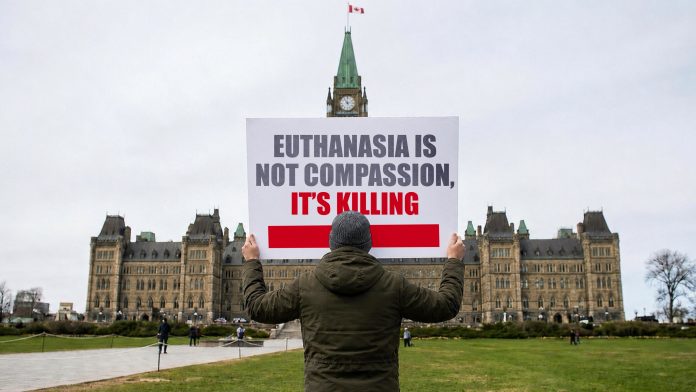
The euthanasia debate has intensified in Canada, which has one of the highest rates of medical assisted dying in the world, as its Parliament Members (MP) debate whether mental illness can be a sole criterion for euthanasia access.
On Oct. 7, members of the Canadian Parliament will vote on Bill-C-218—which would prevent people from being able to use mental illness as the sole reason to be euthanized. The first debate on the bill happened Dec. 5, and the second debate came Wednesday.
Currently, Canadians can be considered for Medical Assistance in Dying (MAiD) if they “have a serious illness, disease or disability,” “be in an advanced state of decline that cannot be reversed,” and “experience unbearable physical or mental suffering from your illness, disease, disability or state of decline that cannot be relieved under conditions that you consider acceptable.”
MAiD’s official page states that one does not need to have a fatal or terminal condition to be eligible for state-sanctioned killing.
“If your only medical condition is a mental illness, you are not eligible for medical assistance in dying until March 17, 2027,” the page states. “If you have a mental illness along with other medical conditions, you may be eligible for medical assistance in dying.”
Central to the debate is the question of whether doctors can accurately predict if a patient’s mental illness will improve. For those supporting the bill, foreseeing someone’s serious mental illness is difficult to establish, and many will improve with treatment over time. For those opposing the bill, assuming that someone will recover, as well as denying such a person euthanasia, could constitute as discrimination.
Conservative MP Tamara Jansen, who introduced Bill C-218, argued that instead of helping people facing mental health crisis die, the healthcare system should instead support people through these seasons of intense mental illness. She used the example of her younger brother, who was asked on six separate occasions if he wanted death by assisted suicide. Her brother had been diagnosed with terminal brain cancer, and according to Jansen, the medical staff at his hospital “seemed to want to end his life.” But he refused every time.
Jansen argued that those in mental crisis may not have the strength to say no to relentless requests and pressure from their medical staff.
“They were relentless,” Jansen said. “They pressed him saying that they didn’t think they would be able to control his pain, scaring him out of his wits, but he still had the will to live. … He had time to mend fences, make friends with the staff at Hospice, say goodbye to his family. This is why Bill C-218 is necessary. Because not everyone will be able to fight the way my brother fought. Not everyone will have the strength to say no six times. And when someone is sick, frightened, depressed or unable to see any hope for tomorrow, surely the responsibility of our medical system is not to reinforce their despair, but to protect them while they are vulnerable and help them find their way back to hope. That is particularly true when we are talking about mental illness.”
Michael Cooper, a Conservative MP who is backing the bill, cited psychiatrists during the debate.
“As Dr. Karin Neufeld, who is one of Canada’s most renowned psychiatrists and is none other than the chair of the Association of Chairs of Psychiatry in Canada, put it in her brief to the Special Joint Committee on MAID, which is studying this very issue, ‘Psychiatric disorders lack reliable biomarkers, follow non-linear trajectories, and frequently improve after years of severe impairment.’
“Accordingly, Dr. Neufeld concluded that psychiatrists are poor predictors of long-term outcomes. Simply put, modern psychiatry lacks the tools to predict irremediability in individual cases of mental illness. It is so uncertain in terms of predicting irremediability, that studies show that psychiatrists get it right less than 50% of the time.”
MP Luc Thériault, who opened the speech, criticized the bill and leading psychiatrists who say that mental health can be treated or cured.
“A few psychiatrists use anecdotal, unsubstantiated claims to assert that every mental illness is treatable or curable, but they also say that psychiatry is wrong about both prognoses and diagnoses,” Thériault said. “Those psychiatrists cannot explain why we should rely on anecdotal, unsubstantiated accounts involving patients whom they say would have met the MAiD eligibility criteria and safeguards set out in the expert panel report when those psychiatrists have no experience with MAiD, either as assessors or providers, and when they are effectively opposed to track 2 or MAiD in general.”
Euthanasia deaths in Canada outpace gun homicides in the U.S. Euthanasia is one of the leading causes of death in Canada, and Canada has the highest number of euthanasia deaths in the world. Canada ranks as the second-highest per capita rate of such deaths. About 5% of deaths in the Canada are done under MAiD.
The debate has only heightened after a Canadian family made public the story of their grandma who was allegedly euthanized without her consent. The grandmother had dementia and had actively opposed euthanasia because it violated her Christian faith. The family is arguing that she was euthanized despite never expressing a final consent. And with bypassed power of attorney, she did not have the mental capacity to decide to be euthanized. A criminal investigation has since been opened to examine her death.