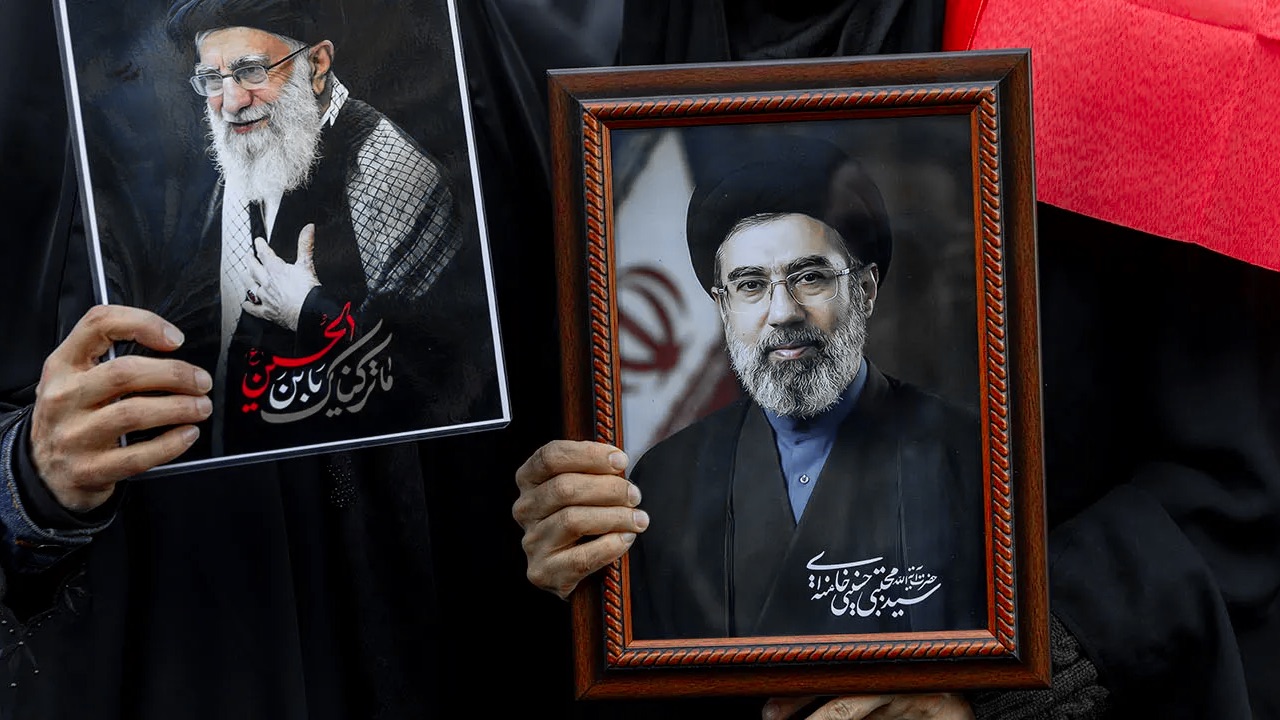
Experts warn that Mojtaba Khamenei, Iran’s newly selected leader, may be more radical than his father, Ayatollah Ali Khamenei, the former supreme leader who was killed during the Feb. 28 U.S. and Israeli airstrikes on Tehran. And Christian aid groups are concerned for the future welfare of Christians in the nation.
Mojtaba Khamenei, 56, was selected on March 8 by Iran’s 88-member Assembly of Experts. Long-rumored to be a key influence behind the scenes in Iran’s government and security forces, Khamenei is a mid-ranking cleric who was trained in Shiite seminaries in Qom, Iran.
Janer Rajabi, an Iranian exile and former Islamic Revolutionary Guard Corps (IRGC) operative who claims to have studied with Khamenei, warned in a recent interview with The Atlantic that Khamenei is an “apocalypse-obsessed” man who is “uniquely dangerous” and “more dangerous than 50 nuclear bombs.”
“He thinks there are milestones on the path to the end of the world and he himself will have a special part in hastening humanity down that path,” Rajabi said.
Rajabi also told ArabCast news that Khamenei “puts a lot of weight on visions and dreams and these things. He sees them and says, ‘I saw them, and they say that you are al-Sayyid al-Khorasani’ … I mean, once he told me, ‘Adam, peace be upon him, came to him [in a dream and told me this].’”
According to Rajabi, the newly selected leader believes he is a prophesied figure of the Khorasani that would help fulfill the Mahdi’s return. The Mahdi—sometimes called the 12th Imam—is an Islamic messianic figure who appears before the end times, based on Shia eschatology. Mahdi’s return, Shia Muslims believe, is to be announced by three figures, including the Khorasani, a leader from the historical region of Khorasan, which contains parts of Iran, Afghanistan, and Central Asia.
In an article in the National Interest, Jason Brodsky, policy director of United Against Nuclear Iran, said the new leadership points to a “dark turn for the Islamic republic,” while Janatan Sayeh of the Foundation for Defense of Democracies said Khamenei “embodies his father’s legacy and all of the Islamic Republic’s defining pathologies: theocratic rule, human rights abuses, destabilizing foreign policy ambitions, and kleptocracy.”
“Should he assume the role of supreme leader,” he wrote, “his growing dependence on the IRGC would further cement the unholy alliance between clerical authority and military power, tightening repression at home while escalating confrontation with the U.S.”
Sayeh further explained that the role of supreme leader “carries the expectation of leadership across the Shia world and stewardship over Tehran’s so-called Axis of Resistance against the United States and Israel. Domestically, it requires balancing the Islamic Republic’s rival institutions while maintaining the IRGC’s support. Khamenei is the closest the regime has to meeting those criteria.”
President Trump is reportedly “not happy” with Khamenei’s selection. Michael Herzog—a former Israeli Ambassador to the U.S.—said in an interview with CNBC that the leader would “probably be vengeful.”
Videos of Iranian citizens chanting “death to Mojtaba” have appeared across social media. In the past, he reportedly advocated for vicious crackdowns on protests.
Questions remain on whether conditions will worsen for the Iranian Christian population. Christians, a minority group, comprise several hundred thousand to 1 million or more people of Iran’s 90 million population. Evangelism and owning a Bible in their native language, Farsi, is illegal, according to International Christian Concern. Most believers are underground, and some Christian converts have faced prolonged imprisonment or the death sentence, as Islam is the majority religion.
Hormoz Shariat, founder and president of Iran Alive Ministries, told Decision in a recent interview that the government is afraid of citizens converting to Christianity.
“They know when somebody becomes Christian, they will never go back to Islam,” Shariat said. “They tried years ago to brainwash those they have arrested, and they have stopped doing that. They know somebody who comes to Christ will never be convinced to go back or intimidated to go back to Islam. That’s why the government of Iran is afraid of Christians.”
Shariat believes the government is also afraid because Christianity grows fast, and once a person becomes a Christian, conversion stories spread across the people around them.
“Many Christians have been arrested, and since last year—about 40 at one time, 17 another time, and they have been sentenced to long jail terms,” Shariat shared.