British solicitor Tom Ellis manages Ai Law, a commercial law firm run with a “Christian ethos.” Its varied commercial practice allows Ai Law to build expertise and resources to serve the wider community. Within the firm’s scope of services Ellis looks for impactful opportunities to help Christians facing legal difficulties—especially those involving religious liberty and free speech in the United Kingdom, where hostility toward Christianity continues to rise.
This important area of practice within the firm builds on cases ran by Ellis’s late father, also named Tom Ellis, who tackled many religious freedom cases.
Ellis told Decision during a visit to the Billy Graham Evangelistic Association’s (BGEA) Charlotte office in July that “the human rights work and the religious liberties work is principled and meaningful. [When] you’re working on those cases, you’re doing something bigger than just acting for people in terms of supporting their commercial interests.”
Beyond his broader legal work, Ellis said his “most rewarding” cases are those he has litigated in concert with BGEA. In the last decade, the ministry prevailed, thanks to assistance from Ellis and others, in cases that challenged the ability of BGEA to place ads and hire venues, after opposition threatened to prevent Franklin Graham from preaching at some public events in the U.K.
“They’re purely Gospel-based,” Ellis emphasized about BGEA’s evangelistic outreaches, “and people are [trying to stop] you from preaching the Gospel and fulfilling your mission.”
Yet even in a contentious culture, Ellis said BGEA’s approach is “always very conciliatory.” In these cases, “you’re living out the Gospel. You’re not trying to get revenge. You’re not trying to sue people for money. You’re just standing up for the right to preach the Gospel and to spread the Gospel, and that is incredibly rewarding to be involved in.”
Fighting for religious liberty in the U.K. differs from similar battles waged in American courts, Ellis noted.
The U.S. Constitution has been historically understood to safeguard what the Founding Fathers believed were fundamental human rights, including freedom of speech and religious liberty.
In the U.K. system, laws come from Parliament, but legal rulings in the courts as to their interpretation establish common law precedent as opposed to any overarching document like the Constitution. Each precedent builds upon earlier rulings. Thus, when a court rules in favor of religious liberty, Ellis explained, it creates a stronger foundation for others who later bring similar concerns.
Fight the Good Fight
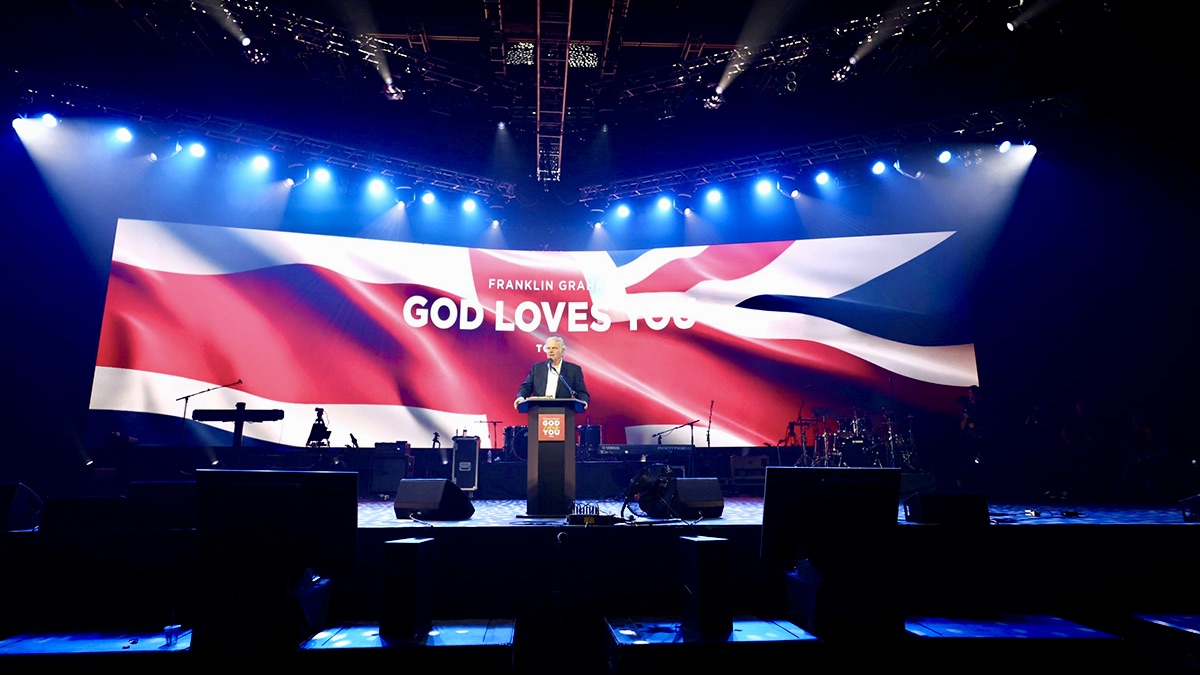
Ellis recounted two memorable BGEA’s cases, one involving the Lancashire Festival of Hope in Blackpool and the other cancellation of venue arrangements for the God Loves You Tour, tied to Franklin Graham’s preaching in the U.K. On both occasions, news that Franklin planned to share the Good News of Jesus Christ quickly drew opposition.
In Blackpool, authorities pulled bus advertisements for the 2018 Lancashire Festival of Hope after backlash over Franklin’s Biblical views on sexuality. Nearly two years later in Glasgow, the scheduled God Loves You Tour event at the SEC Hydro arena was canceled following adverse publicity and pressure over those same Biblical values.
Ellis and his late father challenged the cancellations, arguing that BGEA was protected against discrimination based on its religious belief. “We had real opposition,” Ellis said. “But because of … those cases that we’d ran in the past, each one being a brick, we were able to rely upon the case law. So, the law was in our favor to challenge the decisions and actually overturn them.”
“It’s just about fighting the good fight,” Ellis stated. “Then keeping the faith and finishing the race.” The Blackpool case challenged the removal of bus advertising after opposition from those with opposing views. It was ultimately a major victory for BGEA, and the Lancashire Festival of Hope proceeded as planned, which Ellis and his father attended. Opposition remained. “As we drove to the event, reports on the case were being played on the radio. The Blackpool Tower is a landmark in Blackpool, [and] they actually lit it up in rainbow colors when the event was going on.”
Elsewhere, protestors from a progressive church set up a large paper mâché Jesus with a rainbow sash on. Looking back on the city’s opposition in the Blackpool case, Ellis said, “even though we [eventually] won, … the council were still dead set against it. [The political pressure can be intense]… you just have to keep fighting.”
When asked if he had genuine hope for religious liberty in the U.K. amid growing challenges, Ellis answered simply: “We know the world’s going to get worse, [yet] my hope lies with individuals”—especially the hope of seeing hearts and minds turned toward good.
“It’s really important to have a good government, but it’s also all about the hearts of the people. And I think until the people change, there’s not going to be that systemic-wide change that we want to see.”
That’s why the work of Franklin and BGEA matters so much, he explained. Sharing the Gospel with thousands at a time plants seeds. “I see the change happening at different levels,” Ellis said. “There is hope.”
Justin Arnot, BGEA General Counsel, who has quarterbacked BGEA’s cases run by Ellis, offered a complementary perspective: “The hope for the future of religious liberty isn’t that we’ll [conquer] Rome, so to speak, or that the law will end up being more favorable. We already have favorable law, but still there’s darkness encroaching.” Rather, “the hope for religious liberty is that people will value the sharing of their faith so much that they will do it anyway.”
Arnot added: “It doesn’t matter if it’s ‘legal’ or not. The Gospel thrives with opposition. That’s the important part. So, this is just another ministry front for BGEA to be engaged in by presenting the Gospel to people in different contexts, to create the opportunity for them to consider the claims of Christ and make a decision about what to do with Jesus.”
“Pray for those that are doing the work of religious liberty,” Arnot said, “not just for success in that work, but pray for the heart behind it. If we’re not praying that the Holy Spirit would lead, guide, protect and give discernment in all these things, we’re completely out of the game.”
Ellis noted that as the world grows more overtly evil, it serves as an opportunity for more people to realize “that we need our Lord and Savior.” In a darkened world, “that will just mean the light of Jesus will shine brighter. And in the meantime, we have to fight the good fight of faith.”
Meanwhile, Ellis asked believers to pray for churches in the U.K., “that they have the heart of the Gospel.”
“Ephesians six,” he said, “the fight is against spiritual principalities in heavenly places. And that’s literally what we’re dealing with. We’re in a physical world dealing with physical courts, but we’re fighting a spiritual battle, so pray for that.”