
May 20, 2026

May, 20, 2026
May 20, 2026

give

untitled artwork

untitled artwork

World news biblically understood

TRENDING:

Why We Cannot Allow The Firm Foundation Of The Truth To Be Compromised

Josh Davis

Christianity is built upon the bedrock of historical truth. Without absolute truth, the world is left floundering in a sea of subjectivity. What would happen when a Christian who claims Jesus is the only way to heaven is met with the reply, “You have your truth and I have my truth”? With one sentence, the Christian witness is cut off at the knees and the authority of Scripture is minimized.  

The implications are dire for Christianity and those who seek to defend it. In 1 Corinthians 15, the Apostle Paul argued that if Jesus did not rise from the dead, then the Christian faith is worthless. He further stated that those who believed in Jesus for forgiveness of sins are not forgiven. Worse yet, all those who died believing that Jesus was the way to heaven would not be in heaven if Jesus had not risen from the dead.

Take this argument about truth back one step. The Christian faith is built upon the historical accuracy and reliability of the Bible. If there is no absolute truth, how certain could someone be that what the Bible says is authentic and trustworthy? Without absolute truth, the concept of terms like authentic and trustworthy would be meaningless, the Christian faith is worthless and Christian apologetics is pointless. This prospect is downright depressing.

When Jesus stood trial before Pontius Pilate, the truth was really on trial. As Pilate attempted to discover the cause of this brewing controversy, he grew frustrated with Jesus’ seemingly enigmatic answers about kingship, such as John 18:36: “Jesus answered, My kingdom is not of this world: if my kingdom were of this world, then would my servants fight, that I should not be delivered to the Jews: but now is my kingdom not from hence.”

Pilate responded bluntly, “Art thou a king then?” (John 18:37a). Jesus replied with an answer that reveals the very purpose for His human existence. It is a statement that Christian apologists cannot afford to miss: “Thou sayest that I am a king. To this end was I born, and for this cause came I into the world, that I should bear witness unto the truth. Every one that is of the truth heareth my voice” (John 18:37b). As Jesus stood trial before Pilate, He rested His case on His testimony to the truth. He further argued that those who were interested in discovering the truth would listen to Him.

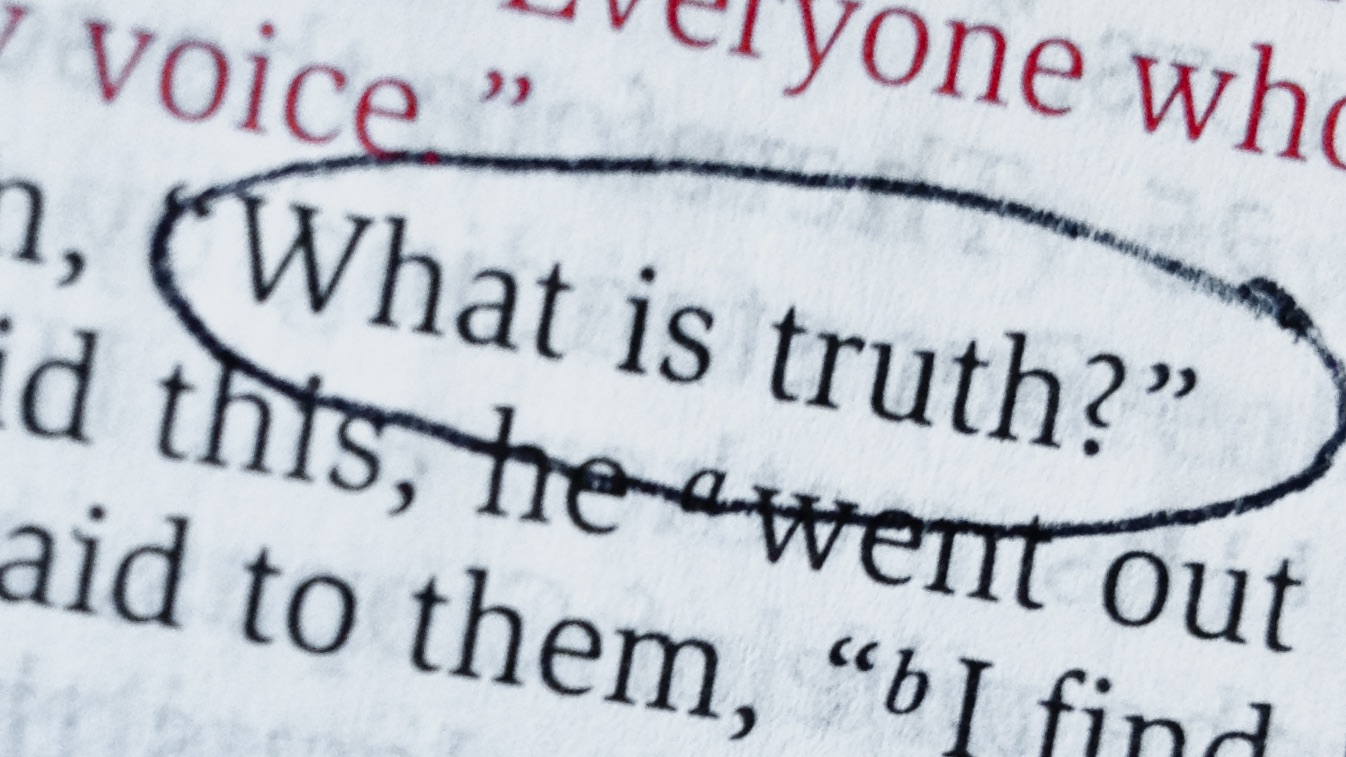
Yet again, Pilate responded bluntly: “What is truth? And when he had said this, he went out again unto the Jews, and saith unto them, I find in him no fault at all” (John 18:38). Was Pilate interested in Jesus’ answer to his question, “What is truth?” No, because as soon as he asked the question he left Jesus’ presence. What a tragic mistake! Pilate turned his back on the human embodiment of eternal truth to try to solve this temporary judicial puzzle. 

Sadly, some people today are as dismissive and disinterested in the truth as Pilate was. Without truth, Christianity would be meaningless and life on Earth would cease. This might sound like the dictionary definition of hyperbole, but it is not. 

The Masquerade of Postmodernism

Is truth whatever one wants it to be? Are statements like, “You have your truth and I have my truth” legitimate? Postmodernism floods universities with this definition of truth. This view believes that truth is in the eye of the beholder; it is relative and subjective instead of absolute and objective. Thus, Christianity’s absolute and objective claims are met with skepticism by postmodernists.  

This is one reason why views on morality are shifting as quickly as they are. Some websites list over 100 different gender identities. To the postmodern mind, the two genders of male and female are an outdated construct based on objective claims. Thus, gender is viewed as relative and subjective; the individual gets to decide who or what they want to be according to their will instead of some external source of truth. 

Take a step back to understand these terms. What is the difference between relative and absolute truths? Relative truth is something true for some people in some places at some times. An absolute truth, by contrast, is something true for all people in all places at all times. One is forced to use absolute truth to attempt to deny its existence. It is inescapable.   

Consider the statement “truth is relative.” Is that statement true only for some people in some places at some times? No. What about the statement, “There is no such thing as absolute truth.” Is that true for some people in some places at some times or true for all people in all places at all times? Thus, postmodernists are forced into a logical trap. They must use absolute truth to deny that it exists. In essence, they must say, “It is absolutely true that there is no absolute truth; it is absolutely true that truth is relative.” These self-defeating statements produce a logical nightmare!

What about statements like, “You have your truth and I have my truth”? Is that true for some people or all people? In other words, is it absolutely and objectively true that you have your truth and I have my truth? An outworking of this statement is, “I get to define who I am.” Is that an absolute truth claim? Yes, it is. Remember, absolute truth is inescapable. 

Instead of redefining truth, postmodernists have merely changed their allegiance. They have rejected the absolute authority of Almighty God and have made themselves the absolute authority for all matters of morality, purpose and destiny. Do away with the masquerade of relativism – behind all of this is a new religion of self-worship.    

But What About…?

The relativist might reply, “But there are relative truths like when two people are in the same room and one complains about being hot while the other complains about being cold.”
Is this an example of relative truth? No. Why not? Because each person is describing how they feel about the room temperature. The temperature is measurable and objective while their perception of it is subjective. 

Lots of variables impact the temperature of a room. Perhaps one person is sitting next to an open window while the other is sitting next to a roaring fireplace. The point is the temperature can be measured where each one is sitting. This might explain the temperature difference that they perceive. 

These two people might be sitting in a room where the temperature is constant and yet one feels cold while the other feels hot. Describing how they feel about the room temperature does not change what the thermometer reads. How one feels about the truth does not change what is true. The subjective response to objective truth does not alter the objective truth.   

Other similar examples are occasionally offered to support relativism, such as height. Some relativists might argue that professional basketball players are typically taller than horse jockeys; therefore, height is relative. However, this is not a relative truth. No matter where in the world a particular 7-foot-tall basketball player and a certain 5-foot-tall horse jockey are, there will never be an instance where this jockey will be taller than this basketball player. No one suddenly grows or shrinks 6 inches when they step off of an airplane from America to Australia. Every person’s height is a measurable, absolute truth. One cannot identify as 10 feet tall if they are really 6 feet tall. 

How does truth work?

These examples reveal the absolute nature of truth. Consider another example. Suppose a man walked into a bank with a check for $1,000. He handed it to the teller to deposit it into his checking account. The teller hands him a receipt that says $5 was deposited into his checking account. 

How should he respond? The only grounds he has for protesting this is if there is absolute truth. Otherwise, the teller could respond, “You have your definition of $1,000 and we have ours. You have your truth; we have our truth. To you, it is $1,000 but to us, it is $5.” The only way for the teller to be wrong is if absolute truth governs money. 

However, absolute truth governs more than money. It governs all truth claims. As the previous sections pointed out, absolute truth is inescapable. One must use it in an attempt to deny it. If it is unacceptable to accept relative truth in money, why do some people gamble away their eternal souls with statements like, “You have your truth about the afterlife and I have mine”?

The Christian faith is built upon the bedrock of historical facts. If Jesus’ life, death and resurrection are fictional fairy tales, Christian apologetics is worthless. However, if these things are historically correct, and I certainly believe they are, then the Christian apologist has absolute truth on his side as he builds his case and reveals the truth to others. Once the truth is presented, each person must decide if they are willing to follow the facts where they lead. The Christian faith is worth believing because it is built upon the firm foundation of the truth. 


Give

Give

Constant Crisis Has Created Spiritual Numbness—And That May Be The Greatest Danger Of All

The modern world is experiencing what many psychologists and cultural analysts now describe as “apocalypse fatigue.” After years of pandemics, lockdowns, economic instability, global conflict, social unrest, and relentless media-driven fear cycles, people are emotionally worn down. Many no longer react with urgency to alarming headlines because they have become desensitized. Constant crisis has created spiritual numbness. Ironically, this emotional fatigue is occurring at the exact moment Bible prophecy indicates the world should be paying closer attention than ever before.

Weaponized Compassion: Requiring Legal Assimilation Is Not Is Bigotry

Under the guise of standard social justice rhetoric, which has gained steam throughout the 21st century, political forces have intentionally grouped vastly different global populations into a single, massive group, referred to as "the oppressed." Within this manufactured coalition, one group has become particularly shielded from critical scrutiny: Muslims. Everyone is welcome in America, under the big umbrella of freedom. The United States welcomes people of any faith, ethnicity, or background—including Muslims—provided they enter through established, lawful channels and possess the proper motivation to honor this nation. This is legal assimilation. What this is not is bigotry.

sign up

Prophetic Pieces: As Putin Ups The Ante In The Arms Race, Russia Considers Providing Refuge To Top Iranian Leaders

Prophetic events in the end times right now are casting their shadows over the Middle East like never before. Preparations for the Gog Magog coalition prophesied in Ezekiel 38 and 39 are increasing and intensifying. Written 2,500 years ago by Ezekiel, these chapters prophesy an end-time invasion of Israel led by the nations of Russia, Iran, and Turkey. Two significant developments showcase that the prophetic pieces are falling perfectly into place.

ABC's of Salvation

Decision

UTT

FOI

untitled artwork

Israel My Glory

Josh Davis

Christianity is built upon the bedrock of historical truth. Without absolute truth, the world is left floundering in a sea of subjectivity. What would happen when a Christian who claims Jesus is the only way to heaven is met with the reply, “You have your truth and I have my truth”? With one sentence, the Christian witness is cut off at the knees and the authority of Scripture is minimized.  

The implications are dire for Christianity and those who seek to defend it. In 1 Corinthians 15, the Apostle Paul argued that if Jesus did not rise from the dead, then the Christian faith is worthless. He further stated that those who believed in Jesus for forgiveness of sins are not forgiven. Worse yet, all those who died believing that Jesus was the way to heaven would not be in heaven if Jesus had not risen from the dead.

Take this argument about truth back one step. The Christian faith is built upon the historical accuracy and reliability of the Bible. If there is no absolute truth, how certain could someone be that what the Bible says is authentic and trustworthy? Without absolute truth, the concept of terms like authentic and trustworthy would be meaningless, the Christian faith is worthless and Christian apologetics is pointless. This prospect is downright depressing.

When Jesus stood trial before Pontius Pilate, the truth was really on trial. As Pilate attempted to discover the cause of this brewing controversy, he grew frustrated with Jesus’ seemingly enigmatic answers about kingship, such as John 18:36: “Jesus answered, My kingdom is not of this world: if my kingdom were of this world, then would my servants fight, that I should not be delivered to the Jews: but now is my kingdom not from hence.”

Pilate responded bluntly, “Art thou a king then?” (John 18:37a). Jesus replied with an answer that reveals the very purpose for His human existence. It is a statement that Christian apologists cannot afford to miss: “Thou sayest that I am a king. To this end was I born, and for this cause came I into the world, that I should bear witness unto the truth. Every one that is of the truth heareth my voice” (John 18:37b). As Jesus stood trial before Pilate, He rested His case on His testimony to the truth. He further argued that those who were interested in discovering the truth would listen to Him.

Yet again, Pilate responded bluntly: “What is truth? And when he had said this, he went out again unto the Jews, and saith unto them, I find in him no fault at all” (John 18:38). Was Pilate interested in Jesus’ answer to his question, “What is truth?” No, because as soon as he asked the question he left Jesus’ presence. What a tragic mistake! Pilate turned his back on the human embodiment of eternal truth to try to solve this temporary judicial puzzle. 

Sadly, some people today are as dismissive and disinterested in the truth as Pilate was. Without truth, Christianity would be meaningless and life on Earth would cease. This might sound like the dictionary definition of hyperbole, but it is not. 

The Masquerade of Postmodernism

Is truth whatever one wants it to be? Are statements like, “You have your truth and I have my truth” legitimate? Postmodernism floods universities with this definition of truth. This view believes that truth is in the eye of the beholder; it is relative and subjective instead of absolute and objective. Thus, Christianity’s absolute and objective claims are met with skepticism by postmodernists.  

This is one reason why views on morality are shifting as quickly as they are. Some websites list over 100 different gender identities. To the postmodern mind, the two genders of male and female are an outdated construct based on objective claims. Thus, gender is viewed as relative and subjective; the individual gets to decide who or what they want to be according to their will instead of some external source of truth. 

Take a step back to understand these terms. What is the difference between relative and absolute truths? Relative truth is something true for some people in some places at some times. An absolute truth, by contrast, is something true for all people in all places at all times. One is forced to use absolute truth to attempt to deny its existence. It is inescapable.   

Consider the statement “truth is relative.” Is that statement true only for some people in some places at some times? No. What about the statement, “There is no such thing as absolute truth.” Is that true for some people in some places at some times or true for all people in all places at all times? Thus, postmodernists are forced into a logical trap. They must use absolute truth to deny that it exists. In essence, they must say, “It is absolutely true that there is no absolute truth; it is absolutely true that truth is relative.” These self-defeating statements produce a logical nightmare!

What about statements like, “You have your truth and I have my truth”? Is that true for some people or all people? In other words, is it absolutely and objectively true that you have your truth and I have my truth? An outworking of this statement is, “I get to define who I am.” Is that an absolute truth claim? Yes, it is. Remember, absolute truth is inescapable. 

Instead of redefining truth, postmodernists have merely changed their allegiance. They have rejected the absolute authority of Almighty God and have made themselves the absolute authority for all matters of morality, purpose and destiny. Do away with the masquerade of relativism – behind all of this is a new religion of self-worship.    

But What About…?

The relativist might reply, “But there are relative truths like when two people are in the same room and one complains about being hot while the other complains about being cold.”
Is this an example of relative truth? No. Why not? Because each person is describing how they feel about the room temperature. The temperature is measurable and objective while their perception of it is subjective. 

Lots of variables impact the temperature of a room. Perhaps one person is sitting next to an open window while the other is sitting next to a roaring fireplace. The point is the temperature can be measured where each one is sitting. This might explain the temperature difference that they perceive. 

These two people might be sitting in a room where the temperature is constant and yet one feels cold while the other feels hot. Describing how they feel about the room temperature does not change what the thermometer reads. How one feels about the truth does not change what is true. The subjective response to objective truth does not alter the objective truth.   

Other similar examples are occasionally offered to support relativism, such as height. Some relativists might argue that professional basketball players are typically taller than horse jockeys; therefore, height is relative. However, this is not a relative truth. No matter where in the world a particular 7-foot-tall basketball player and a certain 5-foot-tall horse jockey are, there will never be an instance where this jockey will be taller than this basketball player. No one suddenly grows or shrinks 6 inches when they step off of an airplane from America to Australia. Every person’s height is a measurable, absolute truth. One cannot identify as 10 feet tall if they are really 6 feet tall. 

How does truth work?

These examples reveal the absolute nature of truth. Consider another example. Suppose a man walked into a bank with a check for $1,000. He handed it to the teller to deposit it into his checking account. The teller hands him a receipt that says $5 was deposited into his checking account. 

How should he respond? The only grounds he has for protesting this is if there is absolute truth. Otherwise, the teller could respond, “You have your definition of $1,000 and we have ours. You have your truth; we have our truth. To you, it is $1,000 but to us, it is $5.” The only way for the teller to be wrong is if absolute truth governs money. 

However, absolute truth governs more than money. It governs all truth claims. As the previous sections pointed out, absolute truth is inescapable. One must use it in an attempt to deny it. If it is unacceptable to accept relative truth in money, why do some people gamble away their eternal souls with statements like, “You have your truth about the afterlife and I have mine”?

The Christian faith is built upon the bedrock of historical facts. If Jesus’ life, death and resurrection are fictional fairy tales, Christian apologetics is worthless. However, if these things are historically correct, and I certainly believe they are, then the Christian apologist has absolute truth on his side as he builds his case and reveals the truth to others. Once the truth is presented, each person must decide if they are willing to follow the facts where they lead. The Christian faith is worth believing because it is built upon the firm foundation of the truth. 


Trusted Analysis From A Biblical Worldview

Help reach the lost and equip the church with the living and active truth of God's Word in our world today.

YOU CARE ABOUT

BIBLICAL TRUTH. SO DO WE.


Together, We Can Deliver A Biblical Understanding

Of News Events Around The World.

Constant Crisis Has Created Spiritual Numbness—And That May Be The Greatest Danger Of All

The modern world is experiencing what many psychologists and cultural analysts now describe as “apocalypse fatigue.” After years of pandemics, lockdowns, economic instability, global conflict, social unrest, and relentless media-driven fear cycles, people are emotionally worn down. Many no longer react with urgency to alarming headlines because they have become desensitized. Constant crisis has created spiritual numbness. Ironically, this emotional fatigue is occurring at the exact moment Bible prophecy indicates the world should be paying closer attention than ever before.

Weaponized Compassion: Requiring Legal Assimilation Is Not Is Bigotry

Under the guise of standard social justice rhetoric, which has gained steam throughout the 21st century, political forces have intentionally grouped vastly different global populations into a single, massive group, referred to as "the oppressed." Within this manufactured coalition, one group has become particularly shielded from critical scrutiny: Muslims. Everyone is welcome in America, under the big umbrella of freedom. The United States welcomes people of any faith, ethnicity, or background—including Muslims—provided they enter through established, lawful channels and possess the proper motivation to honor this nation. This is legal assimilation. What this is not is bigotry.

untitled artwork 6391

Prophetic Pieces: As Putin Ups The Ante In The Arms Race, Russia Considers Providing Refuge To Top Iranian Leaders

Prophetic events in the end times right now are casting their shadows over the Middle East like never before. Preparations for the Gog Magog coalition prophesied in Ezekiel 38 and 39 are increasing and intensifying. Written 2,500 years ago by Ezekiel, these chapters prophesy an end-time invasion of Israel led by the nations of Russia, Iran, and Turkey. Two significant developments showcase that the prophetic pieces are falling perfectly into place.

ABC's of Salvation

TV AD

worldview matters

Decision Magazine V AD

Decision

Jan Markell

Israel My Glory

Erick Stakelbeck

untitled artwork

YOU CARE ABOUT

BIBLICAL TRUTH.

SO DO WE.

Together, We Can Deliver A Biblical Understanding Of News Events Around The World And Equip The Church To Stand With A Biblical Worldview.

untitled artwork

Israel My Glory

YOU CARE ABOUT

BIBLICAL TRUTH.

SO DO WE.


Together, We Can Deliver A Biblical Understanding Of News Events Around The World And Equip The Church To Stand With A Biblical Worldview.