
December 16, 2025

December, 16, 2025
December 16, 2025

give

untitled artwork

untitled artwork

World news biblically understood

TRENDING:

Professor Of Color Says He Was Denied Funding Due To ‘Insufficient’ Diversity, Equity & Inclusion Enthusiasm

Chemistry Professor Patanjali Kambhampati said he has been denied two grants over the past two years for failing to properly pledge allegiance to equity, diversity and inclusion.

Kambhampati was born in India. He grew up and was educated in the United States.

Since 2003, Kambhampati has successfully conducted cutting-edge research at the intersection of chemistry and physics as a member of the Department of Chemistry at McGill University in Canada.

“What I do is I develop lasers and laser-based instrumentation to measure the motion of electrons and atoms in materials that might be used in anything from solar cells to flat panel displays to lasers to next generation computers,” he said in a recent phone interview with The College Fix.

Kambhampati said he has raised close to $7 million over the last 15 years to further his work, receiving funding from the government of Canada in addition to various organizations, provinces and corporations.

“But everything seemed to change about a year or two ago,” Kambhampati said. “In the last two years the federal grants have begun to ask for equity, diversity and inclusion statements.”

“Initially, they started asking us to state our EDI position, which is a new thing,” he said. “The newer thing happened in the last year where the federal agencies said we’re going to look at your EDI statements first and foremost. That will be the gatekeeper.”

If a researcher doesn’t write a satisfactory EDI statement, some federal funding agencies will not even look at the scientific merits of the work anymore, Kambhampati said.

This was baffling to Kambhampati, who noted, at first, he wasn’t even sure what the agencies wanted exactly.

Kambhampati shared with The College Fix the EDI statement he included for one recent grant proposal he submitted to the Natural Sciences and Engineering Research Council of Canada.

In it, Kambhampati highlighted the cultural and intellectual diversity of the students that work in his lab and the importance of “improving access and retention for underrepresented groups in STEM.”

He talked about how he is “a racialized minority, from the 3rd world, from three nations” and how, “With this lived experience [he] can leverage those experience[s] to provide a more inclusive and equitable environment for an ever-increasing bandwidth of people aiming to do world-class laser science.”

He emphasized his group’s “long history of inclusion of women into ultrafast laser science,” noting one particular woman he mentored is now a physicist with a tenure-track position in Germany.

All this, however, was insufficient for the Natural Sciences and Engineering Research Council of Canada.

Kambhampati provided The College Fix with the letter he received from the organization informing him his grant proposal was being removed from consideration for funding.

In the letter, Jennifer Bean, director of research partnerships, stated that “The Equity, Diversity and Inclusion considerations in the application were deemed insufficient. The training plan did not adequately describe specific, concrete practices that will be put in place to ensure that EDI is intentionally and proactively supported in the training plan. Vague or generic statements are not sufficient and therefore the application is being rejected.”
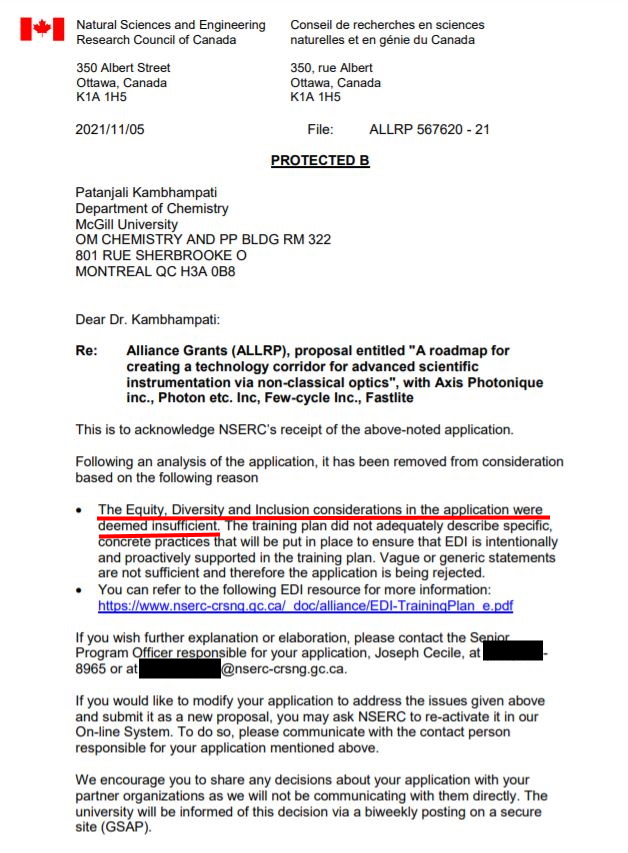
This rejection was frustrating and confusing for Kambhampati, he said, noting he is an Indian American working in Canada who’s been denied funding due to an “EDI thing.”

“Certainly speaking for myself,” he said, “I’ve dealt with a lot of racism in my life and as a result I try to treat people as equals and as individuals and apparently that wasn’t good enough. … I’ve actually supervised, you know, fifteen PhD students and three master’s students and they’re from all walks of life and apparently that success wasn’t good enough.”

“I have to pledge allegiance to language that I don’t even know how to articulate because it’s so different than my core values,” Kambhampati added. “I think what they’re asking you to do in the EDI pledges is literally in opposition to the sort of things Martin Luther King taught us how to think in the 1960s.”

Looking forward, Kambhampati said, there are two problems he sees for himself and others on account of these increasingly common EDI requirements.

The first is the initial problem of maintaining funding, although Kambhampati stated he recently received a generous grant from Sony and applied for another grant that “seems to be going along nicely.”

Neither of these, he noted, required an EDI statement; they just asked him about science.

Kambhampati also acknowledged that he has been given the opportunity to rewrite and resubmit the rejected NSERC grant.

The more daunting challenge though, may be the second problem, which Kambhampati described as the “longterm political problem of what is the right thing to do.”

When funding agencies ask for an EDI statement, Kambhampati said, “One might not always agree with it. That’s the key point. One might have differences of opinion. One might have differences of visions. And that difference will not be tolerated. You must pledge allegiance to whatever the language is that’s been created to foster DEI. You cannot dissent.”

A contact named in the rejection letter declined to comment when contacted by The College Fix. A media representative for NSERC has also not responded to a request for comment.


HD Editor’s Note: Why Is This News Biblically Relevant?

Radical “progressives” often tout their dedication to promoting tolerance and acceptance. However, as many people who faced this agenda point out, that facade of tolerance is proven to be a sham when others carry a different opinion, or do not wholeheartedly endorse and promote their narrative.

This is especially the case in schools, which have been used to overload children and young adults with radical and anti-Biblical worldviews, even coming at the expense of education itself.

From a Christian perspective, we know that the forceful removal of God from schools paved the way for redefinitions of morality, race, equality, and history.

The Bible teaches that “from one man [God] made all the nations, that they should inhabit the whole earth; and he marked out their appointed times in history and the boundaries of their lands” (Act 17:26). In other words, every human being is created in the image of God, starting from the same man (Adam). We are all therefore one race, one family, and equal one to another (Genesis 1:27).

It is also solely through anti-Biblical teaching that the idea can be espoused that skin color determines whether a person is inherently racist or a victim of racism.

The Bible states that there “is no respect of persons with God” (Romans 2:11). Furthermore, 1 Samuel 16:7 says that the Lord does not see people as man does “for man looketh on the outward appearance, but the LORD looketh on the heart” and Jesus encourages us to do the same (John 7:24).

When Jesus’ disciples came to Him and asked, “What shall be the sign of thy coming, and of the end of the world?” Jesus explained to them that one of the signs that would precede His coming would be “nations” rising against “nations.”

The word “nations” found in this verse (Matthew 24:7) is from the Greek word “ethnos,” where we get our English word for “ethnicity.” Therefore, this verse can also be read that “ethnicity shall rise against ethnicity” in the last days.

Racism is not new. However, what is new to our generation is the fabricated racism taught in schools, espoused by media, and reiterated by politicians. This stoking of division will, in the not too distant future, lead to genuine widespread racism. Racism is a sin, we are all created in the image of God. Creating division and hatred is a sin (Prov. 6:16-19Luke 11:171 John 2:9). All of these things are deeply rooted in a rebellion against God, His Word, and His design.

give

untitled artwork

To Claim That Hell Is Not ‘Eternal Torment’ Is To Downplay The Entire Gospel Message

Failing to understand God’s judgment means that you also neglect to recognize your desperate need for a Savior—and what you have been saved from. Severely downplaying the horrific nature of Hell may be popular in a culture not wanting to be judged for their sins, but it undermines the entire Gospel message.

Socialist Nicaragua Adds Bibles To The List Of Items Prohibited From Entering The Country

“We call on the government of Nicaragua to lift this ban immediately,” Stangl said, “and to cease its continued efforts to stifle freedom of religion or belief and expression in the country. We also reiterate our call on the international community to seek creative ways to support and strengthen independent Nicaraguan voices both inside the country and in exile.”

sign up

Christians Are Not Called To Fear The Future, They Are Called To Understand It

Indeed, it has become commonplace among many churches and Christian circles to avoid and even dismiss the subject of Bible prophecy. The rationale behind such a decision is often motivated by fear of teaching on matters that can be viewed as controversial or contentious. Instead of expounding on prophetic Scripture that may be viewed as difficult or having the potential for objections and debate, some churches choose to simply overlook, omit, and neglect these portions of God’s Word.

ABC's of Salvation

Decision

UTT

untitled artwork

Israel My Glory

Chemistry Professor Patanjali Kambhampati said he has been denied two grants over the past two years for failing to properly pledge allegiance to equity, diversity and inclusion.

Kambhampati was born in India. He grew up and was educated in the United States.

Since 2003, Kambhampati has successfully conducted cutting-edge research at the intersection of chemistry and physics as a member of the Department of Chemistry at McGill University in Canada.

“What I do is I develop lasers and laser-based instrumentation to measure the motion of electrons and atoms in materials that might be used in anything from solar cells to flat panel displays to lasers to next generation computers,” he said in a recent phone interview with The College Fix.

Kambhampati said he has raised close to $7 million over the last 15 years to further his work, receiving funding from the government of Canada in addition to various organizations, provinces and corporations.

“But everything seemed to change about a year or two ago,” Kambhampati said. “In the last two years the federal grants have begun to ask for equity, diversity and inclusion statements.”

“Initially, they started asking us to state our EDI position, which is a new thing,” he said. “The newer thing happened in the last year where the federal agencies said we’re going to look at your EDI statements first and foremost. That will be the gatekeeper.”

If a researcher doesn’t write a satisfactory EDI statement, some federal funding agencies will not even look at the scientific merits of the work anymore, Kambhampati said.

This was baffling to Kambhampati, who noted, at first, he wasn’t even sure what the agencies wanted exactly.

Kambhampati shared with The College Fix the EDI statement he included for one recent grant proposal he submitted to the Natural Sciences and Engineering Research Council of Canada.

In it, Kambhampati highlighted the cultural and intellectual diversity of the students that work in his lab and the importance of “improving access and retention for underrepresented groups in STEM.”

He talked about how he is “a racialized minority, from the 3rd world, from three nations” and how, “With this lived experience [he] can leverage those experience[s] to provide a more inclusive and equitable environment for an ever-increasing bandwidth of people aiming to do world-class laser science.”

He emphasized his group’s “long history of inclusion of women into ultrafast laser science,” noting one particular woman he mentored is now a physicist with a tenure-track position in Germany.

All this, however, was insufficient for the Natural Sciences and Engineering Research Council of Canada.

Kambhampati provided The College Fix with the letter he received from the organization informing him his grant proposal was being removed from consideration for funding.

In the letter, Jennifer Bean, director of research partnerships, stated that “The Equity, Diversity and Inclusion considerations in the application were deemed insufficient. The training plan did not adequately describe specific, concrete practices that will be put in place to ensure that EDI is intentionally and proactively supported in the training plan. Vague or generic statements are not sufficient and therefore the application is being rejected.”

This rejection was frustrating and confusing for Kambhampati, he said, noting he is an Indian American working in Canada who’s been denied funding due to an “EDI thing.”

“Certainly speaking for myself,” he said, “I’ve dealt with a lot of racism in my life and as a result I try to treat people as equals and as individuals and apparently that wasn’t good enough. … I’ve actually supervised, you know, fifteen PhD students and three master’s students and they’re from all walks of life and apparently that success wasn’t good enough.”

“I have to pledge allegiance to language that I don’t even know how to articulate because it’s so different than my core values,” Kambhampati added. “I think what they’re asking you to do in the EDI pledges is literally in opposition to the sort of things Martin Luther King taught us how to think in the 1960s.”

Looking forward, Kambhampati said, there are two problems he sees for himself and others on account of these increasingly common EDI requirements.

The first is the initial problem of maintaining funding, although Kambhampati stated he recently received a generous grant from Sony and applied for another grant that “seems to be going along nicely.”

Neither of these, he noted, required an EDI statement; they just asked him about science.

Kambhampati also acknowledged that he has been given the opportunity to rewrite and resubmit the rejected NSERC grant.

The more daunting challenge though, may be the second problem, which Kambhampati described as the “longterm political problem of what is the right thing to do.”

When funding agencies ask for an EDI statement, Kambhampati said, “One might not always agree with it. That’s the key point. One might have differences of opinion. One might have differences of visions. And that difference will not be tolerated. You must pledge allegiance to whatever the language is that’s been created to foster DEI. You cannot dissent.”

A contact named in the rejection letter declined to comment when contacted by The College Fix. A media representative for NSERC has also not responded to a request for comment.


HD Editor’s Note: Why Is This News Biblically Relevant?

Radical “progressives” often tout their dedication to promoting tolerance and acceptance. However, as many people who faced this agenda point out, that facade of tolerance is proven to be a sham when others carry a different opinion, or do not wholeheartedly endorse and promote their narrative.

This is especially the case in schools, which have been used to overload children and young adults with radical and anti-Biblical worldviews, even coming at the expense of education itself.

From a Christian perspective, we know that the forceful removal of God from schools paved the way for redefinitions of morality, race, equality, and history.

The Bible teaches that “from one man [God] made all the nations, that they should inhabit the whole earth; and he marked out their appointed times in history and the boundaries of their lands” (Act 17:26). In other words, every human being is created in the image of God, starting from the same man (Adam). We are all therefore one race, one family, and equal one to another (Genesis 1:27).

It is also solely through anti-Biblical teaching that the idea can be espoused that skin color determines whether a person is inherently racist or a victim of racism.

The Bible states that there “is no respect of persons with God” (Romans 2:11). Furthermore, 1 Samuel 16:7 says that the Lord does not see people as man does “for man looketh on the outward appearance, but the LORD looketh on the heart” and Jesus encourages us to do the same (John 7:24).

When Jesus’ disciples came to Him and asked, “What shall be the sign of thy coming, and of the end of the world?” Jesus explained to them that one of the signs that would precede His coming would be “nations” rising against “nations.”

The word “nations” found in this verse (Matthew 24:7) is from the Greek word “ethnos,” where we get our English word for “ethnicity.” Therefore, this verse can also be read that “ethnicity shall rise against ethnicity” in the last days.

Racism is not new. However, what is new to our generation is the fabricated racism taught in schools, espoused by media, and reiterated by politicians. This stoking of division will, in the not too distant future, lead to genuine widespread racism. Racism is a sin, we are all created in the image of God. Creating division and hatred is a sin (Prov. 6:16-19Luke 11:171 John 2:9). All of these things are deeply rooted in a rebellion against God, His Word, and His design.

Trusted Analysis From A Biblical Worldview

Help reach the lost and equip the church with the living and active truth of God's Word in our world today.

YOU CARE ABOUT

BIBLICAL TRUTH. SO DO WE.


Together, We Can Deliver A Biblical Understanding

Of News Events Around The World.

To Claim That Hell Is Not ‘Eternal Torment’ Is To Downplay The Entire Gospel Message

Failing to understand God’s judgment means that you also neglect to recognize your desperate need for a Savior—and what you have been saved from. Severely downplaying the horrific nature of Hell may be popular in a culture not wanting to be judged for their sins, but it undermines the entire Gospel message.

Socialist Nicaragua Adds Bibles To The List Of Items Prohibited From Entering The Country

“We call on the government of Nicaragua to lift this ban immediately,” Stangl said, “and to cease its continued efforts to stifle freedom of religion or belief and expression in the country. We also reiterate our call on the international community to seek creative ways to support and strengthen independent Nicaraguan voices both inside the country and in exile.”

untitled artwork 6391

Christians Are Not Called To Fear The Future, They Are Called To Understand It

Indeed, it has become commonplace among many churches and Christian circles to avoid and even dismiss the subject of Bible prophecy. The rationale behind such a decision is often motivated by fear of teaching on matters that can be viewed as controversial or contentious. Instead of expounding on prophetic Scripture that may be viewed as difficult or having the potential for objections and debate, some churches choose to simply overlook, omit, and neglect these portions of God’s Word.

ABC's of Salvation

TV AD

worldview matters

Decision Magazine V AD

Decision

Jan Markell

Israel My Glory

Erick Stakelbeck

untitled artwork

YOU CARE ABOUT

BIBLICAL TRUTH.

SO DO WE.

Together, We Can Deliver A Biblical Understanding Of News Events Around The World And Equip The Church To Stand With A Biblical Worldview.

Israel My Glory

untitled artwork

YOU CARE ABOUT

BIBLICAL TRUTH.

SO DO WE.


Together, We Can Deliver A Biblical Understanding Of News Events Around The World And Equip The Church To Stand With A Biblical Worldview.