January 26, 2026

January, 26, 2026
January 26, 2026

give

untitled artwork

untitled artwork

World news biblically understood

TRENDING:

Politics ‘Outweighed The Pursuit Of Truth’: Professors Work To Debunk ‘Native Children Genocide’ Narrative

Professors in both Canada and the United States have begun questioning a recent study that alleged 215 Indigenous children are buried in unmarked graves near the Kamloops Indian Residential School in British Columbia, Canada.

“Frankly, most of this so-called ‘Native Children Genocide’ narrative looks like a political cudgel and a cash cow for social justice activists,” said San Jose State University anthropologist Elizabeth Weiss in an email to The College Fix.

In May 2021, anthropologist Sarah Beaulieu conducted an experiment using ground-penetrating radar to determine whether, as local Indigenous lore alleged, hundreds of children were buried near the residential school. The radar technology is supposed to detect unusual patterns in the ground that may suggest the presence of foreign objects, such as human bodies.

But as University of Montreal history Professor Jacques Rouillard pointed out in a recent article in The Dorchester Review, not one actual body has been exhumed from the site. Rouillard argued that without physical evidence, the story of the missing children remains a “thesis.”

“All of this is based only on soil abnormalities that could easily be caused by root movements, as the anthropologist herself cautioned in the July 15 press conference,” Rouillard wrote.

Weiss agreed that the ultrasound shouldn’t be taken as fact.

“Ground Penetrating Radar is an imperfect tool — it should be a starting point, but not an endpoint in research,” she said.

When the study went public, it quickly became a national story in Canada.

The Tk’emlúps te Secwépemc community in British Columbia, where the school was located, released a statement claiming an “unthinkable loss that was spoken about but never documented” was confirmed.

“This past weekend, with the help of a ground penetrating radar specialist, the stark truth of the preliminary findings came to light — the confirmation of the remains of 215 children who were students of the Kamloops Indian Residential School,” said Chief Rosanne Casimir of the Tk’emlúps te Secwépemc community.

“To our knowledge, these missing children are undocumented deaths,” she added.

“The news that remains were found at the former Kamloops residential school breaks my heart – it is a painful reminder of that dark and shameful chapter of our country’s history,” wrote Canadian Prime Minister Justin Trudeau on Twitter. “I am thinking about everyone affected by this distressing news. We are here for you.”

In The New York Times, Indigenous Canadian Professor Kisha Supernant said that “the oral histories of former residential school students are sufficient proof that many of the missing children — of which there are 10,000 to 15,000 total, by current estimates — were buried in unmarked graves on school grounds.”

The study stirred up a controversial topic in Canada, where [Catholic] denominations often set up residential schools and forced Indigenous children to attend. In 2015, Canada’s Truth and Reconciliation Commission released a report detailing the damaging legacy of the country’s residential school system, claiming thousands of Indigenous children had been separated from their families and forced into residential schools.

But as Rouillard noted, the Kamloops Indian Residential School was situated in the heart of the Kamloops Reserve itself. If 215 schoolchildren had gone missing, he argued, someone on the reservation would have noticed.

“With the cemetery so close by, is it really credible that the remains of 200 children were buried clandestinely in a mass grave, on the reserve itself, without any reaction from the band council until last summer,” he questioned.

“Chief Casimir states that the presence of children’s remains had been ‘known’ in the community for a long time. Aboriginal families are certainly as concerned about the fate of their children as any other community; why did they say nothing?”

Further, he noted, even if there are graves of some children on the land, they were most likely marked with wooden crosses that have long since deteriorated; thus, any graves present would not have been “unmarked.”

Weiss has long been a proponent of using scientific research over Indigenous lore, which has earned her the ire of some Native American archaeologists.

“Oral histories are full of things we know not to be true, such as creation myths (e.g., the Zunis’ story of people emerging from underwater), mystical creatures (e.g., the Blackfoot’s underwater panthers and thunderbirds, which provided horses to the tribe), and anachronisms (e.g., steamboats prior to European contact),” Weiss wrote in an article in Liberty late last year.

[“The discovery of burials at residential schools in Canada is a prime example of erasing the historic record, in circumstances in which written words have been incomplete,” she explained. “In the New York Times, Kisha Supernant has said that ‘the oral histories of former residential school students are sufficient proof that many of the missing children — of which there are 10,000 to 15,000 total, by current estimates — were buried in unmarked graves on school grounds.’ However, as noted in the Truth and Reconciliation Report, archival records from the Indian Residential Schools, although far from perfect, reveal that the graves were marked by wooden crosses. Nearly all burials (both of Native Canadians and white Canadians) in middle class cemeteries in the late 1800s and early 1900s consisted of painted wooden crosses that deteriorate over time; the graves were not unmarked, but the markings have disintegrated.”]

“But this doesn’t fit the narrative of victimization that’s being promoted for political reasons — and financial ones too, perhaps, if compensation or reparations become a possibility,” she said.

Earlier this month, Mount Royal University fired tenured professor Frances Widdowson for disputing a claim published by the Truth and Reconciliation Commission that the Canadian colonial residential school system was a “key component of a Canadian government policy of cultural genocide.” Widdowson had also criticized campus “wokeism” and the Black Lives Matter movement.

Widdowson had been accused of racism for arguing that Indigenous people’s economic progress has been hindered by advocates, academics and others who profit from current conditions.

“It gives a terrible and simplistic impression of complex issues in Canadian history,” wrote Rouillard. “The exhumations have not yet begun and no remains have obviously been found.”

“Imaginary stories and emotion have outweighed the pursuit of truth. On the road to reconciliation, isn’t the best way to seek and tell the whole truth rather than deliberately create sensational myths?”

Collage Fix - Logo

HD Editor’s Note: ‘Never Let The Facts Get In The Way Of A Good Narrative’

In the summer of 2021, as many recall, the “new evidence” of “unmarked graves” in Kamloops sparked a disturbing trend of church burnings in Canada. Over 50 churches across the country were attacked by arsonists. In response, Canadian politicians like Prime Minister Justin Trudeau brazenly called their actions “understandable.”

It wasn’t too long after the media took hold of the story that evidence started coming out, showing that the story was being reported in a less than honest fashion. The truth was inconvenient to those who wanted to run with a narrative that served to stir up racial tensions and increase hostility towards churches.

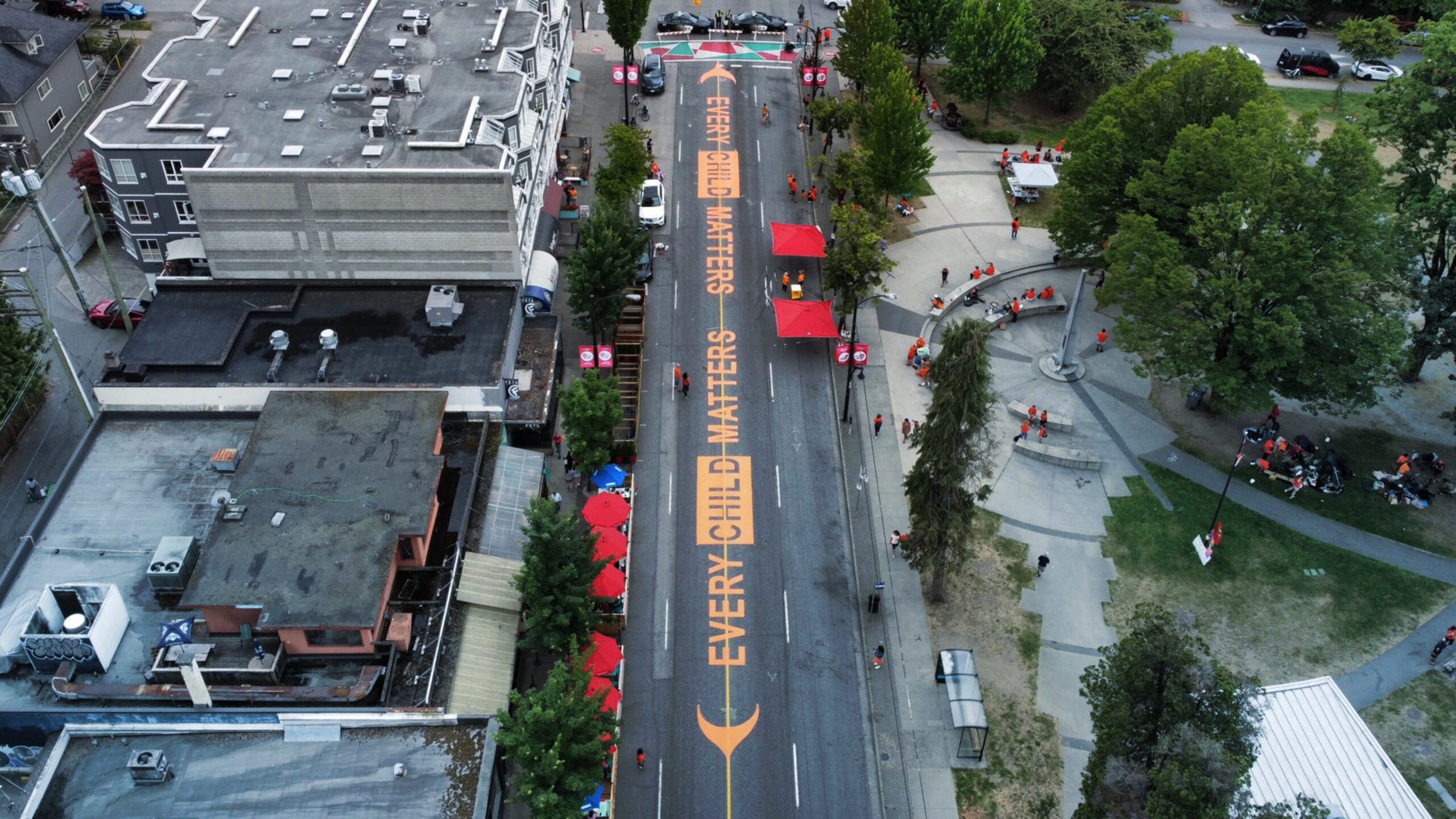
In many ways, the story starkly resembled the incident with George Flloyd. Many news companies were unwilling to dig deeper because of the racial tensions and violent riots that accompanied it. Protesters in Canada even used the phrase “every child matters,” similar to “black lives matter,” painting it as a large mural on roads (pictured). Who could argue? This fear of backlash from activists was exploited to keep the truth suppressed and provide a thriving environment for dishonest reporting.

Journalist Candice Malcolm of True North reamed the media in both the United States and Canada at the time for what she said was “incredibly irresponsible” reporting.

In a detailed article, Malcolm provided six reasons why the scandalous story was dishonest. She called into question the unverified reports, identity of those buried, cause of death, the extent of the evidence, and what was known about the area prior to the “findings.”

“The remains were found when remedial work was being performed in the area to replace the fence at the cemetery” in 2020, she explained. 

“Sophie Pierre, former chief of the St Mary’s Indian Band and a survivor of the school itself, told Global News that while the news of the unmarked graves had a painful impact on her and surrounding communities, they had always known the graves were there. ‘There’s no discovery. We knew it was there; it’s a graveyard,’ Pierre said. ‘The fact there are graves inside a graveyard shouldn’t be a surprise to anyone.’

“So when we’re talking about so-called unmarked graves, at least in the context of the Lower Kootenay Band, what we are more likely talking about is abandoned graves at an existing cemetery,” Malcolm wrote. “Abandoned graves where people of different backgrounds — not just children from residential schools — were buried.”

“What an amazing leap to go from an uncared for community cemetery to mass graves, mass murder, and genocide,” she noted. “Mark Twain once said to never let the truth get in the way of a good story. Well, for journalists, they might say never let the facts get in the way of a good narrative.”

Although the news of atrocities committed against children quickly stir up emotions, and it is unpopular, to say the least, to question the validity of such stories, the Bible compels Christians to seek the truth and be discerning. This is especially important as we live in a time in which the Bible states “men of corrupt minds” will increasingly work to “resist the truth” (2 Timothy 3:8).

Your support helps Harbinger's Daily propel the boldest and most sound Christian voices of our day—those unwavering in their defense of the truth and passionate about reaching the unsaved world—while engaging millions to stand courageously with a worldview grounded in God's Word. 

Will you defend the truth and equip others to do the same?

The ‘Broad’ Crisis Facing Christian Media

It's not a shocking statement to say that our world has a media problem. Bias, ideology, and lawless journalistic standards have brought the average person's trust in the media to an all-time low. While this problem is most prominent within secular circles, Christian media has a crisis of its own, and it's rooted in compromise. Many of these organizations were once sound—but a little compromise compromised the whole publication! Numerous newsgroups operating under a "Christian" banner have begun promoting abortion, attacking Israel, applauding LGBT ideology, and disseminating apostasy.

With A Survey Of God’s Commandments, We Quickly Realize Our Need For National Repentance

I applaud states such as Texas, Arkansas, and Louisiana, which are currently waging court battles to defend their laws requiring that the Ten Commandments be on display in public schools. When I was in grade school, this was common practice. But that was before our public schools expelled common sense from the classroom and forgot that boys are male and girls are female. Survey God’s list of do’s and don’ts in Exodus 20, and we quickly realize our need for repentance.

sign up

In An Ever Darkening World, We Can Find Solace In Bible Prophecy

The bright side of the growing evil in the world is that it is a sure sign that we are living in the season of the Lord’s return. If you will check Genesis 6, you will find that Noah’s society was characterized by violence and immorality. This is the reason that the great pastor, Adrian Rogers (1931-2005), once said, “The world is growing gloriously dark.” How can the acceleration of evil be considered “glorious”? Because it is a sign of the imminent return of Jesus.

ABC's of Salvation

Decision

UTT

untitled artwork

Israel My Glory

Professors in both Canada and the United States have begun questioning a recent study that alleged 215 Indigenous children are buried in unmarked graves near the Kamloops Indian Residential School in British Columbia, Canada.

“Frankly, most of this so-called ‘Native Children Genocide’ narrative looks like a political cudgel and a cash cow for social justice activists,” said San Jose State University anthropologist Elizabeth Weiss in an email to The College Fix.

In May 2021, anthropologist Sarah Beaulieu conducted an experiment using ground-penetrating radar to determine whether, as local Indigenous lore alleged, hundreds of children were buried near the residential school. The radar technology is supposed to detect unusual patterns in the ground that may suggest the presence of foreign objects, such as human bodies.

But as University of Montreal history Professor Jacques Rouillard pointed out in a recent article in The Dorchester Review, not one actual body has been exhumed from the site. Rouillard argued that without physical evidence, the story of the missing children remains a “thesis.”

“All of this is based only on soil abnormalities that could easily be caused by root movements, as the anthropologist herself cautioned in the July 15 press conference,” Rouillard wrote.

Weiss agreed that the ultrasound shouldn’t be taken as fact.

“Ground Penetrating Radar is an imperfect tool — it should be a starting point, but not an endpoint in research,” she said.

When the study went public, it quickly became a national story in Canada.

The Tk’emlúps te Secwépemc community in British Columbia, where the school was located, released a statement claiming an “unthinkable loss that was spoken about but never documented” was confirmed.

“This past weekend, with the help of a ground penetrating radar specialist, the stark truth of the preliminary findings came to light — the confirmation of the remains of 215 children who were students of the Kamloops Indian Residential School,” said Chief Rosanne Casimir of the Tk’emlúps te Secwépemc community.

“To our knowledge, these missing children are undocumented deaths,” she added.

“The news that remains were found at the former Kamloops residential school breaks my heart – it is a painful reminder of that dark and shameful chapter of our country’s history,” wrote Canadian Prime Minister Justin Trudeau on Twitter. “I am thinking about everyone affected by this distressing news. We are here for you.”

In The New York Times, Indigenous Canadian Professor Kisha Supernant said that “the oral histories of former residential school students are sufficient proof that many of the missing children — of which there are 10,000 to 15,000 total, by current estimates — were buried in unmarked graves on school grounds.”

The study stirred up a controversial topic in Canada, where [Catholic] denominations often set up residential schools and forced Indigenous children to attend. In 2015, Canada’s Truth and Reconciliation Commission released a report detailing the damaging legacy of the country’s residential school system, claiming thousands of Indigenous children had been separated from their families and forced into residential schools.

But as Rouillard noted, the Kamloops Indian Residential School was situated in the heart of the Kamloops Reserve itself. If 215 schoolchildren had gone missing, he argued, someone on the reservation would have noticed.

“With the cemetery so close by, is it really credible that the remains of 200 children were buried clandestinely in a mass grave, on the reserve itself, without any reaction from the band council until last summer,” he questioned.

“Chief Casimir states that the presence of children’s remains had been ‘known’ in the community for a long time. Aboriginal families are certainly as concerned about the fate of their children as any other community; why did they say nothing?”

Further, he noted, even if there are graves of some children on the land, they were most likely marked with wooden crosses that have long since deteriorated; thus, any graves present would not have been “unmarked.”

Weiss has long been a proponent of using scientific research over Indigenous lore, which has earned her the ire of some Native American archaeologists.

“Oral histories are full of things we know not to be true, such as creation myths (e.g., the Zunis’ story of people emerging from underwater), mystical creatures (e.g., the Blackfoot’s underwater panthers and thunderbirds, which provided horses to the tribe), and anachronisms (e.g., steamboats prior to European contact),” Weiss wrote in an article in Liberty late last year.

[“The discovery of burials at residential schools in Canada is a prime example of erasing the historic record, in circumstances in which written words have been incomplete,” she explained. “In the New York Times, Kisha Supernant has said that ‘the oral histories of former residential school students are sufficient proof that many of the missing children — of which there are 10,000 to 15,000 total, by current estimates — were buried in unmarked graves on school grounds.’ However, as noted in the Truth and Reconciliation Report, archival records from the Indian Residential Schools, although far from perfect, reveal that the graves were marked by wooden crosses. Nearly all burials (both of Native Canadians and white Canadians) in middle class cemeteries in the late 1800s and early 1900s consisted of painted wooden crosses that deteriorate over time; the graves were not unmarked, but the markings have disintegrated.”]

“But this doesn’t fit the narrative of victimization that’s being promoted for political reasons — and financial ones too, perhaps, if compensation or reparations become a possibility,” she said.

Earlier this month, Mount Royal University fired tenured professor Frances Widdowson for disputing a claim published by the Truth and Reconciliation Commission that the Canadian colonial residential school system was a “key component of a Canadian government policy of cultural genocide.” Widdowson had also criticized campus “wokeism” and the Black Lives Matter movement.

Widdowson had been accused of racism for arguing that Indigenous people’s economic progress has been hindered by advocates, academics and others who profit from current conditions.

“It gives a terrible and simplistic impression of complex issues in Canadian history,” wrote Rouillard. “The exhumations have not yet begun and no remains have obviously been found.”

“Imaginary stories and emotion have outweighed the pursuit of truth. On the road to reconciliation, isn’t the best way to seek and tell the whole truth rather than deliberately create sensational myths?”

Collage Fix - Logo

HD Editor’s Note: ‘Never Let The Facts Get In The Way Of A Good Narrative’

In the summer of 2021, as many recall, the “new evidence” of “unmarked graves” in Kamloops sparked a disturbing trend of church burnings in Canada. Over 50 churches across the country were attacked by arsonists. In response, Canadian politicians like Prime Minister Justin Trudeau brazenly called their actions “understandable.”

It wasn’t too long after the media took hold of the story that evidence started coming out, showing that the story was being reported in a less than honest fashion. The truth was inconvenient to those who wanted to run with a narrative that served to stir up racial tensions and increase hostility towards churches.

In many ways, the story starkly resembled the incident with George Flloyd. Many news companies were unwilling to dig deeper because of the racial tensions and violent riots that accompanied it. Protesters in Canada even used the phrase “every child matters,” similar to “black lives matter,” painting it as a large mural on roads (pictured). Who could argue? This fear of backlash from activists was exploited to keep the truth suppressed and provide a thriving environment for dishonest reporting.

Journalist Candice Malcolm of True North reamed the media in both the United States and Canada at the time for what she said was “incredibly irresponsible” reporting.

In a detailed article, Malcolm provided six reasons why the scandalous story was dishonest. She called into question the unverified reports, identity of those buried, cause of death, the extent of the evidence, and what was known about the area prior to the “findings.”

“The remains were found when remedial work was being performed in the area to replace the fence at the cemetery” in 2020, she explained. 

“Sophie Pierre, former chief of the St Mary’s Indian Band and a survivor of the school itself, told Global News that while the news of the unmarked graves had a painful impact on her and surrounding communities, they had always known the graves were there. ‘There’s no discovery. We knew it was there; it’s a graveyard,’ Pierre said. ‘The fact there are graves inside a graveyard shouldn’t be a surprise to anyone.’

“So when we’re talking about so-called unmarked graves, at least in the context of the Lower Kootenay Band, what we are more likely talking about is abandoned graves at an existing cemetery,” Malcolm wrote. “Abandoned graves where people of different backgrounds — not just children from residential schools — were buried.”

“What an amazing leap to go from an uncared for community cemetery to mass graves, mass murder, and genocide,” she noted. “Mark Twain once said to never let the truth get in the way of a good story. Well, for journalists, they might say never let the facts get in the way of a good narrative.”

Although the news of atrocities committed against children quickly stir up emotions, and it is unpopular, to say the least, to question the validity of such stories, the Bible compels Christians to seek the truth and be discerning. This is especially important as we live in a time in which the Bible states “men of corrupt minds” will increasingly work to “resist the truth” (2 Timothy 3:8).

Trusted Analysis From A Biblical Worldview

Help reach the lost and equip the church with the living and active truth of God's Word in our world today.

YOU CARE ABOUT

BIBLICAL TRUTH. SO DO WE.


Together, We Can Deliver A Biblical Understanding

Of News Events Around The World.

The ‘Broad’ Crisis Facing Christian Media

It's not a shocking statement to say that our world has a media problem. Bias, ideology, and lawless journalistic standards have brought the average person's trust in the media to an all-time low. While this problem is most prominent within secular circles, Christian media has a crisis of its own, and it's rooted in compromise. Many of these organizations were once sound—but a little compromise compromised the whole publication! Numerous newsgroups operating under a "Christian" banner have begun promoting abortion, attacking Israel, applauding LGBT ideology, and disseminating apostasy.

With A Survey Of God’s Commandments, We Quickly Realize Our Need For National Repentance

I applaud states such as Texas, Arkansas, and Louisiana, which are currently waging court battles to defend their laws requiring that the Ten Commandments be on display in public schools. When I was in grade school, this was common practice. But that was before our public schools expelled common sense from the classroom and forgot that boys are male and girls are female. Survey God’s list of do’s and don’ts in Exodus 20, and we quickly realize our need for repentance.

untitled artwork 6391

In An Ever Darkening World, We Can Find Solace In Bible Prophecy

The bright side of the growing evil in the world is that it is a sure sign that we are living in the season of the Lord’s return. If you will check Genesis 6, you will find that Noah’s society was characterized by violence and immorality. This is the reason that the great pastor, Adrian Rogers (1931-2005), once said, “The world is growing gloriously dark.” How can the acceleration of evil be considered “glorious”? Because it is a sign of the imminent return of Jesus.

ABC's of Salvation

TV AD

worldview matters

Decision Magazine V AD

Decision

Jan Markell

Israel My Glory

Erick Stakelbeck

untitled artwork

YOU CARE ABOUT

BIBLICAL TRUTH.

SO DO WE.

Together, We Can Deliver A Biblical Understanding Of News Events Around The World And Equip The Church To Stand With A Biblical Worldview.

Israel My Glory

untitled artwork

YOU CARE ABOUT

BIBLICAL TRUTH.

SO DO WE.


Together, We Can Deliver A Biblical Understanding Of News Events Around The World And Equip The Church To Stand With A Biblical Worldview.