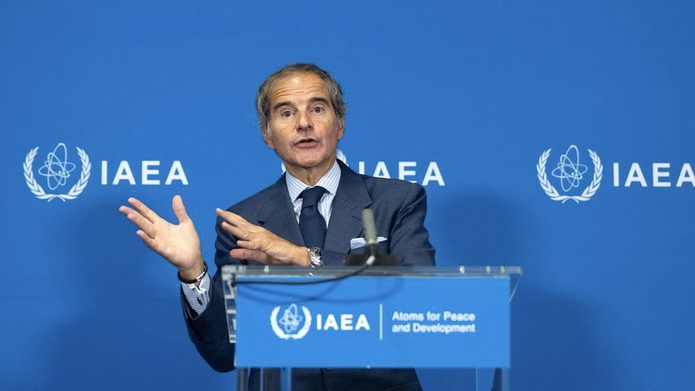
Syria’s former Bashar Assad regime was secretly constructing a nuclear reactor designed in a configuration capable of efficiently producing fissile material for nuclear weapons, International Atomic Energy Agency Director General Rafael Grossi revealed Monday.
Grossi said the reactor’s technical characteristics were particularly effective at producing material that could be used directly in the manufacture of nuclear weapons. Assad’s government never declared the facility and repeatedly denied operating an illicit nuclear program.
The reactor at Deir el-Zour in eastern Syria, reportedly constructed with North Korean assistance, was destroyed by an Israeli airstrike in 2007 before it became operational. The IAEA later determined that Syria’s failure to declare the reactor violated its nuclear safeguards obligations.
The collapse of Assad’s government has now given international inspectors access to locations that were largely closed to them for years. During inspections in August, investigators confirmed that newly exposed cooling infrastructure at the Deir el-Zour site was consistent with a nuclear reactor.
More significantly, inspectors entered another previously undeclared location where they discovered approximately 73 tons of natural uranium metal, much of it fashioned into fuel rods. Grossi said inspectors had to tear down walls and navigate confined passages to reach material that had been concealed inside the facility.
The uranium itself cannot simply be placed into a nuclear weapon. However, experts warn that material of this type could have been irradiated and processed to produce plutonium for a weapons program.
The IAEA has installed surveillance equipment and placed the uranium under international safeguards. Syria’s new government has so far cooperated with inspectors, providing an opportunity to uncover what remains of a secret nuclear program that the Assad regime denied for nearly two decades.