November 4, 2026

November, 4, 2026
November 4, 2026

give

untitled artwork

untitled artwork

World news biblically understood

TRENDING:

US celebrates withdrawal of UN Security Council resolution against peace plan

After a rancorous UN Security Council debate Tuesday, during which every member nation except the United States and Israel distanced themselves from US President Donald Trump’s peace plan, the White House celebrated the withdrawal of a resolution rejecting the proposal.

The administration reportedly put heavy pressure on critics to drop the measure, introduced by Indonesia and Tunisia, and diplomats gave up when it risked not having the necessary nine out of 15 votes to secure its passage.

“By not putting forward a polarizing resolution, the United Nations Security Council demonstrated that the old way of doing things is over,” a senior Trump official told The Times of Israel.

“For the first time on the Israeli-Palestinian issue, the Council was willing to think outside the conventional box, and not reflexively fall back on the calcified Palestinian position, which has only allowed the failed status quo to continue.”

Palestinian Authority President Mahmoud Abbas holds up a map of US President Donald Trump’s Middle East plan as he speaks to the UN Security Council at the United Nations headquarters on February 11, 2020 in New York. (Johannes EISELE / AFP)

Palestinian officials insist that they may still propose a resolution at the Security Council, possibly later this week. The text’s initial draft, which said the plan violated international law, had been softened to say it departs from accepted parameters of an Israeli-Palestinian settlement.

“The Palestinians’ inability to put forward a vote tonight shows the change that the international community has gone through in recent years,” Ron Prosor, a former Israeli ambassador to the UN, told The Times of Israel on Tuesday.

Two years ago, the Palestinians easily recruited many countries willing to vote in favor of a resolution condemning the US recognition of Jerusalem as Israel’s capital. The US vetoed the decision.

“This time they don’t have nine countries behind them,” Prosor said. “It shows that countries have different priorities now and they put their own interests first. Sure, they will probably go to the General Assembly where they have an automatic majority to pass a resolution, but the majority might not be as large as it was after the Jerusalem declaration.”

At Tuesday’s Security Council session, representatives of all 15 member states spoke, all of whom — except the Israeli and the American envoys — declared their respective support for the traditionally accepted parameters of an Israeli-Palestinian peace accord.

Some welcomed the American initiative, saying it injected a new impetus into the stalled peace process. Still, all made clear that their positions have not changed.
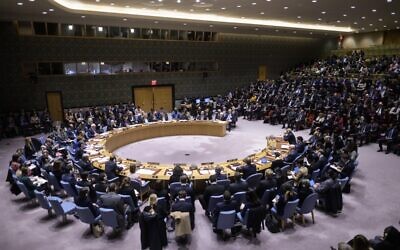
Palestinian Authority President Mahmoud Abbas(L) speaks to the UN Security Council at the United Nations headquarters on February 11, 2020 in New York. (Johannes EISELE / AFP)

“We remain committed to a negotiated two-state solution, based on 1967 lines, with equivalent land swaps, as may be agreed between the parties, with the State of Israel and an independent, democratic, contiguous, sovereign and viable State of Palestine, living side by side in peace, security and mutual recognition,” said Jürgen Schulz, Germany’s deputy ambassador to the UN, speaking on behalf of his own county, as well as Estonia, France and Poland.

Breaking with past US administrations, the Trump plan envisions the creation of a Palestinian state in about 70 percent of the West Bank, a small handful of neighborhoods in East Jerusalem, most of Gaza and some areas of southern Israel — if the Palestinians recognize Israel as a Jewish state, disarm Hamas and other terror groups in the coastal enclave, and fulfill other conditions.

The plan also allows Israel to annex settlements, grants the Jewish state sovereignty over the Jordan Valley and overriding security control west of the Jordan River, and bars Palestinian refugees from settling in Israel.

The European members of the council all expressed their deep concern over Israel’s plan to apply sovereignty over large swaths of the West Bank.

“The annexation of any part of the Occupied Palestinian Territory, including East Jerusalem, constitutes a breach of international law, undermines the viability of the two-state solution and challenges the prospects for just, comprehensive and lasting peace,” Schulz said. “In line with international law and relevant UN Security Council resolutions, we do not recognize Israel’s sovereignty over the territories occupied since 1967.”

Prime Minister Benjamin Netanyahu at a tree planting event for the Jewish holiday of Tu Bishvat in the West Bank settlement of Mevo’ot Yericho, in the Jordan Valley, February 10, 2020. (Flash90)

The representatives of Indonesia, Tunisia, South Africa, Vietnam, China, Russia, St. Vincent and the Grenadines, the UK, and the Dominican Republic, in their respective statements likewise insisted that the basis for peace talks must remain the two-state solution leading to a Palestinian state on the 1967-lines, with mutually agreed swaps, and Jerusalem as shared capital of Palestine and Israel.

The senior Trump official said that Washington was “optimistic that countries are keeping an open mind with regard to our Vision for Peace, and are willing to have an honest and open discussion on it as a possible basis to restart negotiations for a realistic two-state solution. As we’ve said all along, our plan is the start of a process, not the end.”

Palestinian Authority President Mahmoud Abbas firmly rejected the US plan before the Council on Tuesday, but said he would be willing to open negotiations with Israel under the patronage of the Quartet and on the basis of international resolutions.

The Quartet is composed of the US, Russia, the UN and the European Union.

“I came to all of you today to affirm the Palestinian position which rejects the American-Israeli deal,” Abbas said. “It legalized what is illegal: settlement building and confiscation and annexation of Palestinian lands. I affirm, here, that it is necessary that this deal or any part of it not be considered an international reference for negotiations.”


We Want Politicians Who Have A Biblical Worldview… But Politics Can Never Solve Our Most Significant Problem

The Bible tells us that our ultimate problem is a spiritual problem—it’s sin! It’s a heart issue. We’re all sinners in rebellion against God, and sin nature is ultimately at the root of all of our problems. Crime, immorality, corruption, greed, poverty, disease—all of these exist because of our sin and the fallen state of creation. Because our ultimate problem is sin, politics will never ultimately solve our problems. Now, don’t misunderstand me: politics matter, certainly, and we want politicians who have a biblical worldview and will make decisions based on the truths of Scripture. But even a “best-case scenario” with politics won’t ultimately save anyone—even if it makes a difference in this life.

There Is Only One ‘Preparedness Plan’ The Unbelieving World Should Be Focusing On: Getting Right With God

I'm sure you've seen all the headlines and the news alerts: “Be prepared,” “An emergency is coming,” “Make a plan.” We are being told a global crisis is coming—and not just one in your hometown. I've read two dozen doomsday scenarios where we are to stock up on food, medicine, have a strategy to meet up with family and friends if separated, and much more because something “big” is coming. I have read the reports… but I'm sounding an even bigger warning.

sign up

The Church Cannot Remain Silent On Biblical Matters Because They Have Been Declared ‘Political’

Jesus called His followers the salt of the earth and the light of the world. Neither image suggests withdrawal. Both describe engagement that makes a difference. So the issue is not whether the church should become political. It is whether Christians will remain biblical when biblical truth has political consequences. Our calling is neither to become the mouthpiece of a party nor to retreat into silence. It is to stand on God’s word, defend what is right, confront what is wrong, and speak with courage — even when the culture would rather we remain silent.

ABC's of Salvation

Decision

christ in prophecy

christ in prophecy

Decision

untitled artwork

Israel My Glory

After a rancorous UN Security Council debate Tuesday, during which every member nation except the United States and Israel distanced themselves from US President Donald Trump’s peace plan, the White House celebrated the withdrawal of a resolution rejecting the proposal.

The administration reportedly put heavy pressure on critics to drop the measure, introduced by Indonesia and Tunisia, and diplomats gave up when it risked not having the necessary nine out of 15 votes to secure its passage.

“By not putting forward a polarizing resolution, the United Nations Security Council demonstrated that the old way of doing things is over,” a senior Trump official told The Times of Israel.

“For the first time on the Israeli-Palestinian issue, the Council was willing to think outside the conventional box, and not reflexively fall back on the calcified Palestinian position, which has only allowed the failed status quo to continue.”

Palestinian Authority President Mahmoud Abbas holds up a map of US President Donald Trump’s Middle East plan as he speaks to the UN Security Council at the United Nations headquarters on February 11, 2020 in New York. (Johannes EISELE / AFP)

Palestinian officials insist that they may still propose a resolution at the Security Council, possibly later this week. The text’s initial draft, which said the plan violated international law, had been softened to say it departs from accepted parameters of an Israeli-Palestinian settlement.

“The Palestinians’ inability to put forward a vote tonight shows the change that the international community has gone through in recent years,” Ron Prosor, a former Israeli ambassador to the UN, told The Times of Israel on Tuesday.

Two years ago, the Palestinians easily recruited many countries willing to vote in favor of a resolution condemning the US recognition of Jerusalem as Israel’s capital. The US vetoed the decision.

“This time they don’t have nine countries behind them,” Prosor said. “It shows that countries have different priorities now and they put their own interests first. Sure, they will probably go to the General Assembly where they have an automatic majority to pass a resolution, but the majority might not be as large as it was after the Jerusalem declaration.”

At Tuesday’s Security Council session, representatives of all 15 member states spoke, all of whom — except the Israeli and the American envoys — declared their respective support for the traditionally accepted parameters of an Israeli-Palestinian peace accord.

Some welcomed the American initiative, saying it injected a new impetus into the stalled peace process. Still, all made clear that their positions have not changed.

Palestinian Authority President Mahmoud Abbas(L) speaks to the UN Security Council at the United Nations headquarters on February 11, 2020 in New York. (Johannes EISELE / AFP)

“We remain committed to a negotiated two-state solution, based on 1967 lines, with equivalent land swaps, as may be agreed between the parties, with the State of Israel and an independent, democratic, contiguous, sovereign and viable State of Palestine, living side by side in peace, security and mutual recognition,” said Jürgen Schulz, Germany’s deputy ambassador to the UN, speaking on behalf of his own county, as well as Estonia, France and Poland.

Breaking with past US administrations, the Trump plan envisions the creation of a Palestinian state in about 70 percent of the West Bank, a small handful of neighborhoods in East Jerusalem, most of Gaza and some areas of southern Israel — if the Palestinians recognize Israel as a Jewish state, disarm Hamas and other terror groups in the coastal enclave, and fulfill other conditions.

The plan also allows Israel to annex settlements, grants the Jewish state sovereignty over the Jordan Valley and overriding security control west of the Jordan River, and bars Palestinian refugees from settling in Israel.

The European members of the council all expressed their deep concern over Israel’s plan to apply sovereignty over large swaths of the West Bank.

“The annexation of any part of the Occupied Palestinian Territory, including East Jerusalem, constitutes a breach of international law, undermines the viability of the two-state solution and challenges the prospects for just, comprehensive and lasting peace,” Schulz said. “In line with international law and relevant UN Security Council resolutions, we do not recognize Israel’s sovereignty over the territories occupied since 1967.”

Prime Minister Benjamin Netanyahu at a tree planting event for the Jewish holiday of Tu Bishvat in the West Bank settlement of Mevo’ot Yericho, in the Jordan Valley, February 10, 2020. (Flash90)

The representatives of Indonesia, Tunisia, South Africa, Vietnam, China, Russia, St. Vincent and the Grenadines, the UK, and the Dominican Republic, in their respective statements likewise insisted that the basis for peace talks must remain the two-state solution leading to a Palestinian state on the 1967-lines, with mutually agreed swaps, and Jerusalem as shared capital of Palestine and Israel.

The senior Trump official said that Washington was “optimistic that countries are keeping an open mind with regard to our Vision for Peace, and are willing to have an honest and open discussion on it as a possible basis to restart negotiations for a realistic two-state solution. As we’ve said all along, our plan is the start of a process, not the end.”

Palestinian Authority President Mahmoud Abbas firmly rejected the US plan before the Council on Tuesday, but said he would be willing to open negotiations with Israel under the patronage of the Quartet and on the basis of international resolutions.

The Quartet is composed of the US, Russia, the UN and the European Union.

“I came to all of you today to affirm the Palestinian position which rejects the American-Israeli deal,” Abbas said. “It legalized what is illegal: settlement building and confiscation and annexation of Palestinian lands. I affirm, here, that it is necessary that this deal or any part of it not be considered an international reference for negotiations.”

Trusted Analysis From A Biblical Worldview

Help reach the lost and equip the church with the living and active truth of God's Word in our world today.

YOU CARE ABOUT

BIBLICAL TRUTH. SO DO WE.


Together, We Can Deliver A Biblical Understanding

Of News Events Around The World.

We Want Politicians Who Have A Biblical Worldview… But Politics Can Never Solve Our Most Significant Problem

The Bible tells us that our ultimate problem is a spiritual problem—it’s sin! It’s a heart issue. We’re all sinners in rebellion against God, and sin nature is ultimately at the root of all of our problems. Crime, immorality, corruption, greed, poverty, disease—all of these exist because of our sin and the fallen state of creation. Because our ultimate problem is sin, politics will never ultimately solve our problems. Now, don’t misunderstand me: politics matter, certainly, and we want politicians who have a biblical worldview and will make decisions based on the truths of Scripture. But even a “best-case scenario” with politics won’t ultimately save anyone—even if it makes a difference in this life.

There Is Only One ‘Preparedness Plan’ The Unbelieving World Should Be Focusing On: Getting Right With God

I'm sure you've seen all the headlines and the news alerts: “Be prepared,” “An emergency is coming,” “Make a plan.” We are being told a global crisis is coming—and not just one in your hometown. I've read two dozen doomsday scenarios where we are to stock up on food, medicine, have a strategy to meet up with family and friends if separated, and much more because something “big” is coming. I have read the reports… but I'm sounding an even bigger warning.

untitled artwork 6391

The Church Cannot Remain Silent On Biblical Matters Because They Have Been Declared ‘Political’

Jesus called His followers the salt of the earth and the light of the world. Neither image suggests withdrawal. Both describe engagement that makes a difference. So the issue is not whether the church should become political. It is whether Christians will remain biblical when biblical truth has political consequences. Our calling is neither to become the mouthpiece of a party nor to retreat into silence. It is to stand on God’s word, defend what is right, confront what is wrong, and speak with courage — even when the culture would rather we remain silent.

ABC's of Salvation

TV AD

worldview matters

Decision Magazine V AD

Decision

Jan Markell

Israel My Glory

Erick Stakelbeck

untitled artwork

YOU CARE ABOUT

BIBLICAL TRUTH.

SO DO WE.

Together, We Can Deliver A Biblical Understanding Of News Events Around The World And Equip The Church To Stand With A Biblical Worldview.

untitled artwork

Israel My Glory

YOU CARE ABOUT

BIBLICAL TRUTH.

SO DO WE.


Together, We Can Deliver A Biblical Understanding Of News Events Around The World And Equip The Church To Stand With A Biblical Worldview.