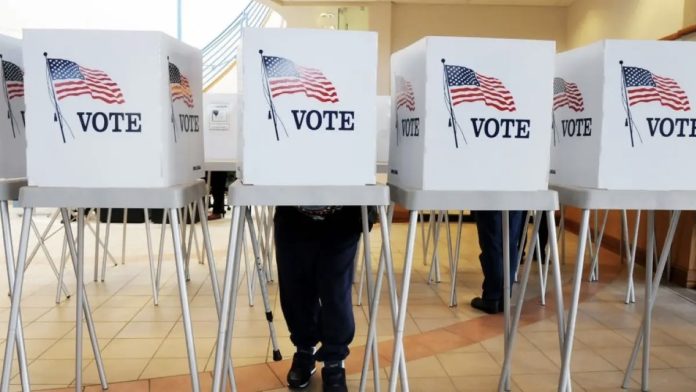
Democratic socialist Angie Nixon scored a surprise victory Tuesday in Florida’s Democratic U.S. Senate primary, defeating heavily funded establishment favorite Alex Vindman and adding to a growing series of socialist and far-left victories reshaping Democratic politics across the country.
Nixon, a 42-year-old state representative and longtime labor activist, won nearly 56% of the vote, according to reported results. Vindman — the former National Security Council official who became nationally known during President Donald Trump’s first impeachment — raised roughly 16 times as much money as Nixon but couldn’t overcome her grassroots campaign.
Nixon will now face Republican Sen. Ashley Moody in November for the remaining two years of the term formerly held by Secretary of State Marco Rubio. Florida has moved sharply toward Republicans in recent election cycles, and political analysts say Nixon’s nomination could make an already difficult Democratic pickup significantly harder.
Still, the result may carry consequences well beyond Florida.
Mamdani’s Victory Helped Open the Door
Nixon’s upset follows the dramatic rise of New York City Mayor Zohran Mamdani, a democratic socialist who stunned the Democratic establishment in 2025 by defeating former Gov. Andrew Cuomo in the mayoral primary before winning the general election.
Mamdani’s campaign centered on sweeping government intervention in housing, transportation and childcare, including rent freezes, free buses, publicly operated grocery stores and higher taxation on wealthy residents. His victory elevated him into one of the most prominent figures on the Democratic Party’s socialist wing.
His influence has since expanded.
In June, all three congressional candidates endorsed by Mamdani won their Democratic primaries in New York. Former city Comptroller Brad Lander defeated Rep. Dan Goldman, Assemblywoman Claire Valdez won an open congressional seat, and activist Darializa Avila Chevalier defeated five-term Rep. Adriano Espaillat, chairman of the Congressional Hispanic Caucus.
Two of the victories are expected to send self-described democratic socialists to Congress from heavily Democratic districts.
Socialist Candidates Advancing Beyond New York
The movement is no longer confined to New York.
The Democratic Socialists of America has also backed successful congressional candidates in Colorado. DSA member Janeese Lewis George won Washington, D.C.’s Democratic mayoral primary, while fellow member Nithya Raman advanced as one of two finalists in the Los Angeles mayoral race.
Reuters reported in July that the DSA claimed more than 100,000 members and had endorsed roughly 150 candidates nationwide during the 2026 election cycle, reporting dozens of victories at federal, state and local levels.
The organization advocates policies including Medicare for All, universal rent controls, tuition-free higher education, substantially higher taxes on corporations and wealthy Americans, public ownership of major infrastructure, a 32-hour workweek and sharply reduced U.S. military spending.
The DSA has also become increasingly hostile toward Israel, calling for an end to U.S. military and economic assistance and supporting divestment campaigns targeting the Jewish state.
A Growing Democratic Divide
The string of victories is intensifying a fundamental debate inside the Democratic Party.
Progressives argue the results show Democratic voters are increasingly frustrated with establishment leaders and attracted to candidates willing to challenge corporations, wealthy donors and traditional party institutions.
Moderate Democrats warn that strategies successful in overwhelmingly Democratic cities may become serious liabilities in competitive congressional and statewide races.
Former Democratic Rep. Steve Israel told Reuters that the party ultimately wins national power through moderate battleground states and districts, not deep-blue strongholds such as New York and California.
Florida may now provide one of the clearest tests yet.
Nixon’s victory shows that democratic-socialist candidates can defeat well-funded establishment Democrats even in states far removed from the movement’s traditional urban strongholds. Whether that ideological energy translates into general-election victories in Republican-leaning territory is another question entirely.
For Democrats heading toward November, the emerging struggle may no longer be simply about defeating Republicans — but about deciding what kind of party Democrats intend to become.