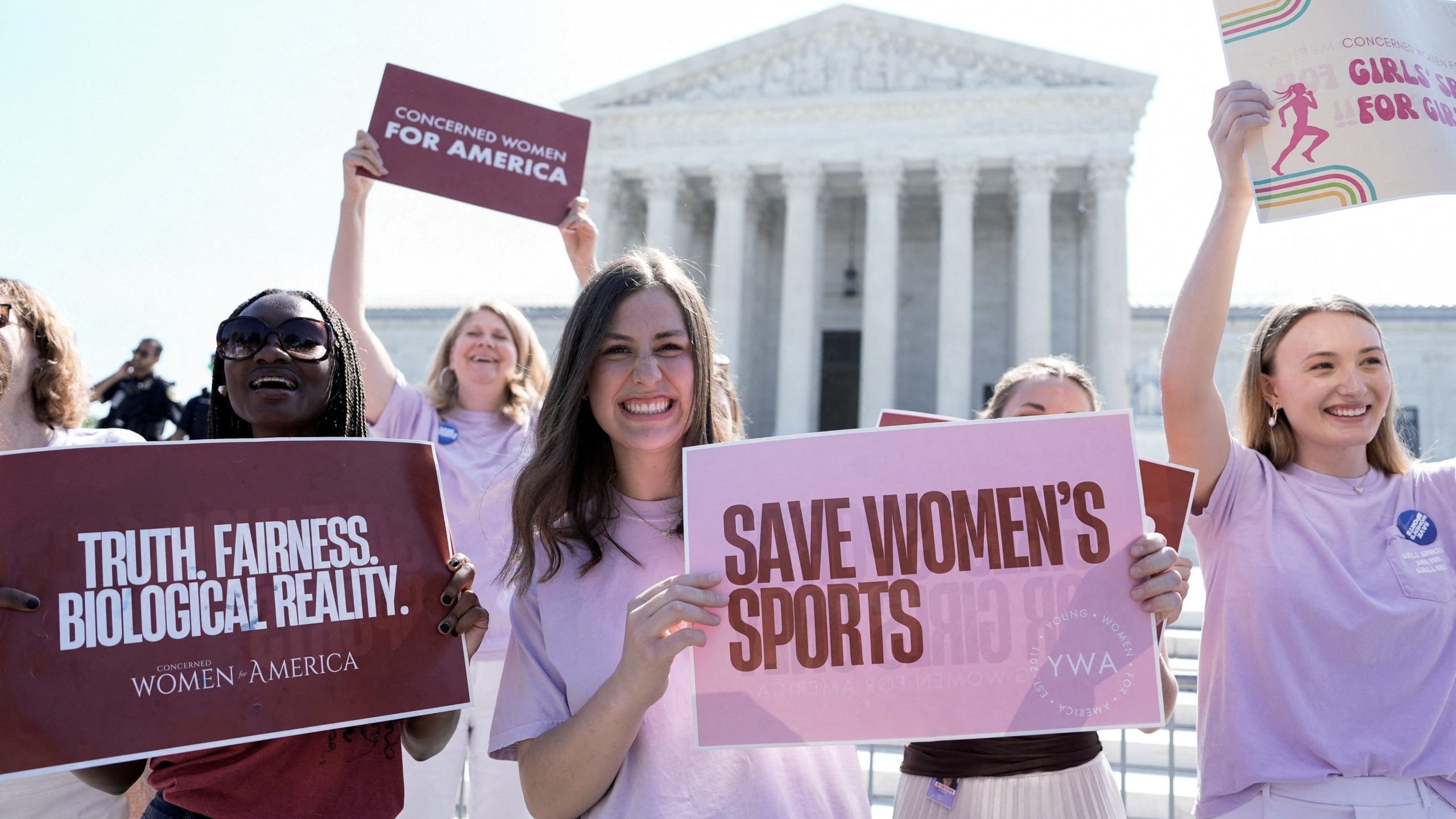

On Tuesday, after years of legal battles, the Supreme Court weighed in decisively, favoring the ability of states to protect women and girl athletes from unfair competition and safety risks. The 6-3 ruling comes after laws in two states, Idaho and West Virginia, were challenged for opposing the invasion of biological males in female sports competitions.
The Supreme Court heard oral arguments for both cases in January, and Tuesday’s long-awaited ruling sparked widespread celebration among female athletes, parents, coaches and other advocates who have long fought to preserve fair play. Organizations like Alliance Defending Freedom (ADF), which represented defendants in both cases, applauded the “massive Supreme Court victory for women’s sports.”
Franklin Graham also reacted: “I’m so thankful that the Supreme Court has ruled in favor of protecting women and girls in sports. This historic ruling permits states to protect fairness, opportunity, and safety for female athletes. Justice Clarence Thomas wrote, ‘A man does not have a legal right to compete against women just because he believes that he is a woman.’ Also, a big thank you to the courageous young women who took a stand when coaches, administrators, and many others remained silent.”
ADF President Kristen Waggoner said the court’s ruling represents a “victory for every girl who refused to stay quiet,” pointing to real-world cases where biological males dominated competitions, displaced hundreds of girls, and even raised safety issues in locker rooms.
“Men cannot be women, and no drug erases the male athletic advantage,” Waggoner asserted. “After today’s decision, the 27 states that have enacted laws protecting women’s sports can confidently enforce them. And the 23 states still on the sidelines have run out of excuses.”
Idaho Attorney General Raúl Labrador and West Virginia Attorney General JB McCuskey praised the decision as affirming common sense, biological reality and the original intent of Title IX. Female athletes who lost podiums, records and opportunities expressed relief that their hard work would no longer be undermined.
Two Cases, One Issue
Both Idaho and West Virginia implemented state laws that barred biological males from female sports competitions—actions that were quickly met with opposition from activists and lower courts. Idaho’s Fairness in Women’s Sports Act (2020) and West Virginia’s Save Women’s Sports Act (2021) designated teams based on biological sex at birth to preserve fairness, safety and opportunity for biological females.
But quickly, LGBTQ activists accused the states of violating the Equal Protection Clause of the 14th Amendment and federal Title IX rules. Challengers, including Lindsay Hecox in Idaho and B.P.J. (Becky Pepper-Jackson) in West Virginia, argued that the laws discriminated on the basis of sex and so-called “gender identity.” Lower courts had issued mixed rulings, with some blocking the laws and allowing biological males to compete.
Critics of the laws often downplayed inherent biological differences, but the states presented evidence of male physiological advantages in strength, speed and endurance that persist even after hormone suppression—advantages that the states argued have led to displaced female athletes, lost scholarships, safety concerns in contact sports and more.
The Ruling Many Hoped For
The Court ruled to uphold the bans on biological males in female competitions in Idaho and West Virginia, with justices ultimately holding that the laws do not conflict with the 14th Amendment or Title IX rules, which cover sex-based discrimination. In fact, the justices ruled unanimously that the laws do not violate Title IX, concluding that it was enacted to advance opportunities for women and was never designed to erase sex-based distinctions in athletics.
Writing for the majority, Justice Brett Kavanaugh explained: “To provide equal opportunity for female athletes, schools do not merely maintain, for example, one soccer team, one basketball team, one ice hockey team, and one lacrosse team that are equally open to female and male athletes. That approach would deny equal opportunity to female athletes because, as all agree, females and males have inherent physical differences relevant to athletic performance.”
He posed the core question in simple terms: “[M]ay schools determine eligibility for women’s and girls’ sports based on biological sex? The answer is yes.” The opinion noted that, apart from Idaho and West Virginia, 27 states have enacted similar laws safeguarding women’s and girls’ sports for biological females “in the past six years.”
Kavanaugh was joined by Chief Justice John Roberts and Justices Amy Coney Barrett, Samuel Alito, Clarence Thomas, and Neil Gorsuch—with the latter two filing concurring opinions. Justice Sonia Sotomayor filed an opinion concurring in part and dissenting in part, joined by Justices Elena Kagan and Ketanji Brown Jackson, with Jackson also filing a separate opinion.
While the ruling provides strong precedent supporting sex-based categories in sports, implementation details, enforcement mechanisms (such as verification processes), and remaining lawsuits in other states will need to play out, with LGBTQ activists vowing legal and cultural resistance.
Bible passages to ponder amid the fight to protect women’s sports: Genesis 1:27, Micah 6:8