January 1, 2026

January, 1, 2026
January 1, 2026

give

untitled artwork

untitled artwork

World news biblically understood

TRENDING:

Large Blast in Iran came from Suspected Missile Site, Satellite Images Show

An explosion that rattled Iran’s capital came from an area in its eastern mountains that analysts believe hides an underground tunnel system and missile production sites, satellite photographs showed Saturday.

What exploded in the incident early Friday that sent a massive fireball into the sky near Tehran remains unclear, as does the cause of the blast. The Fars news agency, which is close to the country’s ultra-conservatives, initially reported that the blast was caused by “an industrial gas tank explosion” near a facility belonging to the defense ministry. It cited an “informed source” and said the site of the incident was not related to the military.

The unusual response of the Iranian government in the aftermath of the explosion, however, underscores the sensitive nature of an area near where international inspectors believe the Islamic Republic conducted high-explosive tests two decades ago for nuclear weapon triggers.

The blast shook homes, rattled windows and lit up the horizon early Friday in the Alborz Mountains. State TV later aired a segment from what it described as the site of the blast.

One of its journalists stood in front of what appeared to be large, blackened gas cylinders, though the camera remained tightly focused and did not show anything else around the site. Defense Ministry spokesman Davood Abdi blamed the blast on a leaking gas he did not identify and said no one was killed in the explosion.

Abdi described the site as a “public area,” raising the question of why military officials and not civilian firefighters would be in charge. The state TV report did not answer that.

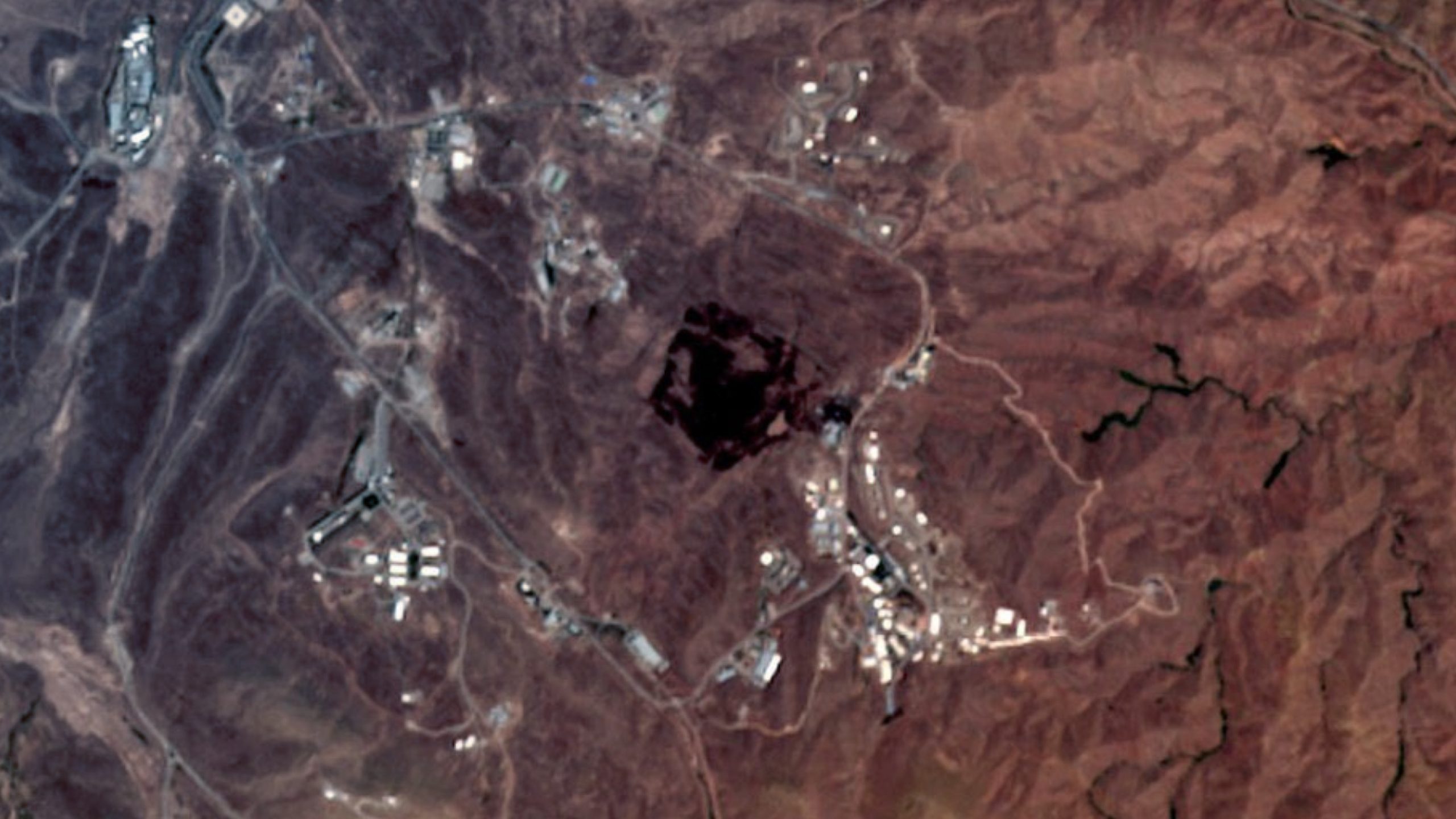
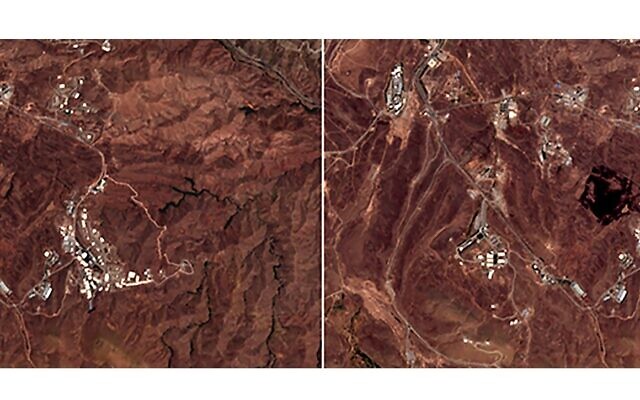
Satellite photos of the area, some 20 kilometers (12.5 miles) east of downtown Tehran, showed hundreds of meters (yards) of charred scrubland not seen in images of the area taken in the weeks ahead of the incident. The building near the char marks resembled the facility seen in the state TV footage.

The gas storage area sits near what analysts describe as Iran’s Khojir missile facility. The explosion appears to have struck a facility for the Shahid Bakeri Industrial Group, which makes solid-propellant rockets, said Fabian Hinz, a researcher at the James Martin Center for Nonproliferation Studies at the Middlebury Institute of International Studies in Monterey, California.
satellite
Photo combo from the European Commission’s Sentinel-2 satellite shows the site of an explosion, before, left, and after, right, that rattled Tehran, on June 26, 2020 (European Commission via AP)

The Washington-based Center for Strategic and International Studies identified Khojir as the “site of numerous tunnels, some suspected of use for arms assembly.” Large industrial buildings at the site visible from satellite photographs also suggest missile assembly being conducted there.

The US Defense Intelligence Agency says Iran overall has the largest underground facility program in the Middle East.

Such sites “support most facets of Tehran’s ballistic missile capabilities, including the operational force and the missile development and production program,” the DIA said in 2019.

Iranian officials themselves also identified the site as being in Parchin, home to a military base where the International Atomic Energy Agency previously said it suspects Iran conducted tests of explosive triggers that could be used in nuclear weapons. Iran long has denied seeking nuclear weapons, though the IAEA previously said Iran had done work in “support of a possible military dimension to its nuclear program” that largely halted in late 2003.

Western concerns over the Iranian atomic program led to sanctions and eventually to Tehran’s 2015 nuclear deal with world powers. The US under President Donald Trump unilaterally withdrew from the accord in May 2018, leading to a series of escalating attacks between Iran and the US, and to Tehran abandoning the deal’s production limits.

satellite
CLICK HERE FOR
SOURCE

give

untitled artwork

The Destructive Nature Of The Goddess Movement

Although we see different names and different locations, in essence they all originated in mankind’s desire to worship a goddess figure. Although there have also been false male gods worshipped throughout the millennia, it is interesting to see mankind continually stumble into the worship of a feminine divine figure. Why is that so?

Are We Listening?: Rightly Dividing God’s Prophetic Word

At the heart of the disagreement between the various eschatological viewpoints lies the Millennium. We have addressed the theological variance in those perspectives many times, but suffice it to say that anyone who simply opens the Book and reads God’s prophetic revelations will tend to come to a Pre-Tribulation, Pre-Millennial understanding.

sign up

Prime Minister Anthony Albanese Has Been Failing Australia’s Jewish Community For 25 Years

The Australian Jewish News reported that Mr Albanese had also been at a Canberra rally in 2000, referring to him as a “pro-Palestinian Labor MP.” Sadly, as it is now, so it was then. Synagogues were vandalised in both Sydney and Canberra (the locations of the two rallies), and Jewish families were advised to avoid public displays of faith.   Where did Australia go wrong? In part, 25 years ago. Anthony Albanese failed Australia’s Jewish community in 2000, and he failed them again in 2025. By God’s mercy, may this be the last of his failures.

ABC's of Salvation

Decision

UTT

untitled artwork

Israel My Glory

An explosion that rattled Iran’s capital came from an area in its eastern mountains that analysts believe hides an underground tunnel system and missile production sites, satellite photographs showed Saturday.

What exploded in the incident early Friday that sent a massive fireball into the sky near Tehran remains unclear, as does the cause of the blast. The Fars news agency, which is close to the country’s ultra-conservatives, initially reported that the blast was caused by “an industrial gas tank explosion” near a facility belonging to the defense ministry. It cited an “informed source” and said the site of the incident was not related to the military.

The unusual response of the Iranian government in the aftermath of the explosion, however, underscores the sensitive nature of an area near where international inspectors believe the Islamic Republic conducted high-explosive tests two decades ago for nuclear weapon triggers.

The blast shook homes, rattled windows and lit up the horizon early Friday in the Alborz Mountains. State TV later aired a segment from what it described as the site of the blast.

One of its journalists stood in front of what appeared to be large, blackened gas cylinders, though the camera remained tightly focused and did not show anything else around the site. Defense Ministry spokesman Davood Abdi blamed the blast on a leaking gas he did not identify and said no one was killed in the explosion.

Abdi described the site as a “public area,” raising the question of why military officials and not civilian firefighters would be in charge. The state TV report did not answer that.

Satellite photos of the area, some 20 kilometers (12.5 miles) east of downtown Tehran, showed hundreds of meters (yards) of charred scrubland not seen in images of the area taken in the weeks ahead of the incident. The building near the char marks resembled the facility seen in the state TV footage.

The gas storage area sits near what analysts describe as Iran’s Khojir missile facility. The explosion appears to have struck a facility for the Shahid Bakeri Industrial Group, which makes solid-propellant rockets, said Fabian Hinz, a researcher at the James Martin Center for Nonproliferation Studies at the Middlebury Institute of International Studies in Monterey, California.

satellite
Photo combo from the European Commission’s Sentinel-2 satellite shows the site of an explosion, before, left, and after, right, that rattled Tehran, on June 26, 2020 (European Commission via AP)

The Washington-based Center for Strategic and International Studies identified Khojir as the “site of numerous tunnels, some suspected of use for arms assembly.” Large industrial buildings at the site visible from satellite photographs also suggest missile assembly being conducted there.

The US Defense Intelligence Agency says Iran overall has the largest underground facility program in the Middle East.

Such sites “support most facets of Tehran’s ballistic missile capabilities, including the operational force and the missile development and production program,” the DIA said in 2019.

Iranian officials themselves also identified the site as being in Parchin, home to a military base where the International Atomic Energy Agency previously said it suspects Iran conducted tests of explosive triggers that could be used in nuclear weapons. Iran long has denied seeking nuclear weapons, though the IAEA previously said Iran had done work in “support of a possible military dimension to its nuclear program” that largely halted in late 2003.

Western concerns over the Iranian atomic program led to sanctions and eventually to Tehran’s 2015 nuclear deal with world powers. The US under President Donald Trump unilaterally withdrew from the accord in May 2018, leading to a series of escalating attacks between Iran and the US, and to Tehran abandoning the deal’s production limits.

satellite
CLICK HERE FOR
SOURCE

Trusted Analysis From A Biblical Worldview

Help reach the lost and equip the church with the living and active truth of God's Word in our world today.

YOU CARE ABOUT

BIBLICAL TRUTH. SO DO WE.


Together, We Can Deliver A Biblical Understanding

Of News Events Around The World.

The Destructive Nature Of The Goddess Movement

Although we see different names and different locations, in essence they all originated in mankind’s desire to worship a goddess figure. Although there have also been false male gods worshipped throughout the millennia, it is interesting to see mankind continually stumble into the worship of a feminine divine figure. Why is that so?

Are We Listening?: Rightly Dividing God’s Prophetic Word

At the heart of the disagreement between the various eschatological viewpoints lies the Millennium. We have addressed the theological variance in those perspectives many times, but suffice it to say that anyone who simply opens the Book and reads God’s prophetic revelations will tend to come to a Pre-Tribulation, Pre-Millennial understanding.

untitled artwork 6391

Prime Minister Anthony Albanese Has Been Failing Australia’s Jewish Community For 25 Years

The Australian Jewish News reported that Mr Albanese had also been at a Canberra rally in 2000, referring to him as a “pro-Palestinian Labor MP.” Sadly, as it is now, so it was then. Synagogues were vandalised in both Sydney and Canberra (the locations of the two rallies), and Jewish families were advised to avoid public displays of faith.   Where did Australia go wrong? In part, 25 years ago. Anthony Albanese failed Australia’s Jewish community in 2000, and he failed them again in 2025. By God’s mercy, may this be the last of his failures.

ABC's of Salvation

TV AD

worldview matters

Decision Magazine V AD

Decision

Jan Markell

Israel My Glory

Erick Stakelbeck

untitled artwork

YOU CARE ABOUT

BIBLICAL TRUTH.

SO DO WE.

Together, We Can Deliver A Biblical Understanding Of News Events Around The World And Equip The Church To Stand With A Biblical Worldview.

Israel My Glory

untitled artwork

YOU CARE ABOUT

BIBLICAL TRUTH.

SO DO WE.


Together, We Can Deliver A Biblical Understanding Of News Events Around The World And Equip The Church To Stand With A Biblical Worldview.