



LIVE UPDATES — FROM Feb. 22nd – 28th
Israel At War: Week Seventy-Three Coverage

Day 511 — Friday, February 28
At Least 13 Wounded In Combined Terror Ramming, Stabbing Attack In Central Israel

At least 13 pedestrians were wounded after a terrorist rammed into pedestrians on Highway 65 near the Pardes Hanna-Karkur intersection, Israel Police confirmed on Thursday afternoon.
Following the ramming, police officers immediately identified the suspect’s vehicle traveling toward Gan Shmuel and blocked its path.
The terrorist accelerated, rammed a police vehicle, and then exited while charging at officers with a sharp object, later identified as a screwdriver. At this point, the terrorist was shot.
Thirteen civilians were injured in the attack, including one critically and two seriously. A police officer was also among the injured.
Hillel Yaffe Medical Center in Hadera said it had received one individual in critical condition, two in serious condition, and three in moderate condition. MDA reported that a 17-year-old girl was the person who was critically wounded.
Later on Thursday evening, a MDA helicopter transported two seriously wounded people from Hillel Yaffe Hospital to Sheba Hospital in Tel Hashomer, including the teenage girl – who reportedly has head and limb injuries and is sedated and on a ventilator – and a 76-year-old man with a head injury who is sedated and on a ventilator.
Later the police confirmed that the terrorist was a 53-year-old Palestinian from Jenin who was residing illegally in Israel with his family. The circumstances of his presence in Israel are under investigation by the ISA.
Israel Police spokesperson: “The terrorist ran over several people at a bus station, then proceeded to stab others with a screwdriver and crashed into a police vehicle.”
Day 511 — Friday, February 28

Freed hostage Eli Sharabi says he became especially close with 24-year-old Alon Ohel while they and two other Israelis were held hostage in Gaza under cramped, painful conditions.
“I adopted him from the first minute,” Sharabi says. “24/7 together. I know everything about him and his family.”
Sharabi, 53, tells Channel 12’s “Uvda” investigative program the men were able to draw strength from one another. But Ohel took it very hard when he learned that Sharabi and the two others, Or Levy and Eliya Cohen, were being released.
Sharabi says that when he was released with Levy on February 8, Ohel grabbed him and refused to let go until their guard tore him away. He says there were “moments of hysteria” and it took about 15 minutes to calm him down.
“It was a very hard moment,” he says. “He said he was happy for me. I promised him I won’t leave him there. I will fight for him.” Cohen was released two weeks later, leaving Ohel alone.
Sharabi, who lost over 30 kilograms (66 pounds) in captivity, says terrorists held the four hostages in iron chains, and sometimes beat or humiliated them, and they subsisted for months on a single plate of pasta each day.
He says that the hunger pains were unbearable and that getting his captors to give them a dried-out date or a quarter of a piece of bread felt like a victory.
“You could know what happened in the news just from their conduct,” Sharabi says when asked if their captors were exposed to Israeli media, “and therefore… [Israeli leaders’] comments in the media have a lot of power.”
“Any irresponsible remark, the first to get it was us,” he continued. “[The captors] come to us and say, ‘They’re not giving our prisoners food, you won’t eat. They’re beating our prisoners, we’ll beat you. They don’t get a shower, you won’t get a shower.’ It’s all the time there.”
Sharabi was abducted on October 7, 2023, from his home in Kibbutz Be’eri. Sharabi says he had no access to the news and only learned after his release that his wife and two daughters, as well as his brother, were all killed in the Hamas-led attack.
Despite the pain, he says that he feels lucky to be alive and fortunate for the time he spent with his wife Lianne, and daughters, Noiya and Yahel.
“I’m not angry,” he says. “I was lucky I had Lianne for 30 years, I was lucky I had those amazing daughters for years.”
Day 510 — Thursday, February 27
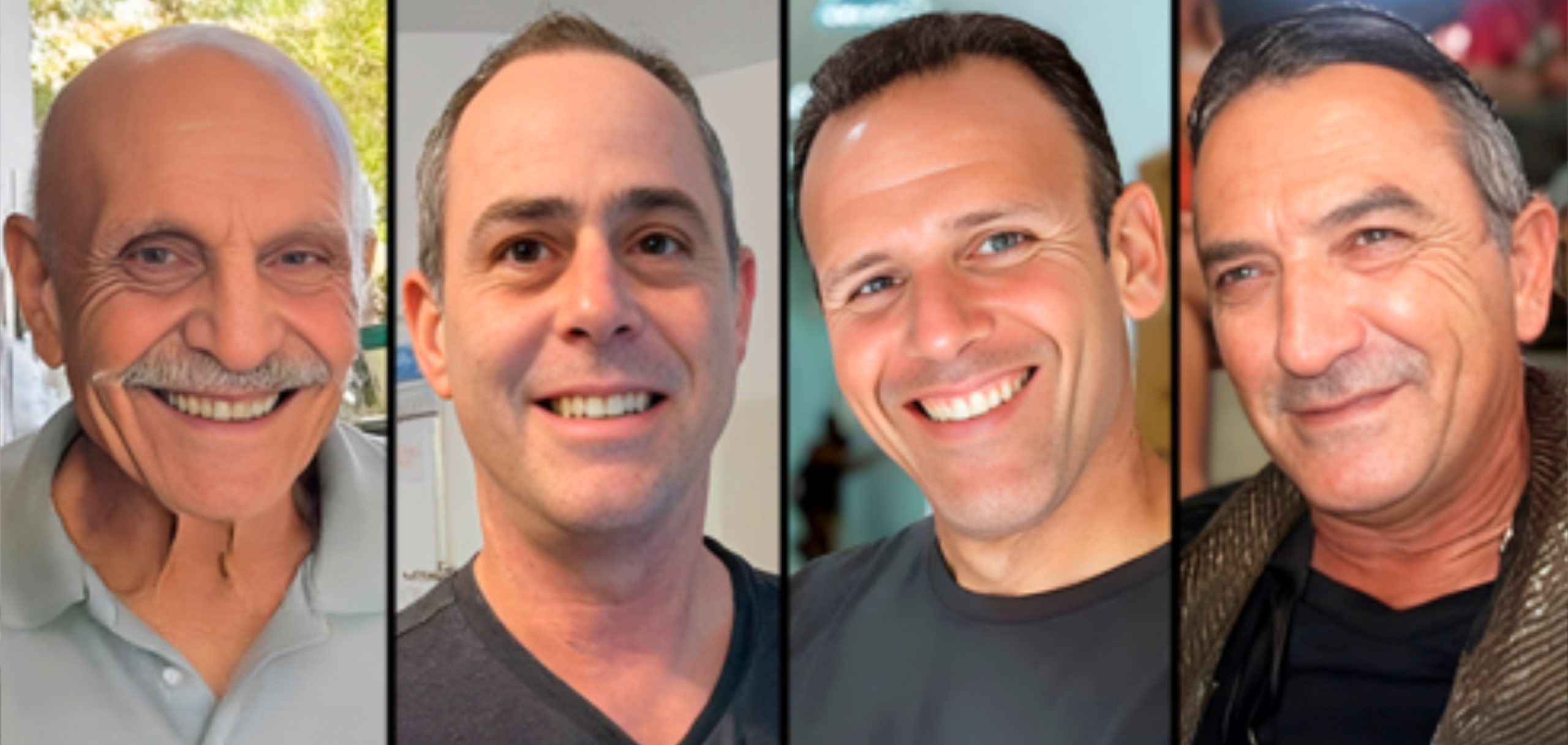
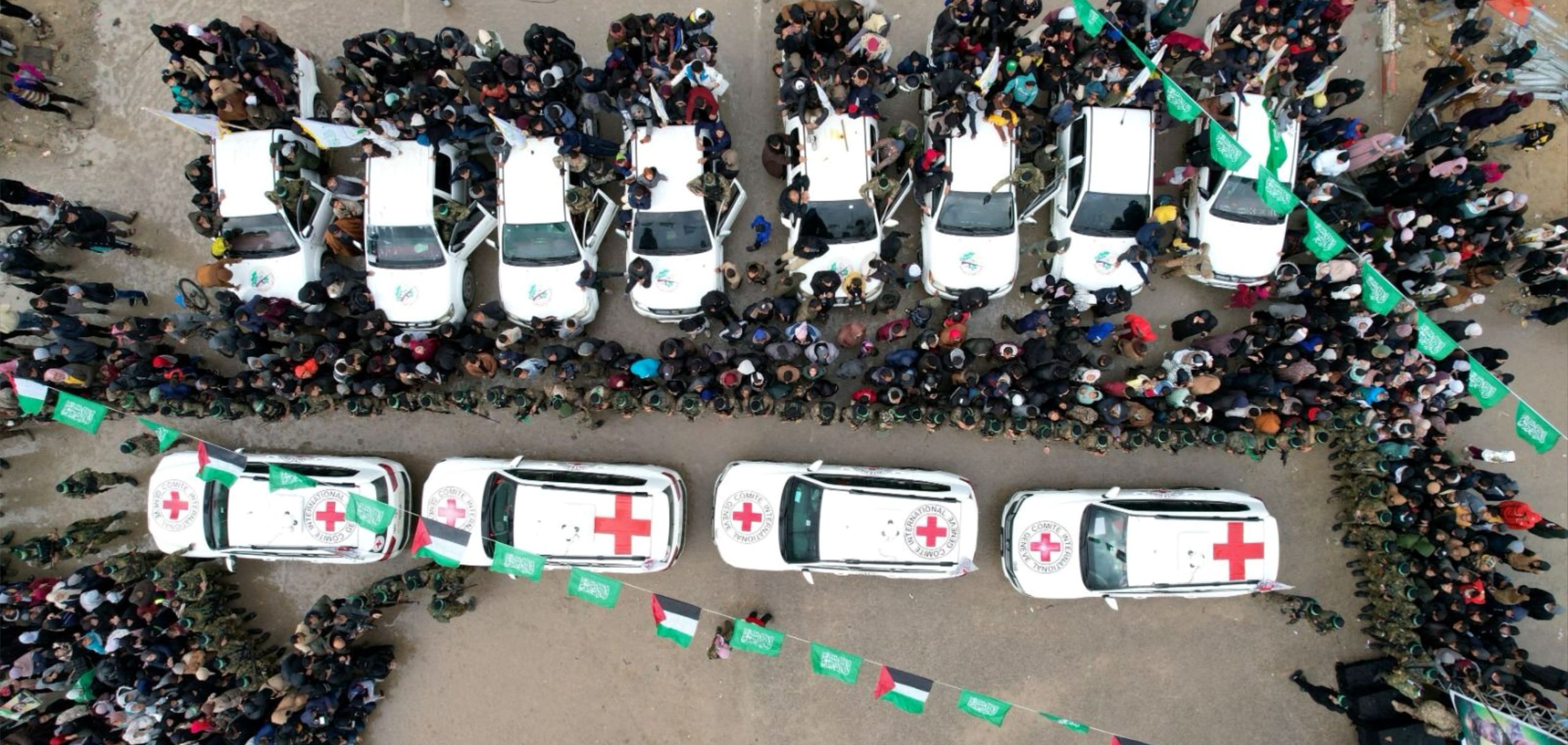
Israel received coffins early Thursday from the Red Cross, after the remains of four Israeli hostages murdered in captivity had been transferred to the international organization in the Gaza Strip.
The four were positively identified as Itzik Elgarat, Ohad Yahalomi, Shlomo Mansour, and Tsachi Idan, who were kidnapped from their homes on October 7, 2023, before being murdered while held hostage by Hamas in Gaza. Hundreds of Palestinian prisoners were released to secure the return of the bodies.
Day 510 — Thursday, February 27

Late Tuesday night, Israeli warplanes carried out airstrikes on military targets in southern Syria, including the town of Kisweh, located around 20 kilometers south of Damascus. The attack, confirmed by local security sources and Syria TV, resulted in blasts heard across the region. The strikes were part of a broader Israeli operation to ensure that Syrian regime forces and terrorist groups do not breach Israel’s security buffer zone in southern Syria.
Defense Minister Israel Katz stressed that these strikes were essential to maintaining Israel’s security. “We will not allow southern Syria to become southern Lebanon,” Katz declared, referencing Israel’s ongoing efforts to prevent the establishment of enemy forces near its borders. “The Air Force is currently conducting powerful strikes in southern Syria as part of our new policy of demilitarizing the region,” he added, emphasizing that any attempts by Syrian regime forces or terrorist organizations to entrench themselves in southern Syria would be met with force.
Syrian reports indicate that at least two individuals were killed, and several others were injured in the airstrikes on Kisweh. The attacks primarily targeted military vehicles within the town. The Israeli Defense Forces (IDF) confirmed the destruction of multiple military sites, including command centers and weapons storage locations. According to the IDF, the presence of these military assets in southern Syria posed a direct threat to Israeli civilians, prompting continued military operations to remove these dangers.
In addition to the airstrikes in Syria, the IDF has also been engaged in counterterrorism operations within Judea and Samaria. On Tuesday, Israeli forces, in cooperation with Shin Bet, thwarted a terrorist plot involving a 100 kg bomb in Kabatiya. As part of this operation, the Nahal Brigade troops apprehended 15 suspected terrorists, dismantled explosives, and seized weapons. The ongoing counterterrorism operation, named Operation Iron Wall, has seen multiple successful strikes against terrorist cells in the West Bank, including a recent attack on a terror cell in a vehicle.
Day 510 — Thursday, February 27

Sen. Ted Cruz (R-Texas) on Tuesday expressed his long-held support for Israel and what he said was its biblically rooted right to its historic homeland in Judea and Samaria
Addressing the Sovereignty Conference 2025 in Jerusalem on Tuesday via video, Cruz reiterated his long-held position that Israel has an “absolute right to determine what happens in Judea and Samaria.”
That right “starts in the Bible and extends through modern times,” he added.
Thanking Yesha Council chairman Israel Gantz for his work to strengthen the U.S.-Israel alliance, Cruz said, “As you meet today, have confidence that the American people stand with you. And under President Trump and our new Republican Congress, the American government stands with you as well.”
The Yesha Council is an umbrella group of local and regional councils in Judea and Samaria.
“As for your enemies, who are also the enemies of America, we know that they seek to weaken you and to weaken us. And then to destroy you. And then to destroy us,” continued Cruz.
He expressed sympathy for the “unfathomable trauma” Israel and the Jewish people endure as “Palestinian savages make the return of every hostage, living or murdered, an ongoing nightmare.”
Cruz quoted remarks by Menachem Begin, part of a famous exchange the former Israeli prime minister had with then-Senator Joe Biden in June 1982.
Biden reportedly banged on the table with his fist, to which Begin replied, “This desk is designed for writing, not for fists. Don’t threaten us with slashing aid.”
Quoting Begin, Cruz said: “Don’t threaten us with cutting off your aid. It will not work. I am not a Jew with trembling knees. I am a proud Jew with 3,700 years of civilized history. Nobody came to our aid when we were dying in the gas chambers and ovens. Nobody came to our aid when we were striving to create our country.
“We paid for it. We fought for it. We died for it. We will stand by our principles. We will defend them. And when necessary, we will die for them again. With or without your aid.”
The Texas senator concluded: “Every person in this room has paid for the Land of Israel, has fought for the Land of Israel, and far too many have died for the Land of Israel. I am proud to stand with you unshakably as you determine the future of Judea and Samaria.”
The Sovereignty Conference brings together prominent leaders and activists on the Israeli right. The event spotlighted expectations for Israel’s government to change the status quo in Judea, Samaria and Gaza, with support from the U.S. administration.
Co-produced by the Yesha Council of Judea and Samaria communities, the event has served for over two decades as a platform to advocate making Judea, Samaria and Gaza, or areas therein, part of Israel.
Day 510 — Thursday, February 27

More than 100,000 Israelis lined the roads as the funeral cars carrying the bodies of slain former hostages Shiri, Ariel, and Kfir Bibas made their way to the cemetery in southern Israel, not far from their home at Kibbutz Nir Oz. The crowd carried Israeli flags and orange balloons, depicting the color of the children’s hair, now a symbol of honor and shared grief for the family.
In a statement, the family wrote, “We see and hear you; we are moved and strengthened by you.” They added, “Yarden (a former hostage, husband of Shiri, and father of Ariel and Kfir) apologizes for not being able to come and hug each and every one of you. We hope for the day when we can once again be together in moments of joy and not sadness.”
Ben Gurion Airport, the Israeli Knesset, and the President’s Residence were lit up in orange Tuesday night to remember the mother and children whose plight captured Israel’s heart.
President Isaac Herzog issued a statement reading, in part, “While an entire nation prayed and hoped for a different outcome, we are left wounded and in pain. Yet, even in our grief, we will continue to pray for better days and for the swift return of all the remaining hostages still held in Gaza.”
The Knesset met Wednesday morning and began with a minute of silence to remember the Bibas family. In his remarks, Knesset Speaker Amir Ohana referred to Kibbutz Nir Oz co-founder Oded Lifshitz, 83, whose body was returned with the Bibas children.
“Last night, Oded Lifshitz was laid to rest, may God avenge his blood, and the Knesset building was lit up in orange in memory of those being laid to rest at this moment: Shiri Bibas and her two young sons, Ariel and Kfir, the redheads, may God avenge their blood,” Ohana declared.
Day 509 — Wednesday, February 26
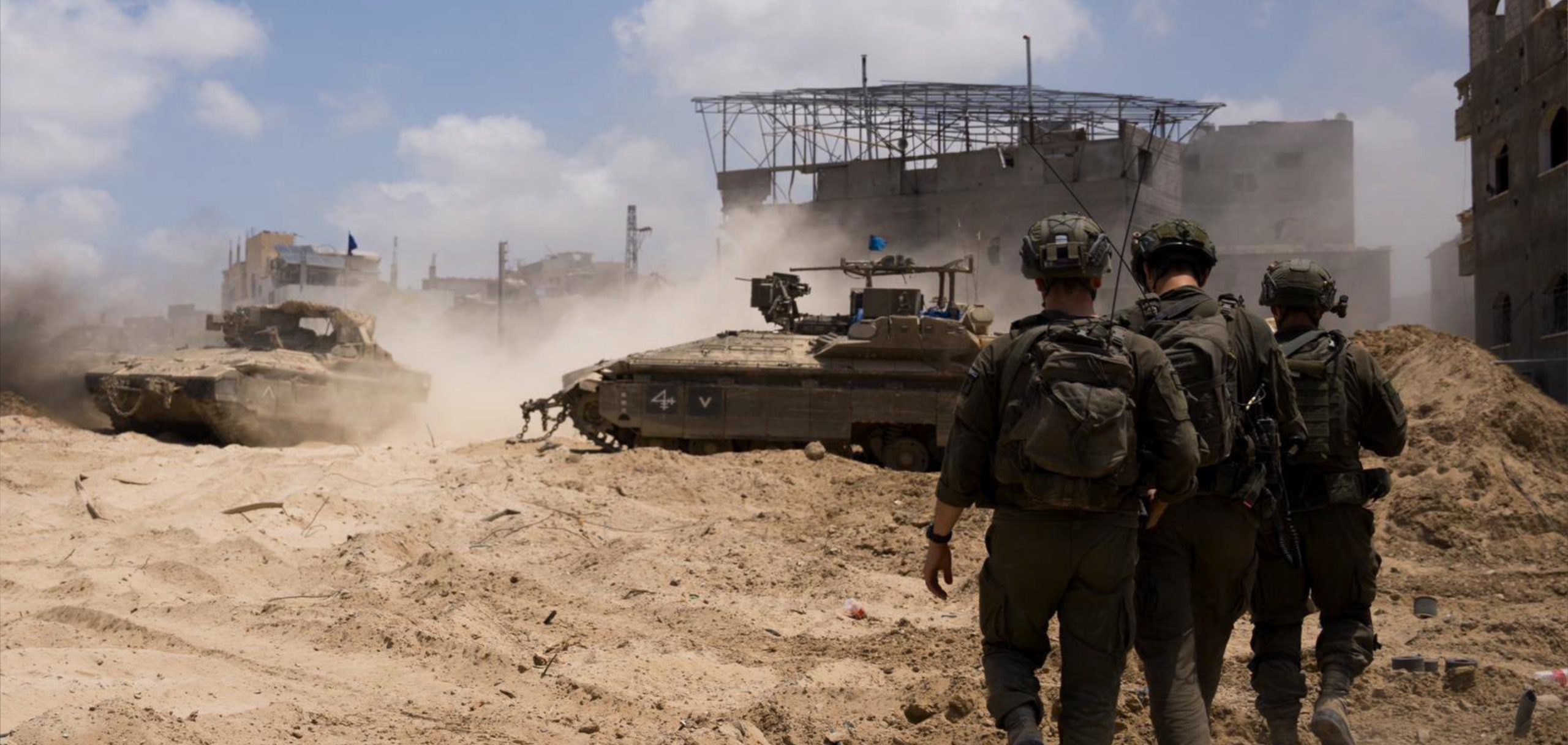
In a recent interview with The New York Times, Mousa Abu Marzouk, the head of Hamas’s foreign relations office, expressed regret over the destructive consequences of the October 7 attacks on Gaza. He admitted that had he known the scale of the devastation that would follow, he would never have agreed to the operation. Abu Marzouk, who was not informed of the full details of the plans, stated, “If it was expected that what happened would happen, there wouldn’t have been October 7.”
During the interview, Abu Marzouk described Hamas’s survival in the war against Israel as a “kind of victory,” though he was quick to clarify that this survival should not be viewed as a true victory, especially given the severe destruction Israel brought to Gaza. He further criticized Israel for “losing control” and taking “revenge against everything.”
In addition to discussing the group’s survival, Abu Marzouk spoke about Hamas’s willingness to negotiate on various issues, including the group’s weapons in Gaza. He also addressed the issue of hostages, revealing that Hamas would demand the release of additional prisoners in exchange for the remaining hostages. He stated that Hamas might be open to releasing all hostages if Israel agreed to release thousands of prisoners and withdrew from Gaza, effectively ending the war.
However, Hamas later responded to Abu Marzouk’s statements, claiming that the interview had misrepresented his words and taken them out of context. The organization emphasized that the October 7 operation was a reflection of their people’s right to resist and reject what they consider the siege, occupation, and settlements. Hamas reiterated that it would continue to uphold its armed resistance until they achieve “liberation and return” of “their land.”
Day 509 — Wednesday, February 26
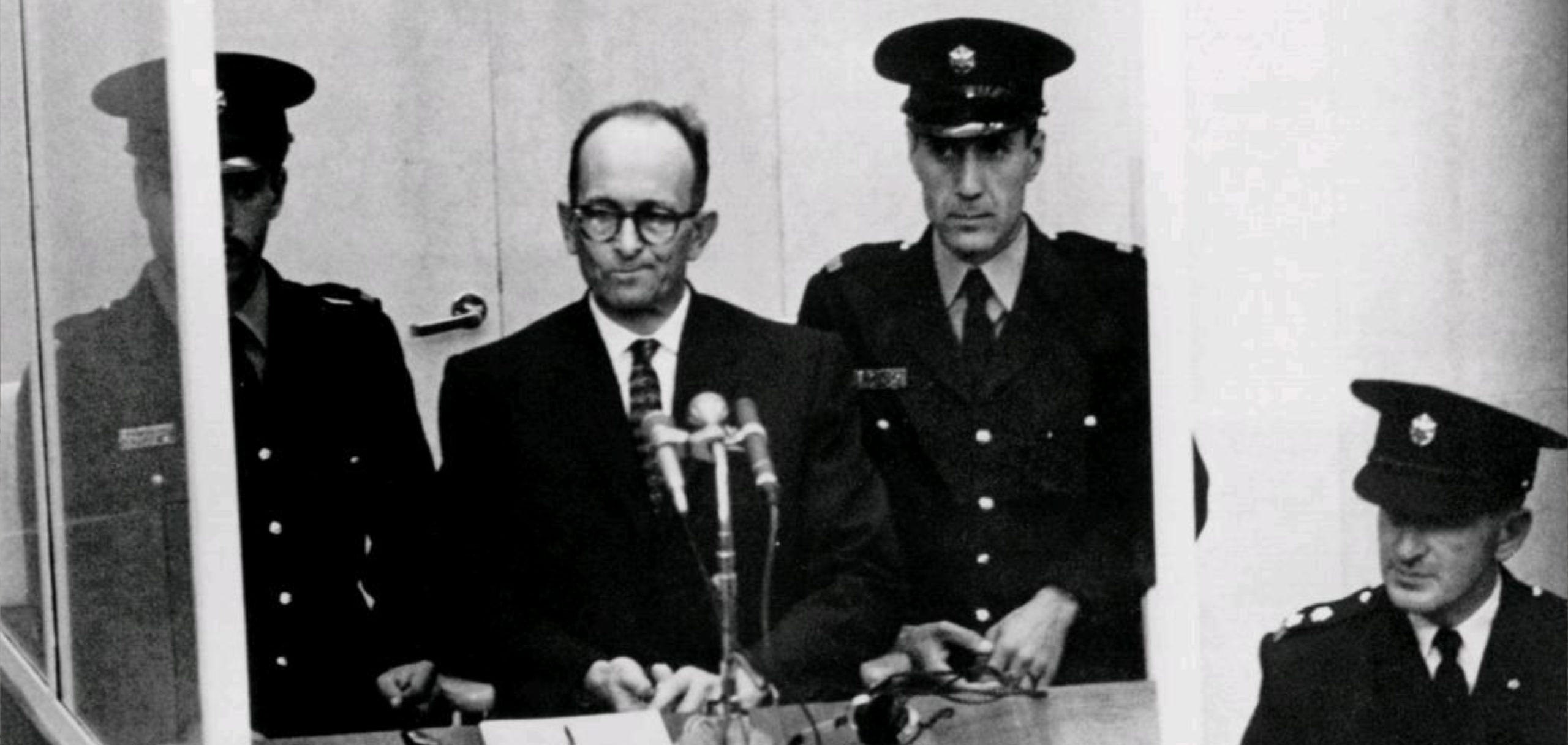
At a meeting at the presidential palace in Buenos Aires on Tuesday, Argentinian President Javier Milei assured visiting officials from the Simon Wiesenthal Center (SWC) that he would grant them access to classified documents detailing how 5,000 Nazi war criminals settled in Argentina after the Holocaust.
Ten thousand Nazi war criminals are estimated to have fled Europe – and justice – following World War II via escape routes known as the so-called “ratlines.” The records on the escapes and who financed them have remained classified with historians and Nazi hunters, including the SWC, unable to gain access.
“While some previous leaders promised full cooperation to get to the hard truths that involved Argentina’s past, Milei is the first to act with lightning speed to enable the SWC to uncover important pieces of the historic puzzle, especially as it related to involvement with Nazis before, during and after the Holocaust,” said Rabbi Abraham Cooper, associate dean of the SWC.
Chairman of the U.S. Senate Judiciary Committee, Sen. Charles Grassley, also sent a letter to Milei, requesting his help in finding out how the Nazi escape routes were organized and funded.
The letter was delivered to the Argentinian president by Jonathan Missner, managing partner at Stein, Mitchell, Beato & Missner. Missner legally represents the SWC and the victims of the Iran-Hezbollah bombing of the Jewish community center in Buenos Aires in 1994.
“President Milei is a staunch ally of the global Jewish community and was eager to open these archives. He knows that confronting Argentina’s history of Nazi collaboration requires nothing less than full transparency, and the same principle undergirds his pursuit of justice for the AMIA bombing,” said Missner.
He noted that uncovering the history of the escape routes will reveal the collusion of governments and large corporations in assisting Nazi war criminals.
“People should understand that for many decades after the Holocaust, governments and multinational corporations helped Nazis hide their stolen money, avoid prosecution, and live the free lives that their victims deserved,” Missner said.
In Argentina, that collusion went straight to the top government echelons with then-President Juan Peron, authorizing key aspects of the ratlines. Peron, alongside other South American leaders, not only welcomed German members of the Nazi party but also Hungarian, Croatian and other Nazi war criminals.
Alongside Argentina, several countries in the Americas secretly welcomed the fleeing Nazi war criminals, including Canada, the United States and Mexico. The Nazis who fled also found safe havens in Australia, Spain and Switzerland. The ratlines were known to U.S. intelligence, which reportedly handpicked top Nazi scientists from the escape routes.
There were two primary escape routes with one passing through Germany and Spain – and across the Atlantic to Argentina – and the second via Germany and Italy and across the Atlantic. The escape routes, which were quite elaborate, were reportedly established with the secret support of several officials from the Vatican.
Among the roughly 5,000 Nazis who were allowed to live out their lives in freedom in Argentina were war criminals Adolf Eichmann and Josef Mengele. The latter fled via the ratlines in 1948 by using the false identity of Helmut Gregor.
Day 508 — Tuesday, February 25

Israeli Prime Minister Benjamin Netanyahu displayed images of Shiri Bibas and her two young sons, Ariel and Kfir, during an address at a combat officers’ graduation ceremony on Sunday, delivering a solemn message.
“I want to show you something. I want to show you this picture of Shiri Bibas and her tender children, Ariel and Kfir Bivas. This picture says it all; I ask that you engrave it on the board of your hearts, so that you will always remember what we are fighting for and against whom we are fighting,” Netanyahu told the graduates, according to Fox News’ translation of the Hebrew speech. “We are fighting to secure our existence against man-monsters who have risen to annihilate us.”
“Already in the first days of the war, they murdered Shiri and her children in cold blood; they strangled the tender children with their own hands,” Netanyahu said, holding up a photo of the Bibas family. “And if they could, they would have killed us all with the same cruelty, until our very last man. Against this we fight, and these monsters we must and can defeat – and defeat them we will. This is our mission, and this is your mission!”
“As the defenders of our homeland, each of you is imbued with purpose, wielding sword and shield,” he added. “We have high expectations of you, but I know that above all, you have expectations of yourselves.”
Hamas handed over the bodies of the two young brothers on Thursday, but initially returned the wrong remains for Shiri in what Netanyahu had decried as a “brazen violation of their agreement.” The Israeli mother’s actual remains were handed over on Saturday and identified by Israeli forensic authorities to be Shiri following a standoff with the terrorist group. Also returned was the body of Oded Lifshitz, a fellow resident of Kibbutz Nir Oz kidnapped by Hamas on Oct. 7, 2023, and who Israel says was murdered in captivity. The Israel Defense Forces said the boys’ bodies proved they were “murdered by terrorists in cold blood,” despite Hamas previously claiming the brothers were killed in an airstrike.
In his speech Sunday, Netanyahu said President Donald Trump “sees eye to eye with us on everything related to Gaza.”
“We support President Trump’s groundbreaking plan to allow free exit for Gazans, and to create a different Gaza,” Netanyahu told the graduating combat officers.
“I thank President Trump for his directive to supply Israel with vital weapons,” Netanyahu said. “The new defensive and offensive arms will greatly aid us in achieving absolute victory. At the same time, we have approved enormous budgets for the domestic development of weapon systems – systems that will enhance our ability to stand up to our enemies on our own.“
Day 508 — Tuesday, February 25

Israel deployed tanks in Jenin for the first time in over 20 years on Sunday, signaling an extended military presence in northern Samaria as it intensifies counterterrorism operations in the region.
For the first time since 2002, Israel deployed tanks in Judea and Samaria following bus bombings in Bat Yam and Holon.
Prime Minister Benjamin Netanyahu vowed to intensify the conflict during a rare visit to the Tulkarem refugee camp.
During a troop visit and briefing by commanders, Netanyahu stated, “In the past year, we have greatly increased our activity. We are entering the terrorist strongholds, clearing entire streets used by terrorists, their homes. We are eliminating terrorists and commanders.”
Israeli Defense Minister Israel Katz ordered the military to “increase the intensity of the activity to thwart terrorism” in Judea and Samaria, stating that troops will remain “for the coming year” and that Palestinians who have fled cannot return.
“We will not allow the return of residents, and we will not allow terrorism to return and grow,” he emphasized.
Katz also instructed the military to prepare for “an extended stay” in emptied Judea and Samraria urban areas, from which about 40,000 Palestinians have fled.
Since launching “Operation Iron Wall” in Judea and Samaria on January 19, Israeli forces have arrested over 200 terror suspects, eliminated 71 deemed security threats, and confiscated more than 300 weapons and explosives. They have also uncovered a bomb-making laboratory.
Additionally, since the October 7 attacks, Israeli forces have detained 6,000 Palestinians in Judea and Samaria, with around 40 percent linked to Hamas.
Day 508 — Tuesday, February 25
As the Israeli hostages return home from Gaza after more than one year, their families are beginning to report on the difficult conditions they faced in Hamas captivity.
The six hostages recently released said they were severely punished without explanation, subjected to physical and psychological torture, and interrogated about their military past.
Several hostages reported receiving meager rations, with their food supply increasing only in the days leading up to their release.
While the female hostages, who returned in the current hostage-ceasefire deal, testified that they were mostly kept in private homes of Gazan families, the male hostages say they were primarily kept in tunnels underground. Medical teams reported that the hostages returned with various conditions, indicating prolonged malnutrition and lack of exposure to sunlight.
During IDF bombings, the men were sometimes moved into deeper tunnels, which were narrower.
Israeli hostage Omer Shem Tov, who returned on Saturday, told his parents that he was “afraid to fall asleep, to wake up, and to realize that it was not a dream.”
Shem Tov was kept by himself in a tunnel after the release of Itai Regev in the November 2023 hostage-ceasefire deal. He suffers from asthma and didn’t receive any medication during his captivity.
Both Omer Wenkert and Eliya Cohen reported that they were kept isolated in tunnels during most of their captivity, were deliberately starved, and even held in cages part of the time. Wenkert was not exposed to any media and had no idea about the efforts to secure his release. Wenkert suffers from an inflammatory bowel disease and did not receive any medication for his condition, despite attempts by the Israeli government to transfer medications to the hostages.
Cohen has epilepsy and was also kept without any access to medication. His family said that during his captivity, he underwent surgery to extract bullets from his body without anesthesia.
The family also said he was held captive with hostages Alon Ohel, Eli Sharabi and Or Levy. The men were often chained together by hands and feet to prevent their escape. This caused wounds. They were also beaten by their captors. Sharabi and Levy were returned two weeks before Cohen. Alon Ohel is still in captivity, and Cohen said Ohel is being held alone after the release on Saturday.
Sha’aban al-Sayed, father of returned Bedouin hostage, Hisham, said his son returned severely troubled after a decade in Hamas captivity. Hisham has a diagnosed history of mental issues, including a 2010 diagnosis of “acute psychotic disorder” and a 2013 diagnosis of schizophrenia.
Hisham wandered into the Gaza Strip in 2015 and was abducted by Hamas terrorists. His family attempted to secure his release multiple times over the past decade, including sending messages to leading Muslim clerics in Gaza.
Sha’aban said his son’s condition indicates that he was severely mistreated.
“We were happy to be able to have him, but when I hugged him I saw that I was hugging something that wasn’t a human being. It looks like a human being, but it’s not a human being,” Sha’aban said. “He doesn’t know how to talk, he doesn’t have a voice, he has no memory of anything. It’s simple, it gives the feeling that he wasn’t held by human beings, and we’re angry about it and we want an answer, why this is happening with the hostages?”
Hostage Agam Berger, one of the female IDF observation scouts who was released at the beginning of the current hostage-ceasefire deal, said the terrorists would prevent her and Liri Elbag, with whom she was being held, from speaking in Hebrew. She explained that the neighbors didn’t know they were there, and that Hamas preferred that as few people as possible knew where they were being held.
Medical officials in Israel have pointed to the premature baldness and hair bleaching demonstrated by many of the returning male hostages as evidence of the long-term malnutrition and stress endured by the men during the almost year and a half of captivity.
The hostage families and the returning hostages themselves have all urged government officials to do whatever is necessary to bring the remaining hostages home, citing mistreatment.
Despite the demand of the families to release the remaining hostages in one go, the Israeli government appears to be trying to extend phase one to additional humanitarian stages, which will include the release of four fathers of young children – David Cuneo, Omri Miran, Elkana Bohbot and Maxim Harkin – alongside injured or sick abductees whose condition has only now been revealed due to the testimonies of the returning hostages.
Of the 59 abductees who were not included in the first phase, 35 are believed to be dead. Families of most of the other 24 have received signs of life in recent weeks.
Israeli Prime Minister Benjamin Netanyahu has promised that he will continue to work to bring all of the remaining hostages home.
Day 508 — Tuesday, February 25
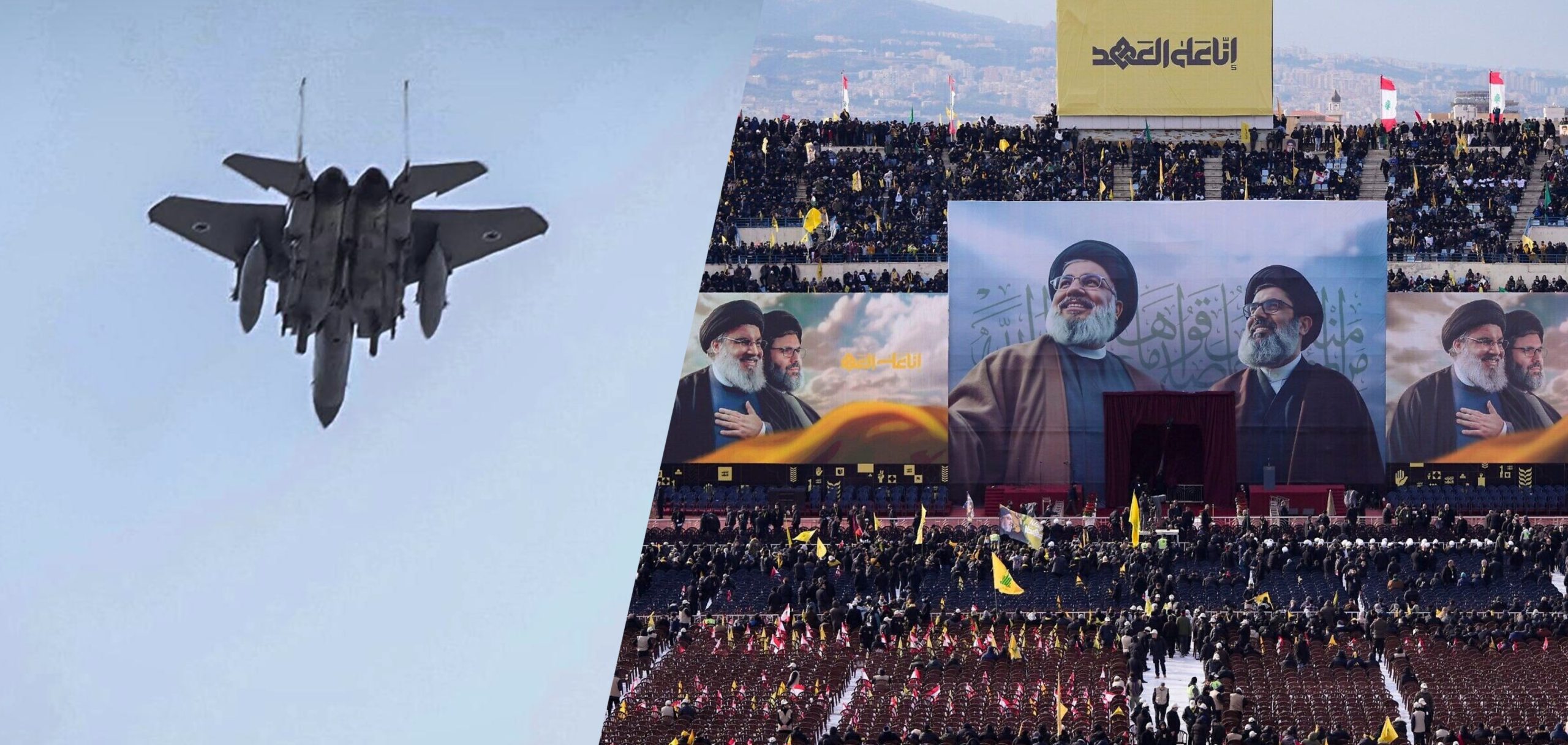
A flyby by the Israeli Defence Forces over the funeral of Hezbollah leader Hassan Nasrallah – who was killed in an Israeli air strike – has sent a bold message.
As Nasrallah’s funeral began at the Camille Chamoun Sports City Stadium in Beirut, Israeli warplanes flew at a low altitude in what Defence Minister Israel Katz said was a ‘clear message’ to anyone who threatens Israel.
‘You will specialise in funerals – and we in victories,’ Katz said.
Women wailed as a truck carrying the coffins of Nasrallah and Hashem Safieddine – Nasrallah’s chosen successor also killed in an Israeli air strike – slowly moved through the crowd, topped with two black turbans and draped in Hezbollah’s yellow flag.
The procession, which was witnessed by tens of thousands of mourners, headed towards the site where Nasrallah will be buried. Safieddine will be interred in his southern hometown of Deir Qanun al-Nahr on Monday.
The September killing of Nasrallah – who led Hezbollah for more than three decades – in a massive Israeli strike dealt a heavy blow to the Iran-backed group.
But Hezbollah, which dominated Lebanon’s politics for decades, has long had a support base in the country’s Shiite Muslim community.
Hezbollah’s new leader, Nasrallah’s successor Naim Qassem, vowed ‘resistance’ to ‘face Israel’ was not over in his televised address at the ceremony.
He added that Hezbollah would keep following his ‘path’, and rejected any control by the ‘tyrant America’ over Lebanon.
Nasrallah speeches were blasted as the mourners raised their fists in the air and chanted: ‘We are at your service, Nasrallah.’
Day 508 — Tuesday, February 25
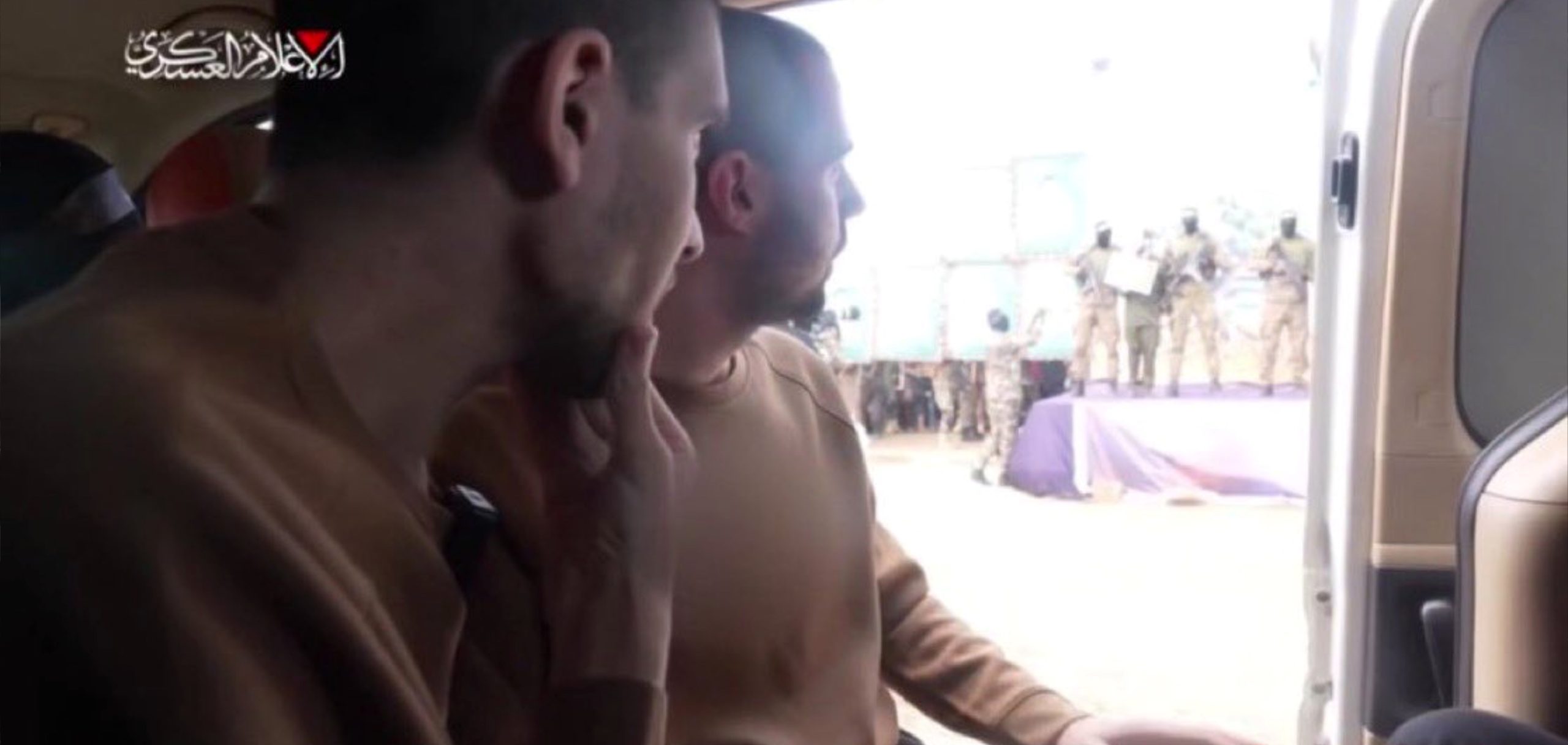
The Hamas terrorist organization released a video on Saturday showing Israeli hostages Evyatar David and Guy Gilboa-Dalal watching their fellow captives being released while seated in a vehicle just meters away from the stage where the release ceremony was taking place.
In another propaganda video, Hamas forced the two men to view the ceremony from inside nearby vehicles. David and Gilboa-Dalal are childhood friends who were both abducted from the Nova music festival on Oct. 7, 2023. As part of the Hamas propaganda, the two, who learned to speak Arabic during their captivity, were forced to condemn the war and plead for their release on camera.
The Hamas video shows the two hostages in a vehicle, watching the release ceremony of Omer Shem Tov, Eliya Cohen, and Omer Wenkert, which took place in the central Gaza neighborhood of Nuseirat.
Several times the two cover their faces with their hands and plead, “Please save us.”
While the video is presented as the natural reaction of the two men to the scene they are witnessing, it is believed the hostages were coached on how to respond and what to say ahead of the filming.
Ilan Dalal, Guy’s father, approved the release of the Hamas video. He told Channel 12 News, “They were forced to watch their friends be released and [then they were] returned to the tunnels. There is nothing more cruel than that. It shows the most urgent need to get them out of there. They can’t go through it, it’s just inhumane.”
Regarding his decision to release the video, Dalal said, “There was no hesitation, I immediately gave permission, I wanted them to see and understand the need to get them out. Perhaps those who oppose the deal will change their minds. Let them see what they’re going through there.”
He also said, “This is the best sign of life I could ask for, but on the other hand there’s nothing more cruel.”
Day 507 — Monday, February 24

With the IDF still occupying a buffer zone in southern Syria, Prime Minister Benjamin Netanyahu went a step further on Sunday and demanded that the new Syrian government commit to keeping its forces out of southern Syria.
“We demand full demilitarization of southern Syria from the forces of the new regime. Also, we will not tolerate any threat to the Druze community in southern Syria,” Netanyahu said during a speech at the graduation ceremony for new IDF combat officers.
“In Syria, the IDF will remain in the Mount Hermon area and the buffer zone for an indefinite period, to protect our settlements and prevent any threat. We will not allow the forces of Hayat Tahrir al-Sham or the new Syrian army to enter the area south of Damascus,” he vowed.
After the collapse of the Assad regime, which was spearheaded by the Islamist terror group Hayat Tahrir al-Sham and its leader Abu Muhammad al-Jolani, who now goes by Ahmad al-Shara, the IDF captured a buffer zone along the frontier with Syria.
“The collapse of the Syrian regime created a vacuum on Israel’s border and in the buffer zone established by the 1974 Separation of Forces Agreement,” Netanyahu’s office said at the time. The prime minister said that Israeli forces would remain in that location “until security on our border can be guaranteed.”
After Netanyahu’s speech, Defense Minister Israel Katz stressed that Israeli security forces would keep scanning the entire area for threats.
“We are committed not to allow a return to the reality of October 7, and that will be the case,” Katz said.
“There is a new reality in southern Syria, as the Prime Minister noted. The IDF will not allow hostile forces to establish themselves and operate in the security zone in southern Syria, from here to Damascus, and we will act against any threat.”
Day 507 — Monday, February 24

When 26-year-old Adi Jegna first noticed the white bag on one of the seats at the back of her city bus in the Tel Aviv suburb of Bat Yam on the way home from work Thursday evening, something didn’t feel right. So she got up and took a closer look.
Inside the bag, she saw rolls of toilet paper, and a container with some yellowish liquid.
“Frankly speaking I debated whether I should say anything,” she recounted to JNS on Sunday.
However, Jegna moved the bag a bit and saw some lettering in Arabic. “Then I understood I could not ignore it,” she said.
Still worried she was over-reacting, she walked up to the bus driver as her stop was approaching and told him that there was a suspicious bag towards the back of the bus, before getting off. Though the bus was almost at the end of its route, there were still some other passengers aboard.
The driver immediately contacted his superiors, who instructed him to head straight to the nearby bus depot while the police bomb squad was alerted. No sooner had he gotten off the bus himself than a huge explosion ripped through it.
Jegna heard the blast from her home, but didn’t immediately connect it to her warning. It was only when a friend texted her that there had been a bus bombing, and that someone had alerted the driver to a suspicious object, that she realized.
“I felt incredible,” she told JNS. “I felt that I was the messenger from God to save many people.”
Soon, the enormity of the thwarted attack became clear: Two additional blasts went off prematurely on other city buses— both empty—one in Bat Yam and one in the nearby city of Holon. Security forces subsequently found that an additional bus had been rigged with explosives.
One of the bombs reportedly bore an Arabic message referencing the Palestinian city of Tulkarem which, along with Jenin, has been a hotbed of terrorism. Israeli forces have been carrying out a comprehensive counter-terrorism operation in the area where the two cities are located, for weeks.
For older Israelis, the images of the demolished bus just south of Tel Aviv brought back memories of the lethal bus bombings of the late 1990s and early 2000s.
While Jegna is too young to remember that time, she has given Israelis a poignant reminder of the importance of speaking out when they see something amiss.
“When I saw the pictures of my destroyed bus, I realized the extent of the disaster that was averted,” she said. “Really thank God I was a good messenger.”
As word spread of her action, Israelis heaped praise on the young woman for her alertness and quick thinking, but while Jegna is appreciative of the thanks, she insists she is no hero and just encourages everyone to be alert.
As to her future commutes, Jegna is still riding the buses, including this week.
“I have no other choice as I go to work,” she said. “I’m simply more careful.”
Day 506 — Sunday, February 23
Israel Delays Palestinian Prisoner Release After Hamas' 'Humiliating' Treatment Of Hostages, Netanyahu Says

Israel will delay the seventh hostage-prisoner exchange in protest of Hamas’ “humiliating” treatment of hostages, according to Israeli officials.
The release of 620 Palestinian prisoners, which was scheduled for Saturday, has been postponed by Prime Minister Benjamin Netanyahu. On Sunday morning, Netanyahu’s office issued a statement condemning Hamas propaganda generated during the exchange.
“In light of Hamas’s repeated violations, including the ceremonies that humiliate our hostages and the cynical exploitation of our hostages for propaganda purposes, it has been decided to delay the release of terrorists that was planned for yesterday until the release of the next hostages has been assured, and without the humiliating ceremonies,” the office’s statement said.
The statement came after reports of Hamas fighters exploiting Israeli prisoners while they were being released. On Saturday, five of the six freed hostages were accompanied by armed militants in front of a crowd, including three Israeli hostages who posed alongside terrorists.
Omer Wenkert, Omer Shem Tov and Eliya Cohen were among the hostages forced to pose with the terrorists. Shem Tov was also forced to appear cheerful, kiss two militants on the head and blew kisses to the crowd.
The three also wore fake army uniforms, though they were not enlisted when they were captured by Hamas.
In another recent ceremony orchestrated by Hamas, four coffins were placed in front of a caricature of Netanyahu with a banner that said, “The war criminal Netanyahu & his Nazi army killed them with missiles from Zionist warplanes.”
Speaking to Fox News Digital, Israeli United Nations Ambassador Danny Danon called the gesture “evil and depraved.”
“For 16 months, Israel has been fighting a deranged terrorist organization that places no value on human life, especially if it is Israeli or Jewish — all while international institutions like the U.N. refrained from condemning Hamas and formally demanding the immediate return of our hostages,“ Danon said.
Day 505 — Saturday, February 22
After Receiving Remains From Hamas, Kibbutz Nir Oz Confirms: Shiri Bibas Was Murdered In Gaza Captivity

Kibbutz Nir Oz announced early Saturday morning that resident Shiri Bibas was murdered while held captive in Gaza, after Hamas said it returned her body to Israel late the previous night.
“With pain and deep sorrow, Kibbutz Nir Oz announces the murder of Shiri Bibas, may her memory be a blessing, who was kidnapped from her home,” according to a statement from the community.
On Thursday, Hamas returned the bodies of the Bibas children, Kfir and Ariel, along with that of octogenarian Oded Lifshitz. However, the fourth body freed from Gaza, which Hamas said was that of Shiri Bibis, was found to belong to an unidentified person.
The Palestinian terror group on Friday night handed over Shiri’s body to the Red Cross, which in turn delivered the corpse to Israel for identification.
“Shiri is brought home after 505 days,” The Hostage and Missing Families Forum confirmed in a statement on Saturday.
“Shiri Bibas was abducted at the age of 32, along with her two young boys from their home in Kibbutz Nir Oz. On October 7th the world held its breath in agony, watching the horrific images of Shiri, holding Ariel and Kfir in her arms, as she was abducted at gunpoint,” it continued.
“Today, we all mourn the loss of this lioness mother, who fiercely defended her sons until the very end.”
The forum subsequently released a statement on behalf of the Bibas family.
“Following the identification process at the Institute of Forensic Medicine, we received this morning the news we had dreaded—our Shiri was murdered in captivity and has now returned home to her sons, husband, sister, and all her family for rest.
“Despite our fears about their fate, we continued to hope that we would get to embrace them, and now we are in pain and heartbroken,” continued the statement. “For 16 months we sought certainty, and now that it’s here, it brings no comfort, though we hope it marks the beginning of closure.”
Day 505 — Saturday, February 22
BBC Forced To Apologize After Featuring Hamas Minister's Son In Gaza Documentary

The British Broadcasting Corporation (BBC) was forced to apologize and issue a clarification after unintentionally profiling a Hamas member’s son in a Gaza documentary.
On Monday, the network premiered the film “Gaza: How To Survive A Warzone,” which followed four young people with ages ranging from 10-24 living in Gaza during the ongoing Israel-Hamas war. One of the subjects included 13-year-old Abdullah, who also narrates the film.
On Friday, the BBC announced the documentary would not be available on its iPlayer during an investigation.
The film soon faced backlash after investigative journalist David Collier revealed that Abdullah was, in fact, the son of Hamas’s deputy minister of agriculture.
“We have said that @bbcnews has become a propaganda tool of Hamas. Well here is the proof. Sit down and hold on to something,” he wrote in an X thread on Tuesday.
On Wednesday, the BBC released a statement saying that it would add a new text to the film clarifying Abdullah’s backstory and apologizing for not doing so beforehand.


Day 511 — Friday, February 28
At Least 13 Wounded In Combined Terror Ramming, Stabbing Attack In Central Israel
At least 13 pedestrians were wounded after a terrorist rammed into pedestrians on Highway 65 near the Pardes Hanna-Karkur intersection, Israel Police confirmed on Thursday afternoon.
Following the ramming, police officers immediately identified the suspect’s vehicle traveling toward Gan Shmuel and blocked its path.
The terrorist accelerated, rammed a police vehicle, and then exited while charging at officers with a sharp object, later identified as a screwdriver. At this point, the terrorist was shot.
Thirteen civilians were injured in the attack, including one critically and two seriously. A police officer was also among the injured.
Hillel Yaffe Medical Center in Hadera said it had received one individual in critical condition, two in serious condition, and three in moderate condition. MDA reported that a 17-year-old girl was the person who was critically wounded.
Later on Thursday evening, a MDA helicopter transported two seriously wounded people from Hillel Yaffe Hospital to Sheba Hospital in Tel Hashomer, including the teenage girl – who reportedly has head and limb injuries and is sedated and on a ventilator – and a 76-year-old man with a head injury who is sedated and on a ventilator.
Later the police confirmed that the terrorist was a 53-year-old Palestinian from Jenin who was residing illegally in Israel with his family. The circumstances of his presence in Israel are under investigation by the ISA.
Israel Police spokesperson: “The terrorist ran over several people at a bus station, then proceeded to stab others with a screwdriver and crashed into a police vehicle.”
Day 511 — Friday, February 28
Freed hostage Eli Sharabi says he became especially close with 24-year-old Alon Ohel while they and two other Israelis were held hostage in Gaza under cramped, painful conditions.
“I adopted him from the first minute,” Sharabi says. “24/7 together. I know everything about him and his family.”
Sharabi, 53, tells Channel 12’s “Uvda” investigative program the men were able to draw strength from one another. But Ohel took it very hard when he learned that Sharabi and the two others, Or Levy and Eliya Cohen, were being released.
Sharabi says that when he was released with Levy on February 8, Ohel grabbed him and refused to let go until their guard tore him away. He says there were “moments of hysteria” and it took about 15 minutes to calm him down.
“It was a very hard moment,” he says. “He said he was happy for me. I promised him I won’t leave him there. I will fight for him.” Cohen was released two weeks later, leaving Ohel alone.
Sharabi, who lost over 30 kilograms (66 pounds) in captivity, says terrorists held the four hostages in iron chains, and sometimes beat or humiliated them, and they subsisted for months on a single plate of pasta each day.
He says that the hunger pains were unbearable and that getting his captors to give them a dried-out date or a quarter of a piece of bread felt like a victory.
“You could know what happened in the news just from their conduct,” Sharabi says when asked if their captors were exposed to Israeli media, “and therefore… [Israeli leaders’] comments in the media have a lot of power.”
“Any irresponsible remark, the first to get it was us,” he continued. “[The captors] come to us and say, ‘They’re not giving our prisoners food, you won’t eat. They’re beating our prisoners, we’ll beat you. They don’t get a shower, you won’t get a shower.’ It’s all the time there.”
Sharabi was abducted on October 7, 2023, from his home in Kibbutz Be’eri. Sharabi says he had no access to the news and only learned after his release that his wife and two daughters, as well as his brother, were all killed in the Hamas-led attack.
Despite the pain, he says that he feels lucky to be alive and fortunate for the time he spent with his wife Lianne, and daughters, Noiya and Yahel.
“I’m not angry,” he says. “I was lucky I had Lianne for 30 years, I was lucky I had those amazing daughters for years.”
Day 510 — Thursday, February 27
Israel received coffins early Thursday from the Red Cross, after the remains of four Israeli hostages murdered in captivity had been transferred to the international organization in the Gaza Strip.
The four were positively identified as Itzik Elgarat, Ohad Yahalomi, Shlomo Mansour, and Tsachi Idan, who were kidnapped from their homes on October 7, 2023, before being murdered while held hostage by Hamas in Gaza. Hundreds of Palestinian prisoners were released to secure the return of the bodies.
Day 510 — Thursday, February 27
Late Tuesday night, Israeli warplanes carried out airstrikes on military targets in southern Syria, including the town of Kisweh, located around 20 kilometers south of Damascus. The attack, confirmed by local security sources and Syria TV, resulted in blasts heard across the region. The strikes were part of a broader Israeli operation to ensure that Syrian regime forces and terrorist groups do not breach Israel’s security buffer zone in southern Syria.
Defense Minister Israel Katz stressed that these strikes were essential to maintaining Israel’s security. “We will not allow southern Syria to become southern Lebanon,” Katz declared, referencing Israel’s ongoing efforts to prevent the establishment of enemy forces near its borders. “The Air Force is currently conducting powerful strikes in southern Syria as part of our new policy of demilitarizing the region,” he added, emphasizing that any attempts by Syrian regime forces or terrorist organizations to entrench themselves in southern Syria would be met with force.
Syrian reports indicate that at least two individuals were killed, and several others were injured in the airstrikes on Kisweh. The attacks primarily targeted military vehicles within the town. The Israeli Defense Forces (IDF) confirmed the destruction of multiple military sites, including command centers and weapons storage locations. According to the IDF, the presence of these military assets in southern Syria posed a direct threat to Israeli civilians, prompting continued military operations to remove these dangers.
In addition to the airstrikes in Syria, the IDF has also been engaged in counterterrorism operations within Judea and Samaria. On Tuesday, Israeli forces, in cooperation with Shin Bet, thwarted a terrorist plot involving a 100 kg bomb in Kabatiya. As part of this operation, the Nahal Brigade troops apprehended 15 suspected terrorists, dismantled explosives, and seized weapons. The ongoing counterterrorism operation, named Operation Iron Wall, has seen multiple successful strikes against terrorist cells in the West Bank, including a recent attack on a terror cell in a vehicle.
Day 510 — Thursday, February 27
Sen. Ted Cruz (R-Texas) on Tuesday expressed his long-held support for Israel and what he said was its biblically rooted right to its historic homeland in Judea and Samaria
Addressing the Sovereignty Conference 2025 in Jerusalem on Tuesday via video, Cruz reiterated his long-held position that Israel has an “absolute right to determine what happens in Judea and Samaria.”
That right “starts in the Bible and extends through modern times,” he added.
Thanking Yesha Council chairman Israel Gantz for his work to strengthen the U.S.-Israel alliance, Cruz said, “As you meet today, have confidence that the American people stand with you. And under President Trump and our new Republican Congress, the American government stands with you as well.”
The Yesha Council is an umbrella group of local and regional councils in Judea and Samaria.
“As for your enemies, who are also the enemies of America, we know that they seek to weaken you and to weaken us. And then to destroy you. And then to destroy us,” continued Cruz.
He expressed sympathy for the “unfathomable trauma” Israel and the Jewish people endure as “Palestinian savages make the return of every hostage, living or murdered, an ongoing nightmare.”
Cruz quoted remarks by Menachem Begin, part of a famous exchange the former Israeli prime minister had with then-Senator Joe Biden in June 1982.
Biden reportedly banged on the table with his fist, to which Begin replied, “This desk is designed for writing, not for fists. Don’t threaten us with slashing aid.”
Quoting Begin, Cruz said: “Don’t threaten us with cutting off your aid. It will not work. I am not a Jew with trembling knees. I am a proud Jew with 3,700 years of civilized history. Nobody came to our aid when we were dying in the gas chambers and ovens. Nobody came to our aid when we were striving to create our country.
“We paid for it. We fought for it. We died for it. We will stand by our principles. We will defend them. And when necessary, we will die for them again. With or without your aid.”
The Texas senator concluded: “Every person in this room has paid for the Land of Israel, has fought for the Land of Israel, and far too many have died for the Land of Israel. I am proud to stand with you unshakably as you determine the future of Judea and Samaria.”
The Sovereignty Conference brings together prominent leaders and activists on the Israeli right. The event spotlighted expectations for Israel’s government to change the status quo in Judea, Samaria and Gaza, with support from the U.S. administration.
Co-produced by the Yesha Council of Judea and Samaria communities, the event has served for over two decades as a platform to advocate making Judea, Samaria and Gaza, or areas therein, part of Israel.
Day 510 — Thursday, February 27
More than 100,000 Israelis lined the roads as the funeral cars carrying the bodies of slain former hostages Shiri, Ariel, and Kfir Bibas made their way to the cemetery in southern Israel, not far from their home at Kibbutz Nir Oz. The crowd carried Israeli flags and orange balloons, depicting the color of the children’s hair, now a symbol of honor and shared grief for the family.
In a statement, the family wrote, “We see and hear you; we are moved and strengthened by you.” They added, “Yarden (a former hostage, husband of Shiri, and father of Ariel and Kfir) apologizes for not being able to come and hug each and every one of you. We hope for the day when we can once again be together in moments of joy and not sadness.”
Ben Gurion Airport, the Israeli Knesset, and the President’s Residence were lit up in orange Tuesday night to remember the mother and children whose plight captured Israel’s heart.
President Isaac Herzog issued a statement reading, in part, “While an entire nation prayed and hoped for a different outcome, we are left wounded and in pain. Yet, even in our grief, we will continue to pray for better days and for the swift return of all the remaining hostages still held in Gaza.”
The Knesset met Wednesday morning and began with a minute of silence to remember the Bibas family. In his remarks, Knesset Speaker Amir Ohana referred to Kibbutz Nir Oz co-founder Oded Lifshitz, 83, whose body was returned with the Bibas children.
“Last night, Oded Lifshitz was laid to rest, may God avenge his blood, and the Knesset building was lit up in orange in memory of those being laid to rest at this moment: Shiri Bibas and her two young sons, Ariel and Kfir, the redheads, may God avenge their blood,” Ohana declared.
Day 509 — Wednesday, February 26
In a recent interview with The New York Times, Mousa Abu Marzouk, the head of Hamas’s foreign relations office, expressed regret over the destructive consequences of the October 7 attacks on Gaza. He admitted that had he known the scale of the devastation that would follow, he would never have agreed to the operation. Abu Marzouk, who was not informed of the full details of the plans, stated, “If it was expected that what happened would happen, there wouldn’t have been October 7.”
During the interview, Abu Marzouk described Hamas’s survival in the war against Israel as a “kind of victory,” though he was quick to clarify that this survival should not be viewed as a true victory, especially given the severe destruction Israel brought to Gaza. He further criticized Israel for “losing control” and taking “revenge against everything.”
In addition to discussing the group’s survival, Abu Marzouk spoke about Hamas’s willingness to negotiate on various issues, including the group’s weapons in Gaza. He also addressed the issue of hostages, revealing that Hamas would demand the release of additional prisoners in exchange for the remaining hostages. He stated that Hamas might be open to releasing all hostages if Israel agreed to release thousands of prisoners and withdrew from Gaza, effectively ending the war.
However, Hamas later responded to Abu Marzouk’s statements, claiming that the interview had misrepresented his words and taken them out of context. The organization emphasized that the October 7 operation was a reflection of their people’s right to resist and reject what they consider the siege, occupation, and settlements. Hamas reiterated that it would continue to uphold its armed resistance until they achieve “liberation and return” of “their land.”
Day 509 — Wednesday, February 26
At a meeting at the presidential palace in Buenos Aires on Tuesday, Argentinian President Javier Milei assured visiting officials from the Simon Wiesenthal Center (SWC) that he would grant them access to classified documents detailing how 5,000 Nazi war criminals settled in Argentina after the Holocaust.
Ten thousand Nazi war criminals are estimated to have fled Europe – and justice – following World War II via escape routes known as the so-called “ratlines.” The records on the escapes and who financed them have remained classified with historians and Nazi hunters, including the SWC, unable to gain access.
“While some previous leaders promised full cooperation to get to the hard truths that involved Argentina’s past, Milei is the first to act with lightning speed to enable the SWC to uncover important pieces of the historic puzzle, especially as it related to involvement with Nazis before, during and after the Holocaust,” said Rabbi Abraham Cooper, associate dean of the SWC.
Chairman of the U.S. Senate Judiciary Committee, Sen. Charles Grassley, also sent a letter to Milei, requesting his help in finding out how the Nazi escape routes were organized and funded.
The letter was delivered to the Argentinian president by Jonathan Missner, managing partner at Stein, Mitchell, Beato & Missner. Missner legally represents the SWC and the victims of the Iran-Hezbollah bombing of the Jewish community center in Buenos Aires in 1994.
“President Milei is a staunch ally of the global Jewish community and was eager to open these archives. He knows that confronting Argentina’s history of Nazi collaboration requires nothing less than full transparency, and the same principle undergirds his pursuit of justice for the AMIA bombing,” said Missner.
He noted that uncovering the history of the escape routes will reveal the collusion of governments and large corporations in assisting Nazi war criminals.
“People should understand that for many decades after the Holocaust, governments and multinational corporations helped Nazis hide their stolen money, avoid prosecution, and live the free lives that their victims deserved,” Missner said.
In Argentina, that collusion went straight to the top government echelons with then-President Juan Peron, authorizing key aspects of the ratlines. Peron, alongside other South American leaders, not only welcomed German members of the Nazi party but also Hungarian, Croatian and other Nazi war criminals.
Alongside Argentina, several countries in the Americas secretly welcomed the fleeing Nazi war criminals, including Canada, the United States and Mexico. The Nazis who fled also found safe havens in Australia, Spain and Switzerland. The ratlines were known to U.S. intelligence, which reportedly handpicked top Nazi scientists from the escape routes.
There were two primary escape routes with one passing through Germany and Spain – and across the Atlantic to Argentina – and the second via Germany and Italy and across the Atlantic. The escape routes, which were quite elaborate, were reportedly established with the secret support of several officials from the Vatican.
Among the roughly 5,000 Nazis who were allowed to live out their lives in freedom in Argentina were war criminals Adolf Eichmann and Josef Mengele. The latter fled via the ratlines in 1948 by using the false identity of Helmut Gregor.
Day 508 — Tuesday, February 25
Israeli Prime Minister Benjamin Netanyahu displayed images of Shiri Bibas and her two young sons, Ariel and Kfir, during an address at a combat officers’ graduation ceremony on Sunday, delivering a solemn message.
“I want to show you something. I want to show you this picture of Shiri Bibas and her tender children, Ariel and Kfir Bivas. This picture says it all; I ask that you engrave it on the board of your hearts, so that you will always remember what we are fighting for and against whom we are fighting,” Netanyahu told the graduates, according to Fox News’ translation of the Hebrew speech. “We are fighting to secure our existence against man-monsters who have risen to annihilate us.”
“Already in the first days of the war, they murdered Shiri and her children in cold blood; they strangled the tender children with their own hands,” Netanyahu said, holding up a photo of the Bibas family. “And if they could, they would have killed us all with the same cruelty, until our very last man. Against this we fight, and these monsters we must and can defeat – and defeat them we will. This is our mission, and this is your mission!”
“As the defenders of our homeland, each of you is imbued with purpose, wielding sword and shield,” he added. “We have high expectations of you, but I know that above all, you have expectations of yourselves.”
Hamas handed over the bodies of the two young brothers on Thursday, but initially returned the wrong remains for Shiri in what Netanyahu had decried as a “brazen violation of their agreement.” The Israeli mother’s actual remains were handed over on Saturday and identified by Israeli forensic authorities to be Shiri following a standoff with the terrorist group. Also returned was the body of Oded Lifshitz, a fellow resident of Kibbutz Nir Oz kidnapped by Hamas on Oct. 7, 2023, and who Israel says was murdered in captivity. The Israel Defense Forces said the boys’ bodies proved they were “murdered by terrorists in cold blood,” despite Hamas previously claiming the brothers were killed in an airstrike.
In his speech Sunday, Netanyahu said President Donald Trump “sees eye to eye with us on everything related to Gaza.”
“We support President Trump’s groundbreaking plan to allow free exit for Gazans, and to create a different Gaza,” Netanyahu told the graduating combat officers.
“I thank President Trump for his directive to supply Israel with vital weapons,” Netanyahu said. “The new defensive and offensive arms will greatly aid us in achieving absolute victory. At the same time, we have approved enormous budgets for the domestic development of weapon systems – systems that will enhance our ability to stand up to our enemies on our own.“
Day 508 — Tuesday, February 25
Israel deployed tanks in Jenin for the first time in over 20 years on Sunday, signaling an extended military presence in northern Samaria as it intensifies counterterrorism operations in the region.
For the first time since 2002, Israel deployed tanks in Judea and Samaria following bus bombings in Bat Yam and Holon.
Prime Minister Benjamin Netanyahu vowed to intensify the conflict during a rare visit to the Tulkarem refugee camp.
During a troop visit and briefing by commanders, Netanyahu stated, “In the past year, we have greatly increased our activity. We are entering the terrorist strongholds, clearing entire streets used by terrorists, their homes. We are eliminating terrorists and commanders.”
Israeli Defense Minister Israel Katz ordered the military to “increase the intensity of the activity to thwart terrorism” in Judea and Samaria, stating that troops will remain “for the coming year” and that Palestinians who have fled cannot return.
“We will not allow the return of residents, and we will not allow terrorism to return and grow,” he emphasized.
Katz also instructed the military to prepare for “an extended stay” in emptied Judea and Samraria urban areas, from which about 40,000 Palestinians have fled.
Since launching “Operation Iron Wall” in Judea and Samaria on January 19, Israeli forces have arrested over 200 terror suspects, eliminated 71 deemed security threats, and confiscated more than 300 weapons and explosives. They have also uncovered a bomb-making laboratory.
Additionally, since the October 7 attacks, Israeli forces have detained 6,000 Palestinians in Judea and Samaria, with around 40 percent linked to Hamas.
Day 508 — Tuesday, February 25
As the Israeli hostages return home from Gaza after more than one year, their families are beginning to report on the difficult conditions they faced in Hamas captivity.
The six hostages recently released said they were severely punished without explanation, subjected to physical and psychological torture, and interrogated about their military past.
Several hostages reported receiving meager rations, with their food supply increasing only in the days leading up to their release.
While the female hostages, who returned in the current hostage-ceasefire deal, testified that they were mostly kept in private homes of Gazan families, the male hostages say they were primarily kept in tunnels underground. Medical teams reported that the hostages returned with various conditions, indicating prolonged malnutrition and lack of exposure to sunlight.
During IDF bombings, the men were sometimes moved into deeper tunnels, which were narrower.
Israeli hostage Omer Shem Tov, who returned on Saturday, told his parents that he was “afraid to fall asleep, to wake up, and to realize that it was not a dream.”
Shem Tov was kept by himself in a tunnel after the release of Itai Regev in the November 2023 hostage-ceasefire deal. He suffers from asthma and didn’t receive any medication during his captivity.
Both Omer Wenkert and Eliya Cohen reported that they were kept isolated in tunnels during most of their captivity, were deliberately starved, and even held in cages part of the time. Wenkert was not exposed to any media and had no idea about the efforts to secure his release. Wenkert suffers from an inflammatory bowel disease and did not receive any medication for his condition, despite attempts by the Israeli government to transfer medications to the hostages.
Cohen has epilepsy and was also kept without any access to medication. His family said that during his captivity, he underwent surgery to extract bullets from his body without anesthesia.
The family also said he was held captive with hostages Alon Ohel, Eli Sharabi and Or Levy. The men were often chained together by hands and feet to prevent their escape. This caused wounds. They were also beaten by their captors. Sharabi and Levy were returned two weeks before Cohen. Alon Ohel is still in captivity, and Cohen said Ohel is being held alone after the release on Saturday.
Sha’aban al-Sayed, father of returned Bedouin hostage, Hisham, said his son returned severely troubled after a decade in Hamas captivity. Hisham has a diagnosed history of mental issues, including a 2010 diagnosis of “acute psychotic disorder” and a 2013 diagnosis of schizophrenia.
Hisham wandered into the Gaza Strip in 2015 and was abducted by Hamas terrorists. His family attempted to secure his release multiple times over the past decade, including sending messages to leading Muslim clerics in Gaza.
Sha’aban said his son’s condition indicates that he was severely mistreated.
“We were happy to be able to have him, but when I hugged him I saw that I was hugging something that wasn’t a human being. It looks like a human being, but it’s not a human being,” Sha’aban said. “He doesn’t know how to talk, he doesn’t have a voice, he has no memory of anything. It’s simple, it gives the feeling that he wasn’t held by human beings, and we’re angry about it and we want an answer, why this is happening with the hostages?”
Hostage Agam Berger, one of the female IDF observation scouts who was released at the beginning of the current hostage-ceasefire deal, said the terrorists would prevent her and Liri Elbag, with whom she was being held, from speaking in Hebrew. She explained that the neighbors didn’t know they were there, and that Hamas preferred that as few people as possible knew where they were being held.
Medical officials in Israel have pointed to the premature baldness and hair bleaching demonstrated by many of the returning male hostages as evidence of the long-term malnutrition and stress endured by the men during the almost year and a half of captivity.
The hostage families and the returning hostages themselves have all urged government officials to do whatever is necessary to bring the remaining hostages home, citing mistreatment.
Despite the demand of the families to release the remaining hostages in one go, the Israeli government appears to be trying to extend phase one to additional humanitarian stages, which will include the release of four fathers of young children – David Cuneo, Omri Miran, Elkana Bohbot and Maxim Harkin – alongside injured or sick abductees whose condition has only now been revealed due to the testimonies of the returning hostages.
Of the 59 abductees who were not included in the first phase, 35 are believed to be dead. Families of most of the other 24 have received signs of life in recent weeks.
Israeli Prime Minister Benjamin Netanyahu has promised that he will continue to work to bring all of the remaining hostages home.
Day 508 — Tuesday, February 25
A flyby by the Israeli Defence Forces over the funeral of Hezbollah leader Hassan Nasrallah – who was killed in an Israeli air strike – has sent a bold message.
As Nasrallah’s funeral began at the Camille Chamoun Sports City Stadium in Beirut, Israeli warplanes flew at a low altitude in what Defence Minister Israel Katz said was a ‘clear message’ to anyone who threatens Israel.
‘You will specialise in funerals – and we in victories,’ Katz said.
Women wailed as a truck carrying the coffins of Nasrallah and Hashem Safieddine – Nasrallah’s chosen successor also killed in an Israeli air strike – slowly moved through the crowd, topped with two black turbans and draped in Hezbollah’s yellow flag.
The procession, which was witnessed by tens of thousands of mourners, headed towards the site where Nasrallah will be buried. Safieddine will be interred in his southern hometown of Deir Qanun al-Nahr on Monday.
The September killing of Nasrallah – who led Hezbollah for more than three decades – in a massive Israeli strike dealt a heavy blow to the Iran-backed group.
But Hezbollah, which dominated Lebanon’s politics for decades, has long had a support base in the country’s Shiite Muslim community.
Hezbollah’s new leader, Nasrallah’s successor Naim Qassem, vowed ‘resistance’ to ‘face Israel’ was not over in his televised address at the ceremony.
He added that Hezbollah would keep following his ‘path’, and rejected any control by the ‘tyrant America’ over Lebanon.
Nasrallah speeches were blasted as the mourners raised their fists in the air and chanted: ‘We are at your service, Nasrallah.’
Day 508 — Tuesday, February 25
The Hamas terrorist organization released a video on Saturday showing Israeli hostages Evyatar David and Guy Gilboa-Dalal watching their fellow captives being released while seated in a vehicle just meters away from the stage where the release ceremony was taking place.
In another propaganda video, Hamas forced the two men to view the ceremony from inside nearby vehicles. David and Gilboa-Dalal are childhood friends who were both abducted from the Nova music festival on Oct. 7, 2023. As part of the Hamas propaganda, the two, who learned to speak Arabic during their captivity, were forced to condemn the war and plead for their release on camera.
The Hamas video shows the two hostages in a vehicle, watching the release ceremony of Omer Shem Tov, Eliya Cohen, and Omer Wenkert, which took place in the central Gaza neighborhood of Nuseirat.
Several times the two cover their faces with their hands and plead, “Please save us.”
While the video is presented as the natural reaction of the two men to the scene they are witnessing, it is believed the hostages were coached on how to respond and what to say ahead of the filming.
Ilan Dalal, Guy’s father, approved the release of the Hamas video. He told Channel 12 News, “They were forced to watch their friends be released and [then they were] returned to the tunnels. There is nothing more cruel than that. It shows the most urgent need to get them out of there. They can’t go through it, it’s just inhumane.”
Regarding his decision to release the video, Dalal said, “There was no hesitation, I immediately gave permission, I wanted them to see and understand the need to get them out. Perhaps those who oppose the deal will change their minds. Let them see what they’re going through there.”
He also said, “This is the best sign of life I could ask for, but on the other hand there’s nothing more cruel.”
Day 507 — Monday, February 24
With the IDF still occupying a buffer zone in southern Syria, Prime Minister Benjamin Netanyahu went a step further on Sunday and demanded that the new Syrian government commit to keeping its forces out of southern Syria.
“We demand full demilitarization of southern Syria from the forces of the new regime. Also, we will not tolerate any threat to the Druze community in southern Syria,” Netanyahu said during a speech at the graduation ceremony for new IDF combat officers.
“In Syria, the IDF will remain in the Mount Hermon area and the buffer zone for an indefinite period, to protect our settlements and prevent any threat. We will not allow the forces of Hayat Tahrir al-Sham or the new Syrian army to enter the area south of Damascus,” he vowed.
After the collapse of the Assad regime, which was spearheaded by the Islamist terror group Hayat Tahrir al-Sham and its leader Abu Muhammad al-Jolani, who now goes by Ahmad al-Shara, the IDF captured a buffer zone along the frontier with Syria.
“The collapse of the Syrian regime created a vacuum on Israel’s border and in the buffer zone established by the 1974 Separation of Forces Agreement,” Netanyahu’s office said at the time. The prime minister said that Israeli forces would remain in that location “until security on our border can be guaranteed.”
After Netanyahu’s speech, Defense Minister Israel Katz stressed that Israeli security forces would keep scanning the entire area for threats.
“We are committed not to allow a return to the reality of October 7, and that will be the case,” Katz said.
“There is a new reality in southern Syria, as the Prime Minister noted. The IDF will not allow hostile forces to establish themselves and operate in the security zone in southern Syria, from here to Damascus, and we will act against any threat.”
Day 507 — Monday, February 24
When 26-year-old Adi Jegna first noticed the white bag on one of the seats at the back of her city bus in the Tel Aviv suburb of Bat Yam on the way home from work Thursday evening, something didn’t feel right. So she got up and took a closer look.
Inside the bag, she saw rolls of toilet paper, and a container with some yellowish liquid.
“Frankly speaking I debated whether I should say anything,” she recounted to JNS on Sunday.
However, Jegna moved the bag a bit and saw some lettering in Arabic. “Then I understood I could not ignore it,” she said.
Still worried she was over-reacting, she walked up to the bus driver as her stop was approaching and told him that there was a suspicious bag towards the back of the bus, before getting off. Though the bus was almost at the end of its route, there were still some other passengers aboard.
The driver immediately contacted his superiors, who instructed him to head straight to the nearby bus depot while the police bomb squad was alerted. No sooner had he gotten off the bus himself than a huge explosion ripped through it.
Jegna heard the blast from her home, but didn’t immediately connect it to her warning. It was only when a friend texted her that there had been a bus bombing, and that someone had alerted the driver to a suspicious object, that she realized.
“I felt incredible,” she told JNS. “I felt that I was the messenger from God to save many people.”
Soon, the enormity of the thwarted attack became clear: Two additional blasts went off prematurely on other city buses— both empty—one in Bat Yam and one in the nearby city of Holon. Security forces subsequently found that an additional bus had been rigged with explosives.
One of the bombs reportedly bore an Arabic message referencing the Palestinian city of Tulkarem which, along with Jenin, has been a hotbed of terrorism. Israeli forces have been carrying out a comprehensive counter-terrorism operation in the area where the two cities are located, for weeks.
For older Israelis, the images of the demolished bus just south of Tel Aviv brought back memories of the lethal bus bombings of the late 1990s and early 2000s.
While Jegna is too young to remember that time, she has given Israelis a poignant reminder of the importance of speaking out when they see something amiss.
“When I saw the pictures of my destroyed bus, I realized the extent of the disaster that was averted,” she said. “Really thank God I was a good messenger.”
As word spread of her action, Israelis heaped praise on the young woman for her alertness and quick thinking, but while Jegna is appreciative of the thanks, she insists she is no hero and just encourages everyone to be alert.
As to her future commutes, Jegna is still riding the buses, including this week.
“I have no other choice as I go to work,” she said. “I’m simply more careful.”
Day 506 — Sunday, February 23
Israel Delays Palestinian Prisoner Release After Hamas' 'Humiliating' Treatment Of Hostages, Netanyahu Says
Israel will delay the seventh hostage-prisoner exchange in protest of Hamas’ “humiliating” treatment of hostages, according to Israeli officials.
The release of 620 Palestinian prisoners, which was scheduled for Saturday, has been postponed by Prime Minister Benjamin Netanyahu. On Sunday morning, Netanyahu’s office issued a statement condemning Hamas propaganda generated during the exchange.
“In light of Hamas’s repeated violations, including the ceremonies that humiliate our hostages and the cynical exploitation of our hostages for propaganda purposes, it has been decided to delay the release of terrorists that was planned for yesterday until the release of the next hostages has been assured, and without the humiliating ceremonies,” the office’s statement said.
The statement came after reports of Hamas fighters exploiting Israeli prisoners while they were being released. On Saturday, five of the six freed hostages were accompanied by armed militants in front of a crowd, including three Israeli hostages who posed alongside terrorists.
Omer Wenkert, Omer Shem Tov and Eliya Cohen were among the hostages forced to pose with the terrorists. Shem Tov was also forced to appear cheerful, kiss two militants on the head and blew kisses to the crowd.
The three also wore fake army uniforms, though they were not enlisted when they were captured by Hamas.
In another recent ceremony orchestrated by Hamas, four coffins were placed in front of a caricature of Netanyahu with a banner that said, “The war criminal Netanyahu & his Nazi army killed them with missiles from Zionist warplanes.”
Speaking to Fox News Digital, Israeli United Nations Ambassador Danny Danon called the gesture “evil and depraved.”
“For 16 months, Israel has been fighting a deranged terrorist organization that places no value on human life, especially if it is Israeli or Jewish — all while international institutions like the U.N. refrained from condemning Hamas and formally demanding the immediate return of our hostages,“ Danon said.
Day 505 — Saturday, February 22
After Receiving Remains From Hamas, Kibbutz Nir Oz Confirms: Shiri Bibas Was Murdered In Gaza Captivity
Kibbutz Nir Oz announced early Saturday morning that resident Shiri Bibas was murdered while held captive in Gaza, after Hamas said it returned her body to Israel late the previous night.
“With pain and deep sorrow, Kibbutz Nir Oz announces the murder of Shiri Bibas, may her memory be a blessing, who was kidnapped from her home,” according to a statement from the community.
On Thursday, Hamas returned the bodies of the Bibas children, Kfir and Ariel, along with that of octogenarian Oded Lifshitz. However, the fourth body freed from Gaza, which Hamas said was that of Shiri Bibis, was found to belong to an unidentified person.
The Palestinian terror group on Friday night handed over Shiri’s body to the Red Cross, which in turn delivered the corpse to Israel for identification.
“Shiri is brought home after 505 days,” The Hostage and Missing Families Forum confirmed in a statement on Saturday.
“Shiri Bibas was abducted at the age of 32, along with her two young boys from their home in Kibbutz Nir Oz. On October 7th the world held its breath in agony, watching the horrific images of Shiri, holding Ariel and Kfir in her arms, as she was abducted at gunpoint,” it continued.
“Today, we all mourn the loss of this lioness mother, who fiercely defended her sons until the very end.”
The forum subsequently released a statement on behalf of the Bibas family.
“Following the identification process at the Institute of Forensic Medicine, we received this morning the news we had dreaded—our Shiri was murdered in captivity and has now returned home to her sons, husband, sister, and all her family for rest.
“Despite our fears about their fate, we continued to hope that we would get to embrace them, and now we are in pain and heartbroken,” continued the statement. “For 16 months we sought certainty, and now that it’s here, it brings no comfort, though we hope it marks the beginning of closure.”
Day 505 — Saturday, February 22
BBC Forced To Apologize After Featuring Hamas Minister's Son In Gaza Documentary
The British Broadcasting Corporation (BBC) was forced to apologize and issue a clarification after unintentionally profiling a Hamas member’s son in a Gaza documentary.
On Monday, the network premiered the film “Gaza: How To Survive A Warzone,” which followed four young people with ages ranging from 10-24 living in Gaza during the ongoing Israel-Hamas war. One of the subjects included 13-year-old Abdullah, who also narrates the film.
On Friday, the BBC announced the documentary would not be available on its iPlayer during an investigation.
The film soon faced backlash after investigative journalist David Collier revealed that Abdullah was, in fact, the son of Hamas’s deputy minister of agriculture.
“We have said that @bbcnews has become a propaganda tool of Hamas. Well here is the proof. Sit down and hold on to something,” he wrote in an X thread on Tuesday.
On Wednesday, the BBC released a statement saying that it would add a new text to the film clarifying Abdullah’s backstory and apologizing for not doing so beforehand.
