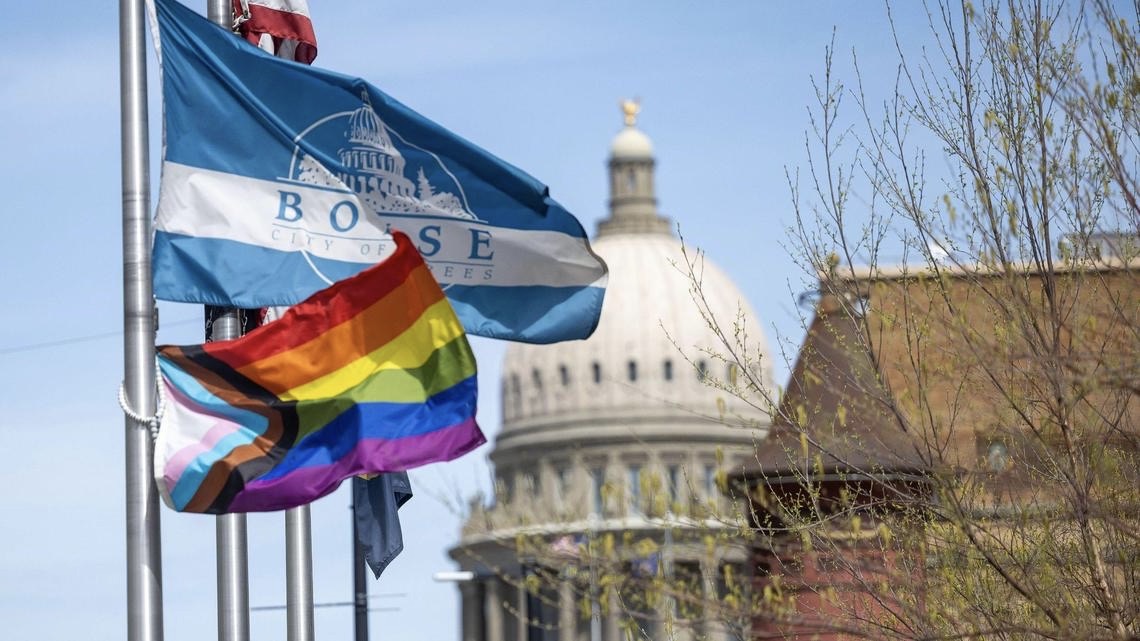
The city of Boise has removed its Pride flag from city hall in accordance with a new Idaho law that only permits state-approved flags to fly on municipalities.
The change comes after the city had attempted to circumvent another state law that banned non-official flags from state and municipal buildings.
Idaho Gov. Brad Little signed House Bill 561 into law on March 31. The law permits only the American flag, state flags, official military flags, official Indian tribe flags, the POW/MIA flag, and some other national and international flags for special occasions. It applies to “land owned and maintained by the governmental entity, including buildings, adjoining land, parks, roads and boulevards.”
For every day a non-official flag is flown, a violator may receive civil penalty of $2,000 per flag after a warning, with 10 days to comply before legal action.
A 2025 law that banned non-official flags did not include a penalty for violations. In response, Boise had passed a loophole resolution to make the LGBTQ flag an official flag.
Mat Staver, Liberty Counsel’s founder and chairman, explained that the bill, which passed with a House vote of 58-11 and a Senate vote of 26-8, closed that loophole.
“Idaho’s law strictly defines ‘official’ government expression via flags and closes a loophole whereby municipalities could embrace a contentious ideology as government expression,” Staver said.
Liberty Counsel represented a Christian organization in the case Shurtleff v. City of Boston, in which the U.S. Supreme Court ruled that Boston could not censor Christian viewpoints by prohibiting a Christian flag in a public forum open to “all applicants.” In matters of public forums opened for private expression, a city cannot discriminate based on viewpoint as it violates the First Amendment.
Staver compared the Supreme Court win to the newly established law, explaining that government buildings are not a public forum, and flagpoles are used only for official government speech.
“The Shurtleff decision established that if a government maintains tight control over a medium and uses it to deliver a specific message, it is ‘government speech,” Staver explained. “The law provides a legal roadmap for government entities to remain neutral because ideological and contentious political flags do not belong in official government speech.”