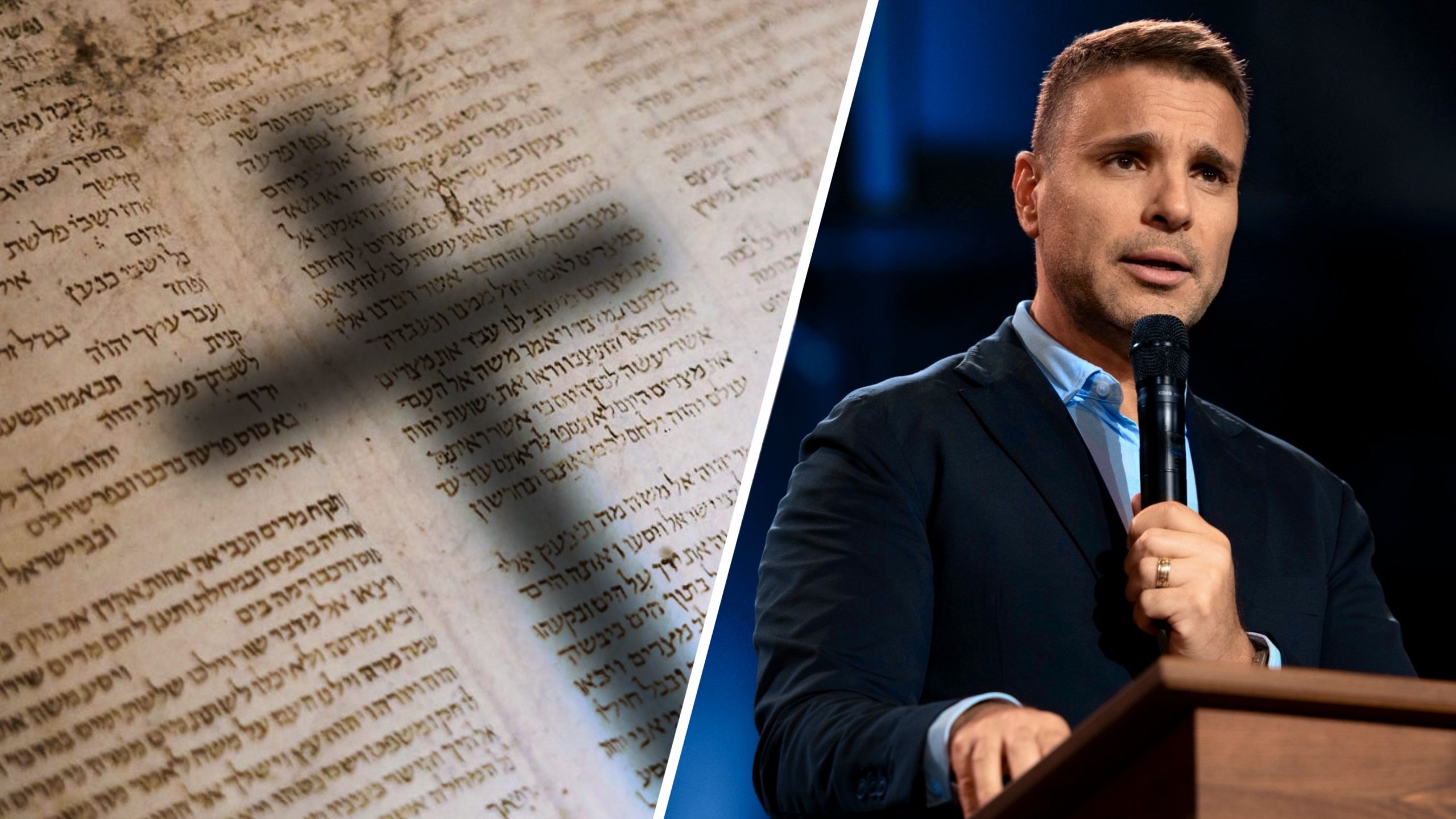

I want to tell you something that revolutionized my entire life. I discovered Jesus in my own Bible, the Hebrew Old Testament, before I ever read a single word in the New Testament.
Growing up, I saw the New Testament as a Gentile book about a Gentile religion. It wasn’t mine. This presumption was called into question when someone challenged me: “Read your own scriptures. Look for the Messiah in the Torah, in the prophets, in the Psalms.”
So I did… and what I found was staggering. Jesus is everywhere from Genesis to Malachi.
What shocked me most was that Jesus proved He was the Messiah using only the Hebrew Scriptures, the Old Testament. Not once did He quote the New Testament—it didn’t exist yet! In Luke chapter 24, after His resurrection, Jesus appeared to two disciples on the road to Emmaus. They were heartbroken and confused. Their eyes were kept from recognizing Him. In verses 25-27, Jesus said, “‘O foolish ones, and slow of heart to believe in all that the prophets have spoken! Ought not the Christ to have suffered these things and to enter into His glory?’ And beginning at Moses and all the Prophets, He expounded to them in all the Scriptures the things concerning Himself.”
Jesus gave them a complete Bible study from Genesis to Malachi, proving He was the Messiah. I wish we had those notes! Then in verse 44, Jesus declared, “These are the words which I spoke to you while I was still with you, that all things must be fulfilled which were written in the Law of Moses and the Prophets and the Psalms concerning Me.”
Let me show you Jesus in your Old Testament.
In Psalm 72:17, we read, “His name shall endure forever; His name shall continue as long as the sun….” Incredibly, while your English Bible says, “as long as the sun,” the Hebrew meaning is that His name existed before the sun, before creation. This is the Messiah, the eternal One.
Now look at Genesis 3:15. After Adam and Eve sinned, God spoke to the serpent: “And I will put enmity between you and the woman, and between your seed and her Seed; He shall bruise your head, and you shall bruise His heel.” Seed of the woman? Stop and think about that. Women don’t normally have a seed. The seed of the woman means the seed that was in the woman that was not of the man. So, who is this person born from a woman’s seed without a human father? There’s only one person in all of history: Jesus.
Genesis chapter 4 is also fascinating. For the first time in Scripture, the words “sheep” and “sin” appeared together. Abel brought a lamb, and God was pleased. Cain brought fruit, but God rejected it. From the very beginning, God connected the lamb with sin.
Then, in Genesis chapter 22, we get one of the most remarkable prophecies. Abraham took Isaac up to Mount Moriah. In verse 7, Isaac asked, “Look, the fire and the wood, but where is the lamb for a burnt offering?” Abraham answered in verse 8, “My son, God will provide for Himself the lamb for a burnt offering.” Two thousand years later, on the same mountain range, the range of Mount Moriah, God provided for Himself the lamb, Jesus, on Golgotha.
Notice in verse 12, God said, “Do not lay your hand on the lad, or do anything to him; for now I know that you fear God, since you have not withheld your son, your only son, from Me.” Now jump to John 3:16: “For God so loved the world that He gave His only begotten Son…” God was showing Abraham something: As you were willing to sacrifice your only son, I will also sacrifice Mine.
When John the Baptist saw Jesus at the Jordan in John 1:29, what did he say? “Behold! The Lamb of God who takes away the sin of the world!” A Jewish man raised on Hebrew Scriptures instantly recognized Him. This is the Lamb, the One God promised.
But the prophecy that absolutely changed my life was Isaiah 53. Many rabbis to this day don’t like this chapter. Some call it the “Forbidden Chapter.” Why? Because you cannot deny that it is speaking of Jesus.
Isaiah 53:3-5 reads, “He is despised and rejected by men, A Man of sorrows and acquainted with grief. And we hid, as it were, our faces from Him; He was despised, and we did not esteem Him. …But He was wounded for our transgressions, He was bruised for our iniquities; The chastisement for our peace was upon Him, And by His stripes we are healed.”
This was written 700 years before Jesus was born. But notice, it’s written in the past tense. Why? Because once God declares something, it’s as good as done. It’s “Yes and Amen.”
In verse 7, we read, “He was oppressed, and He was afflicted, Yet He opened not His mouth; He was led as a lamb to the slaughter, And as a sheep before its shearers is silent, So He opened not His mouth.” When did Jesus defend Himself during His trial? Never. He stayed silent. Isaiah predicted it 700 years before it happened.
When I read Isaiah 53 as a young man in Israel, I knew this was Yeshua. He is the Messiah. I’ve heard stories of Israelis who read that very portion and got upset, “This is from the New Testament! Why is this in my Bible?” Meanwhile, they’re holding the prophet Isaiah in their hands.
I could go on. Micah 5:2 tells us that He would be born in Bethlehem, but His goings forth are from everlasting. Isaiah 7:14 prophesies the virgin birth. Psalm 22 describes the crucifixion in detail, written 1,000 years before crucifixion was invented. Zechariah 12:10 states, “…then they will look on Me whom they pierced.” The Messiah will be pierced, and when He returns, Israel will recognize Him and mourn for Him as one mourns for an only son.
You see, the Old Testament is not a Jewish book separate from Christianity. The Old Testament is the foundation, the evidence, the proof. Jesus is all over it, hidden in plain sight.