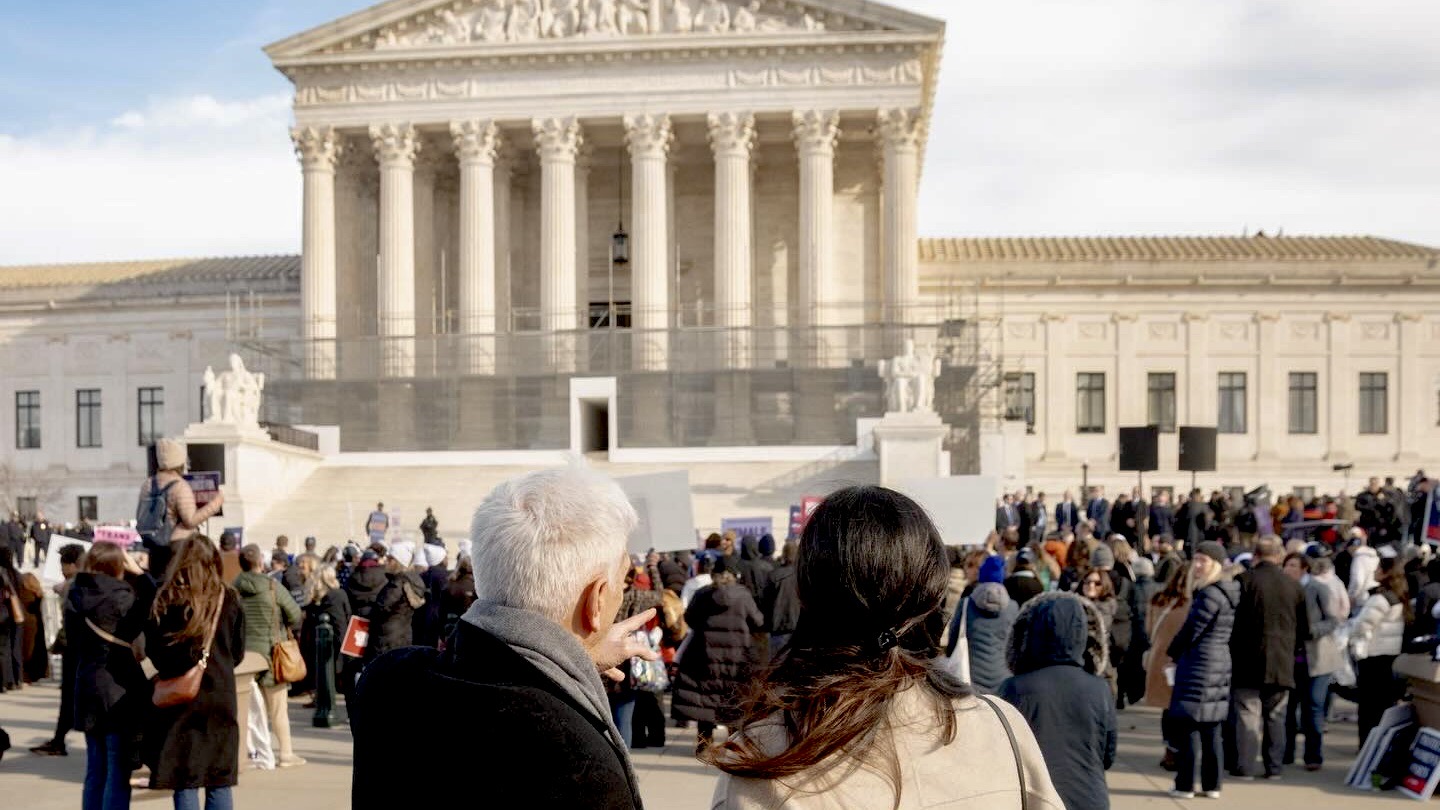
The U.S. Supreme Court appeared sympathetic toward state-wide bans on male athletes competing in women’s sports during oral arguments for State of West Virginia v. B.P.J. and Little v. Hecox.
The Jan. 13 arguments centered on two lawsuits against West Virginia and Idaho, whose laws ban biological males who identify as female from playing in secondary and college sports. Two transgender students, Idaho athlete Lindsay Hecox and West Virginia athlete Becky Pepper-Jackson, challenged the laws several years ago in separate suits. The hearing went more than three hours at the high court, where conservatives hold a 6-3 majority.
The Idaho suit argued that the law violates the Constitution’s equal protection guarantee while West Virginia’s suit centers on whether the law violates Title IX.
During the hearing, justices questioned the plaintiffs’ arguments.
Chief Justice John Roberts asked Kathleen Hartnett of the ACLU, who defended the plaintiffs, to address “whether or not we should view your position as a challenge to the distinction between boys and girls on the basis of sex or whether or not you are perfectly comfortable with the distinction between boys and girls, [and] you just want an exception to the biological definition of girls.”
Roberts stated that if such an exception were adopted, then “that would have to apply across the board and not simply to the area of athletics.”
Justice Amy Coney Barrett questioned the claim that the rules discriminated against transgender athletes.
“How would we say this discriminates on the basis of transgender status when” girls identifying as boys are permitted to play on boy’s teams, and the law’s effect “really only runs towards trans girls?”
Furthermore, Justice Brett Kavanaugh warned that allowing men in women’s sports could “undermine or reverse” the win for fairness and safety for women found in Title IX’s 1972 enactment.
“For the individual girl who does not make the team or doesn’t get on the stand for the medal or doesn’t make all-league, there’s a harm there, and I think we can’t sweep that aside,” Kavanaugh said.
Idaho was the first state to adopt a ban on trans athletes in women’s sports, and West Virginia instilled a ban one year later. Twenty-five other states have enacted such bans in recent years. A Supreme Court decision, which will determine the rights of states to enact such laws, is expected by late June or early July.
Attorneys at law firm Alliance Defending Freedom (ADF) defended the states in their suits and say they are hopeful about the ruling.
Cissie Graham Lynch, who hosts the “Fearless” podcast and is a senior advisor at the Billy Graham Evangelistic Association and Samaritan’s Purse, attended the oral arguments and is calling Christians to stand up for truth in the case.
“I hope these cases help wake Christians up,” Lynch said. “Believers can’t stay on the sidelines anymore. I’m so proud of the girls who have stood up in these cases. But we need to do this together. Christians need to be bold. Now is the time for churches, organizations and ministries to step up and faithfully uphold the truth and the reality that our God-given biology matters.”
Franklin Graham, CEO of the Billy Graham Evangelistic Association and Samaritan’s Purse, voiced his support for ADF’s defense of fairness in female sports before the hearing.
“Thank you, Alliance Defending Freedom and Kristen Waggoner, for defending the rights of girls and women in sports! Pray for the Supreme Court as they hear this important case today,” he posted on social media.