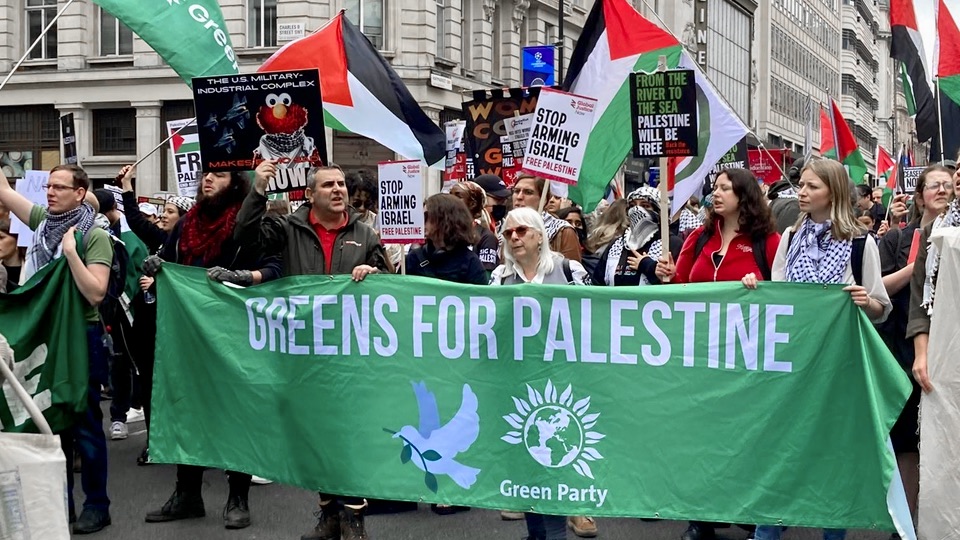
Britain’s Green Party has formally declared itself an “anti-Zionist party,” adopting a sweeping resolution that defines Zionism as racism and calls for the establishment of a single Palestinian state across all of “historic Palestine”—a policy critics say would effectively eliminate Israel as a Jewish state.
The controversial motion passed Sunday at the Green Party of England and Wales annual conference in Brighton by 1,022 votes to 813, despite opposition from several senior Green lawmakers.
The resolution states that Zionism will be “treated as any other form of racism” and describes it as an “ethnonationalist political project” that privileges one ethnic group through the subjugation of others.
The party also reaffirmed its support for the Palestinian “right of return,” the Boycott, Divestment and Sanctions movement, a complete British arms embargo against Israel, and the creation of “a single democratic state throughout historic Palestine.”
Such a state would encompass the territory of modern Israel, Judea and Samaria—also known as the West Bank—and Gaza, replacing the current two-state framework with a single Palestinian state.
Jewish Safeguard Amendment Rejected
The vote went further than simply criticizing the Israeli government.
An amendment intended to protect Jewish Green Party members from disciplinary action because of their association with synagogues or Jewish organizations identifying as Zionist was rejected.
According to Sky News, another proposed amendment that would have preserved the possibility of a two-state solution was also defeated.
The issue is particularly significant because Zionism, broadly understood as supporting the Jewish people’s right to national self-determination in their historic homeland, remains deeply connected to many Jewish institutions and communities.
Even the party’s own Jewish Greens organization had previously warned that declaring Zionism racist could make Jewish members feel unwelcome and create circumstances in which Jews could face discrimination because of their relationships with Zionist synagogues or institutions.
A Jewish Greens survey released shortly before the conference found its members deeply divided over the proposal. Significantly, 53% of respondents said passage of the motion could make discrimination against Jews within the Green Party more likely.
Israel: Resolution Seeks Elimination of Jewish State
Israel’s Foreign Ministry accused the Greens of adopting an ideology aimed at Israel’s destruction and said the resolution went far beyond legitimate criticism of Israeli government policy.
The ministry said the motion “labels as ‘racist’ the aspiration of the Jewish people for self-determination” while advocating a Palestinian state “from the river to the sea.”
Foreign Minister Gideon Sa’ar subsequently barred Green Party leader Zack Polanski from entering Israel, saying the resolution constituted antisemitism under the International Holocaust Remembrance Alliance definition because it denied Jews the right to self-determination.
Israeli President Isaac Herzog called the decision “a disgrace” and warned that describing Zionism as racism endangers Jews and Israelis around the world.
British Jewish Groups Sound The Alarm
Three leading British Jewish organizations—the Board of Deputies of British Jews, Jewish Leadership Council and Community Security Trust—had urged Green leaders before the vote to reject the resolution.
They warned that it could make the Greens “the first electorally significant UK political party in living memory to adopt what appears to be an overtly antisemitic political platform.”
The organizations argued that modern Zionism arose partly in response to centuries of antisemitic persecution, culminating in the Holocaust, and represented the effort to establish a secure Jewish homeland.
They warned that calling for Israel’s elimination disregards the security of Israeli Jews, who constitute roughly half of the world’s Jewish population.
The Movement for Progressive Judaism issued an even stronger denunciation following the vote, arguing that Jewish self-determination is a legitimate national right and that defining those who support it as racists could marginalize Jews throughout British political life.
Deep Divisions Inside The Green Party
The resolution exposed significant fractures inside the Greens themselves.
At least three of the party’s five members of Parliament opposed the motion. Green MP Adrian Ramsay said he was “deeply saddened” by the result and insisted it did not represent either Green principles or his personal position: “The Green Party has long supported the principle of self-determination.”
Green leader Zack Polanski, who is Jewish and has publicly identified himself as “anti-Zionist,” did not participate in the final vote. He had supported amendments that would have preserved the possibility of a “two-state settlement” and protected Jewish members affiliated with Zionist institutions. Both amendments failed.
The vote is particularly striking because only 1,835 members participated out of a party membership exceeding 200,000, according to Sky News.
A Historic Reversal
The controversy carries additional historical weight because the equation “Zionism is racism” echoes language once formally adopted by the United Nations.
In 1975, the U.N. General Assembly passed Resolution 3379 declaring Zionism “a form of racism and racial discrimination.” The resolution was revoked in 1991.
The modern State of Israel was established in 1948 following the 1947 U.N. partition resolution and nearly two millennia after Rome crushed Jewish sovereignty in the land. Zionism emerged in its modern political form during the late 19th century amid intensifying European antisemitism, but Jewish attachment to Jerusalem and the Land of Israel stretches back thousands of years.
The Green Party vote therefore marks something considerably broader than opposition to the policies of Israeli Prime Minister Benjamin Netanyahu or criticism of Israel’s conduct in Gaza.
By declaring Zionism itself racist while endorsing one Palestinian state across the territory now comprising Israel, Judea and Samaria, and Gaza, the party has formally moved from opposition to particular Israeli policies toward opposition to the political principle underlying the existence of a sovereign Jewish state.
For Israel and many Jewish organizations, that distinction is the heart of the controversy: governments and wars can be criticized, but denying Jews alone the national self-determination afforded other peoples crosses an entirely different line.
Prophetic Perspective: “All Nations” and Jerusalem
For students of Bible prophecy, the growing international pressure against Israel carries an unmistakable echo of the prophets. Scripture repeatedly warns that Jerusalem would become the focal point of global controversy in the last days—not merely a regional dispute, but an issue drawing the attention and opposition of the nations.
Zechariah 12:3 declares that Jerusalem would become “a very heavy stone for all peoples” and adds that “all nations of the earth” would ultimately be gathered against it. Later, Zechariah 14:2 speaks even more directly: “For I will gather all the nations to battle against Jerusalem.”
That does not mean every political resolution or anti-Israel vote is the final fulfillment of those passages. But the trajectory is difficult to ignore. Israel is increasingly judged by a different standard, Zionism itself is being branded racist, and political movements in the West are openly embracing formulas that would end Israel’s existence as the world’s only Jewish state.
Through God, the prophets foresaw a day when Jerusalem would stand at the center of an international storm.
Yet the Biblical message does not end with the nations surrounding Jerusalem. Zechariah also declares that the Lord Himself will intervene. The same prophetic passages that describe worldwide opposition to Jerusalem ultimately point toward God’s defense of His purposes and the establishment of His Kingdom.
For believers watching these developments, the response is therefore not fear, but vigilance and prayer. The pressure surrounding Israel may intensify, but Scripture’s final word concerning Jerusalem is not abandonment—it is redemption.