The story is so common that it almost seems inevitable: A college or university is founded as an expressly Biblical institution, but at some point it changes. Some might become completely secular; others may introduce liberal theology or progressive social policies.
Harvard, Yale and Princeton are well-known examples; in fact, seven of the eight Ivy League schools in the U.S. were founded to train pastors but left behind that mission long ago. In the 1970s, Harold Lindsell sounded an alarm in his book The Battle for the Bible, in which he called out seemingly evangelical institutions that had abandoned the infallibility of Scripture. That abandonment, Lindsell argued, “always and ever opens the door to further departures from the faith.”
As authors Peter Greer and Chris Horst write in their book Mission Drift: “Slowly, silently, and with little fanfare, organizations routinely drift from their original purpose, and most will never return to their original intent.”
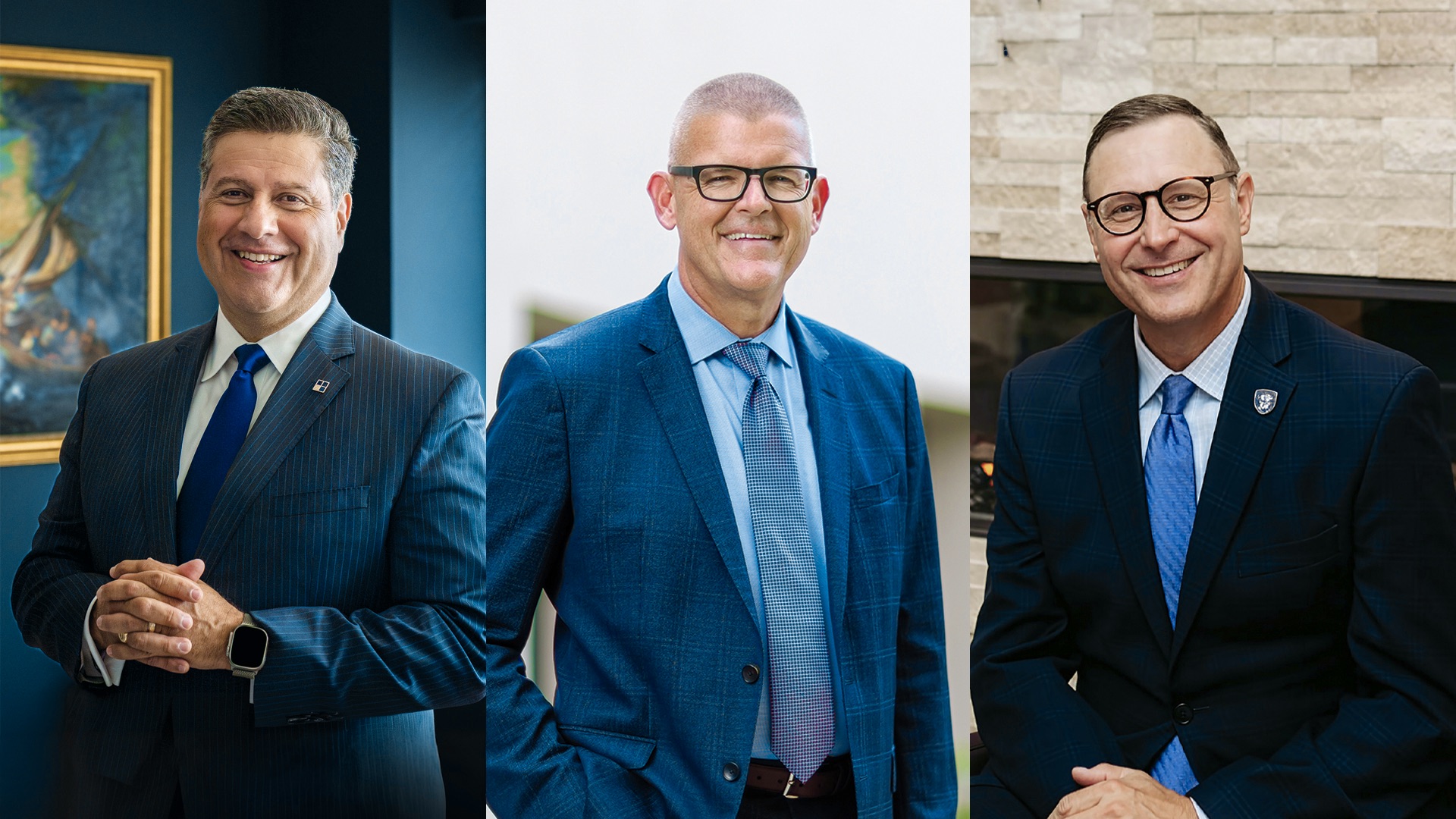
Decision recently spoke with the presidents of three Christian universities who have taken decisive action to counter “mission drift” at their schools. All have come to those positions within the past five years and have faced varying amounts of support or opposition. But all three express a firm determination to keep their schools Christ-focused and unabashedly Biblical.
University of Northwestern-St. Paul
Corbin Hoornbeek joined the University of Northwestern-St. Paul as president in 2022—70 years after Billy Graham’s brief term as president. Hoornbeek says the school’s mission, emphasizing an unwavering commitment to Scripture, has not changed since its founding in 1902. But at times, the commitment to that mission has wavered. When he came, he found the need to root out the presence of theological liberalism, cultural assimilation on LGBTQ issues, and a greater emphasis on social gospel than on the Gospel of salvation.
And for Hoornbeek, part of the role of a leader is “to be so clear about who we are, that it forces a decision, do I fit here? And that applies to our faculty and staff. It also applies to our students.”
Under his leadership, the university renewed its commitment to its mission with the phrase “We Are UNWavering.” This means, first, that the school will pursue an unwavering love for God’s Word.
“We are anchoring our mission in the inerrancy, infallibility and authority of Scripture,” Hoornbeek said.
Second, it means the school will pursue an unwavering love for God’s world. “The more we love God’s Word, the more we love God’s world,” he added.
As Hoornbeek drove a stake in the ground to commit to a Biblical course, many who touted those other views “self-selected themselves out,” for which Hoornbeek is grateful. But not everyone left easily, and Hoornbeek endured some personal attacks in the early days.
“The reality,” he said, “is that every leader has to be willing to draw a line, and when you draw that line, people don’t come at the institution; they don’t review the institutional documents and say, ‘Yeah, this is who we are.’ They come at the leader.”
Cornerstone University
At Cornerstone University, in Grand Rapids, Michigan, President Gerson Moreno-Riaño knew he had a fight on his hands when, the day before his inauguration, the faculty held a widely reported 42-6 vote of no confidence in his leadership.
“I was told when I arrived that it was a university that was on mission, that there was no leftist drift, no progressive drift, no political drift—that everything was fine,” Moreno-Riaño said. “But that was completely inaccurate.
“We had faculty saying there was no obligation to share the Gospel, faculty saying there were no Biblical ethics of sexuality in Scripture. We had faculty openly teaching communism and Marxism.
“One of the things I discovered,” he added, “was that for many years there were faculty and staff who were allowed to initial the parts of our confession of faith they did not believe in, and still be employed in Cornerstone. We said no—you subscribe to every part of this confession, and you affirm it every single year.”
Opposition was fierce at first. During Moreno-Riaño’s first board meeting, a faculty representative read a letter demanding that Moreno-Riaño be fired immediately. One reason for the opposition was that Moreno-Riaño called for an answer to the question: “Are we going to be committed to the Gospel, to the Word of God, to Jesus Christ? Then we have to stand on that Gospel and be faithful to it.”
“We want to do what is honoring to Him, honoring to His Word, honoring to His Son, honoring to the Gospel,” Moreno-Riaño told Decision. “We want Jesus to be first and to be central.”
“What will make Cornerstone a great university,” he added, “is not going to be the president. It’s not going to be the initiative of the president or his team, it’s not going to be the faculty and what they accomplish. It’s not even going to be our students accomplishing things. It’s going to be our faithfulness to the preeminent One, Jesus Christ.”
Azusa Pacific University
In 2018, Azusa Pacific University (APU) quietly removed from its undergraduate standards a ban on same-sex romantic relationships, prompting a strong backlash from many evangelicals, including Franklin Graham.
“It’s disappointing to see a school classified as a Christian university compromising their stand with the Word of God,” Franklin posted on Facebook.
The university’s board quickly overturned the change and reinstituted the ban. But in the midst of the back-and-forth, two board members, including well-known Pastor Raleigh Washington, resigned, alleging that the LGBTQ issue was only a symptom of a much bigger issue: theological and missional drift.
When Adam Morris took the helm at APU in 2022, the board was specifically looking for a leader who could help bring the university back to its Christ-centered mission.
“I think it’s hard to pull an organization back to a place of faithfulness to mission,” Morris said, “and I remember asking the board, ‘Do you have the appetite for that? Are you ready for what might be required of us to do the hard work?’ It was a resounding yes from every member of our board.”
At the start of the 2023 school year, during a meeting with faculty and staff, Morris made his expectations clear. “I pulled up our articles of faith and read them one at a time,” he said.
Morris had a firm message for those who were uncomfortable with those articles. “I’m going to help you exit,” he said. “Because we’re not changing our mission. In fact, we’re doubling down on our Christ-centered mission, and this will increasingly be a frustrating place for you to work.”
Morris says he faced pockets of resistance and had to make some hard personnel decisions, but mostly he saw—among longtime employees, alumni, donors, parents and pastors—a sigh of relief that the school was returning to its Biblical roots.
Why Drift Happens
Drifting from a Biblical mission rarely happens quickly; it tends to be the result of many smaller compromises over time: choosing funding over values; trying to boost the school’s reputation by hiring prestigious faculty members who do not fully align with the school’s mission; or simply by leadership not insisting on fidelity to that mission.
But beneath such actions are more fundamental issues. “The starting point for drift,” Hoornbeek says, “is the loss of the supremacy and primacy of Scripture in everything we do. Second is the replacement of Scripture with the human intellect. Third would be the influence of culture and the desire to be like the rest of the world.”
Moreno-Riaño points out that the temptation in Christian higher education is essentially the same as Adam and Eve faced in the Garden of Eden, when the serpent said, “Yea, hath God said?” In other words, did God really say that, and did God really mean that? The tempter says to college administrators and faculty, “You have your own intellect; you have an advanced doctoral degree. Maybe there’s a different way of seeing this, and maybe there’s a way that we can live that is independent from Him and His Word.”
It’s like a ship’s navigation, Morris says. “You could be off by one degree when you leave the harbor, and that seems insignificant in the moment, but when you’re thousands of miles out at sea, you’re actually hundreds of miles off course.”
A New Hope
All three presidents say any difficulties they have faced have been worth it, as they have seen remarkable changes in the spiritual climate as a result of making clear that their schools will follow a Biblical path.
“There’s probably as much if not more prayer happening here than at any time in APU’s history,” Morris said. “There’s this deep dependence that we have upon the Lord if we’re going to hold true to our Christ-centered mission.”
At Cornerstone, Moreno-Riaño says that as word has spread about the university’s focus, he sees students coming with different goals than before: “It’s not just about the great community that’s here and the beautiful campus. Number one, it’s the Biblical worldview.”
And Hoornbeek says that at the University of Northwestern-St. Paul, not only is the executive leadership team in lockstep with each other about guarding the school’s mission, but the students are studying Scripture with new vigor. “There’ll be 1,400 students packed into the auditorium,” he says, “Bibles open, journals open and pens in hand—and not because anybody told them to do it. They just come ready to dive into the Word.”