As the United States approaches its historic 250th anniversary, with all the celebrations heating up, we stand at a profound crossroads as a civilization. A time like this is a moment for reflection as a nation, and for the believer, it is also a time of waiting and anticipating.
The Statue of Liberty has stood in New York Harbor as a beacon of hope, not only to Americans but to the world, casting her light across the Atlantic. Engraved upon her, we read the immortal words of Emma Lazarus: “Give me your tired, your poor, your huddled masses yearning to breathe free.” To millions of well-meaning Americans, these words are not merely a historic poem; they are a moral mandate. But what does that mean?
Because man is created in the image of God (Imago Dei), we are hardwired for genuine compassion and empathy, notwithstanding the effects of the fall. We instinctively identify with the plight of those suffering, the displaced, and the oppressed. When we see families fleeing war, tyranny, or economic devastation, and our natural impulse—our spiritual inclination—is to offer help, extend our hands, and provide a place of refuge, safety, and the freedom we enjoy.
However, as we look at the current situation, we must confront and acknowledge a fallen world in which (noble) human impulses are frequently weaponized by those with motives often entirely different. What begins as an act of compassion among people is often hijacked by political actors, globalists, and those who view ‘people’ not through the lens of humanitarianism, but through the lens of manipulation and power.
Because man is created in the image of God, our natural impulse is to extend a hand. However, Scripture warns that “the heart is deceitful above all things, and desperately wicked; who can know it?” (Jeremiah 17:9). Untethered empathy fails to recognize that political and spiritual adversaries routinely exploit human kindness. Christians are commanded to be “wise as serpents and harmless as doves” (Matthew 10:16), which means practicing a fact-driven discernment that looks past humanitarian rhetoric to see the underlying agenda. It may sound cold and heartless, but it is an exercise of wisdom and stewardship.
Under the guise of standard social justice rhetoric, which has gained steam throughout the 21st century, political forces have intentionally grouped vastly different global populations into a single, massive group, referred to as “the oppressed.” Within this manufactured coalition, one group has become particularly shielded from critical scrutiny: Muslims.
Many immigrants from the Middle East and North Africa possess darker skin complexions; therefore, political operatives have seamlessly integrated them into the domestic narrative of racial grievance and minority victimhood … yep, here we go! By tying religious ideology to physical characteristics, political folk and other nefarious actors have effectively insulated and protected Islamic doctrine from legitimate critique. What happens when you speak out against a Muslim or Islamic activity? You are, by default, a “racist bigot.”
Muslims have historically, and to the modern day, exploited ‘victimhood’ to advance their expansion.
Everyone is welcome in America, under the big umbrella of freedom. The United States welcomes people of any faith, ethnicity, or background—including Muslims—provided they enter through established, lawful channels and possess the proper motivation to honor this nation. This is legal assimilation. What this is not is bigotry.
The importance of assimilation is a biblical principle, connected directly to a nation’s stewardship and governance (a whole article could be written detailing this principle alone). When Nehemiah rebuilt the walls of Jerusalem, he did not do so out of hatred toward the nations outside; he did so to protect the people inside, appointing gatekeepers to ensure that only those who respected the city’s laws could enter (Nehemiah 7:1–3).
People tend to love the teaching in Nehemiah, until it is turned back to America. A nation that opens its gates indiscriminately to an ideology—one that rejects its foundational principles—is inviting devastation. Do we allow people within our residence to violate and destroy our homes and families? Do we lock our doors at night to keep the good folks outside from getting in?
The crisis we face as we hit the 250-year milestone is not a crisis of skin color or ethnicity; it is a profound crisis of ideology. The stark reality that many well-meaning people refuse to confront is that standard Islamic doctrine does not seek assimilation into a secular republic; historically, textually, and culturally, it aims for domination.
Those who adhere to this Islamic ideology are not confused about this.
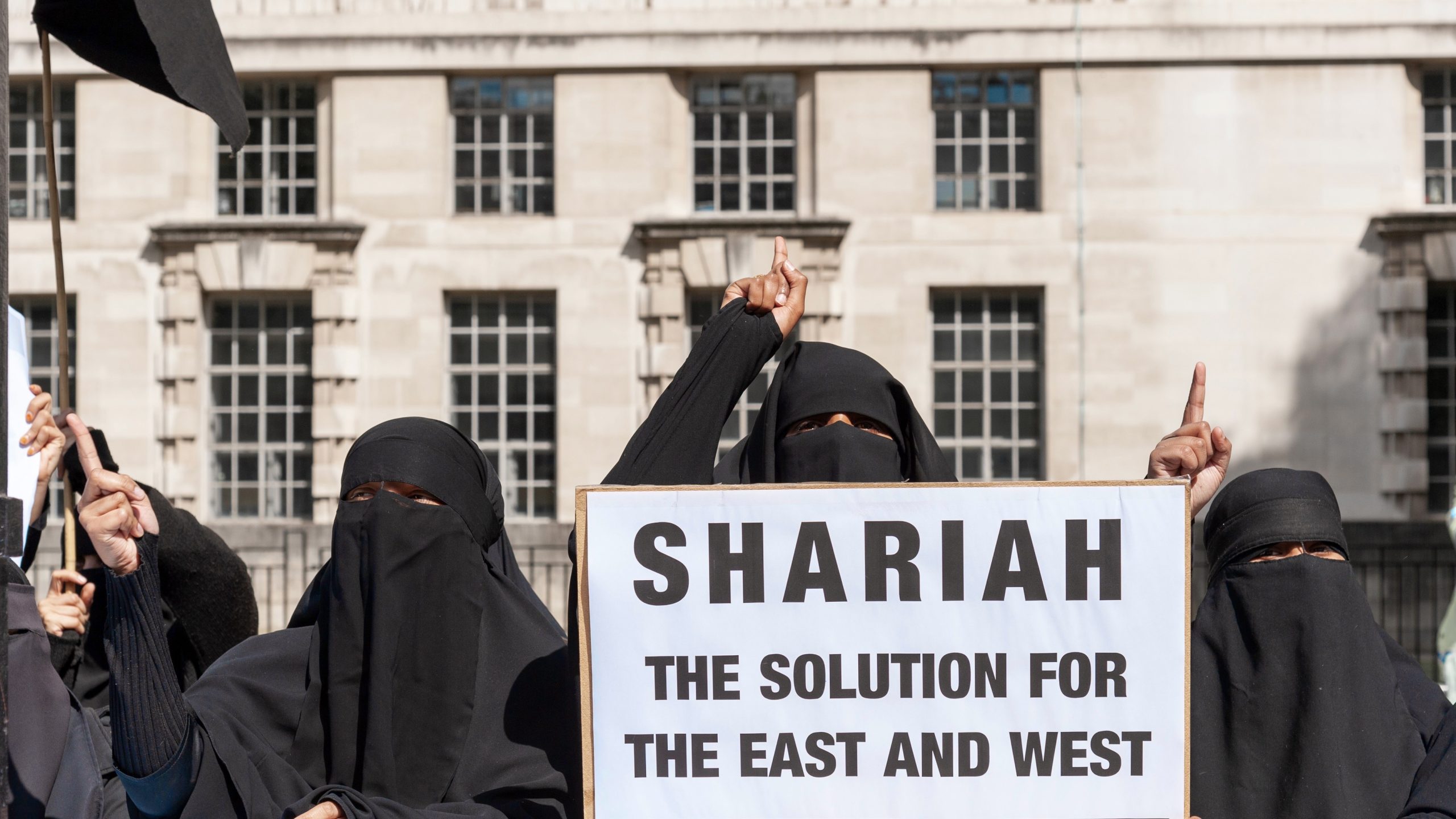
While millions of individual Muslims live peacefully and do not actively seek to overthrow Western laws, the underlying religious and political systems of Islam contain an inherent mandate for societal transformation and domination. Unlike Christianity, which operates under a theology of two realms—rendering to Caesar the things that are Caesar’s and to God the things that are God’s (Matthew 22:21)—traditional Islam recognizes no distinction between the religious and the political. Sharia is a comprehensive legal, social, and political framework designed to govern every aspect of public and private life.
Historically and doctrinally, when Islam enters a new geographic territory, the long-term trajectory follows a distinct, three-fold pattern. First, it begins with infiltration and expansion, utilizing migration (Hijrah) to establish a demographic foothold within a host nation while presenting as a peaceful, marginalized minority. Second, this naturally progresses into indoctrination and enclavement (isolation from surrounding culture), where the group actively resists cultural assimilation by forming self-segregating communities, establishing independent religious councils, and demanding special legal exemptions that mirror Sharia principles. This is the stage happening in America today. The final stage is domination, characterized by a gradual political and cultural assertion that moves from a posture of peaceful co-existence to a position of systemic control over local institutions, speech laws, and governance.
Years ago, I discovered something alarming: statistics consistently demonstrate that even among moderate Islamic folks, when radical or fundamentalist elements begin asserting societal dominance or implementing fundamentalist policies strictly, the vast majority of the population is either in agreement or at the very least turns away. The result is that the moderates rarely to never restrain those aspects of their culture that are particularly troubling.
This blind spot has created an incredibly bizarre and precarious political alliance in the West. Today, we routinely see far-left secular progressives, feminist organizations, and LGBTTTQQIAA… activists marching alongside fundamentalist Islamic groups under the banner of solidarity.
This naive coalition ignores a glaring, historical truth: the very progressive groups that stand shoulder-to-shoulder with radical Islamic ideologies at the beginning of their political ascent invariably become the primary targets of their hostility at the end! In nations where Islamic law achieves political dominance, Western progressive ideals—such as radical gender theory, secular feminism, and LGBTQ advocacy—are completely eradicated, most often through the most heinous violence. The very liberals who welcomed the ideology are immediately reclassified as enemies.
This phenomenon is perfectly captured by the classic fable of the frog and the scorpion. A scorpion asks a frog to carry him across a deep river on its back. The frog hesitates, arguing, “If I do, you will sting me, and I will drown.” The scorpion reassures him, “That makes no sense. If I sting you, we will both drown.” Convincing the frog of his logical compassion, the scorpion climbs aboard. Halfway across the violent river, the scorpion drives his venomous stinger deep into the frog’s back. As they both begin to sink into the dark waters, the paralyzed frog cries out, “Why did you do that? Now we will both die!” The scorpion simply replies, “I could not help it. It is my nature.” In the case of our current situation, the sting will come once dominance is established.
The ideological systems currently migrating into the West have never hidden their nature. Their foundational texts, historical actions, and current global practices openly declare their aim. The crisis in Western civilization, as we celebrate 250 years of liberty, is not that our guests are deceiving us; it is that we, as the host nation, are living in a state of profound, willful denial. Driven by blind, emotional compassion that ignores biblical wisdom, historical precedent, and even common sense, America is begging for its own destruction.
As we mark this historic anniversary, we are reminded of a recurring pattern in Scripture: a generation inherits a blessing, grows wealthy and secure, and eventually forgets God who established them. We are rapidly approaching the tragedy of Judges 2:10, where “another generation arose after them who did not know the Lord nor the work which He had done.”
Here is the good news: it is not too late! We must honor the stewardship passed down since 1776 … but, if the current trajectory continues under the banner of blind compassion, Liberty’s torch will be extinguished by our negligence.