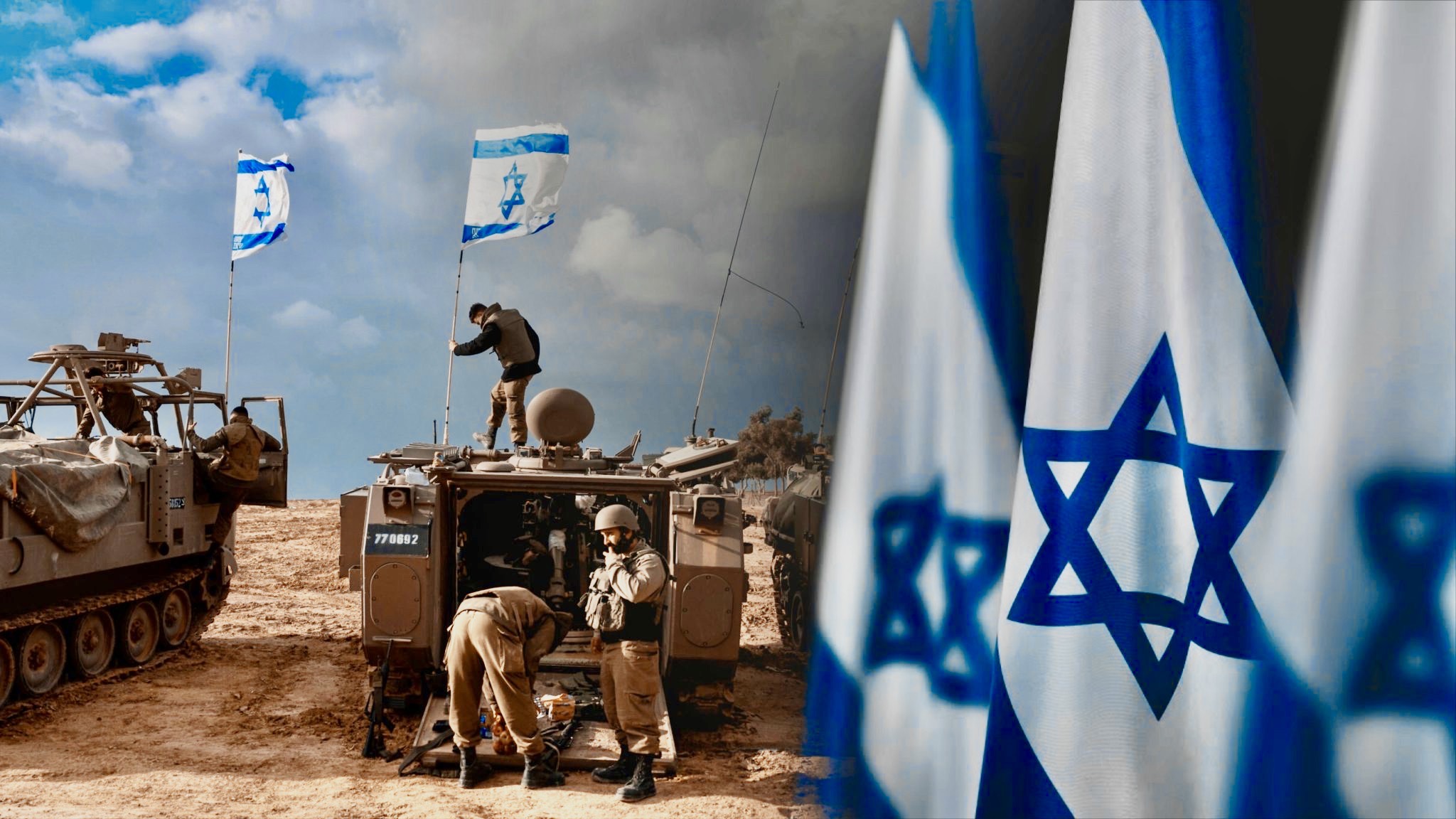

For 4,000 years, Israel has been surrounded by those who hate it. Even after God scattered the Jewish people among the nations, hatred of them never abated.
Perhaps that is because God’s enemies are Israel’s enemies—and God has many enemies (Ps. 83; cf. Jas. 4:4). Israel is the only nation in the world aligned through covenants with the one true God of the universe. Being God’s agent to reveal His Word, bring His salvation to the world, and bless the world makes it a target of those who rebel against the Almighty. Today, we see hatred for Israel playing out on a global scale as the nations of the world rise in opposition to the Jewish people.
So, in this universal context of hatred, how was modern Israel ever born? The simple answer is God, but how He brought the event about is not so simple.
The End of an Empire
Entering the 20th century, the region that included Israel was commonly referred to as Palestine (a title the Romans gave to spite the Jewish people in the 2nd century AD) and was controlled by the Ottoman Turkish Empire. Most of the land was owned by the government and a few wealthy absentee landlords, not by the inhabitants.
Although a remnant of Jewish people have always lived in the land, Jews in Eastern Europe began returning to Palestine in significant numbers in the late 1800s. Driven by antisemitic violence and forced settlements in Russia, many fled to their ancient homeland. An estimated 50,000 Jewish people lived in Palestine in 1900, under Ottoman rule.
As the Lord promised, He used persecution to drive His people back to the land He promised them, where they purchased property at exorbitant prices from the Ottomans, whose empire was in severe decline. By the early 1920s, the Jewish population had grown to around 85,000 and more than doubled by 1930, creating a growing momentum for a Jewish state. What began as the Zionist movement in the 1890s under the leadership of Theodor Herzl was gaining traction through key events orchestrated by God.
In 1916, during World War I, France and England made a secret treaty, the Sykes-Picot Agreement, that divided the Ottoman Empire’s Middle Eastern territory between Britain, France, and Russia. Artificial borders were drawn that cut across natural boundaries and ethnic groups, creating instability. Under the agreement, Palestine would be administered by Britain, France, and Russia.
The British defeated the Ottomans at the Battle of Megiddo and drove the empire out of Palestine. In the aftermath, prior to a formal pact to divide the Middle East, the Faisal-Weizmann Agreement was forged in 1919 between Arab leader Emir Faisal and Jewish Zionist leader Chaim Weizmann.
In some ways, it was a precursor to the modern Abraham Accords, as it provided for recognition of a sovereign Jewish state in Palestine and support for Arab independence. The agreement included economic ties and cooperation between the Arab and Jewish populations. But it fell apart as the victors of World War I worked to develop a mandate to partition the Ottoman Middle East between themselves.
As Britain gained control over the area, God used this Christian nation to help restore ancient Jewish land to the Jewish people. Many in the British government and military were professing believers who read their Bibles, knew Bible prophecy, and believed God would return the Jews to the land He promised to give them “forever” (Gen. 13:15; Ex. 32:13; Josh. 14:9; 1 Chr. 28:8; Isa. 60:21; Jer. 7:7).
When British General Edmund Allenby approached Jerusalem in December 1917, Prime Minister David Lloyd George challenged him to capture the city before Christmas as “a Christmas present for the British people.” Allenby took Jerusalem without a single shot fired on December 9, 1917.
Balfour Declaration and San Remo
During World War I, the British sought to thank Chaim Weizmann, then a resident of England, for his contribution to the war effort. A chemist, Weizmann had developed an explosive compound that gave Britain a great advantage over its enemies. In return, British Foreign Secretary Arthur Balfour issued the Balfour Declaration in 1917, stating the British government’s support for establishing a Jewish national home in Palestine, while protecting Arab rights. Balfour was a committed Christian.
In 1920, the World War I Allies met in San Remo, Italy, to determine the future of the former Ottoman Middle East. They created a mandate for Britain and France to divide the territory. Like the Sykes-Picot Agreement, straight-line borders were drawn without regard to natural borders or people groups. Much of the trouble in the region today is due to the Allies’ arbitrary divisions. The San Remo Resolution gave control of Palestine to the British.
The Lord used the 1920 San Remo Resolution to include a mandate for a Jewish state in Palestine. The Balfour Declaration was formally incorporated into the terms of the British Mandate, making it an internationally binding obligation. Britain was responsible for working to establish a national home for the Jewish people while considering Arab interests. This was the international, foundational document for the establishment of the modern State of Israel and the two-state solution.
Birthed in a Day
During the 1930s and 1940s, Jewish immigration to Palestine accelerated; and by 1940 the Jewish population reached 450,000. But this growth stoked tensions with the Arabs, as both sought favor with the British.
In 1939, through a document called the White Paper, Britain restricted Jewish immigration. Because the Arabs possessed oil, a vital source of energy for their economy, the British often favored the Arabs over the Jews.
In time, the British tired of the complexity of the conflict and the escalating violence. Following World War II, the pressure reached a boiling point. The cost of controlling the land was immense, and there was growing international demand to permit Holocaust survivors to immigrate to Palestine. In 1947, Britain informed the United Nations of its intent to withdraw from Palestine in May 1948.
The UN formed a commission to address the situation. The Commission went to Palestine to investigate and recommended UN Resolution 181: a plan to divide Palestine into two states, one Jewish and one Arab. Jerusalem and Bethlehem were to remain under international control. Jewish leaders accepted the resolution; Arab leaders rejected it.
On November 29, 1947, UN Resolution 181 passed by a vote of 33 nations in favor, 13 against, and 10 abstaining. Hence, the Jewish people had the world’s approval to become a nation once again.
They had six months to prepare. In Isaiah 66:8, the Lord asks, “Shall the earth be made to give birth in one day? Or shall a nation be born at once?” At once is exactly how God birthed modern Israel. At 4 p.m. on May 14, 1948, David Ben-Gurion, leader of the Jewish community in the land and soon to become Israel’s first prime minister, read the Declaration of Independence for the State of Israel. In one day, Israel became a sovereign nation again.
A mere 11 minutes after Ben-Gurion finished reading the Declaration, in the face of strong resistance from his administration, U.S. President Harry Truman released a quickly written statement recognizing the newly formed State of Israel. A Southern Baptist from Missouri, Truman later reflected that he believed God put him in the White House for such a time as this (cf. Est. 4:14).
On May 15, 1948, the British withdrew. Furious over Israel’s independence, surrounding Arab nations attacked the infant state. Without time to form an army or prepare for war, Israel fought using militia, newly arrived immigrants, and Holocaust survivors. Through miracle after miracle, God gave tiny Israel an improbable David-versus-Goliath victory over the massive Arab armies.
The Arabs call Israel’s War of Independence the Nakba, the “catastrophe.” For Israel, it was a dream come true. In early 1949, after months of fighting, an armistice with Egypt, Jordan, Syria, and Lebanon ended the hostilities. By the end of the war, Israel had gained a significant portion of land, enlarging the size of the country.
Through agreements and key individuals, God orchestrated the return of the Jewish people to the land He promised “they shall inherit . . . forever” (Isa. 60:21) and rebirthed the nation in a day, preserving it from its enemies. Only an almighty, all-powerful, Most High God could accomplish the modern miracle that is Israel.
Despite continuing efforts to wipe Israel off the map, God continues to protect and prosper His uniquely Chosen People, just as He promised.