A ruling by the U.S. Supreme Court on whether two states can ban biological males from participating in female school sports is not expected until sometime in June. But attorneys who petitioned the high court say they are optimistic that common sense will prevail for the sake of women’s privacy, safety, and fairness in athletic competition.
The court, with its 6-3 conservative majority, convened for more than three hours Jan. 13 to hear oral arguments in separate cases involving two transgender female students, Lindsay Hecox and Becky Pepper-Jackson, who challenged state bans in Idaho and West Virginia, respectively.
But following oral arguments, many court observers said the justices seemed sympathetic to the state bans, and attorneys for the states said they felt hopeful about their case.
“Women deserve an equal opportunity for fairness and safety,” said John Bursch, senior counsel and vice president of appellate advocacy with Alliance Defending Freedom (ADF), the nonprofit law firm that helped the Idaho state legislature ratify the nation’s first Fairness in Women’s Sports Act into law in 2020.
“Today, Idaho and West Virginia asked the Supreme Court to allow states to protect women’s sports by affirming a basic truth: women and men are biologically different,” Bursch said following the justices’ hearing of oral arguments. “Yet today the ACLU asked the court to make it impossible to define sex accurately. Identity does not determine your sex, and laws that distinguish between the sexes do not violate federal law when biological differences matter, like on the playing field and in the locker room. No drug can make a man into a woman. Puberty blockers and testosterone suppression do not erase the physical advantages males have over females. All athletes can compete, but they must do so on a level playing field.”
Justice Samuel Alito challenged an attorney representing a biological male athlete in the Idaho case of Little v. Hecox about what it means to be a “boy or a girl or a man or a woman” when it comes to equal protection purposes. “How can a court determine whether there’s discrimination on the basis of sex without knowing what sex means for equal protection purposes?” Alito asked.
The attorney, Kathleen R. Hartnett, agreed that a school may have separate teams for students “classified as boys and a category of students classified as girls.”
The other case, State of West Virginia v. B.P.J., centers around a 15-year-old transgender athlete who has publicly identified as a girl since the third grade. B.P.J., a biological male named Becky Pepper-Jackson, takes puberty blockers while also receiving hormone therapy with estrogen.
B.P.J. has competed on a West Virginia girls’ track team, finishing ahead of almost 300 girls in three years in middle school cross-country and track-and-field events. The state’s attorney general and ADF attorneys intervened in a lawsuit to defend the state’s law, which was enacted to ensure equal athletic opportunities for women.
Alito grilled ACLU attorney Joshua Block for suggesting that the federal Department of Education’s Title IX anti-discrimination protections for females could be defined beyond biological sex.
“Title IX prohibits discrimination on the basis of sex,” Alito asserted. “It’s a statutory term. It must mean something. You’re arguing here there is discrimination on the basis of sex, and how can we decide that question without knowing what sex means in Title IX? … It has to mean something.”
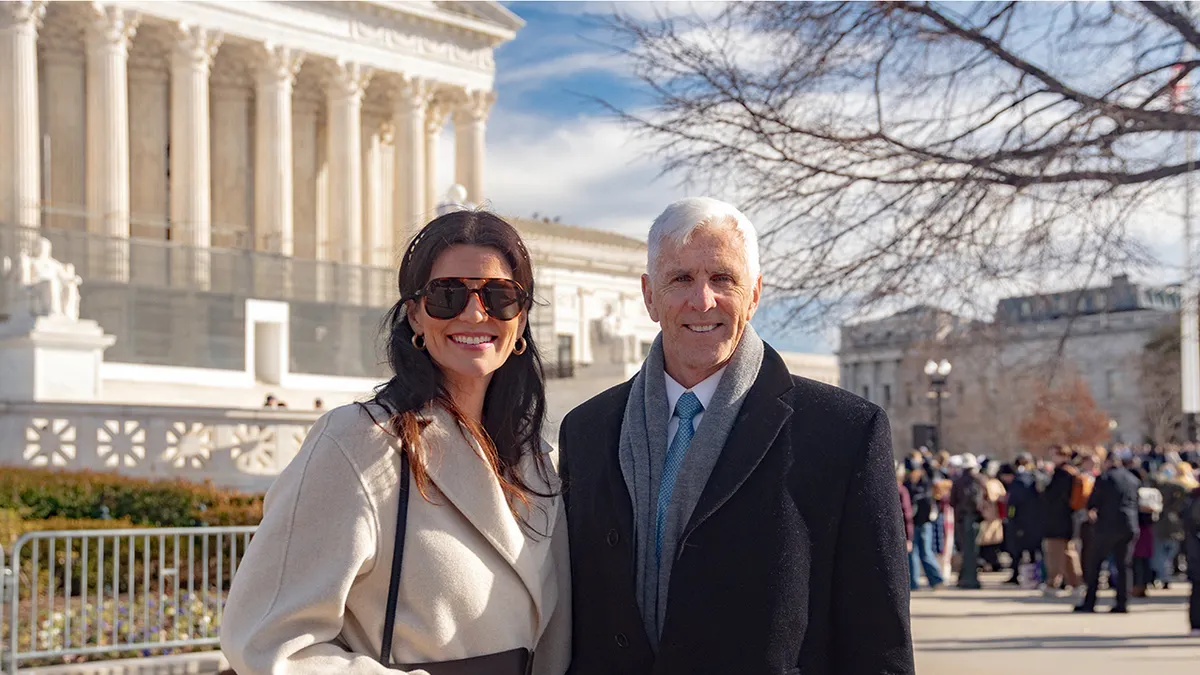
In an interview with Fox News Digital, Cissie Graham-Lynch, who attended the oral arguments, commented: “This isn’t a political issue. This is a Genesis 1 issue.” The senior advisor for the Billy Graham Evangelistic Association continued: “Regardless of what the Supreme Court decides, God’s Word is clear—men are men and women are women. And today I’m grateful, girls finally had their historic day in court to say just that.”
“So God created man in His own image; in the image of God He created him; male and female He created them” (Genesis 1:27).
Cissie later hosted her Fearless podcast in the nation’s capital, featuring an interview with Kate Anderson, senior counsel with ADF.
Todd Chasteen, vice president of public policy and general counsel for Samaritan’s Purse, attended the Supreme Court hearing with Cissie.
“What kept getting repeated in the case today—this was the key thing—was that when it comes to women’s sports, biology matters,” Chasteen said. “And that’s a pretty simple statement, but it’s common sense, it’s true, and it lines up with Scripture.”
More than 50 friend-of-the-court briefs have been filed in these combined cases—by women’s rights groups, female athletes, scientists, dozens of other advocacy groups, 27 states and the U.S. government—all asking the justices to allow enforcement of state laws that protect women’s sports. Samaritan’s Purse has also joined an amicus brief with Concerned Women for America.
Conversely, 130 Democrat members of Congress have signed an amicus brief urging the justices to rule in favor of the two trans athletes.
In the Idaho case, Hecox, the biological male, had wanted to try out for the Boise State University women’s track and cross-country teams, before eventually scrapping those plans.
Meanwhile, two female track athletes at Idaho State University, Madison Kenyon and Mary Kate Marshall, asked ADF lawyers to intervene in the case on their behalf after a male athlete from the University of Montana crushed the competition and took first place in the women’s mile at the 2020 NCAA Division I Big Sky Conference Championships.
Following unfavorable rulings in federal court and the U.S. Court of Appeals for the 9th Circuit against Idaho’s fairness law to keep men out of women’s athletic competition, ADF attorneys and the Idaho attorney general petitioned the U.S. Supreme Court to review the lower court rulings.
In its petition for review by the Supreme Court of Little v. Hecox, the state told the justices that its law was intended to ensure that “women and girls are not forced to compete against men and boys who benefit from the ‘enduring physical differences between men and women.’” It urged the court to grant review and “decide whether the Constitution prohibits the people’s elected representatives in half the states from relying on sex-based distinctions to save women’s sports.”
To date, 27 states have passed laws banning males from participating in girls’ school sports under Title IX and the Constitution’s equal protection clause.
Following the Supreme Court hearing of the oral arguments, Kenyon, now a former Idaho State University track athlete, expressed gratitude for those who have supported her fight for women’s rights.
“I am so proud to be from Idaho, and I’m so proud of West Virginia for standing up for the rights of women and girls, specifically the Attorney General Labrador and Attorney General McCuskey,” she said.
“Idaho’s laws protecting women’s sports reflects reality. Men and women are different, whether some want to admit it or not, you can’t change those differences by suppressing testosterone. Women don’t join sports for a participation trophy; we want to win. We work to win, and we deserve a fair shot at winning that trophy and taking home the victory. I’ll happily compete against challenging odds, but nobody should lose the race before it has started. We are hopeful that the court will see Idaho and West Virginia’s laws for what they are, a respecter of biology, fairness, and women.”