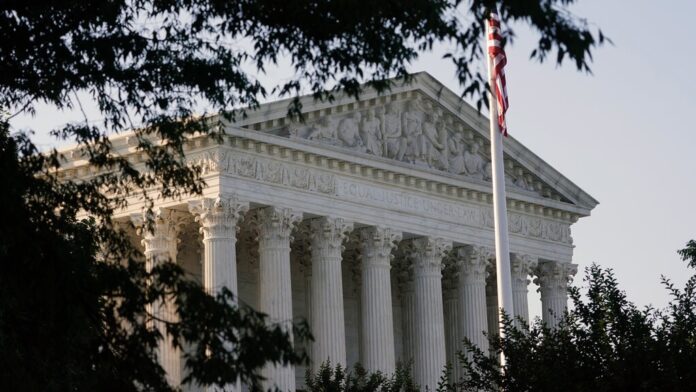
Since 2018, First Liberty has secured nine Supreme Court wins that have set major precedents and also overturned several rulings that have been harmful to religious freedom.
Our Coach Kennedy and American Legion cases overturned the Lemon Test, a precedent that stifled religious liberty and public expressions of faith for decades. With Lemon gone, Americans now have more religious freedom than they’ve had in 50 years.
Our Faithful Carrier Case strengthened legal protections for people of faith at work by setting a very high bar for employers to deny a religious accommodation. Our case significantly narrowed a 1977 case that previously had given employers the upper hand to deny those requests.
Every one of our Supreme Court victories are causing a seismic shift in the law. However, there is much more to be done. There are many bad precedents on the books that still need to be corrected or overturned.
Employment Division v. Smith (1990)
Employment Division v. Smith involved two Native American counselors fired from their jobs for consuming a small amount of peyote as part of a religious ceremony.
According to their file, they were fired with cause for misconduct and were denied unemployment benefits. They challenged that denial in court under the First Amendment’s Free Exercise Clause, arguing they’d been discriminated against based on their religious beliefs.
The Supreme Court ruled against the counselors, rejecting their First Amendment claim. It held that the Free Exercise Clause does not require the government to make religious exceptions to generally applicable, neutral laws.
This standard has been applied more broadly around the nation, negatively impacting the religious freedom of millions of Americans.
First Liberty’s SweetCakes by Melissa case presents an opportunity to review the Smith decision.
Santa Fe Independent School District v. Doe (2000)
Santa Fe High School in Texas allowed a student chaplain to routinely delivered a prayer over the PA system before varsity football games. However, several families sued, claiming that this violated the Establishment Clause.
The school district argued that its policy was constitutional because the student’s prayer was private speech.
The Supreme Court concluded that these prayers were considered public speech. It ruled that the policy allowing student-led, student-initiated prayers was unconstitutional.
First Liberty’s Cambridge Christian School case—which is pending right now with the Supreme Court—presents an opportunity to correct Santa Fe, which has stifled the free expression of students for over two decades.
Many schools in Providence, Rhode Island, invited clergy members to give invocations at school graduation ceremonies. So, Robert E. Lee, a middle school principal, invited a rabbi to speak and pray at the school’s graduation ceremony.
However, Daniel Weismann, the father of one student, didn’t agree with this decision. He sued to ban the school from inviting religious leaders to speak.
The Supreme Court ruled that allowing clergy members to give an invocation or benediction at state-sponsored events, like graduations, violates the Establishment Clause.
Christian Legal Society v. Martinez (2010)
The Christian Legal Society (CLS) was denied official recognition by a public law school because CLS required its members and leaders to sign a statement of faith.
According to the school, CLS was in violation of the school’s policy, which allowed “any student to participate, become a member, or seek leadership positions, regardless of their status or beliefs.”
The Supreme Court ruled that CLS’s requirement was discriminatory and that the school was correct in denying the club official recognition. The ruling set a precedent that undermines the First Amendment rights of faith-based groups across the nation. Reviewing Christian Legal Society would be an opportunity to affirm that religious groups have the constitutional right to determine the requirements of membership and leadership in their organizations.
Colorado has a law that creates a 100-foot zone around the entrance of abortion centers. Within this zone, no one is allowed to come within eight feet of another person and hand them a leaflet, hold a sign, or engage in an oral protest, counseling or education.
The law imposes severe, content-based restrictions on speech. It targets Americans with religious convictions who want to offer pro-life help and alternatives to women and families in need.
The Supreme Court held that the Colorado statute was constitutional because it was not a regulation of speech, rather “it is a regulation of the places where some speech may occur.”
However, the Supreme Court’s landmark ruling Dobbs v. Jackson Women’s Health Organization (2022), properly returned the power to regulate abortion back to the states. In Dobbs, the Court specifically stated that cases like Hill “have distorted First Amendment doctrines.”
First Liberty’s case involving Wendy Faustin directly challenges Colorado’s buffer zone law. The case is currently pending in federal appeals court, one level below the Supreme Court. We’re arguing that Colorado’s law singles out religious and life-affirming speech, which is unconstitutional.
Several parents challenged a Kentucky law requiring a copy of the Ten Commandments in every classroom, claiming it violated the Establishment Clause. Relying on the Lemon Test, the Supreme Court ruled the law was unconstitutional.
“Stone v. Graham is a relic of a previous time when the Lemon test censored religion from public life and is no longer good law,” explains First Liberty Executive General Counsel Hiram Sasser.
There’s pending litigation in several states—including Arkansas, Texas and Louisiana—in which Ten Commandments displays in public schools are being challenged. If those cases make their way to the Supreme Court, it could be an opportunity for the justices to review Stone and strike it down for good.