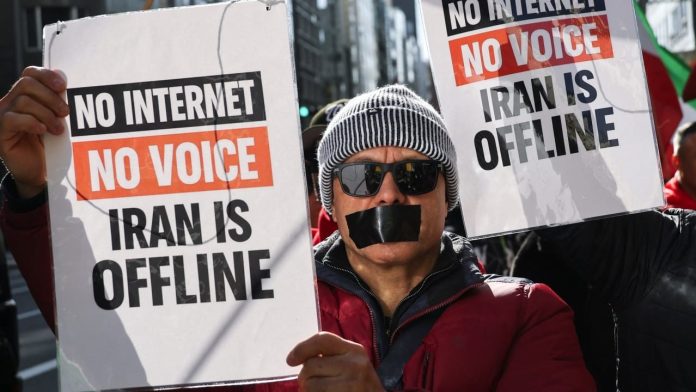
Iran’s Islamic regime is facing growing scrutiny after partially restoring internet access — but only for select groups — raising concerns that the move is less about openness and more about tightening control over information.
Experts told The Jerusalem Post that Tehran’s selective rollback of restrictions is effectively creating an ideological filter, allowing pro-regime voices online while the broader population remains largely cut off from the global internet.
Iran’s Deputy Science Minister, Seyed Mehdi Abtahi, announced that researchers and professors would gradually regain access to international websites, excluding those still censored by the regime. The access expansion is being facilitated through a special service known as “Internet Pro,” which is available only to approved institutions, businesses, and individuals.
However, analysts argue that this is not a step toward liberalization. Roger Macmillan, a terrorism and security specialist, said the initiative reflects a long-term strategy to centralize control over Iran’s digital ecosystem.
“This is not a liberalization signal,” Macmillan explained. “It is the visible face of a control architecture that has been in development since at least 2025.”
According to experts, the regime’s original internet shutdown—implemented during nationwide protests triggered by economic hardship—was aimed at suppressing dissent rather than addressing national security threats. The blackout severely limited communication both Iran and with the outside world.
United Nations experts, including Mai Sato, have warned that such restrictions hinder global monitoring of alleged human rights abuses during protests, further isolating the Iranian population.
Cybersecurity analyst Amir Rashidi echoed these concerns, stating that Iran is redefining internet access as a controlled resource rather than a universal right.
“In Iran, the internet is no longer treated as a public right,” Rashidi said. “It’s now considered strategic infrastructure, where access depends on state priorities.”
Critics say the regime’s approach could enable discriminatory practices in determining who receives access. Reports indicate that individuals may be granted varying levels of connectivity—including “white SIM cards” with fewer restrictions—based on opaque criteria that could involve political loyalty or even demographic factors.
Meanwhile, concerns are mounting over surveillance. Experts warn that Iran’s development of its own digital certification systems could allow authorities to intercept and manipulate private communications, potentially exposing activists and whistleblowers to greater risk.
Macmillan cautioned that the controlled reopening of internet access may distort how the outside world perceives Iran.
“The information we’re receiving is not a true reflection of Iranian society,” he said. “It’s the regime deciding which voices the world is allowed to hear.”
Analysis: A Digital Iron Curtain
Iran’s evolving internet policy underscores a broader trend among authoritarian regimes: leveraging technology not just to block dissent, but to shape narratives. By selectively amplifying regime-aligned voices while silencing others, Tehran appears to be constructing a digital ecosystem designed to project stability while suppressing unrest.
For many Iranians, however, the reality remains unchanged—limited access, restricted communication, and a growing sense that their voices are being systematically filtered from the global stage.