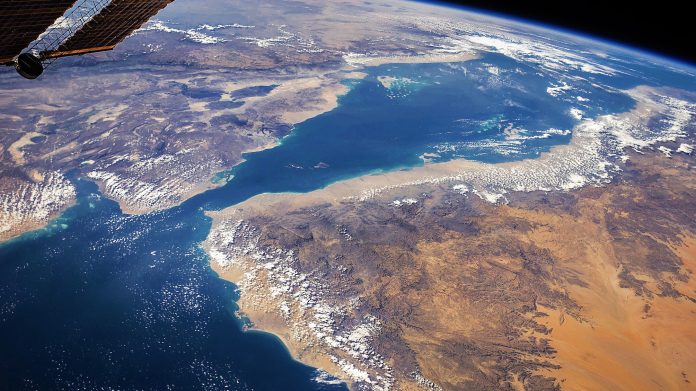
Somaliland’s emergence as a potential U.S. and Israeli partner marks a major strategic shift in the Red Sea region, offering Washington and Jerusalem a new foothold near the vital Bab el-Mandeb Strait as Iran-backed Houthi threats continue to menace global shipping.
According to a Fox News Digital exclusive, Iran is “deeply threatened” by the small but strategically located breakaway state because its deep-water port and airbase could be used by the United States, Israel, and other Western powers to counter Tehran’s influence across one of the world’s most important maritime corridors.
The concern centers on Somaliland’s location across the Gulf of Aden from Yemen, where Iran-backed Houthi terrorists have repeatedly targeted commercial shipping in the Red Sea and threatened vessels linked to Israel, the United States, and their allies.
Lisa Daftari, a Middle East and foreign policy expert, told Fox News Digital that Iran’s regime views Somaliland as a potential “pro-Western” and “pro-Israel” platform overlooking the Bab el-Mandeb — a foothold that could weaken Tehran’s ability to use the Houthis as leverage over Red Sea shipping and Israel.
That is precisely why Somaliland’s offer matters. Its port city of Berbera provides deep-water access along the route connecting the Red Sea to the Indian Ocean, while its airfield has long been viewed as a strategic asset. A previous Fox News Digital report noted that Somaliland has offered the United States access to Berbera as a possible air and naval base at a time when Houthi threats and pressure around the Strait of Hormuz have elevated concerns over global trade routes.
Somaliland Foreign Minister Abdirahman Dahir Adam told Fox News Digital that his government has reiterated its longstanding offer to give the United States access along its coast, saying Somaliland is ready to play a practical role in helping Washington secure global trade routes.
The offer is especially significant because U.S. naval forces operating in the Red Sea currently face long resupply routes after expending missile batteries. Somaliland officials have reportedly floated logistical support, including storage space for Tomahawk missiles, as part of a broader effort to strengthen Western maritime security.
At the same time, the United States already maintains a major military presence in nearby Djibouti, but analysts warn that China’s expanding military and commercial footprint there has made Washington’s reliance on Djibouti more complicated. Somaliland, by contrast, is presenting itself as a willing partner with a different strategic profile.
The diplomatic challenge remains substantial. Somaliland declared independence from Somalia in 1991 after the collapse of the Somali state, but the United States still publicly recognizes Somalia’s federal government and has not formally recognized Somaliland as an independent country. Somaliland, however, has maintained its own government, security forces, elections, currency, and relative stability for more than three decades.
Somaliland’s roots go deeper than its 1991 declaration. The territory was once a British protectorate, briefly became independent on June 26, 1960, and then united days later with the former Italian Somaliland to form the Somali Republic. After years of war and repression under Somalia’s military regime, Somaliland reasserted independence in 1991, though most of the world continued to treat it as part of Somalia.
Its relationship with Israel has now pushed Somaliland into the center of regional geopolitics. Israel formally recognized Somaliland on December 26, 2025, becoming the first United Nations member state to recognize it as an independent and sovereign state. Reuters reported that the move could reshape regional dynamics while intensifying Somalia’s opposition to Somaliland’s secession.
That recognition reportedly infuriated Iran. Edmund Fitton-Brown, a senior fellow at the Foundation for Defense of Democracies and former U.K. ambassador to Yemen, told Fox News Digital that Iran opposes Somaliland’s recognition in part because Israel moved first, and because Somaliland could become a base for enforcing pressure against the Houthis.
For Israel, Somaliland’s location offers obvious strategic value. The Washington Institute noted that Israel’s recognition of Somaliland introduced new dynamics in the Red Sea Basin, potentially restoring a diplomatic and security presence for Israel in an area where its regional access had declined in recent years.
For Washington, the case for Somaliland is increasingly framed around counterterrorism, maritime security, and strategic redundancy. Sen. Ted Cruz, R-Texas, has urged the United States to recognize Somaliland, calling it a potential counterterrorism ally because of its willingness to partner with America and its location near the Red Sea.
Still, the Pentagon publicly maintains that the United States works through the Federal Government of Somalia. Fox News Digital reported that U.S. officials continue to describe American counterterrorism operations in northern and southern Somalia as coordinated with Mogadishu, even as U.S. military delegations have reportedly maintained contact with Somaliland.
The larger reality is difficult to ignore: as Iran leans on the Houthis to threaten maritime trade, Somaliland is offering the United States and Israel a rare opportunity — a stable, pro-Western partner on the African side of the Red Sea, positioned near the gateway between the Indian Ocean and the Mediterranean trade route.