
January 20, 2026

January, 20, 2026
January 20, 2026

give

untitled artwork

untitled artwork

World news biblically understood

TRENDING:

In-Depth: Marrying Theology to So-Called Science (Part 3) — Coming Full Circle

Calvin Smith

In part 2 of our series, we showed how many modern earth scientists have become much more comfortable with accepting the idea of catastrophic geological events having shaped earth’s past—to the point where some have abandoned and even mocked the older uniformitarian (slow and steady) geological model in favor of neo-catastrophism.

The reason for their doing so is because of the obvious observational evidence that contradicts it—such as trees 30+ feet tall extending through what would be considered millions of years of sedimentary deposition according to the old Lyellian model. It is so obvious that a dead tree would not survive hundreds of thousands of years of slow deposition and subsequent fossilization that one geologist (Derek Ager) referred to it as “ridiculous.”

So, Christians who formerly adopted what was considered “established science” as the reason to reinterpret portions of Scripture (particularly Genesis) instead of accepting them as plainly written face a bit of a dilemma. They now need to decide whether to abandon that older specific interpretation of facts in favor of the new one or perhaps to abandon the whole notion of allowing secular interpretations in science to have the authority to interpret Scripture.

Eroding Belief in Neo-catastrophism

Well, for those who decide to commit to neo-catastrophism to any extent, they should understand there is a huge challenge to this new way of interpreting earth’s age based on the sedimentary rock layers as well. Derek Ager’s quote mentioned in part 2 contains an important clue regarding this, so let me repeat it.

We cannot escape the conclusion that sedimentation was at times very rapid indeed and that at other times there were long breaks in sedimentation, though it looks both uniform and continuous. (emphasis mine)

Notice he says he believes there was rapid sedimentation interspersed with long ages but that the layers themselves look “both uniform and continuous.” This means the layers appear to have been laid down one after another in a smooth, continuous fashion, and yet because of his commitment to old earth ideology, he must believe there were vast breaks of time in between them regardless.

And that is a huge problem, because we see that the surface of the earth is constantly changing due to erosion, with drastic changes sometimes occurring within our own lifetimes. Erosion is relentlessly taking place as rain, wind, and other factors are constantly at work on the topography of the earth. However, erosion does not occur consistently and uniformly.

Different hardness of soil and rock, varying weather patterns, and other factors can contribute to more or less rapid erosion occurring at differing rates in different locations. If millions of years of time had occurred between major sections of strata, then there should be ample evidence showing uneven, more jagged contact points. And yet as Ager admits, most of the rock layers we observe look uniform and continuous.

Think of it like a stack of pancakes of various thicknesses being gradually placed on a plate located where a bunch of rats are able to nibble away at the tops of each one before the next is placed on top of it. If the rats (erosion) chew the top of each pancake (rock layers) to various uneven depths and then a soft, warm, new pancake is placed on top and fills in the gaps in the one underneath, and this keeps occurring with more and more pancakes, what would you see if you were to cut the stack in half and look at the layers revealed?

What you’d observe would be called a disconformity (in geologic terms). You’d see jagged, wavy edges filled in one on top of another—not mostly straight horizontal lines like a normal stack of pancakes. But that’s not what we consistently observe in the rock layers.

Looking at the Layers

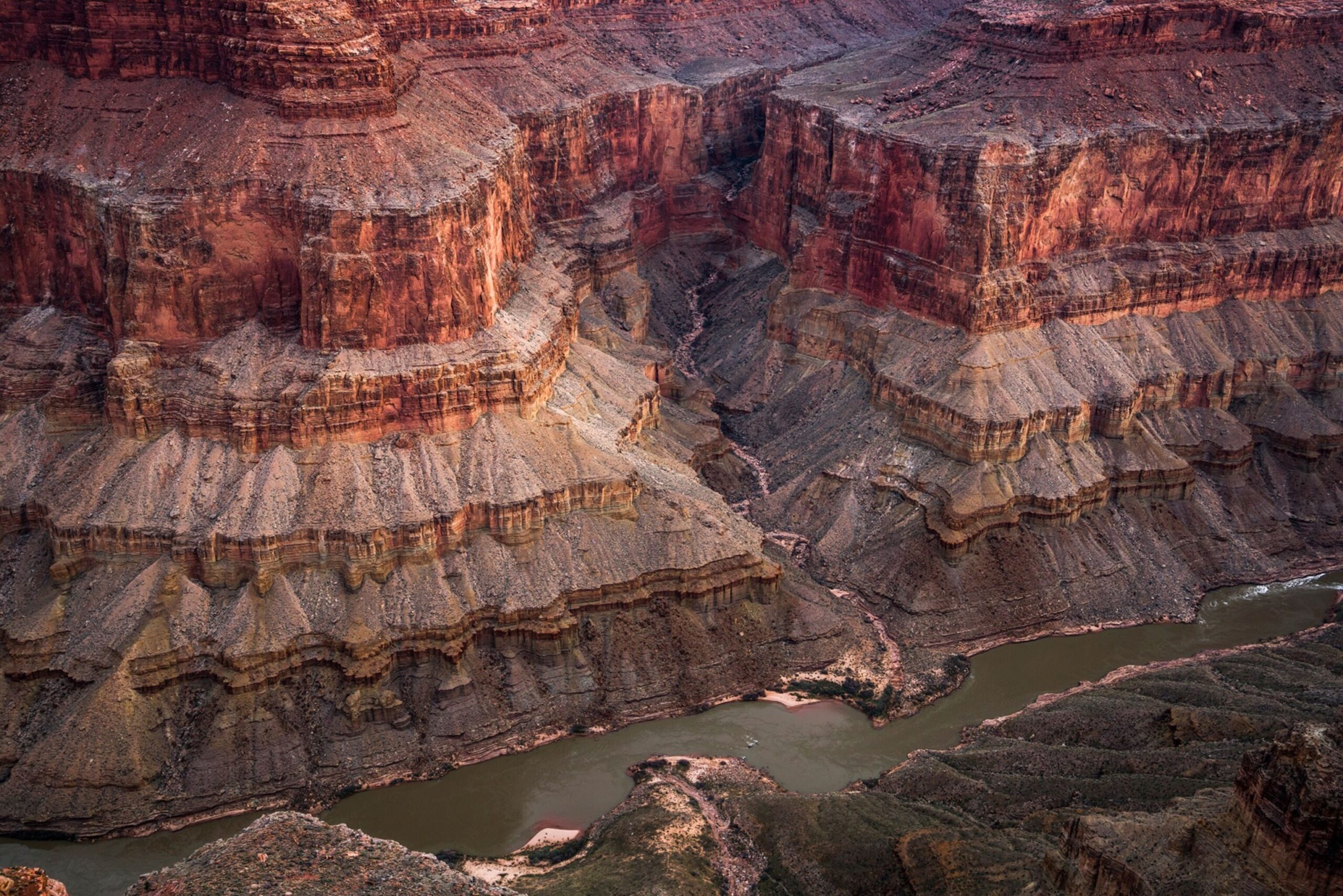
The Grand Canyon is an excellent example of layers laid bare where we can see a vast amount of sedimentary rock (cut in half, so to speak), and it represents a huge portion of the geologic column (some evolutionists suggest it represents up to 40% of the total). And what does it reveal? Does it look more like the old stack of pancakes roughed up by rodents or a nice, neat stack of hotcakes from Denny’s?

Well obviously, it’s uniform and continuous overall, with a great example being seen at the contact point of the Coconino Sandstone (above) with the Hermit Shale (below) along the Bright Angel Trail. The line between them looks like it was drawn with a ruler, and yet 10 million years is supposed to have taken place between when these unique layers were laid down, which means there was plenty of time for erosion to have caused massive disconformity. And yet it isn’t there.

This indicates what Ager refers to—a smooth, continuous deposition. So the contact should be called a conformity, because observationally, it’s indicative of layers being deposited with little time break in between. And yet, because of the commitment to a millions-of-years timeframe (primarily established through Lyell’s now often abandoned uniformitarian model), secular geological literature usually refers to such contact points as para-conformities.

However, this is primarily because of secular geologists’ nonnegotiable commitment to deep time rather than because of what is being observed. Remember what Ager’s statement concluded? Read it once more.

We cannot escape the conclusion that sedimentation was at times very rapid indeed and that at other times there were long breaks in sedimentation, though it looks both uniform and continuous

His basic summary is this: Because of physical evidence, we can’t escape the conclusion there was rapid, catastrophic deposition of sediments at times, yet even though there’s no significant disconformity in the rocks (i.e., no physical evidence) indicating a vast amount of time between these deposition events, we somehow know millions of years of time passed between them regardless.

Which Model Better Explains It All?

Now, while some might contend that there are examples in the geologic world that do show evidence of erosion between various layers, all of those examples are quite easily explained in the biblical creationist diluvian model (the general geological model stating that the biblical Noah’s flood was the cause of the majority of sedimentary layers and fossils therein).

Many people have the idea that flood geology somehow proposes that the Genesis flood was virtually instantaneous—covering the whole earth, stirring everything up, and dumping all of the sediments in one continuous event. However, according to Scripture, Noah’s ark floated on the floodwaters for months. In the initial 40 days of the flood, “all the high mountains under the whole heaven were covered,” but the floodwaters “prevailed on the earth” for a total of 150 days (likely with tumultuous rising and falling) before they began a permanent recession (Genesis 7:17–24). At this point, it still took several more months for the water to subside as “the mountains rose, the valleys sank down” (Psalm 104:8) at the end of the flood.

So, in their respective geologic models, both flood geologists and neo-catastrophists believe there would have been episodic periods of massive, rapid deposition and also periods of time in between, where erosion events would occur.

But flood geologists see the time frame for erosion as minutes or months, not millions of years, and recognize that the layers may have been softer and not completely solidified in some cases, whereas neo-catastrophists would have to believe the layers were completely solidified before the next event occurred in their model.

The point is that the occasional non- or para-conformities sometimes observed in the geologic column are easily explained and consistent with what we’d expect to find if Noah’s flood is true history. However, the massive amount of smooth and continuous layers we see all over the world with almost no evidence of large-scale erosion are not consistent with the neo-catastrophist view.

Epilogue

This brings us full circle. If uniformitarian geology (which overthrew flood geology in scientific circles) was based on a false interpretation of the rock layers, and neo-catastrophism (which has replaced uniformitarianism because of the latter’s lack of explanatory power) cannot account for the uniform and continuous nature of the vast majority of the rock layers we observe—why not return to the model that can account for all of the observable evidence?

Why won’t scientists simply return to the Genesis account of Noah’s flood and a corresponding literal, six-day creation as the better explanation?

The answer likely is that this whole controversy was never really about the scientific facts—their false conclusions were driven by a worldview ideology rather than simply “falling out of the facts.” We’ll expose this in part 4 of our series.


Answers in Genesis - AIG - Logo

Your support helps Harbinger's Daily propel the boldest and most sound Christian voices of our day—those unwavering in their defense of the truth and passionate about reaching the unsaved world—while engaging millions to stand courageously with a worldview grounded in God's Word. 

Will you defend the truth and equip others to do the same?

‘Take Back Our Country’: Anti-Regime Protesters Hack Iranian State TV, Showing Clips Of Exiled Crown Prince

Iran's state television broadcast was hacked amid a near-total internet blackout, with video clips of exiled crown prince Reza Pahlavi and images of ongoing anti-government protests briefly airing on multiple channels. Pahlavi used the opportunity to call on the Iranian military to break with the Islamic Republic and to side with protesters who have been demonstrating against the regime.

Report Finds Support For Religious Liberty In The America Is Stronger Than Ever

“As we celebrate National Religious Freedom Day, it’s encouraging to see that a growing number of Americans reject the idea that faith belongs behind closed doors,” said Rienzi. “The Founders recognized that our nation is stronger when we allow our neighbors to bring their beliefs into the public square without fear, even when those beliefs cut against the grain.”

sign up

In An Ever Darkening World, We Can Find Solace In Bible Prophecy

The bright side of the growing evil in the world is that it is a sure sign that we are living in the season of the Lord’s return. If you will check Genesis 6, you will find that Noah’s society was characterized by violence and immorality. This is the reason that the great pastor, Adrian Rogers (1931-2005), once said, “The world is growing gloriously dark.” How can the acceleration of evil be considered “glorious”? Because it is a sign of the imminent return of Jesus.

ABC's of Salvation

Decision

UTT

untitled artwork

Israel My Glory

Calvin Smith

In part 2 of our series, we showed how many modern earth scientists have become much more comfortable with accepting the idea of catastrophic geological events having shaped earth’s past—to the point where some have abandoned and even mocked the older uniformitarian (slow and steady) geological model in favor of neo-catastrophism.

The reason for their doing so is because of the obvious observational evidence that contradicts it—such as trees 30+ feet tall extending through what would be considered millions of years of sedimentary deposition according to the old Lyellian model. It is so obvious that a dead tree would not survive hundreds of thousands of years of slow deposition and subsequent fossilization that one geologist (Derek Ager) referred to it as “ridiculous.”

So, Christians who formerly adopted what was considered “established science” as the reason to reinterpret portions of Scripture (particularly Genesis) instead of accepting them as plainly written face a bit of a dilemma. They now need to decide whether to abandon that older specific interpretation of facts in favor of the new one or perhaps to abandon the whole notion of allowing secular interpretations in science to have the authority to interpret Scripture.

Eroding Belief in Neo-catastrophism

Well, for those who decide to commit to neo-catastrophism to any extent, they should understand there is a huge challenge to this new way of interpreting earth’s age based on the sedimentary rock layers as well. Derek Ager’s quote mentioned in part 2 contains an important clue regarding this, so let me repeat it.

We cannot escape the conclusion that sedimentation was at times very rapid indeed and that at other times there were long breaks in sedimentation, though it looks both uniform and continuous. (emphasis mine)

Notice he says he believes there was rapid sedimentation interspersed with long ages but that the layers themselves look “both uniform and continuous.” This means the layers appear to have been laid down one after another in a smooth, continuous fashion, and yet because of his commitment to old earth ideology, he must believe there were vast breaks of time in between them regardless.

And that is a huge problem, because we see that the surface of the earth is constantly changing due to erosion, with drastic changes sometimes occurring within our own lifetimes. Erosion is relentlessly taking place as rain, wind, and other factors are constantly at work on the topography of the earth. However, erosion does not occur consistently and uniformly.

Different hardness of soil and rock, varying weather patterns, and other factors can contribute to more or less rapid erosion occurring at differing rates in different locations. If millions of years of time had occurred between major sections of strata, then there should be ample evidence showing uneven, more jagged contact points. And yet as Ager admits, most of the rock layers we observe look uniform and continuous.

Think of it like a stack of pancakes of various thicknesses being gradually placed on a plate located where a bunch of rats are able to nibble away at the tops of each one before the next is placed on top of it. If the rats (erosion) chew the top of each pancake (rock layers) to various uneven depths and then a soft, warm, new pancake is placed on top and fills in the gaps in the one underneath, and this keeps occurring with more and more pancakes, what would you see if you were to cut the stack in half and look at the layers revealed?

What you’d observe would be called a disconformity (in geologic terms). You’d see jagged, wavy edges filled in one on top of another—not mostly straight horizontal lines like a normal stack of pancakes. But that’s not what we consistently observe in the rock layers.

Looking at the Layers

The Grand Canyon is an excellent example of layers laid bare where we can see a vast amount of sedimentary rock (cut in half, so to speak), and it represents a huge portion of the geologic column (some evolutionists suggest it represents up to 40% of the total). And what does it reveal? Does it look more like the old stack of pancakes roughed up by rodents or a nice, neat stack of hotcakes from Denny’s?

Well obviously, it’s uniform and continuous overall, with a great example being seen at the contact point of the Coconino Sandstone (above) with the Hermit Shale (below) along the Bright Angel Trail. The line between them looks like it was drawn with a ruler, and yet 10 million years is supposed to have taken place between when these unique layers were laid down, which means there was plenty of time for erosion to have caused massive disconformity. And yet it isn’t there.

This indicates what Ager refers to—a smooth, continuous deposition. So the contact should be called a conformity, because observationally, it’s indicative of layers being deposited with little time break in between. And yet, because of the commitment to a millions-of-years timeframe (primarily established through Lyell’s now often abandoned uniformitarian model), secular geological literature usually refers to such contact points as para-conformities.

However, this is primarily because of secular geologists’ nonnegotiable commitment to deep time rather than because of what is being observed. Remember what Ager’s statement concluded? Read it once more.

We cannot escape the conclusion that sedimentation was at times very rapid indeed and that at other times there were long breaks in sedimentation, though it looks both uniform and continuous

His basic summary is this: Because of physical evidence, we can’t escape the conclusion there was rapid, catastrophic deposition of sediments at times, yet even though there’s no significant disconformity in the rocks (i.e., no physical evidence) indicating a vast amount of time between these deposition events, we somehow know millions of years of time passed between them regardless.

Which Model Better Explains It All?

Now, while some might contend that there are examples in the geologic world that do show evidence of erosion between various layers, all of those examples are quite easily explained in the biblical creationist diluvian model (the general geological model stating that the biblical Noah’s flood was the cause of the majority of sedimentary layers and fossils therein).

Many people have the idea that flood geology somehow proposes that the Genesis flood was virtually instantaneous—covering the whole earth, stirring everything up, and dumping all of the sediments in one continuous event. However, according to Scripture, Noah’s ark floated on the floodwaters for months. In the initial 40 days of the flood, “all the high mountains under the whole heaven were covered,” but the floodwaters “prevailed on the earth” for a total of 150 days (likely with tumultuous rising and falling) before they began a permanent recession (Genesis 7:17–24). At this point, it still took several more months for the water to subside as “the mountains rose, the valleys sank down” (Psalm 104:8) at the end of the flood.

So, in their respective geologic models, both flood geologists and neo-catastrophists believe there would have been episodic periods of massive, rapid deposition and also periods of time in between, where erosion events would occur.

But flood geologists see the time frame for erosion as minutes or months, not millions of years, and recognize that the layers may have been softer and not completely solidified in some cases, whereas neo-catastrophists would have to believe the layers were completely solidified before the next event occurred in their model.

The point is that the occasional non- or para-conformities sometimes observed in the geologic column are easily explained and consistent with what we’d expect to find if Noah’s flood is true history. However, the massive amount of smooth and continuous layers we see all over the world with almost no evidence of large-scale erosion are not consistent with the neo-catastrophist view.

Epilogue

This brings us full circle. If uniformitarian geology (which overthrew flood geology in scientific circles) was based on a false interpretation of the rock layers, and neo-catastrophism (which has replaced uniformitarianism because of the latter’s lack of explanatory power) cannot account for the uniform and continuous nature of the vast majority of the rock layers we observe—why not return to the model that can account for all of the observable evidence?

Why won’t scientists simply return to the Genesis account of Noah’s flood and a corresponding literal, six-day creation as the better explanation?

The answer likely is that this whole controversy was never really about the scientific facts—their false conclusions were driven by a worldview ideology rather than simply “falling out of the facts.” We’ll expose this in part 4 of our series.

Answers in Genesis - AIG - Logo

Trusted Analysis From A Biblical Worldview

Help reach the lost and equip the church with the living and active truth of God's Word in our world today.

YOU CARE ABOUT

BIBLICAL TRUTH. SO DO WE.


Together, We Can Deliver A Biblical Understanding

Of News Events Around The World.

‘Take Back Our Country’: Anti-Regime Protesters Hack Iranian State TV, Showing Clips Of Exiled Crown Prince

Iran's state television broadcast was hacked amid a near-total internet blackout, with video clips of exiled crown prince Reza Pahlavi and images of ongoing anti-government protests briefly airing on multiple channels. Pahlavi used the opportunity to call on the Iranian military to break with the Islamic Republic and to side with protesters who have been demonstrating against the regime.

Report Finds Support For Religious Liberty In The America Is Stronger Than Ever

“As we celebrate National Religious Freedom Day, it’s encouraging to see that a growing number of Americans reject the idea that faith belongs behind closed doors,” said Rienzi. “The Founders recognized that our nation is stronger when we allow our neighbors to bring their beliefs into the public square without fear, even when those beliefs cut against the grain.”

untitled artwork 6391

In An Ever Darkening World, We Can Find Solace In Bible Prophecy

The bright side of the growing evil in the world is that it is a sure sign that we are living in the season of the Lord’s return. If you will check Genesis 6, you will find that Noah’s society was characterized by violence and immorality. This is the reason that the great pastor, Adrian Rogers (1931-2005), once said, “The world is growing gloriously dark.” How can the acceleration of evil be considered “glorious”? Because it is a sign of the imminent return of Jesus.

ABC's of Salvation

TV AD

worldview matters

Decision Magazine V AD

Decision

Jan Markell

Israel My Glory

Erick Stakelbeck

untitled artwork

YOU CARE ABOUT

BIBLICAL TRUTH.

SO DO WE.

Together, We Can Deliver A Biblical Understanding Of News Events Around The World And Equip The Church To Stand With A Biblical Worldview.

Israel My Glory

untitled artwork

YOU CARE ABOUT

BIBLICAL TRUTH.

SO DO WE.


Together, We Can Deliver A Biblical Understanding Of News Events Around The World And Equip The Church To Stand With A Biblical Worldview.