“Broken glass. Blood everywhere. All because we’re Jewish — and tried to open dialogue.” — Students supporting Israel, Toronto Metropolitan University
On Wednesday, November 5th, Toronto Metropolitan University’s campus club, Students Supporting Israel (SSI), hosted an event featuring IDF veterans, providing students with the opportunity to speak with former Israeli soldiers. With University Campuses across the West becoming bastions of hatred against the Jewish State, it didn’t take long for the event to erupt into chaos.
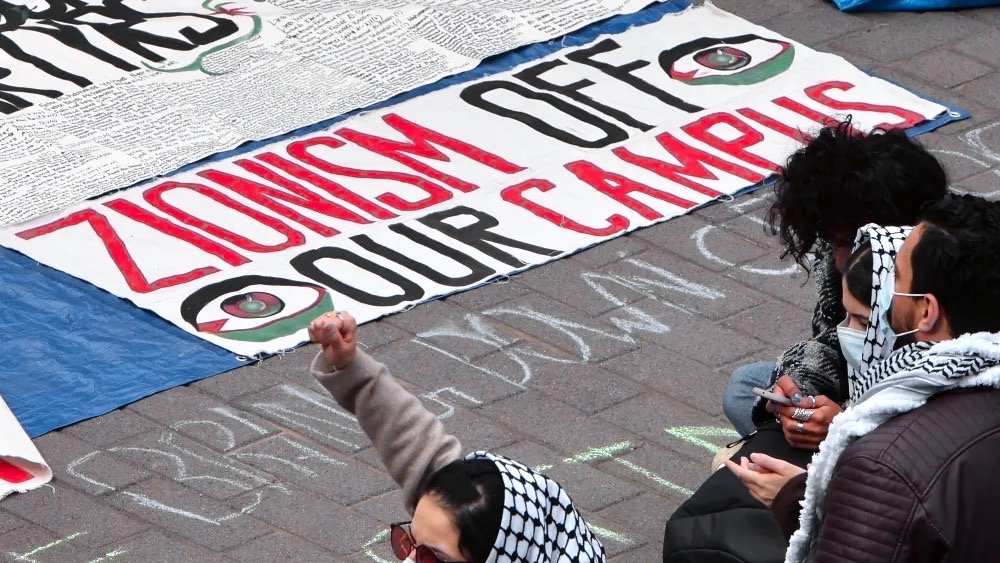
The National Post reported that, shortly after 2 p.m., Toronto Police posted on X that a group of demonstrators had forced their way into a building near the TMU campus. As the situation escalated, footage circulated on social media showed Jewish students barricading the doors with furniture as a crowd of protesters swarmed outside, shouting that they would not allow “zionist war criminals” in their city.
According to SSI, one of the doors, which was held shut by IDF veteran Johnathan Karten, was shattered by the mob using a drill bit. The broken glass resulted in significant lacerations on the veteran’s arm, for which he was taken to the hospital to receive stitches.
A female TMU student, identified as “Sam,” was reportedly insulted and physically attacked while attempting to enter the event. The Palestinian protesters forced her to the ground, telling her that the “Zionists are worse than the KKK,” that they knew who she was, and she wouldn’t be able to hide.
When Sam got into the building and saw the shattered glass and blood on the ground, she lost consciousness and suffered a seizure, the National Post detailed. She was released from the hospital later on Wednesday.
Earlier that day, Students for Justice in Palestine (SJP), in collaboration with several pro-Palestinian organizations in Toronto, posted on Instagram announcing an “emergency rally” at the time and location of the IDF veterans’ speaking event, which was held at a private off-campus location. The post read: “Zionist war criminals have once again been welcomed into this city… Show up now!”
Later that afternoon, after the shocking events, SJP followed up with another post, making the shocking and twisted claim that “Canadian students advocating for Palestine [were] attacked by Israeli soldiers and TPS”—an accusation that witnesses and footage of the incident easily disproved.
According to the National Post, the event’s organizer, Liat, who serves as the President of SSI’s TMU chapter and as a student ambassador for Allied Voices for Israel (AVI), explained how she felt: “My body was shaking. I was hyperventilating. I was trying to talk to the police, but I was crying.”
In an interview with Harbinger’s Daily, Jonathan Karten, the IDF veteran hospitalized from the activists’ violence, explained the events.
“I came to tell the students my story, then we were first attacked by 5-8 people, one of whom was wielding a drill bit, which they used to break the glass of the door I was holding shut,” Karten described. “We then had to barricade the second door until the police came.”
“I couldn’t think, I just had to act,” he recounted.
“I’ve been to Canada before, but Canada is different now after October 7th,” he lamented. “People find vigilante justice in trying to attack us… Vilify our entire people.”
Karten’s story does not start with TMU’s violent events. As an IDF veteran, Johnathan has seen war and experienced the reality of the fight in Gaza. On October 8th, he arrived in Israel from Argentina to join his team in fighting for his country’s very existence. What he saw in the wake of October 7 forever changed his life. This was the story Karten sought to convey to the students.
“I saw first-hand the barbarism of our enemies,” he told Harbinger’s Daily. “What they did to the bodies, to the women… the barbarism… What we thought was relegated to the history books is alive and well.”
“It is not a genocide,” Karten emphasized. “We as IDF soldiers put our lives on the line to go above and beyond to differentiate between combatants and civilians in our military operations. We are fighting against pure hate… and [it is] a war on behalf of Western civilization.”
Several years before, Karten’s uncle was killed by Jamal Al-Hor, a Palestinian terrorist who currently operates as a spokesperson for Hamas. Al-Hor was taken to an Israeli prison but was released in a 2011 exchange. On October 7th, Jamal Al-Hor supervised the kidnapping of three Israeli children before being recaptured and placed back in an Israeli prison.
Under the latest ceasefire agreement, Jamal Al-Hor was again set to be released—one of the thousands of terrorists freed in exchange for innocent Israeli civilian hostages. Karten petitioned the government to get the name of his uncle’s murderer and other brutal re-offending terrorists removed from the list. He was successful, proving the incredibly high-risk reality of releasing Jamal Al-Hor and other ringleaders hell bent on killing innocent Israelis.
Today, Karten works at an Israeli venture capital fund, investing in dual-use defence technologies and critical infrastructure for national security. His mission, however, extends beyond his own nation as he urges the world to wake up to the rise of Antisemitism.
“Antisemitism is a canary in the coal mine,” he underscored. “Right now it’s our fight, but it will spread.”
With the recent peace agreement, brokered by the United States between Israel and Hamas, one might reasonably expect the anti-Israel movement on university campuses in the West to subside. Recent events at Toronto Metropolitan University (TMU) seem to suggest otherwise.
As a student at a Canadian University near TMU, I believe that the continued rise in antisemitism—on campuses and across the world—reveals a reality that should not surprise those who understand its roots. Even if there is a ceasefire in Gaza, many Jewish people feel unsafe in Canada. The fight against the Jewish people is not about “Palestine.” It is not about babies in Gaza, and it is not about humanity’s supposed concern for “genocide.” At its core, this reflects a deeper spiritual conflict between God, who loves and chose the Jewish people and set His name upon the land of Israel, and Satan, who hates God and everything God loves.
Psalm 83:3-4 speaks directly to this ongoing struggle of antisemitism, “They have taken crafty counsel against Your people and consulted together against Your sheltered ones. They have said, ‘Come, and let us cut them [Israel] off from being a nation, that the name of Israel may be remembered no more.’”
With this reality in mind, as Bible-believing Christians, we must take a stand—with God and against evil antisemitism. We must not back down when evil is loud or let fear of being “political” render us useless. We must pray, stand firm, and remain ultimately grounded in the unchanging truth of God’s Word.
In closing my interview with Karten, he offered a word of encouragement to the Jewish people in light of the tragic events at TMU: “Antisemitism is not new. We’ve been through worse and gotten out the other end.”
God will preserve His people. No matter what form of political correctness or human rights agenda antisemitism dares to take. Antisemitism is not new, but with God’s given resilience and promise of preservation, I know that the Jewish people will endure, just as they always have, standing as a living testament to His faithfulness and covenant.