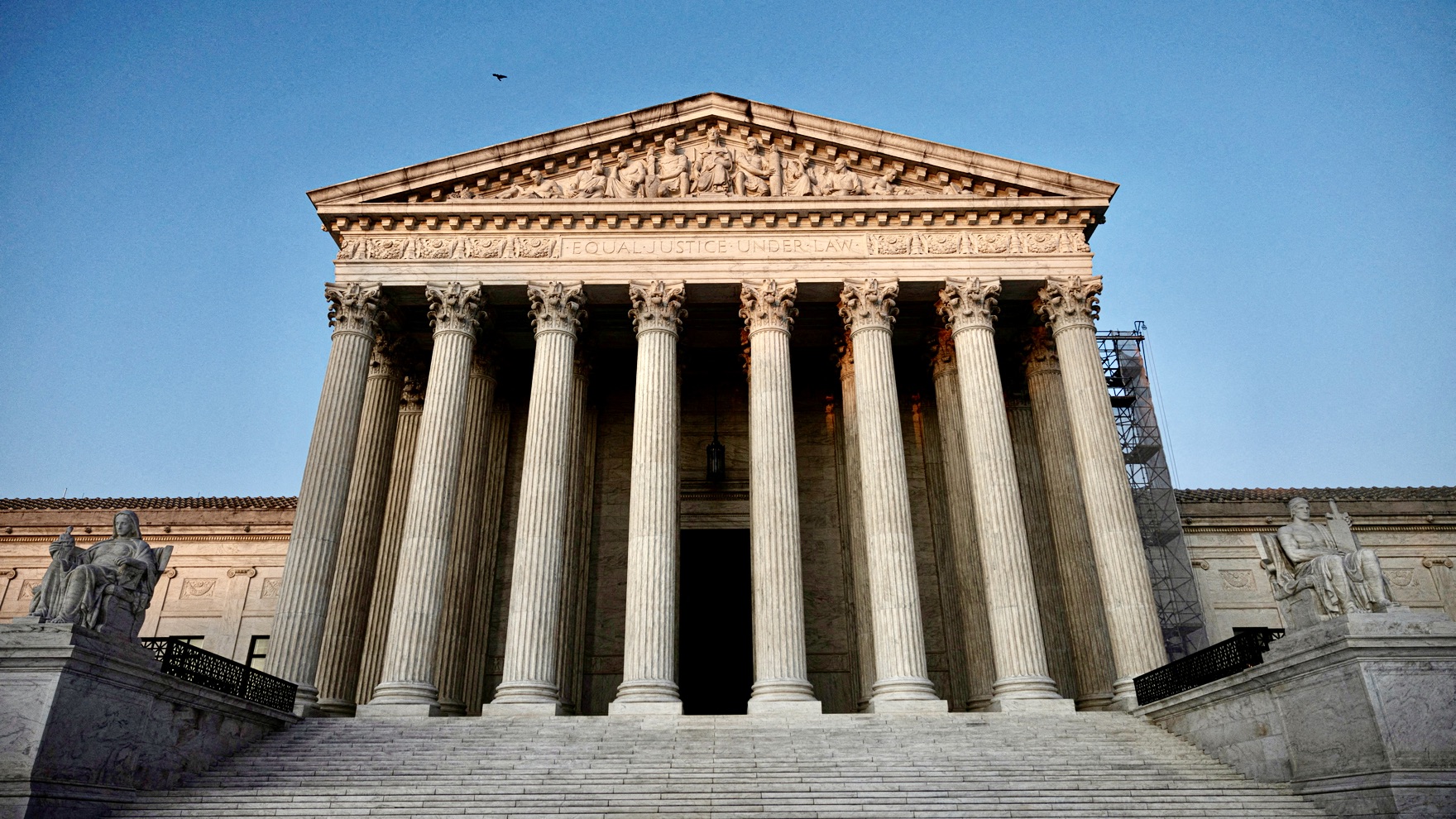
The U.S. Supreme Court unanimously sided with a Mississippi evangelist who was arrested for sharing his Christian faith outside a public event venue.
The high court’s March 21 decision ruled that evangelist Gabriel Olivier’s case must return for trial in the district court, where Olivier can make his case that a city law violates his First Amendment rights to live out his faith.
The Supreme Court’s ruling reversed the U.S. Court of Appeals for the 5th Circuit’s decision, which ruled that Olivier could not bring his claim unless his conviction for evangelizing in a restricted zone became “reversed,” “expunged” or “declared invalid.”
Olivier, who was arrested and fined in May 2021, filed suit a few months later, seeking to reform the city’s laws to protect the religious rights of evangelists. The district court and the 5th Circuit ruled against Olivier, citing Heck v. Humphrey, a 1994 Supreme Court decision which ruled that convicted criminals cannot challenge any law that brought about their conviction if a ruling in their favor “would necessarily imply the invalidity of [their] conviction or sentence.”
Kelly Shackelford, president, CEO, and chief counsel for First Liberty Institute which defended Olivier in his suit, celebrated the ruling.
“This is not only a win for the right to share your faith in public,” Shackelford said, “but also a win for every American’s right to have their day in court when their First Amendment rights are violated.”
In 2018, Olivier began preaching outside Brandon Amphitheater in Brandon, Mississippi, where he could encounter crowds of concert attenders. In response to his and other street preachers’ presence, the city established an ordinance that barred people from “engaging in public protests and/or demonstrations, regardless of the content and/or expression thereof” outside Brandon Amphitheater.
The city ordinance allowed standing in a designated zone only three hours before a ticketed event’s opening and an hour after an event ends. Olivier, however, after finding that few people walked near the designated zone, moved closer to the amphitheater.
Consequently, he was arrested and fined. Arguing that the ordinance violated his First and 14th Amendment rights, First Liberty Institute filed suit against the city on Olivier’s behalf.
A district court dismissed his case. After the U.S. Court of Appeals for the 5th Circuit, ruled against Olivier, First Liberty Institute petitioned to the Supreme Court for a hearing, which was held Dec. 3, 2025.
Justice Elena Kagan, in the court’s 13-page opinion, observed that “Olivier is not challenging the ‘validity of [his] conviction or sentence,’ for the purpose either of securing (or speeding) release or of obtaining monetary damages. … Instead, Olivier is seeking … ‘wholly prospective’ relief—’only to be free from prosecutions for future violations’ of the city ordinance. With this understanding, the Court held Olivier is free “to sue under §1983 to enjoin future prosecutions under the city ordinance, despite his prior conviction.”
Kagan explained that his suit “escapes the so-called Heck bar” since Olivier asked for “only a forward-looking remedy,” rather than reversing his conviction. Therefore, “his suit can proceed.”
Nate Kellum, senior counsel at First Liberty, described the Supreme Court’s ruling as “a wonderful day for Gabe and for the First Amendment.”
“No American should be criminally charged for sharing their faith in public,” Kellum said.
Olivier stated that his goal for the lawsuit was “to be granted my rights as an American citizen under our great Constitution.”
“Now all people with deeply held Christian religious beliefs who are called to share the Good News can do so in the public arena,” Olivier said.