
Imagine a world where artificial intelligence no longer depends upon the traditional power grid. Its computers could operate hundreds of miles offshore, floating autonomously in the ocean. They could generate their own electricity from waves, cool themselves with seawater, and communicate with the rest of civilization through satellites. Meanwhile, above the earth, thousands of orbiting mirrors could redirect sunlight toward selected locations after sunset, extending the usefulness of solar power beyond the normal boundaries of daylight.
This is not a scene from a science-fiction movie. Both technologies are being developed today. Two companies in particular, Reflect Orbital and Panthalassa, are pursuing technologies that demonstrate how radically the infrastructure supporting artificial intelligence could change.
Reflect Orbital is developing satellites capable of redirecting sunlight from space toward specific locations on Earth. Panthalassa is developing autonomous, wave-powered computing platforms capable of operating far out at sea. One looks upward. The other looks outward. But both are responding to the same enormous problem: The AI revolution is running out of easily accessible power.
This technological race deserves the attention of students of Bible prophecy.
Solving AI’s Energy Problem
Artificial intelligence may appear to exist somewhere in the invisible world of cyberspace, but AI is actually extraordinarily physical. Behind every chatbot, image generator, surveillance system, autonomous vehicle, facial-recognition platform, and AI model stands an enormous technological infrastructure. There are processors, Servers, cooling systems, fiber-optic networks, electrical substations, power plants, nd massive data centers.
As AI systems grow, so does their appetite for electricity. The technology industry therefore faces a fundamental question: Where will the energy come from to power the AI world being constructed? The answer increasingly appears to be: everywhere—nuclear power, solar farms, natural gas, geothermal energy, hydroelectric power, space-based solar concepts, and now even the waves of the ocean.
The race for artificial intelligence is rapidly becoming a race for energy. That is what makes Reflect Orbital and Panthalassa so fascinating.
Reflect Orbital: Sunlight on Demand
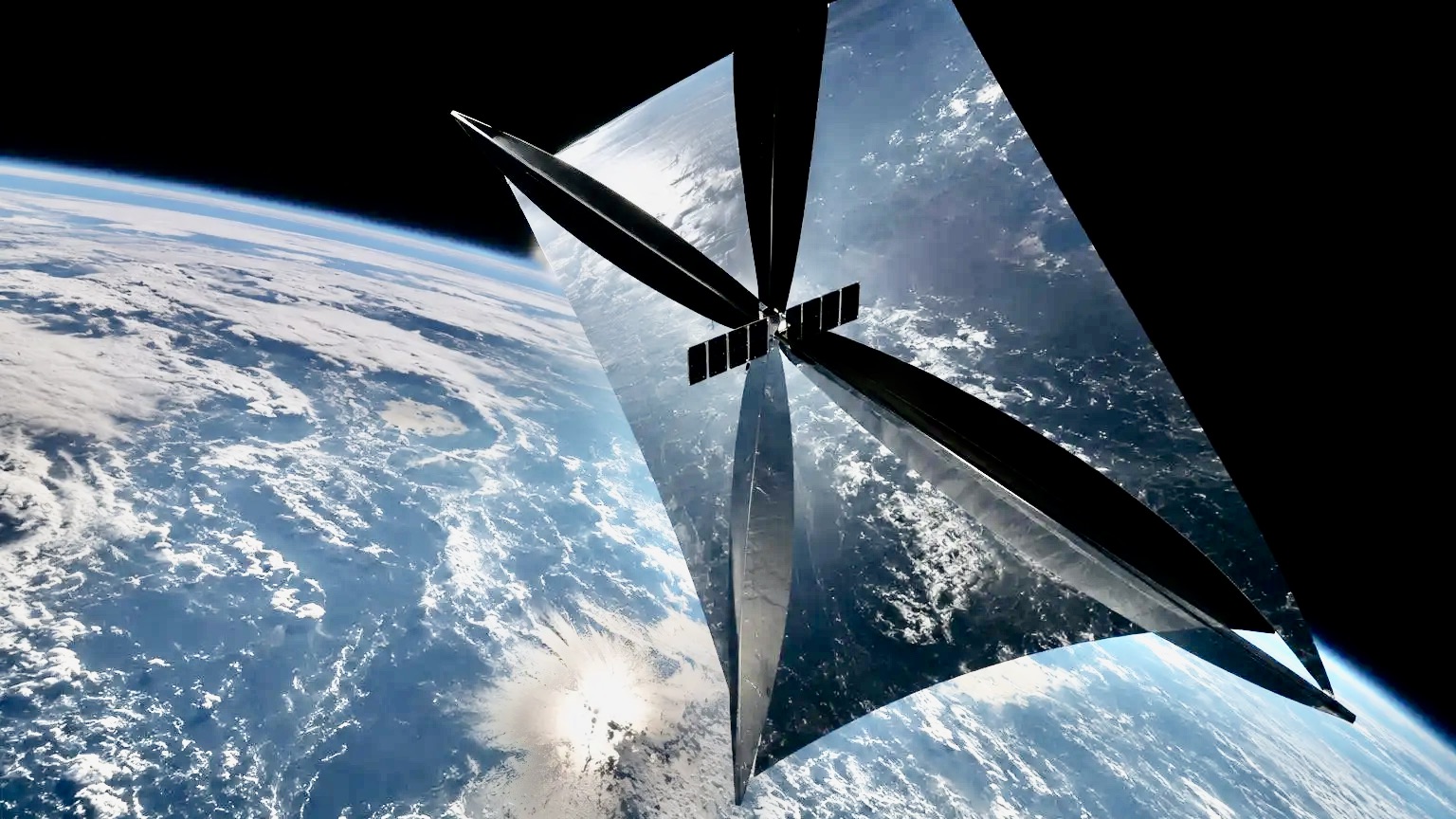
Reflect Orbital describes itself as “The Sunlight Company.” Its concept sounds simple. Place enormous mirrors aboard satellites in low-Earth orbit and use those mirrors to redirect sunlight toward selected areas of Earth after the sun has gone below the horizon. Instead of accepting sunset as the end of solar generation, Reflect Orbital wants to redirect sunlight from space.
On July 9, 2026, the Federal Communications Commission authorized Reflect Orbital’s Eärendil-1 demonstration mission. The experimental spacecraft is expected to carry an approximately 18-by-18-meter deployable mirror into low-Earth orbit. The satellite is intended to reflect sunlight directed toward locations on Earth. But one satellite is only the beginning. Reflect Orbital’s much larger vision calls for 50,000 satellites by 2035. Reflect Orbital is essentially asking: What if sunlight itself could become an on-demand service?
The company says users could eventually request and control the service through an app or website. Human civilization has spent thousands of years adapting itself to nature. Increasingly, technology seeks to make nature adapt to us. Need transportation? Open an app. Need food? Open an app. Need electricity? Open an app. Need sunlight? You guessed it! Open an app.
Panthalassa: Put the Data Center in the Ocean
But while one group of engineers is looking toward space for energy, another is looking toward approximately 70 percent of the Earth’s surface: the oceans.
The company Panthalassa, instead of building another enormous data center on land and then searching for enough electricity to power it, is asking: why not move the computing infrastructure directly to where enormous amounts of renewable energy already exist? The ocean. Panthalassa is developing autonomous offshore platforms that harness wave energy and use that electricity to operate AI computing hardware aboard the platform itself.
The concept turns the traditional data-center model upside down. Normally, electricity must be transported to computers. Panthalassa proposes bringing the computers to the energy. Its Ocean-3 platforms are envisioned as enormous steel structures operating in deep ocean environments. As waves move the platform, water is driven through the system and used to generate electricity. AI processors housed aboard the structure can then use that electricity directly. The surrounding ocean can assist with cooling, while the results of the computation can be transmitted back through satellite communications.
No giant terrestrial power plant beside the data center. With no enormous new transmission line running across several states, and no traditional campus containing acres of server buildings, the data center effectively becomes an autonomous machine at sea.
The Ocean Becomes the Power Plant
Transmitting large quantities of electricity from remote ocean locations back to shore would require enormous infrastructure. So instead of transmitting the electricity, Panthalassa proposes using the electricity where it is generated.
The platform performs the AI computation offshore. Then it transmits the much smaller digital result. As one computer engineer summarized the idea, the company is essentially transforming an energy-transmission problem into a data-transmission problem.
The company raised $140 million in financing in May 2026, with the round led by Peter Thiel and joined by numerous prominent technology investors. The funding is intended to accelerate manufacturing and deployment of Ocean-3 systems designed for AI inference computing at sea. Serious money is betting that the ocean could become part of the infrastructure powering artificial intelligence.
Computers Without Countries?
This raises an even more interesting question: what happens when critical computing infrastructure no longer needs to be located inside cities, or perhaps even close to them?
Historically, governments could identify critical infrastructure relatively easily—power plants, factories, banks, and computer centers all had addresses. But imagine autonomous AI infrastructure scattered across international waters, connected through satellite networks. Now add space-based computing, orbital communications, global satellite internet, autonomous ships, and digital currencies. The technological world begins to look considerably different.
Infrastructure is becoming increasingly global, distributed, autonomous, and difficult to confine within traditional national boundaries. That is where the Bible-prophecy discussion becomes especially interesting.
Again, the Bible is Proven True
Nearly two thousand years ago, the Apostle John wrote about the day when the world will need to have the mark of the beast in order to buy or sell. For generations, Christians wondered how such economic control could possibly function. How could a political system control buying and selling across enormous populations? How could transactions be monitored? How could identity be verified? How could restrictions be enforced rapidly?
The Bible never explains the technology, but it describes the result.
Scripture does not say artificial intelligence is the Beast. It does not say satellites are the Mark of the Beast. It does not say ocean data centers fulfill Revelation 13. We should never force modern inventions into Biblical passages simply because they appear futuristic, but neither should we ignore what is developing before our eyes.
For the first time in history, the technological architecture necessary for extraordinary levels of global economic coordination is becoming conceivable.
What if We Can’t Turn Off the System?
There is another important development: modern technological infrastructure is becoming increasingly self-reliant.
A traditional data center depends upon the electrical grid. What happens when it generates its own electricity? A communication network depends upon towers and cables. What happens when communications move through satellites? A solar farm depends upon daylight. What happens when sunlight can theoretically be redirected from orbit? A computing center depends upon available land and cooling. What happens when computing moves into the ocean? Each innovation removes another limitation.
AI, autonomous energy, satellite communications, and distributed computing equal technological infrastructure that can operate with increasing independence from traditional systems.
Who Controls the Infrastructure?
That may ultimately be the more important question. The issue is not simply whether technology is becoming more powerful. The issue is: Who controls it?
Who controls the satellites, AI, digital identity, financial networks, the data, and the energy? Who determines who receives access? Every technological system has an administrator somewhere. Every network has rules. Every platform has permissions. Every digital account can potentially be approved, restricted, suspended, or terminated.
Revelation 13 describes a future economic system in which participation becomes conditional. For the first time ever, the world’s economic and technological infrastructure is becoming increasingly interconnected.
From Land to Sea to Orbit
We may be witnessing the early stages of the internet connecting the world’s computers. Smartphones connect the world’s people. Cloud computing has centralized enormous amounts of information. Artificial intelligence is beginning to interpret that information. Satellite networks are extending connectivity across the planet. Ocean platforms may decentralize computing. Orbital infrastructure may decentralize energy and computation even further.
The result could eventually resemble something far greater than today’s internet. It could become a planetary computing infrastructure, computing on land, at sea, and in orbit, continuously connected through satellites, powered by multiple autonomous energy sources, and operating twenty-four hours a day.
Christians Must Maintain Biblical Balance
A satellite can provide communication during a disaster. Artificial intelligence can assist medical researchers. The Bible repeatedly warns about human power separated from accountability to God.
The Tower of Babel provides an early example. Genesis 11 records humanity becoming technologically capable, increasingly centralized, and extraordinarily ambitious. Their declaration was: “Let us build us a city and a tower… and let us make us a name” (Genesis 11:4). Their problem was not architecture; their problem was rebellion.
Babel 2.0?
Babel represented humanity attempting to live without God. Revelation describes another global system emerging near the conclusion of human history. Once again, there will be enormous political, economic, and religious power.
And the ability to control society. The infrastructure being constructed today should cause Believers to understand we are watching civilization quietly build tools that a future global system was told about thousands of years ago.
The future global ruler will not need to invent everything described in Revelation. The infrastructure is already built. The satellites will already be orbiting. The AI systems will already be operating. The digital identity systems will already exist. Cashless payment networks will already dominate commerce. Facial recognition will already be widespread. Now computing systems will be operating across land, sea, and space.
From the Ocean to the Heavens
Reflect Orbital and Panthalassa represent two AI infrastructure revolutions. One company wants to redirect energy from the heavens toward the earth. The other wants to harvest energy from the oceans beneath us. Above us—satellites. Around us—AI. Below us—ocean computing. Across the planet—digital networks. We should not sensationalize these developments. But neither should we sleep through them.
We are constructing a world in which computing can exist anywhere. Energy can be generated anywhere. Information can travel anywhere. Transactions can occur anywhere. And with artificial intelligence for the first time in human history, the infrastructure required for something resembling worldwide digital economic administration is no longer difficult to imagine.
That does not mean Revelation 13 has been fulfilled. But it does mean the world described in Revelation 13 no longer sounds technologically impossible.
And that should get our attention as we look up and say Marantha, Lord Jesus!