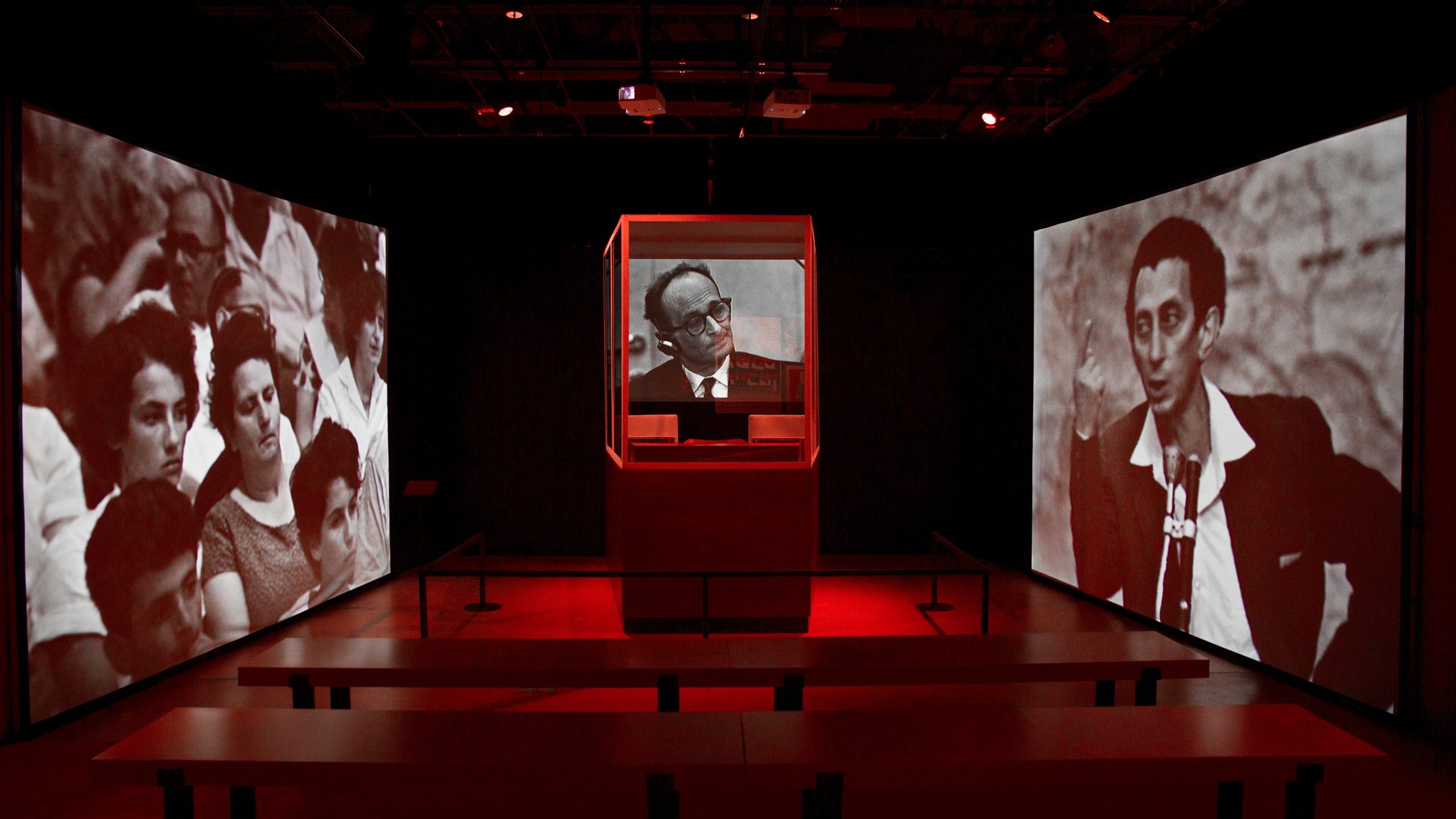
April 11, 1961, Jerusalem. A man in a dark gray suit entered the courtroom and sat inside a bulletproof glass booth.
Slight, balding, and bespectacled, he looked unremarkable—yet he was one of the most notorious killers in modern history, with the blood of millions on his hands.
His name was Adolf Eichmann.
Professional Persecutor
Born in 1906 in Germany, Adolf Eichmann grew up in Austria, joined the Austrian Nazi Party in 1932, then moved to Germany and became deeply involved in the Nazi regime.
Eichmann was long involved in what was termed “Jewish affairs.” But one of his greatest claims to infamy began on January 20, 1942. It was then that Eichmann attended the Wannsee Conference, where plans for the mass extermination of the Jewish people were formalized.
Eichmann and his staff were central to implementing the Final Solution, overseeing roundups, confiscation of Jewish property, and deportations of some 2,700,000 Jews to killing centers in German-occupied Poland.
Escape to South America
As the Allies approached Berlin in April 1945, Eichmann knew he would likely face trial for war crimes, yet he showed no remorse. According to Neal Bascomb’s book Hunting Eichmann, the Nazi official told his underlings, “I will gladly and happily jump into the pit [of death] with the knowledge that with me are 5 million enemies of the Reich,” referring to his estimate of Jewish victims of the Final Solution.
Eichmann was captured by the Americans in May 1945, though his identity was not recognized at the time. He later escaped from custody and lived under an alias. In July 1950, with help from ratlines—a network that included Catholic clergy assisting Nazi fugitives—he fled to Argentina.
For the next decade, under the name Ricardo Klement, Eichmann lived quietly, attempting various failed business ventures before working at a Mercedes-Benz factory. His family joined him in 1952 and settled in a modest home without electricity, running water, or sewer services.
The Hunter Becomes the Hunted
Ironically, Eichmann’s downfall began when his teenage son, Nick, started dating Sylvia Hermann, whose father, Lothar Hermann, was a German emigrant to Argentina and, unbeknownst to Nick, a Holocaust survivor of Jewish descent.
During his first visit to the Hermann home in 1956, Nick and Lothar spoke about Germany and the war. “It would have been better,” Nick told Lothar, “if the Germans had finished their job of extermination.”
In 1957, while reading a German-Argentine newspaper aloud to her father—who had been blinded as a result of Gestapo beatings—Sylvia came across an article on war criminals listing Adolf Eichmann.
Lothar immediately suspected that his daughter’s boyfriend’s father was the architect of the Final Solution. He wrote to the prosecutors named in the article, and his letter eventually reached Dr. Fritz Bauer, chief prosecutor of the West German state of Hesse.
Bauer forwarded Hermann all available information to help determine whether Ricardo Klement was Adolf Eichmann. Given Eichmann’s caution and low profile, confirmation was difficult, but Sylvia pressed the inquiry further. She traveled to Nick Eichmann’s home in Buenos Aires, where she came face to face with “Ricardo Klement”—and, based on a photo she had of him from the war, recognized him as Adolf Eichmann.
After receiving the Hermanns’ identification, Bauer passed the information to Mossad. Israeli intelligence conducted its own investigation and remained uncertain for several years, while the Hermanns continued relaying evidence that eventually reached Mossad chief Isser Harel. Though initially skeptical, Harel ultimately accepted the reports as credible.
In early 1960, Mossad initiated surveillance of Eichmann, confirming his identity, residence, daily routines, and family life. Then, they began planning his capture.
Operation Finale
The plan to abduct Eichmann, dubbed Operation Finale, was a complex mission involving Mossad agents and a civilian physician who entered Argentina during its 150th anniversary celebration of independence from Spain. The timing was crucial, as Israel’s airline El Al did not normally fly to South America, but a government delegation provided cover for the operation.
“Dead or alive,” Prime Minister David Ben Gurion told Harel before he left on the mission, “just bring Eichmann back with you. … Preferably alive. It would be very important, morally, for the young generations of Israel.”
On May 11, 1960, the Mossad team took positions near Eichmann’s home, relying on his routine of returning on bus 203 at 7:40 p.m. and walking alone to his house on Garibaldi Street, where the agents planned to seize him.
The bus was late, but when Eichmann finally disembarked, an agent confronted him: “Un momentito, senor,” then wrestled him into a waiting car. Bound and blindfolded, he was taken to a safehouse.
The hunter of Jews had himself been captured by them. His murderous game was over.
During the following few days, Eichmann confirmed his identity and signed consent to stand trial in Israel. Eleven days after his capture, he was secretly flown to Israel aboard an El Al flight.
On Trial in the Jewish State
On May 23, 1960, just two days after Eichmann’s arrival in Israel, David Ben-Gurion stunned the world by announcing to the Knesset that the architect of the Final Solution had been captured.
Eichmann’s trial in 1961 lasted nine months. On December 15, he was found guilty of crimes against the Jewish people, crimes against humanity, war crimes, and membership in a criminal organization. He was sentenced to death—the only death sentence ever issued in Israel.
After an appeal delayed his execution, Eichmann was hanged on June 1, 1962. His ashes were later scattered in the Mediterranean Sea beyond Israel’s territorial waters.
Conclusion
The capture, trial, and execution of Adolf Eichmann were monumental events for Israelis and the Jewish people worldwide, offering a measure of justice for the 6 million Jews murdered in the Holocaust. They also underscored the power of the Jewish state, whose existence ensures antisemitism is not met with impunity and those who commit genocide do not escape accountability.
While Eichmann intended the Jewish people to be consigned to history’s ash heap, it was his ashes that were ultimately scattered by the Jewish people for his crimes against them.
Am Yisrael Chai—the people of Israel live.