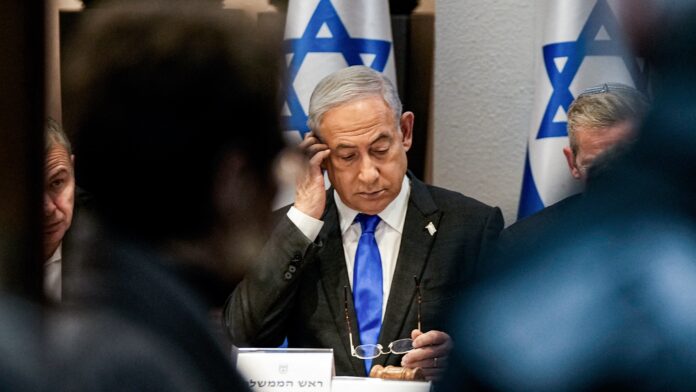
Israeli Prime Minister Benjamin Netanyahu said Thursday that Israel now controls roughly 60 percent of the Gaza Strip and has ordered the Israel Defense Forces to expand that control to 70 percent, signaling a major escalation in Jerusalem’s campaign to weaken Hamas and prevent the terror group from rebuilding its military rule.
Speaking at the Jordan Valley Conference, Netanyahu said Israel’s current hold on Gaza had already surpassed earlier lines set under the October 2025 ceasefire arrangement with Hamas.
“Israel controls 60% of the Gaza Strip,” Netanyahu said. “My directive — 70%. We’ll start there.”
When an audience member shouted that Israel should take control of “100 percent” of Gaza, Netanyahu replied, “First 70%. We’ll start with that.”
The remarks underscore Israel’s growing frustration with the stalled ceasefire framework, which secured the release of hostages held by Hamas and other terror groups but left Hamas in de facto control of parts of the enclave. The agreement was intended to move toward the disarmament of Hamas and the demilitarization of Gaza, but that process has remained frozen as the terror group has refused to lay down its weapons.
Netanyahu’s announcement came as Israeli forces continued targeted operations against Hamas’s military and financial infrastructure.
On Wednesday evening, the IDF struck two senior Hamas commanders in Gaza: Ezz al-Din Beik, commander of Hamas’s northern Gaza brigade, and Imad Aslim, deputy commander of Hamas’s Gaza City brigade and commander of the Zeitoun Battalion. The two men were reportedly targeted while meeting in an apartment after emerging from Hamas’s underground tunnel network.
Israeli security officials were still awaiting final confirmation that both commanders had been killed. A funeral was later held for Aslim, though Hamas had not immediately issued a formal statement confirming the fate of both men.
Separately, the IDF announced that a strike earlier this week in Khan Younis killed Ihab Khrizim, a senior Hamas financial operative accused of running a central network used to transfer millions of dollars to the group’s military wing.
According to the Israeli military, Khrizim continued to violate the ceasefire agreement by helping Hamas rebuild its forces and advance attacks against Israeli civilians and IDF soldiers. The IDF said his death was a “significant blow” to Hamas’s efforts to restore its military capabilities.
The Khan Younis strike also killed Mohammed al-Habash, whom Israel identified as a commander in Hamas’s weapons production headquarters.
Israel has increasingly focused on Hamas’s command structure, tunnel network, weapons production, and funding channels as part of a broader effort to ensure the terror group cannot recover from the war it launched with the October 7, 2023 massacre.