Health care providers beware! Transgender ideology now has such a hold on California policy that one of the state’s hospitals ran afoul of a lawsuit simply for complying with federal policy.
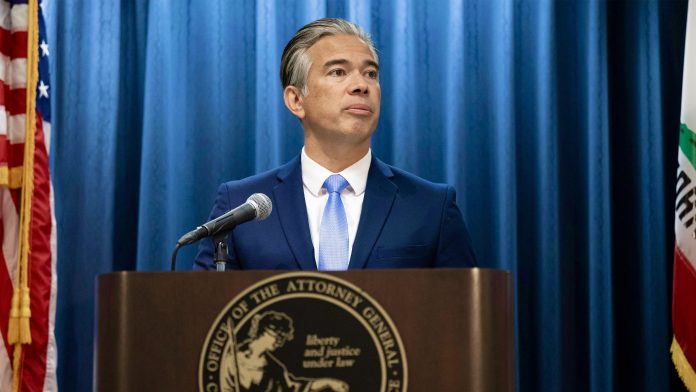
Late last month, California Attorney General Rob Bonta (D) sued Rady Children’s Health (RCH) in Southern California for halting its provision of gender transition procedures for minors. Filed January 30 in San Diego Superior Court, the lawsuit alleged that RCH “violated its legal obligations” to comply with conditions the attorney general’s office had placed on a December 17, 2023 merger agreement between RCH and Children’s Hospital of Orange County (CHOC). Bonta’s office conditionally approved the merger on November 4, 2024.
According to the lawsuit, the attorney general’s conditions placed upon the hospital merger included: “Condition V: Requires continuous maintenance of existing and licensed specialty health care services, including ‘gender-affirming care services’ … for 10 years, ‘at no less than their current capacities, types, acuity levels, licenses, and certifications, and in compliance with state and federal regulations.’ Condition XX: Prohibits discrimination on the basis of protected personal characteristics, including gender identity.”
The “Conditions expressly require RCH to obtain the approval of the Attorney General before reducing or eliminating any services that it agreed to maintain,” the lawsuit declared.
What business does the attorney general have in policing hospital mergers? “California law requires the Attorney General to review transfers of nonprofit health facilities in part to preserve access to uncompensated health care for the poor, elderly, and disabled,” the lawsuit explained. “Pursuant to Corporations Code section 5926, the ‘Attorney General may enforce conditions imposed on the Attorney General’s consent to an agreement or transaction pursuant to [California Corporations Code section 5920] to the fullest extent provided by law.’”
In this case, the attorney general imposed at least 20 conditions on the hospital merger, which he did not approve until 11 months after the agreement was reached. The hospital appears to have little say in what conditions the attorney general may impose, and it must ask the attorney general for permission to change any of the terms. Indeed, it seems that California was striving to the utmost to erase any notion of “free” or “market” from this economic transaction.
In this case, the conditions imposed by the attorney general would force a hospital to keep losing money. Condition V requires the hospital to maintain all “existing … specialty health care services” at “their current capacities” for 10 years. This requirement would hold even if one or more services experienced slackening demand or other conditions that resulted in financial losses.
Bonta argued that RCH had violated these terms. “First, around July 9, 2025, RCH stopped accepting new gender-affirming care patients outside of San Diego and Imperial Counties, and ceased scheduling new medically necessary, gender-affirming care surgeries for individuals under 19.”
It’s worth pausing here to acknowledge the fact that, in 2026, the California attorney general is recycling years-old, long-disproven talking points like claiming that it’s “medically necessary” to carry out gender transition surgeries on minors. Even ideologically captured entities like the American Medical Association (AMA) now admit that there is insufficient evidence to support these surgeries, and they should be “generally” delayed until adulthood.
Unabashed, the lawsuit continued, “Second, on December 22, 2025, RCH stopped accepting new patients, regardless of age, for gender-affirming care services. Finally, on January 20, 2026, RCH announced that effective February 6, 2026, it would stop providing medically necessary gender-affirming care — including puberty blockers and hormone therapy — for all existing transgender patients under the age of 19 throughout its entire health system.”
RCH announced in January that it would discontinue all transgender “medical interventions, procedures and prescriptions” and limit itself to “counseling, mental health resources and care coordination.”
“This was a very difficult decision, made to ensure we can continue serving all children and families across the communities we serve,” the hospital said. “Taken together, these developments affect our role and responsibilities as a provider participating in federal programs such as Medicaid and Medicare, which are essential to caring for children and families in our communities.”
In other words, given the choice between carrying out gender transition procedures and receiving Medicaid and Medicare dollars, RCH chose the latter. Indeed, RCH is neither the first nor the last hospital to make that choice. Already, Children’s Hospital Los Angeles closed its transgender center last July, and even Kaiser Permanente in San Francisco announced a pause to certain procedures for minors.
Bonta showed that he was aware of the federal pressure hospitals are facing. In his press release announcing a lawsuit against RCH, Bonta also boasted about his lawsuits against the federal government on the same point. On August 1, 2025, he “co-led a lawsuit challenging the U.S. Department of Justice’s threat to prosecute providers of medically necessary gender-affirming care for patients under the age of 19.”
On December 23, 2025, Bonta also challenged HHS Secretary Robert Kennedy’s “declaration claiming gender-affirming care fails to meet professionally recognized standards of care, and, as such, HHS may disqualify doctors and hospitals that provide such care from Medicare and Medicaid.” A CMS final rule on gender transition procedures for minors is expected as early as February 17.
Yet this awareness of federal policy did not dissuade Bonta from suing a hospital seeking to comply with it.
Technically speaking, Bonta’s legal argument is more nuanced. “In violation of the Attorney General Conditions, RCH did not provide justification to the Attorney General nor seek or receive approval from the Attorney General before reducing the provision of gender-affirming care to patients under 19 years of age,” he argues — not that Bonta would ever grant such approval.
But not even the attorney general is pretending that he filed the lawsuit over a few procedural oversights. Bonta’s public statement addresses the real issue: “Rady flagrantly disregarded its legal obligations by unilaterally deciding to preemptively comply with the Administration’s demands and cease medically necessary care for roughly 1,450 patients.”
The real issue is that the Trump administration wants to end gender transition procedures on minors, while Attorney General Bonta wants them to continue. In fact, Bonta is so determined to maintain the supply of gender transition procedures to minors that he has not only sued the Trump administration for targeting them, but now also the suppliers who have pulled out of the market for financial reasons. That should be the first sign to Bonta that he is fighting a losing battle.
Yet Bonta is not concerned about the signs. Like progressive nullifiers of federal policy on climate or immigration, Bonta exists within a political ecosystem that rewards confrontation with the Trump administration, no matter how absurd the cause. And Bonta has chosen to challenge the Trump administration on a very absurd cause — chemically and surgically abetting mentally ill boys to pretend to be girls, and vice versa.
Indeed, Bonta’s lawsuit simply responds to the signals set by left-wing protestors. A week before he filed his lawsuit, pro-transgender activists assembled to protest outside the hospital — a decision which likely did nothing to speed the recovery of the patients inside.
For their part, RCH told a local paper that it was “aware of the lawsuit … and is reviewing the filing” but would address it “through the legal process.” The hospital has not yet presented its case publicly, but it will likely argue that it cannot be penalized for actions taken to comply with federal policy, as California law holds any contract provisions “Contrary to an express provision of law” or “Contrary to the policy of express law” to be unlawful. As Solomon cautioned, “The one who states his case first seems right, until the other comes and examines him” (Proverbs 18:17).