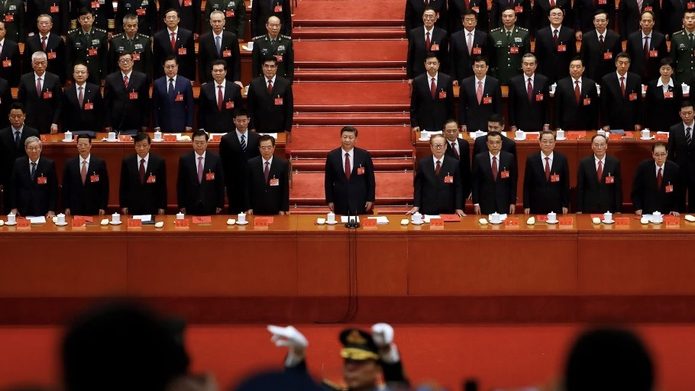
As the Chinese Communist Party publicly enforced political discipline within its ranks at its annual party gathering this week, independent religious organizations continue to experience ever-tightening restrictions on their activities.
China’s 20th Central Committee concluded its fifth plenary session on Oct. 29, adopting a resolution to advance what the party calls “full and rigorous party self-governance.”
The meeting also confirmed the expulsion of dozens of officials for alleged disciplinary and legal violations, underscoring the leadership’s emphasis on political discipline and the implementation of party directives.
The party called on its members to rally around Chinese President Xi Jinping and implement his political ideology, a call it has also made to religious institutions as part of its effort to “Sinicize” religion.
For religious communities, this campaign means submitting their leadership, teaching, and activities to CCP oversight and political priorities. Although the party’s internal disciplinary campaign and its restrictions on religion are distinct policies, both reflect a governing system that places loyalty to the Communist Party above institutional independence.
Religion Under Party Supervision
The CCP’s approach to religion is shaped by its insistence that religious life conform to the political priorities of the state. Under Xi, the government has advanced a policy known as the “Sinicization” of religion, requiring religious communities to align their activities with the party’s understanding of China’s national identity.
Chinese officials present Sinicization as an effort to make religion compatible with Chinese culture and national development. In practice, the policy also strengthens government influence over religious leadership, doctrine, education, and worship. Religious groups are expected to support the party’s objectives rather than maintain an independent public identity that challenges its authority.
China permits several officially recognized religious traditions, including Protestant Christianity, Catholicism, Islam, Buddhism, and Taoism. But recognition does not mean freedom from political control. Registered religious bodies operate within a regulatory system that gives authorities extensive influence over religious leadership, publications, worship, and organizational activity. Congregations that reject this oversight can face closure, surveillance, detention, or criminal prosecution.
The government’s approach to religion has deep historical roots. After taking power in 1949, the CCP established official religious associations, including state-supervised structures that govern officially recognized Protestant churches.
For Protestants, the distinction between state-sanctioned churches and independent house churches matters especially. Many Christians worship in congregations that seek to follow their own leadership and religious convictions rather than submit to government-controlled structures. Some meet in private homes or other informal settings, while others organize large congregations and networks that operate across cities.
The authorities have treated some of these independent networks as unlawful organizations, using regulations on religious activity and online communications to restrict their reach. Churches that refuse to register or comply with government demands can find their meetings disrupted, their buildings closed, and their pastors and members detained. Restrictions on online religious content have also limited congregations’ ability to share sermons, teach believers, and maintain connections beyond their immediate communities.
Political Discipline and Religious Freedom
The CCP’s recent emphasis on internal discipline offers a broader view of the political environment in which these restrictions persist. At its October plenum, the party stressed the need to implement its directives, strengthen its governance, and combat corruption. This insistence on centralized authority helps explain why independent religious institutions face pressure when they maintain leadership, loyalties, and networks that the state cannot fully direct.
The party’s position leaves little room for institutions whose ultimate authority lies outside the political system. For Christians, this can mean a direct conflict between the government’s demand for obedience and the conviction that religious teaching and church leadership must answer to a higher spiritual authority.
Religious freedom does not require a government to endorse any particular faith. It does require that people be free to practice their religion, organize their communities, choose their leaders, and teach their beliefs without coercion. China’s system places those freedoms under extensive state control, leaving independent communities vulnerable when they refuse to conform.