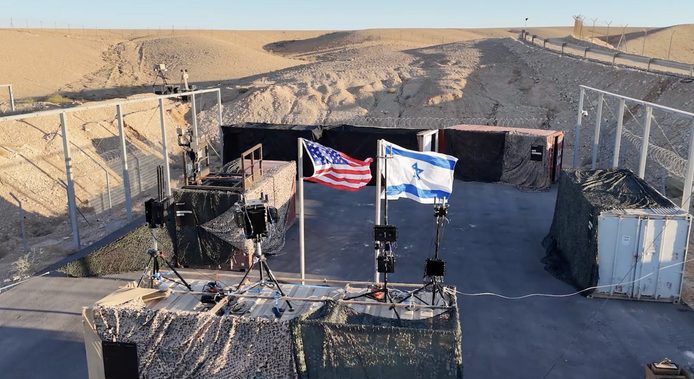
Israel and the United States have completed a groundbreaking series of joint military trials on Israeli soil, testing approximately 20 advanced drone defense systems designed to intercept increasingly sophisticated aerial threats, Israel’s Defense Ministry announced Thursday, November 26.
The trials, conducted under the Black Sands initiative, brought together Israeli and American military forces, defense researchers, and technology companies to evaluate new interception capabilities against unmanned aerial vehicles (UAVs).
It marked the first time the two countries conducted this type of joint counter-drone testing campaign in Israel, reflecting growing concerns over the use of inexpensive yet increasingly sophisticated drones in modern warfare.
Israel and US Expand Drone Defense Cooperation
Israel’s Directorate of Defense Research and Development (DDR&D) led the Black Sands trials, working alongside several American defense organizations, including U.S. Central Command (CENTCOM), Special Operations Command Central (SOCCENT), the Office of Naval Research, and Joint Interagency Task Force 401.
The Israeli Air Force, Israel Defense Forces (IDF) Ground Forces, and leading defense contractors from both countries also participated.
According to the Defense Ministry, the trials examined about 20 interception systems under simulated operational conditions reflecting threats both militaries face.
The initiative seeks to combine Israel’s extensive battlefield experience with American research capabilities, strengthening both countries’ ability to defend military installations, troops, and civilian infrastructure.
Hezbollah Drone Threat Accelerates Military Innovation
The joint trials come as Israel continues confronting evolving aerial threats from Iran and its regional proxies, particularly Hezbollah in Lebanon.
The Jerusalem Post reported that Hezbollah’s use of first-person-view drones, including systems controlled through fiber-optic cables, has presented significant challenges for Israeli forces. Unlike conventional radio-controlled drones, fiber-optic systems can evade certain electronic jamming measures.
The threat has increased pressure on Israel’s defense establishment to develop more effective detection, interception, and battlefield protection systems.
Brig. Gen. (res.) Dr. Daniel Gold, director of Israel’s DDR&D, emphasized that combating unmanned aircraft requires continuous technological innovation and close international cooperation.
The Black Sands program allows both militaries to combine operational knowledge, evaluate emerging technologies, and develop solutions to evolving battlefield challenges, he explained.
Brig. Gen. Beni Aminov, a senior research and development official, also described the partnership as a strategic asset, noting that Israel’s experience confronting drone attacks provides American forces with valuable lessons.
The Defense Ministry did not disclose detailed performance results for the 20 systems or announce when any newly tested technology might become operational.
The initiative underscores a broader shift in modern warfare: As relatively inexpensive drones become increasingly accessible to terrorist organizations and conventional militaries alike, Israel and the United States are investing in technologies intended to defeat threats that traditional missile defense systems were not necessarily designed to counter.
For Israel, which faces persistent threats across multiple fronts, developing effective and affordable drone interception capabilities has become an increasingly urgent national security priority.