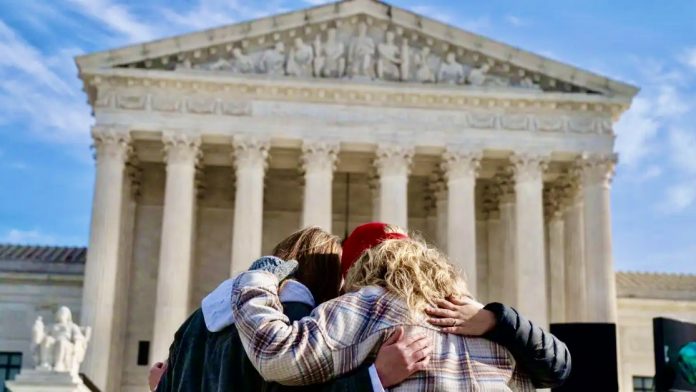
A decade after the 2015 Obergefell v. Hodges decision legalized same-sex marriage nationwide, the possibility of its reversal has reemerged in public discourse. The debate is fierce, spanning across legal, cultural, and political spheres.
For the first time since 2015, the U.S. Supreme Court of the United States is facing a formal request to revisit Obergefell through a case tied to former Kentucky county clerk Kim Davis. Davis, jailed for six days in 2015 for “refusing to issue marriage licenses to same-sex couples on religious grounds,” as reported by the Post Millennial, is now appealing a $100,000 jury award for emotional damages and $260,000 in legal fees in Davis v. Ermold.
Represented by Liberty Counsel (LC), Davis’s case raises two pivotal questions: Does she have a First Amendment defense based on her religious convictions when sued for “emotional distress” with no tangible damages beyond “hurt feelings”? And should the 2015 Obergefell decision, which mandated same-sex marriage nationwide, be overturned?
In their petition, Davis and LC sharply criticized Obergefell, calling it “egregiously wrong,” “deeply damaging,” and “far outside the bound[s] of any reasonable interpretation of the various constitutional provisions to which it vaguely pointed.” She argued it set out “on a collision course with the Constitution from the day it was decided,” asserting that its errors impact “a question of profound moral and social importance that the Constitution unequivocally leaves for the people.”
The petition emphasized that “Obergefell should be overturned because the Constitution makes no reference to same-sex marriage and no such right is implicitly recognized by any constitutional provision.” It further clarifies that overturning Obergefell would not invalidate existing marriage licenses, including those for same-sex couples, but would return marriage regulation to the states, mirroring the 2022 Dobbs v. Jackson decision that overturned Roe v. Wade.
Some have described Davis’s appeal as a long shot. ABC News reported that lower courts have previously rejected her claims, with a federal appeals court ruling that Davis cannot invoke the First Amendment as a defense since her actions constituted state conduct, unprotected by the First Amendment. Yet, the mere possibility of SCOTUS taking the case has ignited significant public and political discourse — especially since public opinion reflects a growing divide on this issue.
At least nine states have introduced bills or resolutions challenging same-sex marriage, with five urging SCOTUS to overturn Obergefell and four proposing to limit marriage to heterosexual couples. The Southern Baptist Convention also called for Obergefell’s reversal at its June 2025 meeting. A May 2025 Gallup poll revealed a 14-point drop in Republican support for same-sex marriage since 2022, with a record 47-point gap between Republicans and Democrats, the widest in 29 years.
In an interview with The Washington Stand, Mathew Staver, one of Davis’s attorneys, reflected on the decade-long legal battle. As he shared, this case represents the slippery slope that led to where our culture sits now, fighting to keep LGBT agendas out of schools, biological men out of women’s sports and private spaces, and more.
“Kim is the right person for a case like this because she’s humble,” said Staver. “[S]he doesn’t hate anybody. She just asked for a very simple religious accommodation.” But she was punished, he added, because two men (David Ermold and David Moore) who identified as homosexual chose to pursue Davis and target her for her faith. “I’ll never forget the day that I saw her — the day after she went to prison,” Staver recalled. “I visited her, and she was in the orange prisoner jumpsuit. It’s really startling to see your client in a prisoner’s outfit for simply asking for their religious beliefs to be accommodated.” As Staver warned, “Kim Davis represents a scenario that if she can be punished like this, then anybody can be punished.”
A decade later, the pursuit of Davis persists relentlessly. Staver stressed that “David Ermold and David Moore never even wanted to get married. They never even thought about it. They did an interview in December of 2015 with GQ magazine, and they said they never thought about getting married until they saw the name Kim Davis on social media.” They wanted to “intentionally intimidate and harass [Kim Davis]. … And they have made it their vendetta for the last 10 years to persecute her because of her Christian faith.”
It “speaks to this whole agenda,” Staver emphasized — it’s “very intolerant and hostile.” The two men could have gone to anyone to get a marriage license, but they chose Davis “to be vindictive,” trying to force her to “celebrate their LGBTQ agenda. It wasn’t good just to get a license. They wanted [Kim’s] name on it because they wanted to mock her Christian faith.”
Fast forward to today, and whether SCOTUS will take up this case is unclear. However, Staver remains “optimistic” because “this case has very compelling facts — with a woman who faces $360,000 in judgments, was sent to prison for six days for a simple request to have her name removed from the license. All of that combined presents a case that I think has high potential for the court to take and for us to win.”
And a win in this case would go far beyond marriage. First, Staver stated, “because religious freedom is involved in this case. And this case would not only provide religious freedom for Kim Davis, but for others where you have this clash, particularly between religious freedom and LGBTQ agendas.” However, he added, it’s also a win because “the court made not only a constitutional mistake, but a huge cultural mistake when they invented same-sex marriage.”