January 29, 2026

January, 29, 2026
January 29, 2026

give

untitled artwork

untitled artwork

World news biblically understood

TRENDING:

The Jewish Nation Lives: The Futility Of Attempts To Annihilate Israel

From Egypt’s Pharaoh to Persia’s Haman to Germany’s Hitler, many a world leader has attempted to destroy the Jewish people, defying God’s declaration that He will “curse him who curses” Israel (Gen. 12:3). Even today, motivated by a satanic hatred, many say, “Come, and let us cut them off from being a nation, that the name of Israel may be remembered no more” (Ps. 83:4).

Modern Israel’s history has been a fight for survival. Though often battered and humbled by brutal assaults, the Jewish nation lives, demonstrating the futility of attempts to annihilate it.

War for Independence (1948)

On May 14, 1948, Britain’s 31-year mandate over Palestine, as it was then known, came to an end; and Israel gained its independence. Six months earlier, the United Nations gave part of the area to the Jews and part to the Arabs. The dream for a revived Jewish nation in its Promised Land became a reality.

No sooner was the State of Israel born than its neighbors—Egypt, Syria, Transjordan, Lebanon, and Iraq—banded together to invade it. Their goal: Wipe the Jewish state off the map. But they could not.

Israel’s War of Independence lasted ten months and went down in history as the country’s bloodiest conflict. Of its 650,000 Jewish citizens in 1948, 6,373 (approximately one-third of whom were Holocaust survivors) perished. But the little Jewish nation pulled through, defeating massive, well-equipped Arab armies.

Six-Day War (1967)

Yet the Arab nations persisted in refusing to accept the Jewish state’s existence. For them, the 1949 armistice lines merely marked where their next attacks should begin.

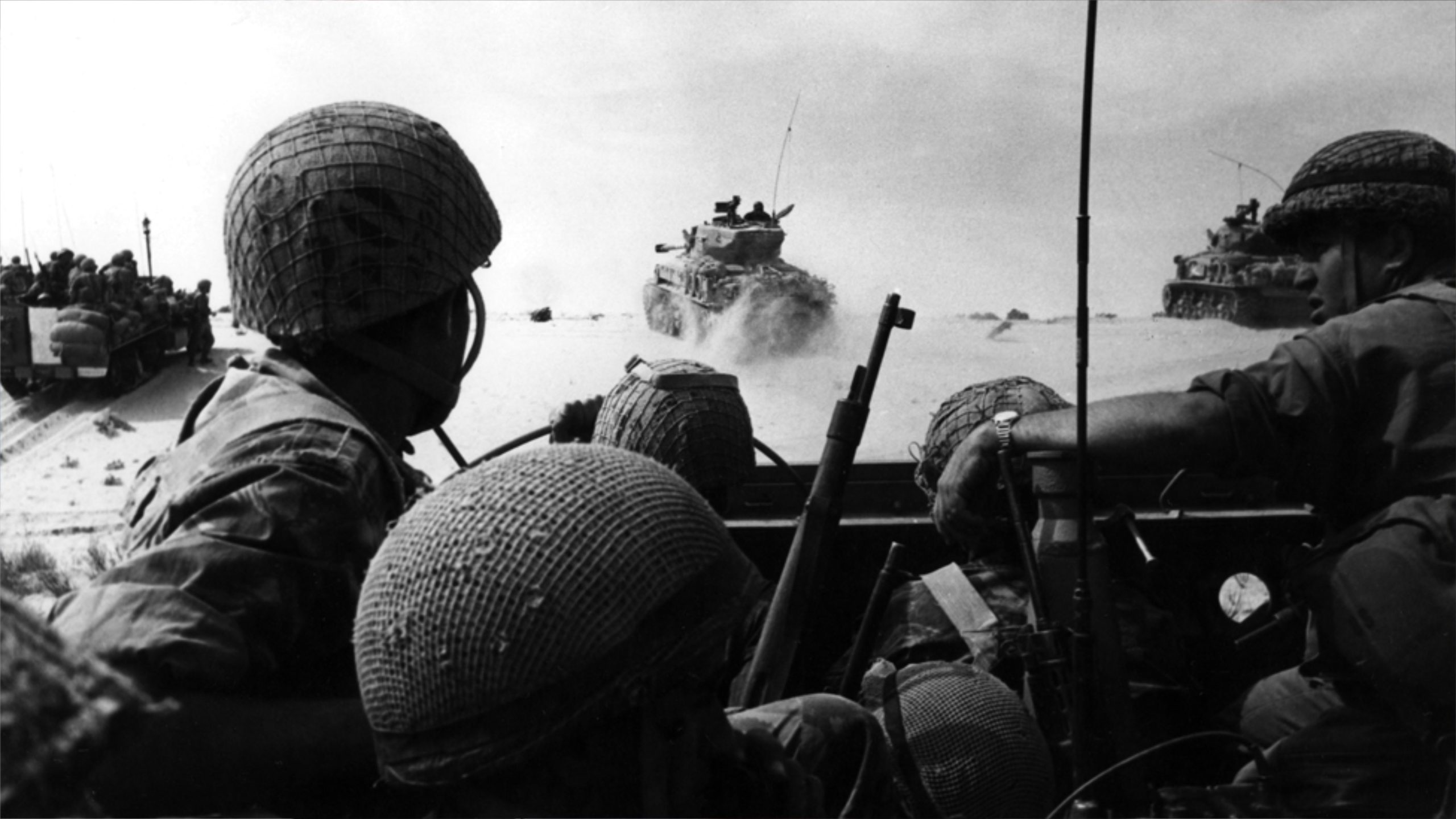
In May 1967, Egyptian President Gamal Abdel Nasser, advised by false intelligence from the Soviet Union, began moving 80,000 Egyptian troops, 550 tanks, and 1,000 pieces of artillery into the Sinai Peninsula. On May 23, he cut off Israel’s shipping lanes by blocking the Straits of Tiran, a direct violation of UN Security Council resolution 118. This was, by all definitions, an act of war.

By early June, five Arab nations had allied against Israel and assembled their armies on Israel’s borders: 80,000 Egyptian troops; 60,000 Jordanian troops, plus Iraqi forces; 50,000 Syrian troops; and a combined Arab air force of some 600 planes.

On June 5, 1967, Israel’s air force, flying low to avoid radar detection, made its way to Egypt. Before Egypt’s air force could get its jets in the air, Israel bombed Egypt’s runways and took out two-thirds of Egypt’s air force, the largest in the Arab world—all in merely four hours.

What Egypt had promised would be “the extermination of Zionist existence” was anything but. Though Egypt’s forces outnumbered Israel’s by three to one, its army retreated in defeat. Israel took control of the Sinai and opened the Port of Sharm el-Sheikh, reopening the sea lanes.

The defeats of the other Arab armies came in quick succession. Most significantly, on June 7, Israel pushed Jordan’s forces out of eastern Jerusalem, taking control of the Temple Mount. This was the first time in 2,000 years that a united Jerusalem lay in the hands of a sovereign Jewish nation. Jordan’s assault on Israel was over.

In merely six days, Israel not only defeated its powerful Arab neighbors, but it also captured militarily strategic territory (the Golan Heights from Syria, Judea and Samaria from Jordan, the Gaza Strip and Sinai from Egypt), making it far easier for Israel to protect its people.

Yom Kippur War (1973)

Yom Kippur, the Day of Atonement, is Judaism’s holiest day of the year. In Israel, everything shuts down as Jewish people fast and pray. Israel’s Arab neighbors, still incensed at their defeat six years earlier, chose this day to launch a war that nearly destroyed the Jewish state.

Though Israel knew war lay ahead, a series of intelligence failures, false alarms, and a sense of national hubris caused the government to doubt its imminence. By October 5, 1973, however, it became clear the Egyptians were planning an attack. Prime Minister Golda Meir, under pressure from the United States not to launch a preemptive strike, mobilized an insufficient number of troops.

On October 6, 1973, Syria and Egypt, backed by the Soviet Union and nine other nations, attacked. Some 1,400 Syrian tanks assailed Israel’s 180 tanks. Israel had a mere 500 soldiers stationed along the Suez Canal when 600,000 Egyptian soldiers struck. In the north, Syria overwhelmed Israeli forces. A staggering 40,000 Syrian troops flooded the Golan Heights, their 1,500 tanks far outnumbering Israel’s pitiful 177.

At Israel’s helm were Prime Minister Golda Meir and Minister of Defense Moshe Dayan. But even these bold, competent leaders feared Israel’s demise was at hand. Riddled with anxiety at the catastrophe, Dayan even considered a nuclear option.

Thanks to help from the United States, Israel was pulled back from the verge of defeat and turned the tide against the Arab invaders, pushing the Egyptians out of the Sinai and all the way back to the Egyptian capital of Cairo. In the north, Israel recaptured Mount Hermon in the Golan and advanced to 25 miles outside Damascus.

The war officially ended on October 28, 1973. Though technically it was a victory for Israel, the victory came at enormous cost. Israel lost 2,656 soldiers, three times the casualties of the 1967 war.

First Intifada (1987)

Twenty years after the Six-Day War, peace was no more in reach than it had been in the 1960s. In December 1987, an Israeli in Gaza was murdered. The next day, an Israeli truck driver accidentally crashed into a row of cars at a Gaza checkpoint, killing four Palestinians and seriously injuring seven.

A rumor spread in the Palestinian territories that the crash was an intentional response to the Israeli murdered in Gaza. Protests sprang up throughout the West Bank and Gaza Strip, demonstrations unlike any Israel or even the Palestine Liberation Organization (PLO) had ever seen.

What was supposedly a nonviolent intifada (Arabic for “shaking off”) against Israel quickly became violent. The Palestinians began rioting and attacking not only Israeli soldiers and civilians but also fellow Arabs accused of collaborating with Israel. In fact, by 1991, “the number of Arabs killed for political and other reasons by Palestinian death squads . . . exceeded the number killed in clashes with Israeli troops.”

Still, Israelis were the main target. More than 700 attacks targeted Israeli soldiers and civilians in the first four years of the First Intifada. Israel suffered not only at the hands of the Palestinians, but also at the hands of the international news media, which majored in turning little Israel into the big, powerful “occupier” of “Palestinian land” and making the massive, aggressive Arab nations the victims. The narrative had changed.

Second Intifada (2000)

In September 2000, Ariel Sharon, then opposition leader in Israel’s Knesset (parliament), and six members of the Likud Party visited the Temple Mount in Jerusalem. Israel had cleared the trip with the Palestinian Preventive Security organization, which assured the Israelis that no problems would ensue as long as the delegation did not enter any mosques. The promise proved false.

Arab radio broadcasts claimed Sharon had intruded on Muslim holy sites. PLO Chairman Yasser Arafat incited Palestinians to “move immediately to stop these aggressions and Israeli practices against holy Jerusalem.” A wave of violence followed that became known as the Second Intifada.

From 2000 to 2005, Arab terrorists unleashed random, bloody attacks on Israeli civilians throughout the country. Israelis feared going out in public and riding buses, which suicide bombers routinely blew up. Arabs murdered 1,137 Israelis during the Second Intifada.

Hamas War (2023)

October 7, 2023, will forever be engraved on the hearts of the Jewish people. That was when Hamas terrorists from the Gaza Strip invaded Israel and murdered, raped, mutilated, immolated, and beheaded more than 1,200 of the most vulnerable Israelis.

In a well-coordinated attack two years in the planning, Hamas infiltrated Israel by land, sea, and air. Some terrorists paraglided into an outdoor music festival being held in the Negev Desert, where they slaughtered more than 360 young people and took at least 40 hostages.

Throughout the day, Hamas launched thousands of rockets from Gaza into Israel and took some 240 hostages, 32 of them children, the youngest only 9 months old. Not since the Holocaust have so many Jewish people been killed in a single day.

In response, Prime Minister Benjamin Netanyahu told the nation, “Citizens of Israel, we are at war. Not an operation, not a round [of fighting], at war!”

That war meant a ground invasion of Gaza. Unlike any other country, Israel warns its enemies that it’s about to strike and urges civilians to seek safety. It urged the Palestinians to flee to the southern part of the Gaza Strip, while the Jewish state tried to eliminate Hamas. Israel began its ground invasion on October 27.

Yet one of the toughest fronts Israel faces is the war in the media. Hamas intentionally hides in densely populated civilian areas, and it built a 300-mile labyrinthine maze of tunnels under the Gaza Strip. The IDF discovered that Hamas’s primary base of operations was underneath the Shifa Hospital in Gaza City.

Hamas deliberately uses civilian areas—such as schools, mosques, and hospitals­—as shields, forcing Israel to bomb these sites, so Hamas can claim Israel is committing war crimes against Palestinian civilians. For Israel, the public-relations battle is as intense as the physical fighting.

At the time of this writing, Israel continues to wage war against Hamas. And Hamas joins the millions of others who, for millennia, have tried to destroy the Jewish people. However, despite all their attempts, including those today, the Jewish people live on.

A song frequently sung at Israel solidarity events is “Am Yisrael Chai,” Hebrew for “The people of Israel live.” And they will continue to live because almighty God has decreed it (Jer. 31:35–37). And what He has decreed, no one can reverse (Isa. 43:13).



Your support helps Harbinger's Daily propel the boldest and most sound Christian voices of our day—those unwavering in their defense of the truth and passionate about reaching the unsaved world—while engaging millions to stand courageously with a worldview grounded in God's Word. 

Will you defend the truth and equip others to do the same?

Congressional Republicans Launch ‘Sharia Free America Caucus,’ Shining A Light On The Dangers Of Rising Islamic Ideology

With twenty-six members from seventeen different states, the newly launched "Sharia Free America Caucus" in the US House of Representatives is working to reveal the dangers and safeguard America from freedom-trampling Islamic ideology. The caucus, chaired by Texas Congressmen Keith Self and Chip Roy, underscores that Sharia Law poses a direct threat to the United States and Western civilization, noting that both members of Congress and American citizens must be educated to understand the danger.

Canada’s Euthanasia Program Isn’t Just Failing Vulnerable People — It’s Actively Manipulating And Betraying Them

Canada’s MAiD regime reveals a society sliding toward moral collapse — one where death is normalized as a budget-friendly “solution,” where safeguards crumble under pressure and emotion, and where the sanctity of life is traded for convenience. The evidence piles up. The body count rises. The human toll devastates. So, why aren’t we demanding abolition now? Why aren’t we pouring resources into palliative care that comforts, mental health services that heal, disability support that dignifies, prison reform that redeems?

sign up

In An Ever Darkening World, We Can Find Solace In Bible Prophecy

The bright side of the growing evil in the world is that it is a sure sign that we are living in the season of the Lord’s return. If you will check Genesis 6, you will find that Noah’s society was characterized by violence and immorality. This is the reason that the great pastor, Adrian Rogers (1931-2005), once said, “The world is growing gloriously dark.” How can the acceleration of evil be considered “glorious”? Because it is a sign of the imminent return of Jesus.

ABC's of Salvation

Decision

UTT

untitled artwork

Israel My Glory

From Egypt’s Pharaoh to Persia’s Haman to Germany’s Hitler, many a world leader has attempted to destroy the Jewish people, defying God’s declaration that He will “curse him who curses” Israel (Gen. 12:3). Even today, motivated by a satanic hatred, many say, “Come, and let us cut them off from being a nation, that the name of Israel may be remembered no more” (Ps. 83:4).

Modern Israel’s history has been a fight for survival. Though often battered and humbled by brutal assaults, the Jewish nation lives, demonstrating the futility of attempts to annihilate it.

War for Independence (1948)

On May 14, 1948, Britain’s 31-year mandate over Palestine, as it was then known, came to an end; and Israel gained its independence. Six months earlier, the United Nations gave part of the area to the Jews and part to the Arabs. The dream for a revived Jewish nation in its Promised Land became a reality.

No sooner was the State of Israel born than its neighbors—Egypt, Syria, Transjordan, Lebanon, and Iraq—banded together to invade it. Their goal: Wipe the Jewish state off the map. But they could not.

Israel’s War of Independence lasted ten months and went down in history as the country’s bloodiest conflict. Of its 650,000 Jewish citizens in 1948, 6,373 (approximately one-third of whom were Holocaust survivors) perished. But the little Jewish nation pulled through, defeating massive, well-equipped Arab armies.

Six-Day War (1967)

Yet the Arab nations persisted in refusing to accept the Jewish state’s existence. For them, the 1949 armistice lines merely marked where their next attacks should begin.

In May 1967, Egyptian President Gamal Abdel Nasser, advised by false intelligence from the Soviet Union, began moving 80,000 Egyptian troops, 550 tanks, and 1,000 pieces of artillery into the Sinai Peninsula. On May 23, he cut off Israel’s shipping lanes by blocking the Straits of Tiran, a direct violation of UN Security Council resolution 118. This was, by all definitions, an act of war.

By early June, five Arab nations had allied against Israel and assembled their armies on Israel’s borders: 80,000 Egyptian troops; 60,000 Jordanian troops, plus Iraqi forces; 50,000 Syrian troops; and a combined Arab air force of some 600 planes.

On June 5, 1967, Israel’s air force, flying low to avoid radar detection, made its way to Egypt. Before Egypt’s air force could get its jets in the air, Israel bombed Egypt’s runways and took out two-thirds of Egypt’s air force, the largest in the Arab world—all in merely four hours.

What Egypt had promised would be “the extermination of Zionist existence” was anything but. Though Egypt’s forces outnumbered Israel’s by three to one, its army retreated in defeat. Israel took control of the Sinai and opened the Port of Sharm el-Sheikh, reopening the sea lanes.

The defeats of the other Arab armies came in quick succession. Most significantly, on June 7, Israel pushed Jordan’s forces out of eastern Jerusalem, taking control of the Temple Mount. This was the first time in 2,000 years that a united Jerusalem lay in the hands of a sovereign Jewish nation. Jordan’s assault on Israel was over.

In merely six days, Israel not only defeated its powerful Arab neighbors, but it also captured militarily strategic territory (the Golan Heights from Syria, Judea and Samaria from Jordan, the Gaza Strip and Sinai from Egypt), making it far easier for Israel to protect its people.

Yom Kippur War (1973)

Yom Kippur, the Day of Atonement, is Judaism’s holiest day of the year. In Israel, everything shuts down as Jewish people fast and pray. Israel’s Arab neighbors, still incensed at their defeat six years earlier, chose this day to launch a war that nearly destroyed the Jewish state.

Though Israel knew war lay ahead, a series of intelligence failures, false alarms, and a sense of national hubris caused the government to doubt its imminence. By October 5, 1973, however, it became clear the Egyptians were planning an attack. Prime Minister Golda Meir, under pressure from the United States not to launch a preemptive strike, mobilized an insufficient number of troops.

On October 6, 1973, Syria and Egypt, backed by the Soviet Union and nine other nations, attacked. Some 1,400 Syrian tanks assailed Israel’s 180 tanks. Israel had a mere 500 soldiers stationed along the Suez Canal when 600,000 Egyptian soldiers struck. In the north, Syria overwhelmed Israeli forces. A staggering 40,000 Syrian troops flooded the Golan Heights, their 1,500 tanks far outnumbering Israel’s pitiful 177.

At Israel’s helm were Prime Minister Golda Meir and Minister of Defense Moshe Dayan. But even these bold, competent leaders feared Israel’s demise was at hand. Riddled with anxiety at the catastrophe, Dayan even considered a nuclear option.

Thanks to help from the United States, Israel was pulled back from the verge of defeat and turned the tide against the Arab invaders, pushing the Egyptians out of the Sinai and all the way back to the Egyptian capital of Cairo. In the north, Israel recaptured Mount Hermon in the Golan and advanced to 25 miles outside Damascus.

The war officially ended on October 28, 1973. Though technically it was a victory for Israel, the victory came at enormous cost. Israel lost 2,656 soldiers, three times the casualties of the 1967 war.

First Intifada (1987)

Twenty years after the Six-Day War, peace was no more in reach than it had been in the 1960s. In December 1987, an Israeli in Gaza was murdered. The next day, an Israeli truck driver accidentally crashed into a row of cars at a Gaza checkpoint, killing four Palestinians and seriously injuring seven.

A rumor spread in the Palestinian territories that the crash was an intentional response to the Israeli murdered in Gaza. Protests sprang up throughout the West Bank and Gaza Strip, demonstrations unlike any Israel or even the Palestine Liberation Organization (PLO) had ever seen.

What was supposedly a nonviolent intifada (Arabic for “shaking off”) against Israel quickly became violent. The Palestinians began rioting and attacking not only Israeli soldiers and civilians but also fellow Arabs accused of collaborating with Israel. In fact, by 1991, “the number of Arabs killed for political and other reasons by Palestinian death squads . . . exceeded the number killed in clashes with Israeli troops.”

Still, Israelis were the main target. More than 700 attacks targeted Israeli soldiers and civilians in the first four years of the First Intifada. Israel suffered not only at the hands of the Palestinians, but also at the hands of the international news media, which majored in turning little Israel into the big, powerful “occupier” of “Palestinian land” and making the massive, aggressive Arab nations the victims. The narrative had changed.

Second Intifada (2000)

In September 2000, Ariel Sharon, then opposition leader in Israel’s Knesset (parliament), and six members of the Likud Party visited the Temple Mount in Jerusalem. Israel had cleared the trip with the Palestinian Preventive Security organization, which assured the Israelis that no problems would ensue as long as the delegation did not enter any mosques. The promise proved false.

Arab radio broadcasts claimed Sharon had intruded on Muslim holy sites. PLO Chairman Yasser Arafat incited Palestinians to “move immediately to stop these aggressions and Israeli practices against holy Jerusalem.” A wave of violence followed that became known as the Second Intifada.

From 2000 to 2005, Arab terrorists unleashed random, bloody attacks on Israeli civilians throughout the country. Israelis feared going out in public and riding buses, which suicide bombers routinely blew up. Arabs murdered 1,137 Israelis during the Second Intifada.

Hamas War (2023)

October 7, 2023, will forever be engraved on the hearts of the Jewish people. That was when Hamas terrorists from the Gaza Strip invaded Israel and murdered, raped, mutilated, immolated, and beheaded more than 1,200 of the most vulnerable Israelis.

In a well-coordinated attack two years in the planning, Hamas infiltrated Israel by land, sea, and air. Some terrorists paraglided into an outdoor music festival being held in the Negev Desert, where they slaughtered more than 360 young people and took at least 40 hostages.

Throughout the day, Hamas launched thousands of rockets from Gaza into Israel and took some 240 hostages, 32 of them children, the youngest only 9 months old. Not since the Holocaust have so many Jewish people been killed in a single day.

In response, Prime Minister Benjamin Netanyahu told the nation, “Citizens of Israel, we are at war. Not an operation, not a round [of fighting], at war!”

That war meant a ground invasion of Gaza. Unlike any other country, Israel warns its enemies that it’s about to strike and urges civilians to seek safety. It urged the Palestinians to flee to the southern part of the Gaza Strip, while the Jewish state tried to eliminate Hamas. Israel began its ground invasion on October 27.

Yet one of the toughest fronts Israel faces is the war in the media. Hamas intentionally hides in densely populated civilian areas, and it built a 300-mile labyrinthine maze of tunnels under the Gaza Strip. The IDF discovered that Hamas’s primary base of operations was underneath the Shifa Hospital in Gaza City.

Hamas deliberately uses civilian areas—such as schools, mosques, and hospitals­—as shields, forcing Israel to bomb these sites, so Hamas can claim Israel is committing war crimes against Palestinian civilians. For Israel, the public-relations battle is as intense as the physical fighting.

At the time of this writing, Israel continues to wage war against Hamas. And Hamas joins the millions of others who, for millennia, have tried to destroy the Jewish people. However, despite all their attempts, including those today, the Jewish people live on.

A song frequently sung at Israel solidarity events is “Am Yisrael Chai,” Hebrew for “The people of Israel live.” And they will continue to live because almighty God has decreed it (Jer. 31:35–37). And what He has decreed, no one can reverse (Isa. 43:13).


Trusted Analysis From A Biblical Worldview

Help reach the lost and equip the church with the living and active truth of God's Word in our world today.

YOU CARE ABOUT

BIBLICAL TRUTH. SO DO WE.


Together, We Can Deliver A Biblical Understanding

Of News Events Around The World.

Congressional Republicans Launch ‘Sharia Free America Caucus,’ Shining A Light On The Dangers Of Rising Islamic Ideology

With twenty-six members from seventeen different states, the newly launched "Sharia Free America Caucus" in the US House of Representatives is working to reveal the dangers and safeguard America from freedom-trampling Islamic ideology. The caucus, chaired by Texas Congressmen Keith Self and Chip Roy, underscores that Sharia Law poses a direct threat to the United States and Western civilization, noting that both members of Congress and American citizens must be educated to understand the danger.

Canada’s Euthanasia Program Isn’t Just Failing Vulnerable People — It’s Actively Manipulating And Betraying Them

Canada’s MAiD regime reveals a society sliding toward moral collapse — one where death is normalized as a budget-friendly “solution,” where safeguards crumble under pressure and emotion, and where the sanctity of life is traded for convenience. The evidence piles up. The body count rises. The human toll devastates. So, why aren’t we demanding abolition now? Why aren’t we pouring resources into palliative care that comforts, mental health services that heal, disability support that dignifies, prison reform that redeems?

untitled artwork 6391

In An Ever Darkening World, We Can Find Solace In Bible Prophecy

The bright side of the growing evil in the world is that it is a sure sign that we are living in the season of the Lord’s return. If you will check Genesis 6, you will find that Noah’s society was characterized by violence and immorality. This is the reason that the great pastor, Adrian Rogers (1931-2005), once said, “The world is growing gloriously dark.” How can the acceleration of evil be considered “glorious”? Because it is a sign of the imminent return of Jesus.

ABC's of Salvation

TV AD

worldview matters

Decision Magazine V AD

Decision

Jan Markell

Israel My Glory

Erick Stakelbeck

untitled artwork

YOU CARE ABOUT

BIBLICAL TRUTH.

SO DO WE.

Together, We Can Deliver A Biblical Understanding Of News Events Around The World And Equip The Church To Stand With A Biblical Worldview.

Israel My Glory

untitled artwork

YOU CARE ABOUT

BIBLICAL TRUTH.

SO DO WE.


Together, We Can Deliver A Biblical Understanding Of News Events Around The World And Equip The Church To Stand With A Biblical Worldview.