



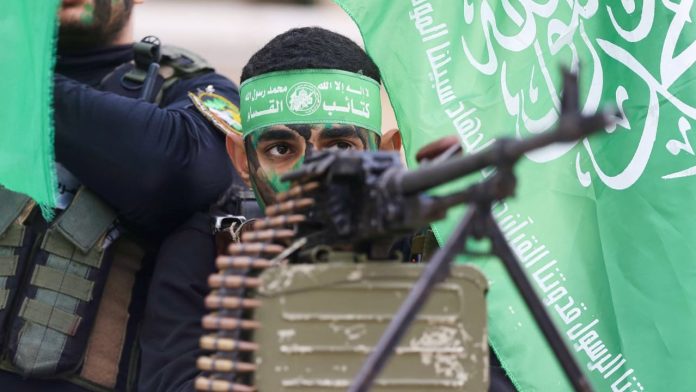
President Donald Trump announced Thursday that Hamas has agreed to a phased process leading to the “complete disarmament” of the terrorist organization and other armed factions in the Gaza Strip, calling the reported agreement a historic step toward lasting peace.
Trump said the understanding was reached through negotiations involving his Board of Peace and mediators from Egypt, Qatar and Turkey. Under the emerging framework, Hamas would surrender its weapons, dismantle military infrastructure and relinquish control of Gaza to a new Palestinian administration. Israeli forces would withdraw in stages as the demilitarization process advances.
“This historic agreement is a monumental step toward lasting peace, security and prosperity in Gaza and throughout the region,” Trump said, describing the proposal as a major milestone in his 20-point plan for Gaza.
Yet the announcement was immediately met with caution in Israel and uncertainty among regional observers. Hamas had not publicly confirmed an unconditional commitment to disarm as of Thursday evening. The terrorist organization reportedly described the arrangement as a draft and continued to link any surrender of weapons to guarantees of a full Israeli withdrawal from Gaza.
That distinction is critical. Hamas has repeatedly indicated that it views its weapons not merely as military equipment but as instruments of what it calls “resistance.” Only weeks ago, Hamas continued to refuse disarmament unless Israel halted its military operations, and earlier negotiations stalled when the organization demanded guarantees of an Israeli withdrawal before it would even discuss surrendering its arsenal.
Israeli officials have therefore remained skeptical that Hamas intends to dismantle its tunnels, surrender its rockets and remove the command structure responsible for the Oct. 7, 2023, massacre. The proposed process could take many months, leaving difficult questions over who would collect the weapons, verify compliance and prevent Hamas from concealing arms or rebuilding its forces.
More Than a Battle Over Weapons
The central question is not simply whether Hamas will hand over rifles and rockets. It is whether the organization is prepared to abandon the Islamist ideology that gave those weapons their purpose.
Hamas was founded as the Palestinian branch of the Muslim Brotherhood and formally calls itself the Islamic Resistance Movement. Its 1988 covenant presents the conflict with Israel in explicitly religious terms, identifies jihad as central to its mission and declares that Israel will continue to exist until Islam destroys it.
Although Hamas issued a revised political document in 2017, it continued to define itself as an Islamic resistance movement whose objective is the “liberation of Palestine” and confrontation with the “Zionist project.” Islam, the document states, remains the framework determining the movement’s principles, goals and methods.
This does not mean that all Muslims share Hamas’s interpretation of Islam. Millions of Muslims reject terrorism and seek peaceful coexistence. But Hamas represents a militant Islamist current that transforms a territorial conflict into what it regards as a sacred, generational struggle. Within that worldview, weapons are not incidental. They are treated as religiously sanctioned tools for advancing the movement’s cause.
That is why genuine disarmament would require more than the transfer of rockets, rifles and explosives. It would require the breaking of an ideology that glorifies martyrdom, sanctifies violence and teaches future generations that Israel’s destruction is a religious obligation.
Israel Will Judge the Agreement by Actions
Trump has repeatedly warned that Hamas must surrender its weapons or face overwhelming consequences. In February, he said the organization would be “very harshly met” if it refused. Earlier, he declared that Hamas would either disarm voluntarily or be disarmed by force.
The reported agreement may therefore represent an important diplomatic opening. If Hamas truly dismantles its tunnels, weapons factories, rocket stockpiles and military command, it would remove one of the greatest barriers to rebuilding Gaza and establishing a government no longer committed to war with Israel.
But Israel is unlikely to accept declarations alone. Hamas has previously used ceasefires to regroup, rearm and restore damaged military networks. A credible agreement will require intrusive inspections, enforceable deadlines and consequences for every violation.
From a Biblical perspective, the conflict also illustrates the spiritual dimension behind the visible battlefield. Scripture teaches that human struggles are often driven by deeper powers, beliefs and deceptions. Peace cannot be secured merely by removing weapons while hatred, indoctrination and the desire for destruction remain rooted in the heart.
Trump’s announcement may prove to be a genuine turning point. But the test will not be found in diplomatic language or celebratory statements. It will be found in whether Hamas dismantles its arsenal, abandons its infrastructure of terror and relinquishes the ideology that has fueled decades of bloodshed.
Until that happens, Israel and its supporters have good reason to hope—but also every reason to remain watchful.







