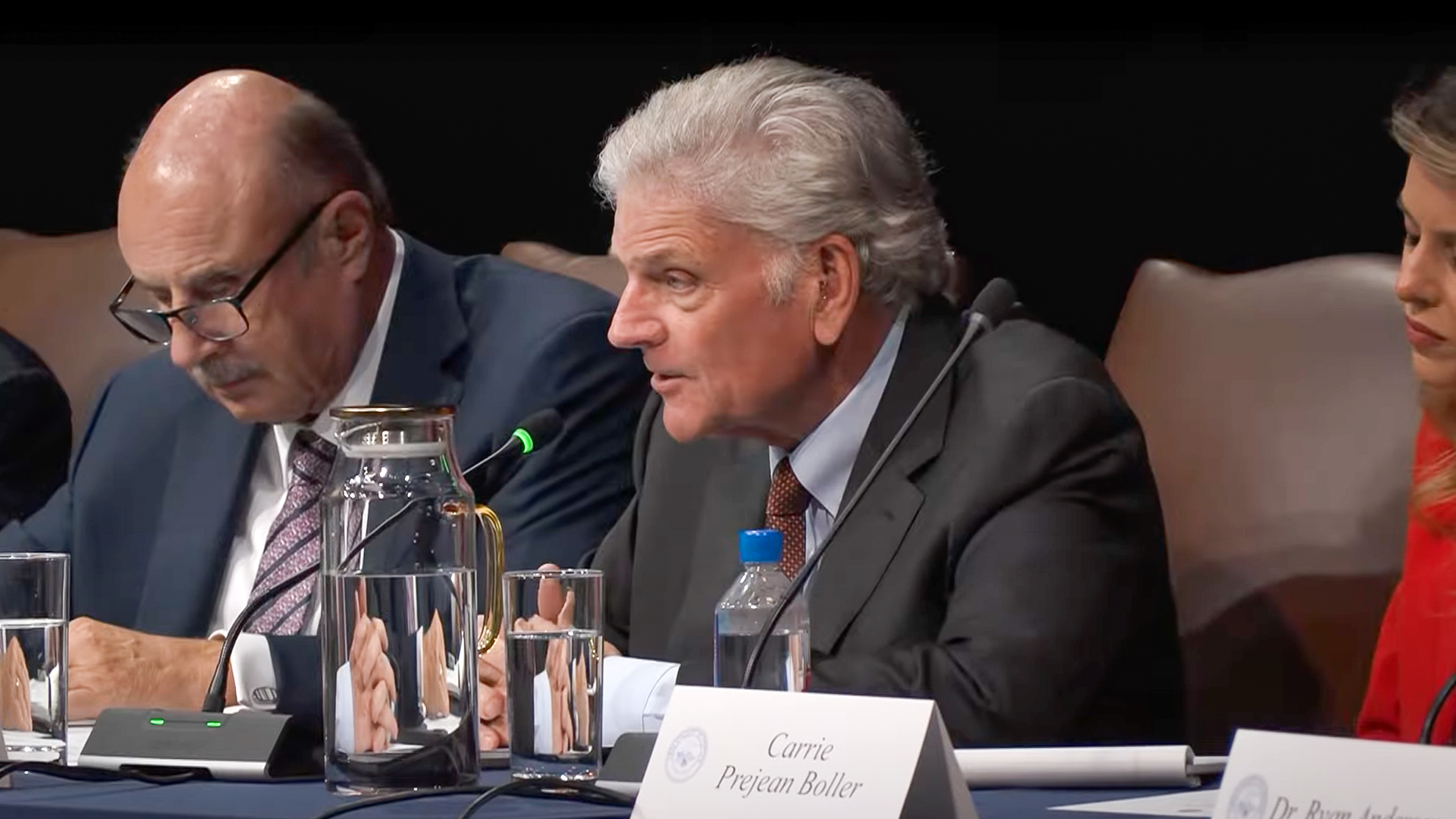
In its third hearing Monday, the President’s Religious Liberty Commission continued its consideration of religious liberty in education, but not before devoting time to what commission chairman Dan Patrick called “the ultimate taking of religious liberty, and that’s when you take someone’s life.”
Patrick referred to the Aug. 27 shooting at the Church of the Annunciation in Minneapolis, Minnesota; the Sept. 28 shooting at a Mormon church in Grand Blanc, Michigan; and the Sept. 10 assassination of conservative activist and outspoken Christian Charlie Kirk.
“I didn’t know Charlie Kirk,” said commission member Franklin Graham. “But I already miss the guy. I miss what he stood for, the impact that he had on our government, the impact that he had on our president, praise God! The impact that he had on so many in the cabinet.”
Commission members discussed some of the fundamental reasons why killings like these may happen.
“We live in a climate that is hyper secular,” said Eric Metaxas. “The mainstream media has fomented hatred of people who love God and who talk about God publicly.”
But he added that churches also share some of the blame, for not having the courage to teach about the link between faith, freedom and virtue, and for trying to avoid “political” issues. “It made Charlie Kirk look like a radical and put a target on him,” Metaxas said.
The commission also heard testimony about threats to the First Amendment rights of teachers and coaches in public schools.
Joe Kennedy told how he was fired from his coaching position in the Bremerton School District in Washington for praying on the 50-yard line after games. “It cost me, really, everything,” Kennedy said, explaining that he nearly lost his marriage because in his lawsuit, he was suing his own wife, who was the human resources director for the school district. After almost seven years, the U.S. Supreme Court upheld Kennedy’s right to pray.
Monica Gill, a high school government teacher in the notoriously liberal school district of Loudon County, Virginia, said that in 2021, her district adopted a policy that, in her words, “forced teachers to deny the foundational truth of what it means to be human—created as male and female.” The policy said that teachers must affirm all transgender students, treating boys as girls and girls as boys.
“I knew that I could not stand in front of my Father in Heaven one day and say, ‘My pension plan was more important than Your truth.’” So Gill took a stand and filed a lawsuit against the district, and this past July, the district agreed that teachers do not need to use pronouns inconsistent with their beliefs.
Others giving testimony included Carroll Conley, the current head of Bangor Christian School, which was at the center of the Supreme Court’s Carson v. Makin decision that held the state could not discriminate against religious schools for public funding.
Keisha Russell, senior counsel at First Liberty Institute, told the commission: “Our kids are our most precious assets that we have in society. And right now, we’re just giving them over to people who don’t love them. They don’t love our country, they don’t love religion, they don’t love morality. And they’re training all these students to grow up to be leaders who feel the exact same way. So that’s why we have a lot of the issues that we have right now on college campuses. And what happened to Charlie Kirk is a result of indoctrination—bad education.”
As was discussed at the commission’s previous hearing, ignorance of the law at the district and school levels is behind many of these battles. Kennedy said that in spite of court decisions upholding religious liberty in schools, “down at the school level, there’s nothing that is written in policy. Still nothing has changed, and people are still losing and fighting because of it.”