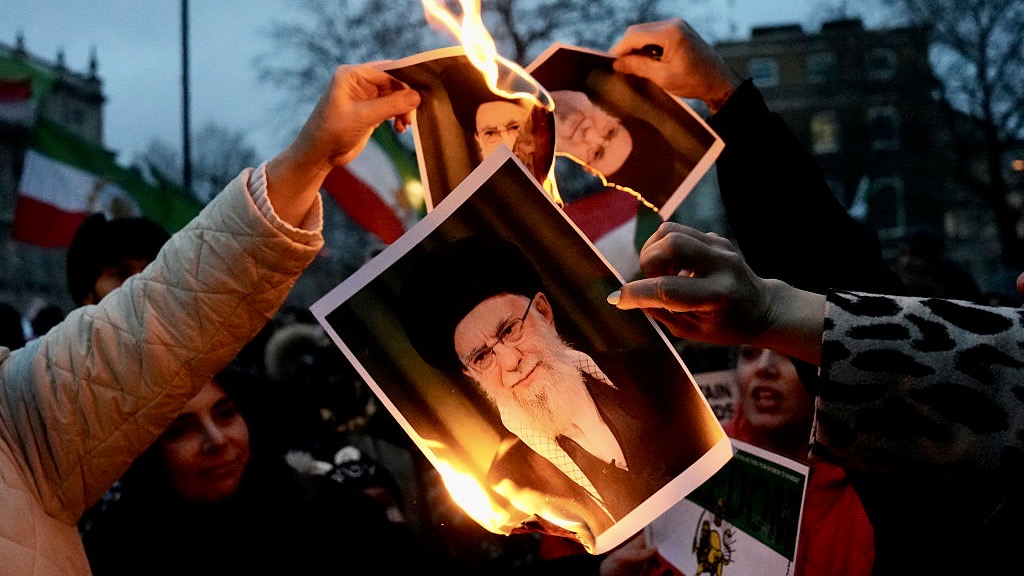
The long-term simmering unrest in Iran reached full boil two weeks ago and Iran has been on fire ever since. Protesters took to the street marching against the Islamic regime and its failed economy, broken infrastructure, and violent suppression of critics. Immediately, police and military forces were dispatched to put down the demonstrations. Their heavy-handed tactics only blew oxygen on the flames, causing the protests to spread in scope and intensity. The police responded in kind and were very soon using live ammunition to suppress the activists. That’s when the bodies began to pile up. First, tens, then hundreds, then thousands.
As of now, more than 12,000 protesters have lost their lives and countless more have been wounded. The hospitals can’t keep up with the wounded, but it some places they don’t have to. In Tehran, there are reports that security forces are taking away gunshot victims as soon as they arrive, even prior to medical treatment. In Isfahan’s Milad hospital, forces from the Ministry of Intelligence conducted a raid during which they abducted several doctors who had treated those wounded during the protests.
Thousands are being detained by the police, and people are starting to disappear from custody. I have been praying for the life of Erfan Soltani, a 26-year-old shopkeeper, who was scheduled to be executed January 14. For now, it appears that his sentence has been stayed, but that is a minor victory overall. His death would have simply been the first official execution. The police forces and military have been executing people without ceasing over the past days.
Where are the protests over this brutality and these deaths? It took until two days ago for the UN Human Rights Commission to finally condemn Iran’s actions. Leftist activists and politicians have either kept silent or provided tepid statements against Iran’s murdering of their citizens. Compare this to the vitriolic outrage that would be voiced by these same people if a Gazan simply got nicked while getting a shave at an Israeli barbershop. If these hatemongers and antisemites, both the professional and the weekend hobbyists, are truly all about protecting the rights of the oppressed, there should be marches in support of the Iranian protesters in every city in America. But there aren’t, because no Jews, no news.
So far, the protests are maintaining their intensity, but that can only last so long without outside help. The Islamic regime shut down the internet a week ago, then shut down Elon Musk’s Starlink after he sent it in to restore outside access. But that didn’t stop Musk. His brainiacs at SpaceX found a way to reactivate the service and Elon is offering it free of charge in the country.
If the ayatollahs do survive this onslaught, they will still be left with a broken country. Five Iranian banks are on the verge of collapse, according to “The Wall Street Journal”. As for their currency, it has finally bottomed out with one Iranian rial being worth 0.000001 USD, meaning it is utterly worthless. That’s no concern for Ayatollah Ali Khamenei, however, whose personal fortune is valued at $250-300 billion, or about three times more than the national budget of Iran.
Israel’s Response to Iran
Threats have been flying back and forth between Tehran and Jerusalem. The ayatollahs desperately need something to distract the people from their hatred of them, so they’re trying to direct it at Israel. Israel’s response is essentially, “Bring it on!” Just in case the Islamic regime is dumb enough to try something, Iron Dome batteries have been transferred to Jerusalem.
Before acting, the mullahs need to consider the fact that with a single strike, Israel can take out two-thirds of Iran’s economy. Using just a handful of precision bombs on critical oil infrastructure sites, the IDF could destroy the final pillar from the country’s economic foundation. Israel held this action in reserve during the June war. If Iran attacks, that forbearance may likely come to an end.
The United States’ Response to Iran
From the beginning, conservative voices in America have spoken out in support of the protesters. Senator Ted Cruz said, “I am proud to stand with the heroes in Iran who don’t want an Islamist dictator oppressing them anymore.” Eliminate Khamenei, encouraged Senator Lindsey Graham, while promising the protesters that help is on the way. The president himself has been very vocal in his support of the anti-regime demonstrators and in his warnings to the government agencies that are shooting them down.
Many believe that a US attack on Iran is imminent. Forces at Al Udeid Air Base in Qatar have been ordered to leave immediately, and Americans have been warned against traveling anywhere in the Middle East. When asked what he might have planned for Iran, Donald Trump’s standard answer is “Watch and find out.” But what does that mean? Recently, a senior American official told the “New York Times” that the goal of any attack against Iran is to send a message to Khamenei over the killing of protesters, as opposed to overthrowing the government.
What are the potential targets for a US strike in Iran?
- Military targets related to Iran’s ballistic missile and nuclear programs, including all the missile cities hidden under the ground.
- The Basij, which is often called the “morality police”. One of the five branches of the IRGC, it is responsible for paramilitary support, internal security, law enforcement, and ensuring obedience to Islamic law. These are the ones who are primarily responsible for violently suppressing dissent and protests.
- Government facilities, such as the parliament, state television and radio headquarters, and the presidential palace.
- Critical infrastructure including oil refineries, oil depots, airports, and seaports.
- Targeted elimination of regime leadership, including senior IRGC commanders, the supreme leader, the president, and member of the Assembly of Experts and the Guardian Council
If President Trump chooses not to target the regime itself, he will focus on military targets and the Basij. If his ultimate goal is regime change, he will need to take down both those groups, as well as destroying government facilities and targeting all the key leaders for elimination. If he wants to go scorched earth on Iran, he will target all five. Although Venezuela was a smaller, easier target, the US showed through that operation that it has the strength and strategic acumen to do whatever it chooses to do. It will be up to Trump and his advisers to decide what is the best option. By all accounts, it appears that an attack of some sort is coming very soon. As I predicted earlier, it’s not if but when.
Another lesson learned in Venezuela is that Trump is not focused on regime change. Reza Pahlavi, son of the last shah of Iran and currently the crown prince, is waiting in the wings for a shot at leading the country. He has a plan that will end Iran’s support of terrorism, confront the vast criminal elements in the country, normalize relations with the United States, and recognize immediately the State of Israel. As wonderful as that all sounds, it is unlikely that Trump will give him a shot. That is disappointing, but it also is a recognition of real life. Based on practical considerations and existing circumstances, Pahlavi’s vision for a throwback 1970’s style Iran is somewhat “pie in the sky”. While its ideological, moral, and ethical principles are appealing, it doesn’t mesh with the realpolitik of today’s Iran.
Amir’s View on Iran
Decapitation or capitulation? Does Trump lop off the Islamist head of the regime or continue to exert maximum pressure to force behavioral change? Any viable strategy must take into account the nature of the ayatollah’s regime. Pride, ideology, and survival define it. An outcome perceived as outright defeat would be intolerable. Any loss must therefore be framed – however implausibly – as victory, or the regime will be unable to accept it or survive internally. Scripture reminds us that pride goes before destruction, yet pride also blinds leaders to reality.
At the same time, both the regime and the United States would sell the world the same argument – the need to avoid chaos, civil war, and the complete disintegration of a country composed of many ethnic, religious, and tribal minorities. The narrative will be stability over collapse, order over fragmentation.
As a Bible believer and teacher, I cannot ignore the biblical dimension of current events. This is where the Israeli connection to the Iranian issue becomes unavoidable. The prophet Ezekiel describes a future war in which Persia (Iran) joins a coalition that comes against Israel, led by Gog of the land of Rosh. In this fight, Israel is shown as not relying on any foreign allies, including America. The nation stands alone with only God by its side.
Based on this biblically assured future, my humble assessment is that the ayatollah’s regime will exercise strategic patience rather than seeking to exacerbate the tension. A face-saving agreement will be made that will likely keep the regime in power but will also give something to the protesters. Meanwhile, the ayatollahs will wait for President Trump to leave the Oval Office before making its next move. That move will not be unilateral, but will occur as part of a broader coalition, when another power leads the charge and Iran follows its appointed role.
Geopolitics explains the maneuvering.
Scripture explains the moment.
God explains the outcome.
Having said all of that, no one more than myself would be happier to be wrong in my prediction. I would love to see the ayatollah’s regime removed, and with it the disappearance of Hamas, Hezbollah, and the Houthis. The Middle East could truly use a few years of peace.