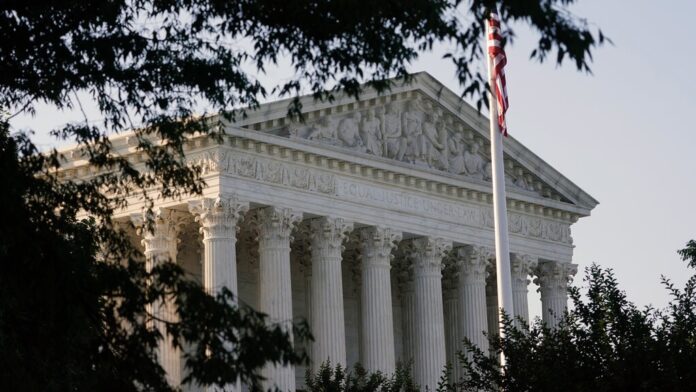
The U.S. Supreme Court declined to hear the case of Cambridge Christian School, a Tampa school that challenged the Florida High School Athletic Association’s (FHSAA) decision to bar them from praying over a loudspeaker before a championship game.
In December 2015, Cambridge Christian and University Christian School played against each other for a state championship football game at Citrus Bowl Stadium. The game was organized by the FHSAA. Although both schools asked to pray through the stadium speaker before the game, the FHSAA denied the request.
“The sole reason for the denial was FHSAA’s conclusion that permitting loudspeaker prayer at a game between two Christian schools ‘can be viewed as endorsing or sponsoring religion’ and thus ‘establishing a religion,’” the school’s petition stated.
FHSAA leaders claimed that the stadium is “off limits” because it is a “public facility, predominantly paid for with public tax dollars,” and federal guidelines and precedent court cases barred the schools from such prayer.
The case has gone back and forth between lower and higher federal courts with conflicting rulings.
In 2016, First Liberty Institute filed suit against the FHSAA on behalf of Cambridge Christian. A district court in 2017 sided with the FHSAA, ruling that praying on the loudspeaker constituted government speech.
However, the 11th U.S. Circuit Court of Appeals disagreed, ruling that the school’s claims for relief were “adequately and plausibly pled” under the Free Speech and Free Exercise Clauses. The 11th Circuit returned the case to the original judge, but he again ruled against the school. Then, on appeal, a different 11th Circuit panel—composed of different judges than earlier—upheld the ban.
So in July, the school appealed to the Supreme Court. The justices announced on Nov. 17 that it would not hear the case, but offered no additional comments, which is typical protocol.
Jeremy Dys, senior counsel at First Liberty, stated that “The 11th Circuit’s decision to label the prayer as government speech abandons the foundational promises of the First Amendment that are meant to guarantee individual freedom.”
Jesse Panuccio, of the law firm Boies Schiller Flexner LLP, which partnered with First Liberty in representing Cambridge Christian, said, “While it’s disappointing the Supreme Court chose not to take up the case to reverse the wrongheaded precedent that led to these events, we are gratified that religious liberty protections in Florida are now stronger today than when we began this case.”