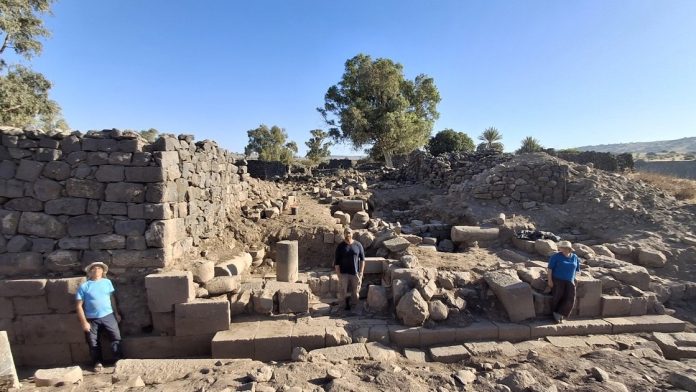
Israeli archaeologists have uncovered the remains of a 1,500-year-old synagogue in the Yehudiya Nature Reserve, providing new evidence of Jewish continuity in the Golan region during the Roman and Byzantine periods, the Israel Nature and Parks Authority and the University of Haifa announced Sunday.
The discovery marks the culmination of years of investigation into the ruins of the ancient village of Yehudiya, where scattered architectural fragments—including stones carved with menorahs and columns—had long hinted at the presence of a synagogue.
Dr. Mechael Osband from the University of Haifa’s Zinman Institute of Archaeology and Kinneret Academic College led the excavation alongside Prof. Haim Ben-David. “The abandoned Syrian village is built on top of ancient remains,” Osband explained. “You’d walk into a house and see a pillar supporting a roof or a Doric capital under an archway. But the synagogue itself remained elusive—until now.”
After decades of speculation, Osband’s team mapped out more than 150 scattered artifacts before finally identifying the synagogue’s foundation beneath a structure in the village. Excavations revealed the southern wall of the basilica-style building, with three entrances facing Jerusalem, benches along the walls, and rows of basalt columns typical of early synagogues.
“We opened a small survey area, and to our surprise, found the base of a column and a stone floor,” Osband said. “Later, when we uncovered the southern wall with its entrances and architectural elements, we knew we had found the synagogue.”
The building, estimated to measure 13 meters wide and at least 17 meters long, was constructed of hewn basalt stone blocks, or ashlars. Among the finds was a tabula ansata—a rectangular tablet with dovetail handles—commonly used for inscriptions in Roman and Greek architecture, though none is yet visible. Researchers plan to use imaging technology to detect any faded writing.
Dr. Dror Ben-Yosef of the Israel Nature and Parks Authority called the discovery a significant addition to the archaeological record. “This synagogue joins roughly 25 others found in the Golan, testifying to the firm hold of Judaism in the region,” he said. “These were not just places of worship but also centers of study and community life.”
Stylistic analysis suggests the structure dates from the late Roman through Byzantine periods (3rd–8th centuries CE), aligning with other ancient synagogues found across the Golan. Archaeologists emphasize that further excavation is needed to determine the full layout and historical phases of the site.
The team hopes to return next summer to complete the dig and eventually make the site accessible to the public.
“Every synagogue has its own story,” Osband reflected. “This one will help us better understand the Jewish communities who lived, prayed, and built their lives here 1,500 years ago.”